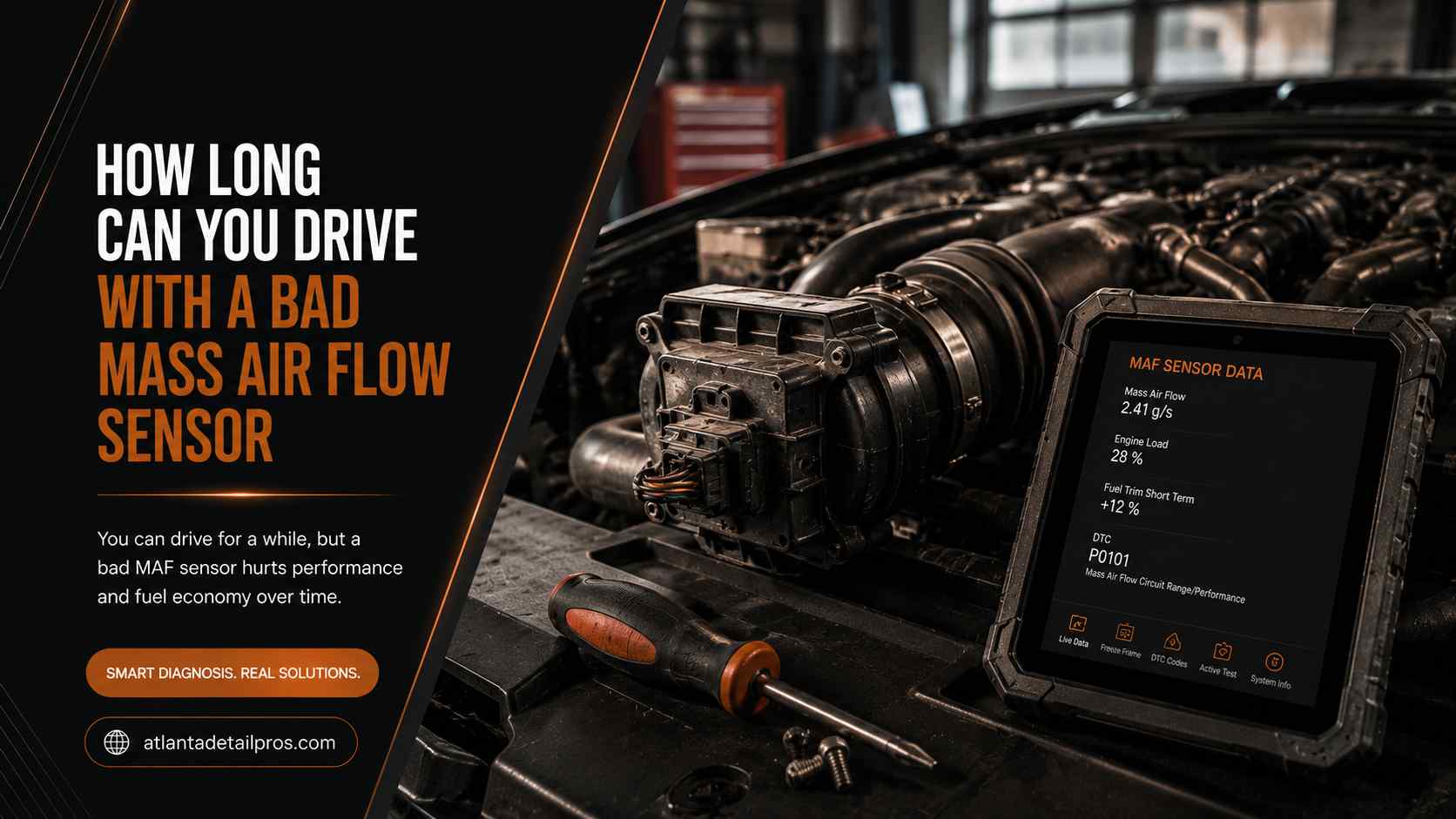
You can drive a vehicle with a failed mass airflow (MAF) sensor for days, weeks, or sometimes much longer because most modern engine control systems fall back to a speed-density fueling strategy using the MAP sensor when MAF data is unavailable or implausible: but the consequences of extended driving with a bad MAF sensor include poor fuel economy, rough idle, reduced power, potential oxygen sensor and catalytic converter damage from chronic rich or lean running, and in some cases difficulty passing emissions testing.
The real question is not whether the car will move, but what is being damaged and how expensive is the collateral repair bill accumulating while you wait.
“My 2013 Silverado ran with a bad MAF for almost three months before I got around to fixing it. It ran rough and got terrible fuel economy but it drove. When I finally replaced the MAF, my fuel economy went from 14 MPG back to 19 MPG. I calculated I burned an extra $280 in fuel waiting. The MAF sensor was $65. I basically paid $280 to save $65.”: Rachel Torres, 2013 Chevrolet Silverado 1500 owner
What the Mass Air Flow Sensor Does and Why Driving Without It Works (Temporarily)
The MAF Sensor’s Role in Fuel Management
The mass airflow sensor measures the actual mass of air entering the engine intake: not the volume, but the mass, accounting for air density at different temperatures and altitudes. The ECM uses this precise measurement to calculate the exact fuel quantity for each injection event.
Why the car can still run without accurate MAF data:
Modern engine control systems include a backup strategy called speed-density fueling, which calculates airflow using the manifold absolute pressure (MAP) sensor, engine RPM, and calibrated volumetric efficiency tables rather than direct airflow measurement. This backup strategy allows the engine to run without MAF input, but it is less precise than MAF-based fuel calculation because it relies on modeled estimates rather than direct measurement.
What “Bad MAF Sensor” Actually Means
A MAF sensor can fail in several ways, each with different consequences:
| Failure Mode | What the ECM Sees | Engine Behavior |
|---|---|---|
| Complete signal loss (open circuit) | No MAF signal; PCM switches to backup | Rough idle; reduced power; check engine light |
| Stuck low reading | Engine appears to have less air than actual | ECM adds less fuel than needed; lean running |
| Stuck high reading | Engine appears to have more air than actual | ECM adds too much fuel; rich running, black smoke |
| Contaminated sensor (partial) | Inaccurate but varying signal | Intermittent rough idle; fuel trim corrections at limits |
How Long Can You Drive: The Honest Answer by Failure Mode
Scenario 1: Complete MAF Signal Loss (P0101 or P0102/P0103)
With a total MAF signal loss, the ECM enters speed-density backup mode. The vehicle will drive but with noticeably different behavior:
- Cold start: may run rich briefly as the ECM enriches without MAF confirmation
- Idle: typically rough or slightly elevated RPM
- Acceleration: reduced performance; may surge or hesitate
- Highway cruising: often acceptable; speed-density is more accurate at steady loads
How long: indefinitely in terms of the engine surviving, but fuel economy loss of 10 to 25 percent is typical, and long-term lean or rich conditions can damage oxygen sensors and the catalytic converter over thousands of miles.
Scenario 2: Contaminated MAF Sending Incorrect Data
This is often worse than a complete failure because the ECM receives a signal it believes is valid but the signal is inaccurate. The ECM does not enter backup mode because it thinks the sensor is working. The result:
- The engine runs lean or rich chronically without the PCM having a confirmed fault to correct against
- Long-term fuel trim (LTFT) increases significantly in one direction as the ECM tries to compensate
- Oxygen sensor life is shortened by chronic rich or lean exhaust exposure
- Catalytic converter efficiency is reduced
How long is this acceptable: less than the complete-failure scenario, because the incorrect data is causing uncorrected fueling errors. Resolve contamination issues within a few weeks of noticing symptoms.
What Gets Damaged While Driving With a Bad MAF Sensor
Oxygen Sensors
The upstream and downstream O2 sensors operate in an exhaust environment that is designed to alternate lean and rich within a narrow band around stoichiometry. Chronic rich running from a MAF that reads low (causing ECM to over-fuel) exposes the O2 sensor ceramic element to elevated temperatures and carbon deposits. Replacement cost: $80 to $250 per sensor.
Catalytic Converter
A catalytic converter operates most efficiently at stoichiometric air-fuel ratio. Chronic rich running from MAF inaccuracy floods the converter with excess hydrocarbons, overheating the substrate. A converter damaged by prolonged rich running requires replacement: $300 to $1,500. This is the most expensive consequence of ignoring a bad MAF sensor.
Fuel Economy Loss
Rachel Torres’s example is mathematically representative. A 25 percent fuel economy reduction on a 15,000-mile/year driver using $3.50/gallon fuel translates to approximately $350 to $500 in additional annual fuel cost: far exceeding the $50 to $200 cost of a replacement MAF sensor.
Cleaning vs. Replacing the MAF Sensor
When Cleaning Works
A MAF sensor that is contaminated with oil film or fine debris but not electrically failed can often be restored with mass airflow sensor cleaner (CRC, WD-40 Specialist, or equivalent). Spraying the sensing wire element with the correct cleaner, allowing it to dry completely, and reinstalling resolves contamination-based MAF issues in approximately 40 to 60 percent of cases.
Cleaning cost: $8 to $15 for the spray can. Time: 20 minutes.
When cleaning is worth trying: if the sensor failure is recent, the vehicle is still under regular maintenance, and the failure is gradual rather than sudden (suggesting contamination rather than electrical failure).
When Replacement Is Necessary
- Complete signal loss (P0101, P0102, or P0103 codes indicating circuit fault)
- Cleaning was performed and codes returned within 200 miles
- The sensor is original on a vehicle above 120,000 miles
- A resistance or voltage test at the sensor confirms it is outside specification
MAF sensor replacement cost: $50 to $250 depending on the vehicle. OEM-quality sensors (Denso, Bosch, Standard) outlast generic aftermarket alternatives significantly. Avoid cheap no-name sensors: they frequently produce inaccurate readings immediately or fail within months.
Frequently Asked Questions
Can You Drive With a Bad MAF Sensor?
Yes. Most vehicles continue to drive with a failed MAF sensor because the ECM switches to a backup fueling strategy using the MAP sensor. However, performance, fuel economy, and idle quality are all affected, and extended operation with incorrect fueling causes oxygen sensor and catalytic converter damage that costs far more to repair than the MAF sensor itself.
What Are the Symptoms of a Bad MAF Sensor?
Common symptoms include rough or unstable idle, reduced acceleration performance, poor fuel economy (often 15 to 25 percent worse than normal), difficulty starting, black smoke from the exhaust (if reading low and ECM over-fuels), check engine light with codes P0100 through P0103, and fuel trim values significantly above or below zero in long-term data.
Will a Bad MAF Sensor Damage My Engine?
Directly, no: the engine itself is not harmed by a bad MAF sensor in the short term. The damage occurs indirectly: prolonged rich running from incorrect MAF data damages the catalytic converter and reduces oxygen sensor life. These secondary repairs cost significantly more than the MAF sensor replacement.
How Much Does a Mass Air Flow Sensor Cost to Replace?
Replacement MAF sensors cost $50 to $250 depending on the vehicle and brand. OEM-quality aftermarket sensors from Denso, Bosch, or Standard Motor Products are recommended over generic units. Labor is typically 15 to 30 minutes. Total shop cost: $80 to $350. This cost is almost always less than the fuel economy loss of driving with a failed sensor for more than a few months.
Can I Clean My MAF Sensor Instead of Replacing It?
Yes, if the failure is caused by contamination rather than electrical fault. Use only specifically formulated mass airflow sensor cleaner: never carburetor cleaner, brake cleaner, or compressed air directly on the sensing element. If cleaning resolves the symptoms and codes do not return within 500 miles, the cleaning was successful. If symptoms return promptly, electrical failure is the cause and replacement is necessary.
The Bottom Line
A bad MAF sensor will not strand you on the side of the road: the engine’s backup fueling strategy keeps you moving. But Rachel Torres’s math is the real answer to “how long can I drive with it”: the fuel wasted waiting to fix it costs more than fixing it immediately. Add the risk of catalytic converter damage from chronic rich running, and the answer becomes clear. Fix the MAF sensor within the same week you identify it, not the same month.