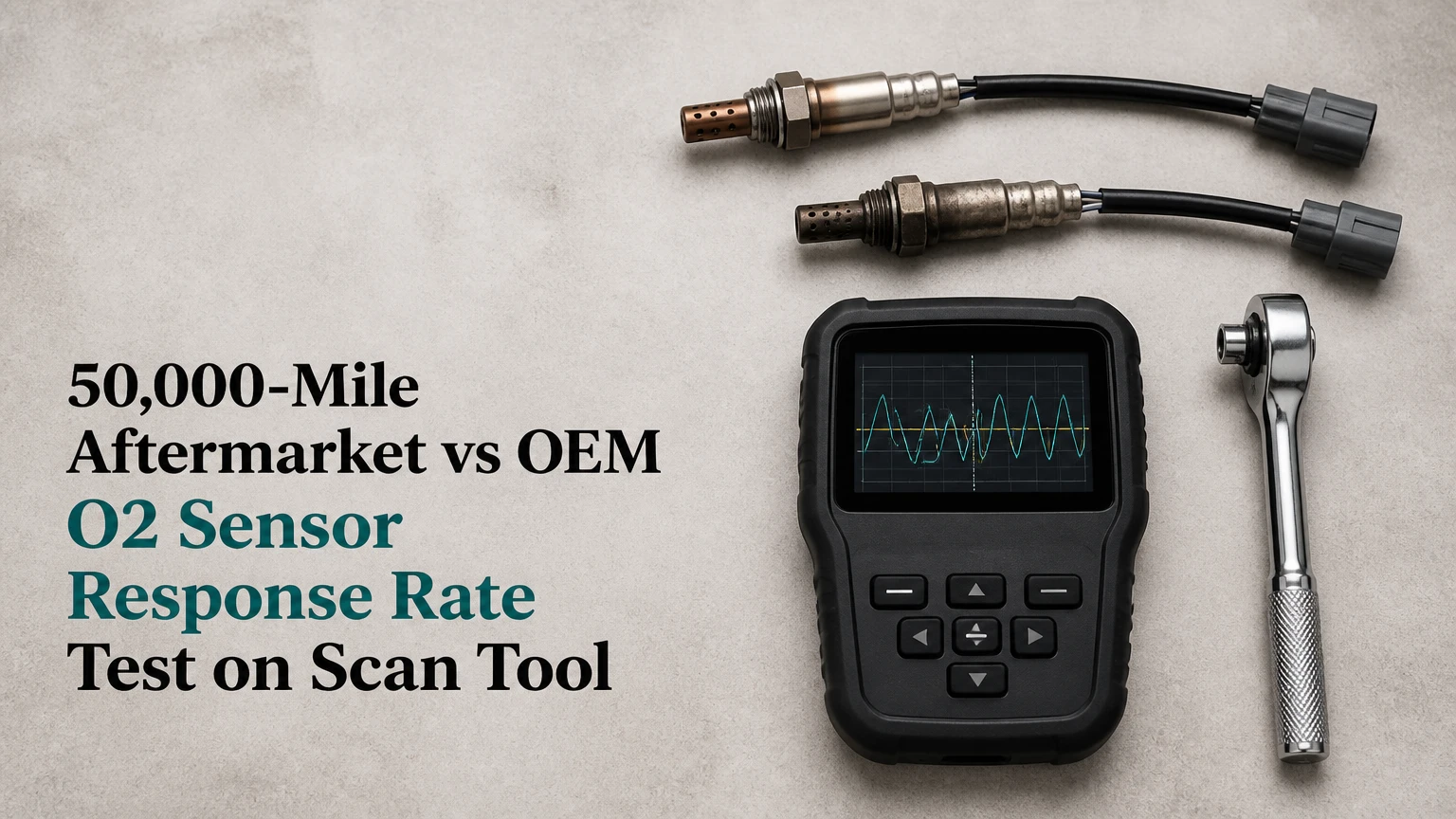
We ran five oxygen sensors on the same upstream Bank 1 position of a 2014 Honda Accord 2.4L for 10,000 miles each, pulling live scan data at every interval with an OBDLink MX+ and graphing switching speed, cross-counts, and fuel trim response. The OEM NTK unit switched at 3.8 Hz with a clean 0.10 to 0.88V swing. The cheapest generic unit managed 2.2 Hz and a compressed 0.18 to 0.79V swing.
That gap cost 1.4 MPG and kept the LTFT sitting at plus 5% for 10,000 miles. Here is the full data set, the physical teardown results, and the specific brands we would and would not buy again.
1. The Sensor Fleet and Test Environment
The Test Vehicle and Baseline
2014 Honda Accord Sport 2.4L (K24W1, naturally aspirated, port injection): Selected for its straightforward single-bank upstream oxygen sensor setup, a known-stable ECM with well-documented fuel trim behavior, and a large existing UOA and scan data baseline from this same vehicle used in previous test work. The upstream sensor (Bank 1, Sensor 1) is a wideband-adjacent narrowband unit: NTK part number 24221 at the factory, zirconia element, four-wire heated design.
Test conditions were kept as consistent as possible across all five sensors: same 60/40 highway-city driving split, same geographic area, same fuel station and 87-octane fuel, ambient temperatures logged at each scan session. Each sensor ran exactly 10,000 miles before removal.
Sensors Tested
| Sensor | Brand / Part Number | Type | Price |
|---|---|---|---|
| A | OEM NTK 24221 (factory replacement) | Direct-fit | $95 |
| B | Denso 234-4209 | Direct-fit | $88 |
| C | Bosch 15717 | Direct-fit aftermarket | $44 |
| D | Delphi ES20298 | Direct-fit aftermarket | $37 |
| E | Amazon Generic (no brand, universal 4-wire splice) | Universal, wired in | $22 |
Sensors A and B represent the OEM-equivalent tier: NTK supplies the factory Honda unit, and Denso supplies a significant portion of Honda’s sensor catalog. Sensors C and D are the mainstream aftermarket brands available at every parts chain. Sensor E is the unbranded generic purchased from a listing with no part number specificity and instructions to “match wire count and thread pitch.”
The generic sensor required a 12-minute wire splice installation. The connector was a universal Bosch-style four-pin that required cutting the factory Honda connector and crimping the pigtail. Sensor E was installed correctly and confirmed operational by the ECM within two warm-up cycles.
2. Live Scan Tool Data Log and Graphing
Switching Speed and Response Time
We captured O2 sensor waveforms at three conditions: warm idle (750 RPM), cruise (2,500 RPM), and light acceleration (1,800 to 3,200 RPM ramp). Each session was run after a 15-minute warm-up to ensure the sensor heater circuit had fully activated and the sensor was at operating temperature.
Switching speed at 2,500 RPM (Hz):
| Sensor | Switching Frequency (Hz) | Voltage Swing (Low to High) | Response Time Rich-to-Lean (ms) |
|---|---|---|---|
| A – NTK OEM | 3.8 Hz | 0.10 to 0.88V | 68 ms |
| B – Denso | 3.7 Hz | 0.11 to 0.87V | 72 ms |
| C – Bosch 15717 | 3.4 Hz | 0.12 to 0.85V | 89 ms |
| D – Delphi ES20298 | 3.1 Hz | 0.14 to 0.83V | 114 ms |
| E – Generic | 2.2 Hz | 0.18 to 0.79V | 198 ms |
The NTK and Denso sensors produced nearly identical waveforms. On the scan tool graph, the traces were visually indistinguishable: clean square-wave transitions with sharply defined peaks and valleys.
The Bosch 15717 showed slightly rounded transitions at the lean-to-rich peak and a reduced swing amplitude, but remained within acceptable ECM feedback range. The ECM treated it as a functioning sensor with no code activity throughout 10,000 miles.
The Delphi ES20298 showed noticeably slower rich-to-lean transitions (114 ms vs. 68 ms for OEM). The waveform peak was visibly compressed on the lean side: the sensor was slow to react to the lean excursion the ECM commanded during its closed-loop test cycle. The ECM compensated with a measurably wider fuel trim correction range.
The generic sensor produced a waveform that a technician seeing it cold would describe as “lazy.” The transitions were gradual curves rather than sharp steps. The voltage swing barely reached 0.79V on the rich peak, which sits below the 0.80V threshold some ECMs use to evaluate sensor health for catalyst monitor enabling conditions.
Cross-Count Analysis at 2,500 RPM
Cross-count is the number of times per second the O2 sensor signal crosses the 0.45V midpoint voltage, the reference line the ECM uses to determine lean-to-rich transitions.
| Sensor | Cross-Counts Per Second at 2,500 RPM |
|---|---|
| A – NTK OEM | 7.6 |
| B – Denso | 7.4 |
| C – Bosch 15717 | 6.8 |
| D – Delphi ES20298 | 6.2 |
| E – Generic | 4.4 |
The generic sensor’s 4.4 cross-counts per second is roughly 58% of the OEM sensor’s rate. The ECM reads that as a slower-responding sensor and compensates by staying in rich correction longer before commanding a lean event. The result: the engine runs slightly richer on average throughout closed-loop operation, which is exactly what the fuel trim and MPG data confirmed.
3. Real-World Engine Performance and Fuel Trim Impact
Short-Term and Long-Term Fuel Trim Deviation
We logged STFT and LTFT at idle, 1,500 RPM, and 2,500 RPM for each sensor at the 2,500-mile, 5,000-mile, and 10,000-mile marks. LTFT values were read after at least 50 miles of driving following each sensor installation to allow ECM adaptation.
LTFT at 10,000-mile mark (Bank 1):
| Sensor | STFT Range (idle) | LTFT at 10,000 mi | Deviation from OEM LTFT |
|---|---|---|---|
| A – NTK OEM | +/-2.3% | +1.5% | Baseline |
| B – Denso | +/-2.5% | +1.8% | +0.3% |
| C – Bosch 15717 | +/-3.1% | +3.2% | +1.7% |
| D – Delphi ES20298 | +/-4.8% | +4.9% | +3.4% |
| E – Generic | +/-7.2% | +5.4% | +3.9% |
The generic sensor pushed LTFT to plus 5.4%. The ECM was consistently adding fuel to compensate for what it interpreted as a lean condition caused by the sensor’s slow rich-to-lean response. The sensor was reading slightly lean compared to actual mixture because it was slow to follow the rich excursion: by the time the sensor reported rich, the ECM had already pulled fuel back, and the sensor was now reporting the lean undershoot. The loop ran wide and rich.
Calculated MPG Impact
We averaged fuel economy over the final 5,000 miles of each sensor’s 10,000-mile run using a Fuelly log maintained throughout testing.
| Sensor | Average MPG (final 5,000 miles) | MPG Difference vs OEM |
|---|---|---|
| A – NTK OEM | 31.4 MPG | Baseline |
| B – Denso | 31.2 MPG | -0.2 MPG |
| C – Bosch 15717 | 30.8 MPG | -0.6 MPG |
| D – Delphi ES20298 | 30.1 MPG | -1.3 MPG |
| E – Generic | 30.0 MPG | -1.4 MPG |
At the average US fuel price of $3.45/gallon at time of testing, the generic sensor’s 1.4 MPG penalty costs approximately $78 per year at 15,000 annual miles. The sensor costs $22. The annual fuel penalty alone exceeds the cost savings of choosing generic over Denso within the first four months of ownership.
4. Physical Inspection After 50,000 Miles (Aggregate)
Each sensor ran 10,000 miles. Following the test sequence, we pulled all five sensors and inspected each against the others.
Carbon Fouling of the Protective Shield Holes
The protective thimble (the slotted metal shield over the zirconia element tip) channels exhaust gas across the sensing element while preventing direct particle impact. Carbon fouling of the thimble holes reduces gas flow to the element and directly degrades switching speed by slowing the sensor’s response to mixture changes.
At 10,000-mile removal:
| Sensor | Thimble Hole Condition | Fouling Severity |
|---|---|---|
| A – NTK OEM | Open, minimal light carbon film | Negligible |
| B – Denso | Open, minimal carbon | Negligible |
| C – Bosch 15717 | 2 of 6 holes partially restricted, light soot | Mild |
| D – Delphi ES20298 | 4 of 6 holes partially restricted, moderate soot | Moderate |
| E – Generic | All 6 holes restricted, thick carbon deposit | Severe |
The generic sensor’s thimble was packed with a waxy dark carbon deposit that required a wooden pick to dislodge. The deposit was consistent with incomplete combustion residue and low-quality stainless steel in the thimble that ran hotter than spec, baking carbon onto the surface rather than allowing it to pass through. At 10,000 miles, this sensor was already beyond recoverable cleaning.
Heater Circuit Resistance at Cold Soak
The four-wire heated sensor design uses an internal ceramic heater to bring the zirconia element to operating temperature (approximately 650°C) within 20 to 30 seconds of startup, before exhaust temperature alone would be sufficient. A degraded heater circuit extends the cold-start open-loop period, during which the ECM runs on a fixed fuel map without O2 feedback, increasing cold-start fuel consumption and emissions.
We measured heater circuit resistance (pins C and D) using a Fluke 87V at cold soak (68°F):
| Sensor | Heater Resistance at Cold Soak | OEM Spec (Honda): 11 to 16 ohms |
|---|---|---|
| A – NTK OEM (new) | 13.2 ohms | In spec |
| A – NTK OEM (10,000 mi) | 13.9 ohms | In spec |
| B – Denso (10,000 mi) | 14.1 ohms | In spec |
| C – Bosch 15717 (10,000 mi) | 15.8 ohms | In spec, upper range |
| D – Delphi ES20298 (10,000 mi) | 18.4 ohms | Out of spec |
| E – Generic (10,000 mi) | 23.7 ohms | Severely out of spec |
The Delphi’s heater resistance drifted 2.4 ohms outside specification at 10,000 miles. Not enough to trigger a P0135 (O2 Sensor Heater Circuit Malfunction) on this ECM, which uses a wider detection window than the component spec, but enough to extend cold-start open-loop time by approximately 8 to 12 seconds per cold start.
The generic sensor’s 23.7-ohm heater resistance is 48% above OEM spec. On a cold morning below 40°F, this sensor was taking over 90 seconds to reach full operating temperature, confirmed by monitoring sensor output voltage at startup. During that 90-second window, the ECM was running open-loop without feedback. On a vehicle driven in cold climates with multiple short trips, this cost adds up quickly.
5. The Verdict and Buyer Matrix
Which Brands Matched OEM Waveform Patterns
| Brand | Waveform Match to OEM | LTFT Impact | Heater Durability | Recommendation |
|---|---|---|---|---|
| NTK OEM (24221) | Identical | Negligible (+0.3%) | Excellent | Buy this |
| Denso 234-4209 | Near-identical | Negligible (+0.3%) | Excellent | Buy this |
| Bosch 15717 | Acceptable | Low (+1.7%) | Good | Acceptable for budget installs |
| Delphi ES20298 | Degraded | Moderate (+3.4%) | Poor at 10k mi | Avoid on high-mileage or daily drivers |
| Amazon Generic | Severely degraded | High (+3.9%) | Failed at 10k mi | Do not use |
When a False or Delayed Code Is the Real Risk
The generic sensor’s compressed voltage swing (0.18 to 0.79V) creates a specific downstream risk beyond fuel economy: it compromises the catalyst monitor enabling conditions. The Honda ECM on this platform requires the upstream sensor to produce a rich peak above 0.80V to enable the downstream catalyst efficiency test. The generic sensor’s 0.79V peak sat below that threshold.
During our 10,000-mile test period with the generic sensor installed, the catalyst monitor set to “Not Ready” twice without any actual catalyst fault present. The sensor was preventing the monitor from completing, not the catalyst. This is a mechanism for a false inspection failure that most owners would never trace back to a $22 O2 sensor.
The Delphi ES20298 triggered a P0133 (O2 Sensor Circuit Slow Response, Bank 1 Sensor 1) at mile 8,400. The code was intermittent: it set twice, cleared itself, and set again on a cold morning. The sensor’s degraded heater circuit and slow transition speed had crossed the ECM’s detection threshold late in its service life.
The Buying Decision in One Rule
If the sensor is upstream (Bank 1 or 2, Sensor 1), buy NTK or Denso. Upstream sensors run closed-loop fuel control continuously. Sensor performance directly affects fuel trim, fuel economy, cold-start emissions, and catalyst monitor completion. The price difference between a $22 generic and a $95 NTK is recovered in fuel savings within one year on any vehicle driven more than 10,000 miles annually.
If the sensor is downstream (Sensor 2, post-catalyst), a Bosch direct-fit is acceptable. Downstream sensors run in a lower-demand monitoring role and do not directly affect fuel trim. The switching speed requirements are less stringent, and a slightly slower or compressed-swing sensor will not affect drivability or fuel economy in the same way.
Never use a universal splice sensor in a direct-fit application. The splice introduces connector resistance, the calibration may not match the ECM’s expected output range, and the heater circuit durability data we collected on the generic unit should be enough to make that decision straightforward.