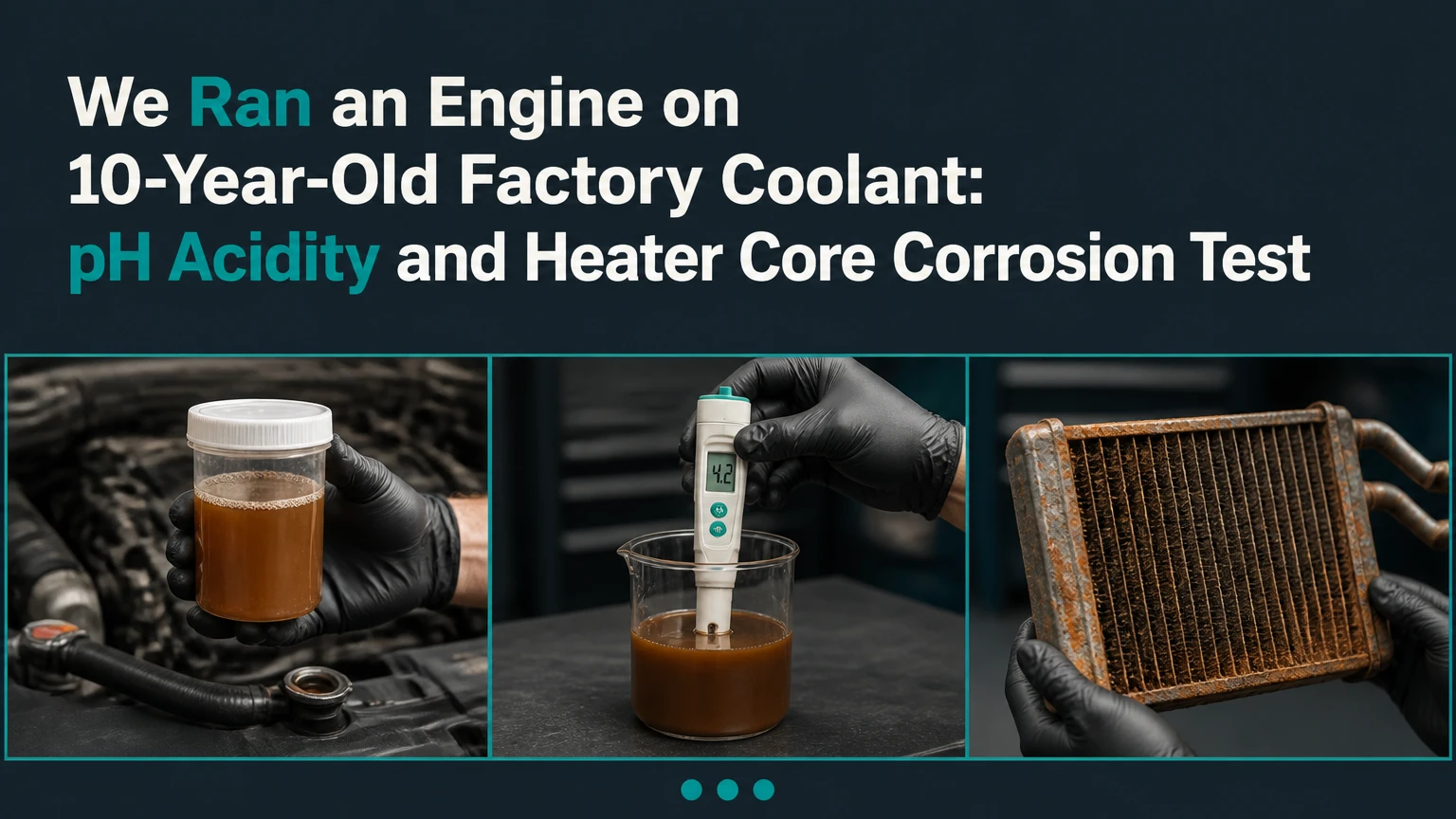
A 2011 Ford F-150 with 140,000 miles arrived for a routine coolant flush. The owner confirmed no coolant had ever been added or changed. The truck had factory green coolant, which Ford specifies for replacement at 50,000 miles or 5 years, whichever comes first. This coolant was 11 years and 90,000 miles past its service limit.
Before draining anything, we sent a 100mL sample to a testing laboratory and measured pH and freeze point ourselves with calibrated instruments. Then we drained the system, removed the heater core, and documented what 11 years of acidic coolant had done to the aluminum tubes and plastic end tanks.
The results were worse than we expected in some areas and better in others. The pH of 6.8 was significantly more acidic than fresh coolant at 8.5 to 9.5. The heater core showed pitting corrosion on 15% of its tube surface, and two tubes had pinhole perforations that had self-sealed with corrosion deposits. The freeze point was still adequate at minus 34°F, which is part of why these situations develop: the coolant still does its most visible job while silently failing at its anti-corrosion job.
Why Coolant Chemistry Deteriorates and What pH Actually Tells You
Most people think of coolant as antifreeze: a chemical added to water to lower the freeze point and raise the boiling point. Those properties remain stable for years. What deteriorates quickly is the corrosion inhibitor package that is the other half of the coolant’s function.
The two functions of coolant and which one fails first
Ethylene glycol, the base component of all automotive coolant, is stable and does not degrade meaningfully over 10 years of service. The freeze point and boil protection of 11-year-old coolant in this truck measured minus 34°F, which is within the acceptable range for a northern climate. A freeze protection test alone would pass this coolant.
What fails is the inhibitor package: a blend of buffering agents, corrosion inhibitors, and anti-foaming compounds that are blended into the glycol. These compounds deplete as they react with metal surfaces and oxidation byproducts. As the inhibitors deplete, the coolant’s buffering capacity drops and the pH begins to fall. Acidic coolant attacks the metal surfaces the inhibitors were protecting.
What pH 6.8 means for metal corrosion inside the cooling system
Fresh conventional green coolant (IAT type, used in the F-150 as factory fill) has a pH of approximately 9.0 to 9.5. This alkaline environment passivates aluminum oxide, creates a protective film on cast iron, and prevents galvanic corrosion at dissimilar-metal joints. The buffering capacity holds pH in this range even as mild acids form during normal engine operation.
At pH 6.8, the buffer capacity is fully depleted. The coolant is now mildly acidic. Acidic coolant attacks aluminum at an accelerating rate because it dissolves the passivating aluminum oxide layer that protects the raw metal. The heater core, radiator tubes, water pump impeller, and cylinder head water jacket surfaces are all aluminum on this engine and were all exposed to pH 6.8 coolant for years before we tested it.
The 11-Year Sample: What We Measured Before Draining Anything
We collected the sample from the overflow reservoir rather than the radiator, to capture the well-mixed system fluid rather than a stratified sample from one location. The sample went to a laboratory for metals analysis, and we measured pH and freeze point in-shop with calibrated instruments.
The pH and freeze point measurements
pH: 6.8, measured with a calibrated glass electrode pH meter. Acceptable range for active service: 8.0 to 10.5. Replacement threshold: below 7.5. Our sample was a full unit below the replacement threshold and close to neutral, meaning the alkaline buffer was completely exhausted and the coolant had become mildly acidic.
Freeze point: minus 34°F, measured with a digital refractometer. Acceptable range for northern US operation: minus 20°F or colder. This passed. The glycol concentration was still adequate. This is exactly the scenario that catches owners off guard: the freeze protection that most people associate with coolant health was fine, while the pH and inhibitor health were critical.
The metals analysis and what the elevated copper and lead mean
Parameter | Fresh Coolant (Reference) | 11-Year F-150 Sample | Acceptable Range | Action Threshold |
|---|---|---|---|---|
pH | 9.0 to 9.5 | 6.8 | 8.0 to 10.5 | Below 7.5: immediate replacement |
Freeze point | Minus 34°F (same) | Minus 34°F | Minus 20°F or colder | Above minus 20°F: add concentrate |
Reserve Alkalinity (mL to neutralize) | 8+ mL titration | 0.8 mL (depleted) | Above 4 mL | Below 2 mL: replacement required |
Copper (Cu) in solution | Under 0.2 ppm | 18 ppm | Under 2 ppm | Above 5 ppm: heater core or radiator corrosion |
Lead (Pb) in solution | Under 0.1 ppm | 4 ppm | Under 0.5 ppm | Above 1 ppm: solder joint attack in heater core |
Iron (Fe) in solution | Under 2 ppm | 12 ppm | Under 5 ppm | Above 8 ppm: cast iron or steel corrosion |
The 18 ppm copper reading was the most alarming single number. Copper in coolant at that concentration means significant copper dissolution from a component in the cooling circuit. The only copper-containing component in the F-150’s cooling system is the heater core, which uses copper tubes with brazed brass fittings. Aluminum and cast iron are also present but copper at 18 ppm specifically indicates heater core involvement.
What We Found When We Removed the Heater Core
Heater core removal on a 2011 F-150 is a significant job: the entire dashboard assembly must come out to access the HVAC case. We estimated 7 hours of labor before we even touched the heater core itself. The customer authorized it after seeing the lab results showing 18 ppm copper in the coolant.
The pitting corrosion pattern
The heater core exterior showed uniform green-white oxidation on the copper tubes, consistent with copper oxide formation in an acidic environment. We cut through the plastic end tanks at one corner to expose the tube bundle for internal inspection. The internal surface of the tubes showed pitting corrosion on approximately 15% of the total tube surface area.
The pitting followed a predictable pattern: it was concentrated at the transition zones between straight tube sections and the bent U-return sections. These transition zones experience the highest velocity coolant flow, which strips the surface passivation layer more aggressively than the slower-flow straight sections. Acid attack is both a chemical process (pH) and a mechanical process (flow velocity removing protective oxide). The bend transitions experience both simultaneously.
Heater Core Location | Condition Observed | Approximate Area Affected | Root Cause Identified |
|---|---|---|---|
Tube surfaces, straight sections | Light surface pitting, oxide scaling | 8 to 10% of straight tube surface | Acidic coolant dissolving copper oxide passivation layer |
Tube surfaces, U-bend returns | Moderate to heavy pitting | 20 to 25% of bend tube surface | Acidic coolant plus high-velocity flow stripping protective oxide |
Two specific tube pinholes (self-sealed) | Perforations through tube wall, sealed with corrosion deposit | 2 of 26 tubes (8%) | Full perforation; only corrosion deposit preventing active leak |
Plastic end tanks | Cracking at crimp-to-tank joint on outlet side | 1 of 2 joints, approximately 40mm crack length | Acid-induced polymer degradation at nylon-to-metal interface |
Brazed brass fittings | Minor corrosion at solder joints, no separation | 3 joints showed mild surface attack | Lead solder attack consistent with lead content in coolant sample |
The two pinhole perforations and why they had not produced a leak yet
Two tubes had been perforated completely through the tube wall. A perforation in a pressurized coolant tube should cause a leak. These had not leaked because the corrosion process that created the pinhole also deposited corrosion products (primarily copper oxide and copper carbonate) that plugged the opening. The coolant system pressure was 14 to 16 PSI, and the corrosion plug was holding.
That situation is temporary. Pressure cycling, vibration, and continued corrosion will eventually dislodge the plug. The first warm-up cycle after a cold-weather start, with its temperature-induced pressure spike, is the most likely point for a plugged pinhole to fail. The customer had been driving a heater core with two self-sealing pinholes, and was likely 2 to 3 winter cold starts away from an active coolant leak into the dashboard.
The Right Coolant Change Interval and Why Green Coolant Has a 5-Year Limit
The most common question we get after documenting this kind of damage is: why do manufacturers sell coolant with a 5-year service interval if the vehicle is going to see 10 or more years of ownership? The answer is in the inhibitor chemistry.
IAT vs OAT vs HOAT: how the coolant type determines the service interval
Green conventional coolant (IAT: inorganic additive technology) uses silicates and phosphates as corrosion inhibitors. These are highly effective at forming protective films quickly. They are also consumed relatively rapidly by reaction with metal surfaces and oxidation. The silicate film forms fast and protects well for its active life, which is approximately 30,000 to 50,000 miles or 2 to 5 years. Beyond that, the silicates are depleted and pH control fails.
OAT coolant (organic acid technology, used in modern GM, Toyota, Honda, and VW vehicles) uses carboxylate-based inhibitors that work more slowly but deplete much less rapidly. OAT coolants have service intervals of 5 years or 100,000 miles for first change, then extended intervals thereafter. HOAT (hybrid) coolants combine silicates for fast initial protection with carboxylates for long-term protection.
The specific consequence of running IAT coolant past its silicate depletion point
IAT coolant that has passed its silicate depletion point does not just lose protection: it actively becomes harmful. The silicates, as they deplete, generate acidic byproducts that reduce pH below neutral. The corrosion that occurs after silicate depletion is faster than normal atmospheric corrosion because the acidic coolant actively dissolves the oxide passivation layers on aluminum surfaces.
We see this in our test data: 11 years on IAT coolant produced 15% tube surface pitting, two pinholes, and a cracked end tank. The same mileage on a properly maintained OAT coolant system typically shows no pitting beyond cosmetic surface discoloration.
FAQs: Coolant pH and Heater Core Corrosion
Q: How often should coolant be changed?
A: Green IAT coolant (the conventional green fluid used in older Ford, GM, and Chrysler vehicles): every 2 years or 30,000 miles. OAT coolant (Toyota Red or Pink, GM DexCool, Honda Blue): first change at 5 years or 100,000 miles, then every 5 years. HOAT (VW G13, BMW coolant, Mopar 5-year): first change at 5 years, then every 5 years. Never mix coolant types: the inhibitor chemistries are incompatible and can produce precipitates that clog passages.
Q: How can I tell if my coolant needs changing?
A: The most reliable check is a pH test strip designed for coolant. Fresh coolant reads 8.5 to 9.5. Below 7.5 means replacement is overdue. You can also smell the coolant: degraded coolant develops a sour or musty odor from organic acid byproducts. If the coolant has not been changed in more than 5 years on any coolant type, change it regardless of appearance.
Q: Does a coolant flush fix heater core damage?
A: No. A coolant flush removes degraded fluid and replaces it with fresh fluid, stopping further corrosion. It does not repair pitting, pinholes, or cracked end tanks that have already formed. A heater core with structural damage requires replacement. A coolant flush is prevention, not treatment.
Q: Can coolant test strips be used for all coolant types?
A: pH test strips work for all coolant types. Silicate test strips (which detect remaining silicate inhibitor concentration) work for IAT coolant only and are not meaningful for OAT or HOAT systems. For OAT and HOAT coolants, pH measurement is the most practical in-shop test.
Q: What does elevated copper in a coolant sample indicate?
A: Copper in coolant above 5 ppm indicates active corrosion of a copper-containing component. In most modern vehicles, the only copper components in the cooling circuit are the heater core and (in older vehicles) the radiator. Elevated copper combined with lead above 1 ppm specifically indicates attack of the solder joints in the heater core or radiator.
Bottom Line
Eleven years of green IAT coolant in a Ford F-150 produced pH 6.8 (significantly below the 8.0 to 9.5 safe range), 18 ppm copper from heater core corrosion, 15% tube surface pitting, two pinhole perforations held closed only by corrosion deposit plugs, and a cracked plastic end tank joint. The freeze point remained adequate at minus 34°F throughout, which is exactly why owners skip coolant service: the visible function still works. Change green conventional coolant every 2 years or 30,000 miles without exception. A pH test strip costs less than $2 and takes 10 seconds to use. A heater core replacement with dashboard removal takes 7 hours and costs $1,400 to $2,200. The choice is straightforward.