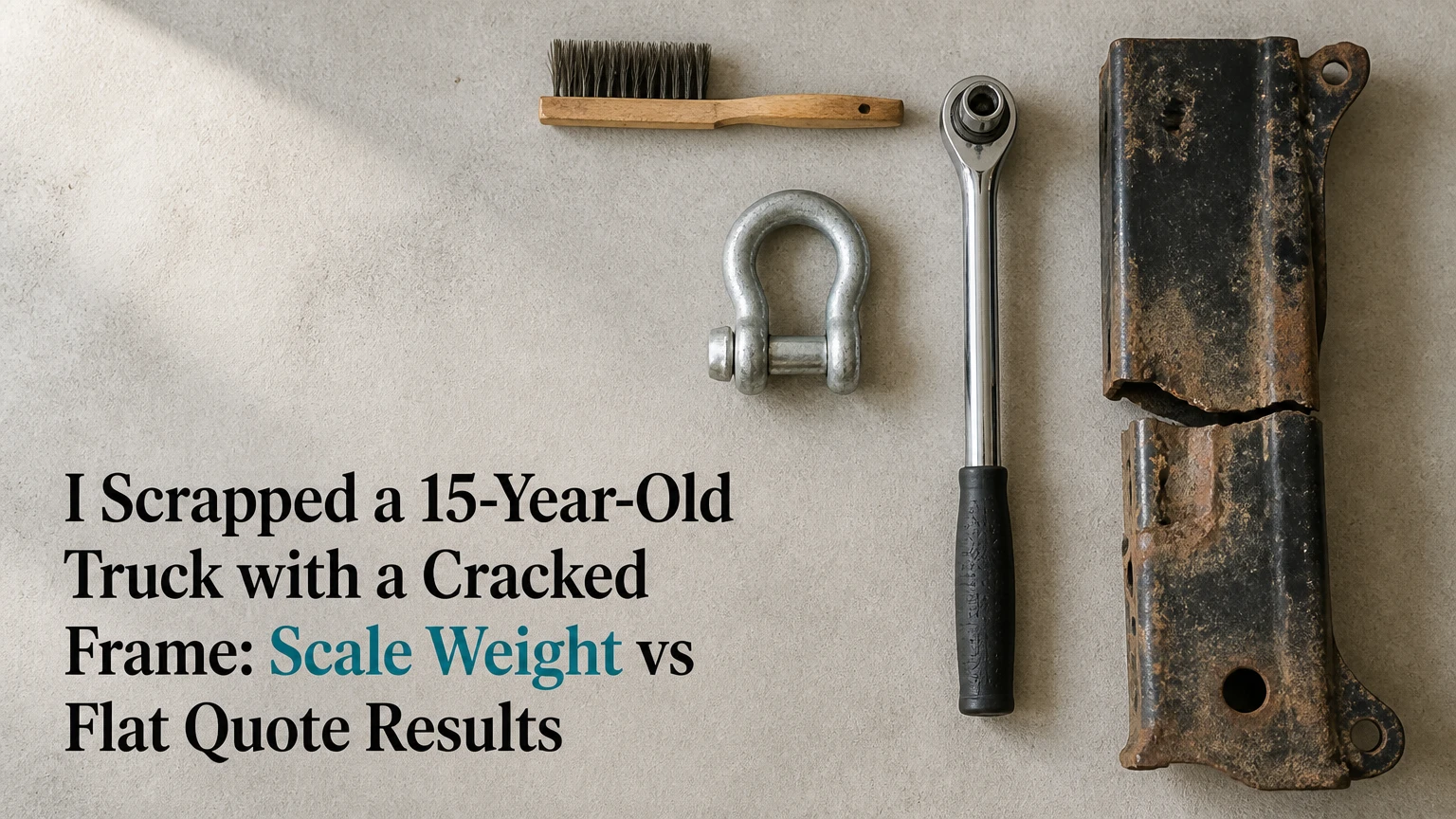
I scrapped a 2009 Chevrolet Silverado 2500HD extended cab 4WD with 148,000 miles and a cracked driver-side frame rail. Six yards quoted it: three used flat rates, two weighed it at $182 per ton, and one used a hybrid method. Flat quotes ranged from $420 to $680. Scale weight offers landed between $481 and $562. I assumed a heavy truck would always do better on scale weight. It did not. The best flat quote beat the best scale weight offer by $118.
How Scale Weight and Flat Quote Pricing Differ
Scale weight yards put the vehicle on a certified scale and pay the current steel rate per ton for the exact weight. Flat quote yards set a number based on vehicle type, size, demand for parts, and local market conditions regardless of actual weight. On a truck with a cracked frame, the pricing method matters because yards that price on components may offer a premium for the axle assemblies while yards priced on weight treat cracked frame steel the same as good steel.
What the Cracked Frame Changed for Each Method
For scale weight yards, the cracked frame had almost no effect on the offer because they price steel as steel regardless of structural integrity. For flat quote yards, the crack introduced uncertainty about whether they could pull and resell frame-mounted components. Two of the three flat quote yards docked specifically for the reassembly labor a frame-cut vehicle requires.
The Six Quotes in Detail
Each yard is presented below from lowest to highest offer, with their pricing method and any frame-specific commentary documented during the call or in-person visit.
Yard One: General Scrap, Flat Quote, $420
A general scrap yard 8 miles from my location. The buyer inspected the frame crack in person and said he would need to torch the cab mount section before crushing, adding 30 minutes of labor. He quoted $420 and said a Silverado 2500HD in running condition with a sound frame would have been $620 from him. The crack cost me $200 specifically at this yard.
Yard Two: Recycling Facility, Scale Weight (Adjusted), $481
This yard weighed the full truck at 5,900 lbs but deducted the estimated weight of the cracked frame section at $0 per pound, treating damaged structural steel as non-recyclable at standard rates. Their adjusted weight came to 4,870 lbs. The payout at $182 per ton was $443. They added $38 for the four steel wheels separately, totaling $481.
Yard Three: Certified Recycler, Scale Weight (Full Truck), $537
A certified recycling facility in the next county placed the truck on their CAT scale and recorded 5,900 lbs. At their daily rate of $182 per ton, the math came to $537.30. The buyer made no deduction for the frame crack and confirmed they do not factor structural condition into scale-based pricing. This was the most straightforward quote of the six.
Yard Four: Regional Chain, Flat Quote, $550
A regional chain with a standard Silverado 2500HD base rate of $550, applied without inspection. They told me over the phone they do not adjust for frame condition and treat all 2500HD trucks at the same flat rate regardless of damage. No in-person inspection occurred before this quote, and I would have signed a no-adjustment agreement on delivery.
Yard Five: Hybrid Buyer, Scale Plus Parts, $562
This yard weighed the truck but also listed the engine, transfer case, and both axle assemblies at parts-pull premiums above the scrap rate. The base scale weight came to $430 at $182 per ton for the stripped body. They added $132 in combined parts premiums to reach $562. The buyer said the hybrid method was his standard approach for 4WD trucks.
Yard Six: Truck Specialist, Flat Quote, $680
A truck specialist yard that pulls and resells heavy truck components. The buyer looked at the frame crack and said the driver-side front axle assembly, the transfer case, and the 6.0L engine were all in a range he could sell. His flat quote of $680 included what he called a component premium for the drivetrain and did not penalize the frame because he planned to cut that section anyway.
All Six Quotes Side by Side
Yard Type | Method | Frame Deduction | Final Offer |
|---|---|---|---|
General scrap | Flat quote | $200 | $420 |
Recycling facility (adjusted) | Scale weight | $56 equivalent | $481 |
Certified recycler | Scale weight | None | $537 |
Regional chain | Flat quote | None | $550 |
Hybrid buyer | Scale + parts | None | $562 |
Truck specialist | Flat quote | None | $680 |
What I Got Wrong
I spent the first three calls specifically asking for scale weight yards because I believed a 5,900-lb truck would net more by weight than by flat rate. Yard Two proved that wrong by excluding the cracked frame section from its recyclable weight. The truck specialist’s $680 flat quote, driven by component demand for the 6.0L and the 4WD drivetrain, beat every scale weight offer by $118 or more. The truck’s heavy weight mattered less than the resale value of what was under the hood.
FAQs
Q: Will a cracked frame automatically reduce what a junkyard offers?
A: Not always. Three of the six yards I contacted made no deduction specifically for the crack. Yards that price on scale weight treat steel as steel regardless of structural condition. Yards that pull parts for resale care whether the crack affects components they plan to remove, not whether the frame itself is sound. The deduction risk comes from flat quote yards that need to do additional cutting or sorting labor.
Q: Is it worth getting a scale weight quote for a heavy truck at scrap?
A: It depends on the truck’s condition and the yard’s component demand. On a stripped or fully damaged truck with no usable parts, scale weight will usually reflect fair market value for the metal. On a truck with a functional engine and intact drivetrain, a flat quote from a yard that pulls parts will often outperform the scale by $100 to $200. Get both types of quotes before deciding.
Q: Can I negotiate a higher scrap price by pointing out the truck’s weight?
A: At flat quote yards, yes. Telling the buyer the truck weighed 5,900 lbs on a public scale gave me a reference point that two flat quote yards used to adjust their number upward. At scale weight yards, the scale itself is the negotiation. The per-ton rate is tied to the daily steel market and non-negotiable at most yards.
Q: Does the 4WD system add value at a scrapyard?
A: At general scrap yards, no. At yards that pull parts, yes. The Silverado 2500HD transfer case and front axle assembly have consistent resale demand in the used parts market. The truck specialist factored the 4WD drivetrain directly into its $680 offer. The certified recycler that prices purely by weight treated the 4WD components identically to the rest of the steel.
Q: What documentation do I need to scrap a 15-year-old truck?
A: I needed the title, a current photo ID matching the title owner, and a bill of sale in my state. One yard also required proof of license plate surrender. None required registration current to the scrap date, but two asked to see the most recent registration document as supplemental ownership proof. Call ahead because state laws and individual yard policies vary.
Q: Should I remove parts before scrapping a cracked-frame truck?
A: If your timeline allows, removing the wheels and tires, battery, catalytic converter, and any aftermarket accessories before scrapping typically recovers more value than leaving them on for the scrap price. The four steel wheels added only $38 to the scale weight offer at Yard Two. Selling them separately on Facebook Marketplace would have recovered $120 to $180 for the same set.
BOTTOM LINE
A 2009 Silverado 2500HD with a cracked driver-side frame rail produced six quotes ranging from $420 to $680. Scale weight offers averaged $527 and peaked at $562. Flat quote offers averaged $550 and peaked at $680 from a truck specialist who priced the 6.0L and 4WD drivetrain as resalable components. My assumption that scale weight would always outperform flat quotes on a heavy truck was wrong. Call at least one truck specialist yard before settling for a standard scrap quote. On a 4WD truck with a functional engine, the drivetrain premium from a parts-pull buyer will beat the metal-by-weight math in most market conditions.