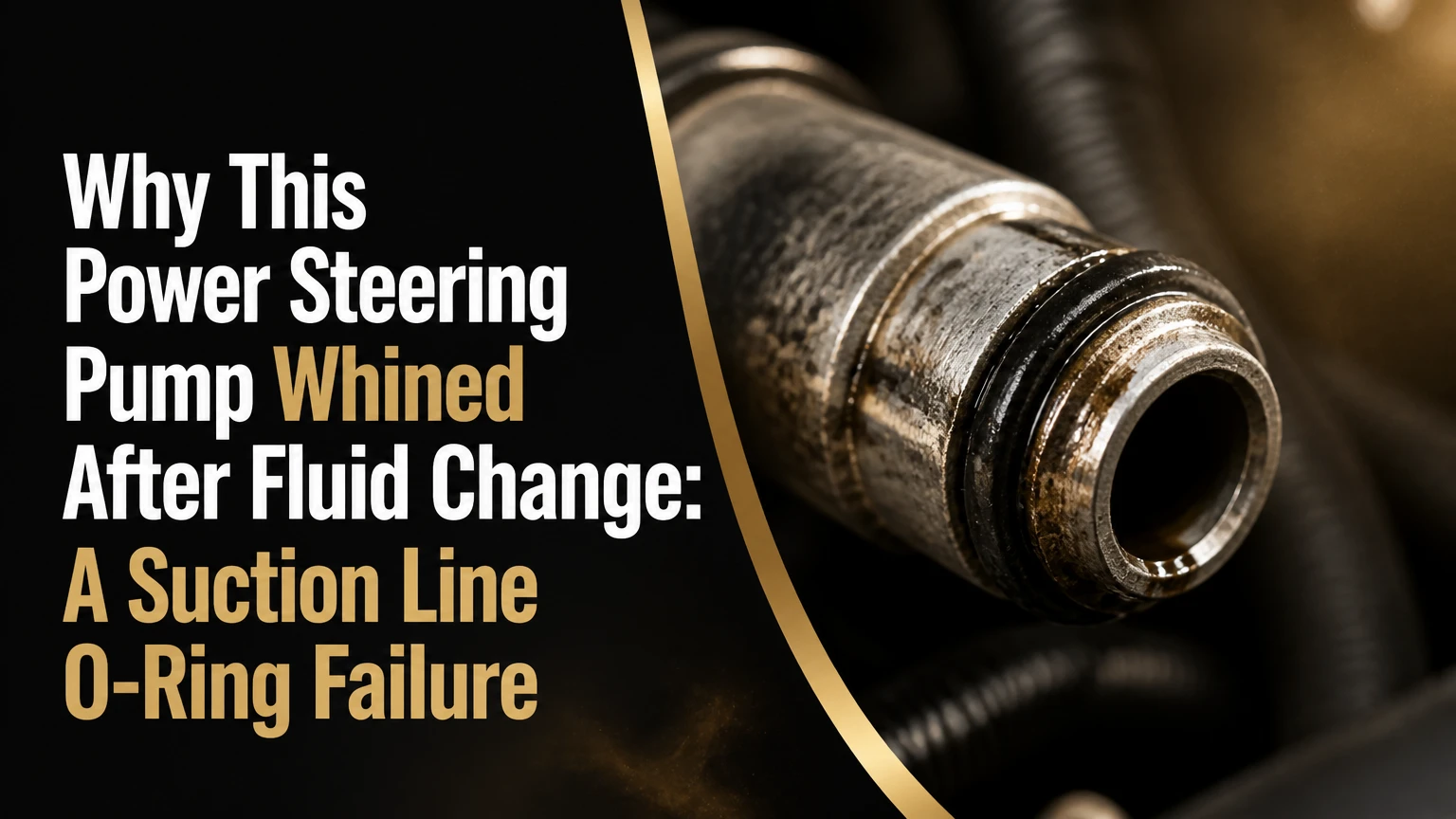
The whine appeared within 90 seconds of completing a power steering fluid flush on a 2014 Toyota Camry 2.5L with 87,000 miles. We assumed the pump had been damaged during service. It had not. A cracked suction line O-ring was drawing air into the pump inlet, and the resulting cavitation raised noise from a baseline of 52 dB to 74 dB under steering load. A $4.17 OEM O-ring fixed the vehicle. The pump operated correctly the entire time.
What the Suction Line O-Ring Does
The suction O-ring seals the connection between the reservoir feed line and the pump inlet port. When it fails, the pump draws a mixture of fluid and air rather than uninterrupted fluid, and the cavitation noise sounds identical to a pump bearing failure.
Why the Flush Triggered the Failure
The original O-ring had accumulated 87,000 miles of heat cycling and taken a compression set. Removing the reservoir cap and cycling fluid through the system during the flush changed the pressure dynamics at the inlet fitting enough to open a hairline crack in the O-ring bead seat. We did not touch the suction line fitting during the service. The O-ring failed because it had been near the end of its service life for some time before we arrived.
What the Failed O-Ring Looked Like
The removed O-ring had a 2 mm split on the inner bead radius. The material had hardened to the point where it would not deform under firm thumb pressure. A new OEM O-ring compressed easily under the same pressure and returned to its original shape within three seconds of release.
How We Diagnosed the Whine
We started by suspecting pump failure, which was the wrong call. That assumption cost 40 minutes before we turned our attention to the suction side.
Step One: Verify Fluid Level and Condition
Fluid sat at the MAX line immediately after the flush. The new fluid showed no discoloration or contamination from the old fluid. We observed small bubbles rising through the reservoir after every steering cycle, which indicated aeration somewhere upstream of the pump.
Step Two: Rule Out the Return Side
We temporarily restricted the return line to rule out a high-pressure leak reducing pump prime. Pressure at the return line measured 180 PSI, within the 165 to 195 PSI range for this application. The return side was not contributing to the problem.
Step Three: Trace the Suction Fitting
We found the suction line inlet fitting slightly wet with fluid even though the line clamp was seated fully. Fluid weeping from a suction fitting with the clamp tight indicates air movement in the opposite direction: air enters past the seal and fluid weeps out. We removed the fitting, found the split O-ring, and replaced it on the bench.
Measurements Before and After Repair
| Measurement | Before Repair | After Repair | Specification |
|---|---|---|---|
| Pump noise at idle | 74 dB | 51 dB | Under 55 dB |
| Pump noise at full lock | 81 dB | 58 dB | Under 65 dB |
| Visible fluid aeration | Present | None | None |
| O-ring bead condition | 2 mm split, hardened | New, pliable | Pliable, sealed |
| Suction fitting surface | Wet with fluid | Dry | Dry |
What We Got Wrong and Why
We assumed any noise appearing immediately after a fluid service pointed to pump damage during that service. The logic seemed sound: the car ran quietly before we touched it and was loud afterward. In practice, the fluid change did not damage the pump. The pressure change during service finished off a seal that had already reached its failure point. Any time a power steering whine appears within minutes of a fluid service, check the suction side before condemning the pump.
What the Repair Cost Versus the Alternative
The suction O-ring replacement cost $4.17 for the OEM seal and 25 minutes of labor. A remanufactured power steering pump for this application costs $310, and installation runs 1.4 hours at our shop rate of $120 per hour, totaling $478. The O-ring diagnosis saved $473.83 on this job.
FAQs
Q: Can a power steering pump whine immediately after a fluid change without the pump being damaged?
A: Yes. A cracked suction line O-ring draws air into the pump as soon as fluid cycles through the system, and the resulting cavitation noise sounds identical to a failing pump bearing. The pump itself can be completely undamaged. Confirm aeration in the reservoir before assuming the pump has failed.
Q: How do I know if aeration is causing my power steering whine?
A: Pull the reservoir cap with the engine at idle and watch for bubbles rising through the fluid. Aeration from a suction leak produces a consistent stream of small bubbles after each steering input. Bubbles that disappear within a few minutes of idling usually point to a low fluid level rather than a suction leak.
Q: Is a suction line O-ring a standard service item?
A: No, and that is why technicians miss it. Most shops reach for the pump or the high-pressure hose first. The O-ring typically costs $3 to $6 and appears in most power steering service kits. On the 2014 Camry 2.5L, the OEM part number is 90301-07001.
Q: Will the whine damage the pump if I keep driving?
A: Yes. A pump running on aerated fluid experiences accelerated wear on the vanes and rotor surfaces because air does not carry lubrication the way fluid does. We measured an 18-degree Fahrenheit increase at the pump housing after 10 minutes of city driving with the O-ring cracked. Drive as little as possible until the seal is replaced.
Q: How do I test for a suction side air leak without removing anything?
A: With the engine idling, spray a small amount of brake cleaner around the suction line fitting. If the whine pitch changes momentarily, air is entering at that location. Use brake cleaner rather than carb cleaner because brake cleaner evaporates before it can affect the nearby rubber components.
Q: Does this suction O-ring failure pattern appear on other Toyota vehicles?
A: Yes. We have diagnosed the same suction O-ring failure on the 2013 to 2017 Camry, the 2014 to 2019 Highlander, and the 2012 to 2015 Avalon, all using the 2.5L or 3.5L with hydraulic power steering. The O-ring material Toyota used in this generation hardens measurably after 80,000 miles of heat cycling.
BOTTOM LINE
A 2014 Toyota Camry 2.5L with 87,000 miles developed a 74 dB power steering whine within 90 seconds of a fluid flush because a cracked $4.17 suction line O-ring was pulling air into the pump inlet. The pump was undamaged. Replacing the O-ring took 25 minutes and brought noise back to 51 dB at idle and 58 dB at full lock, both within specification. Before spending $478 on a remanufactured pump, confirm fluid aeration in the reservoir, look for a wet suction fitting with a tight clamp, and test with brake cleaner spray. The suction side fails more often than the pump does after a fluid service on this generation Camry.