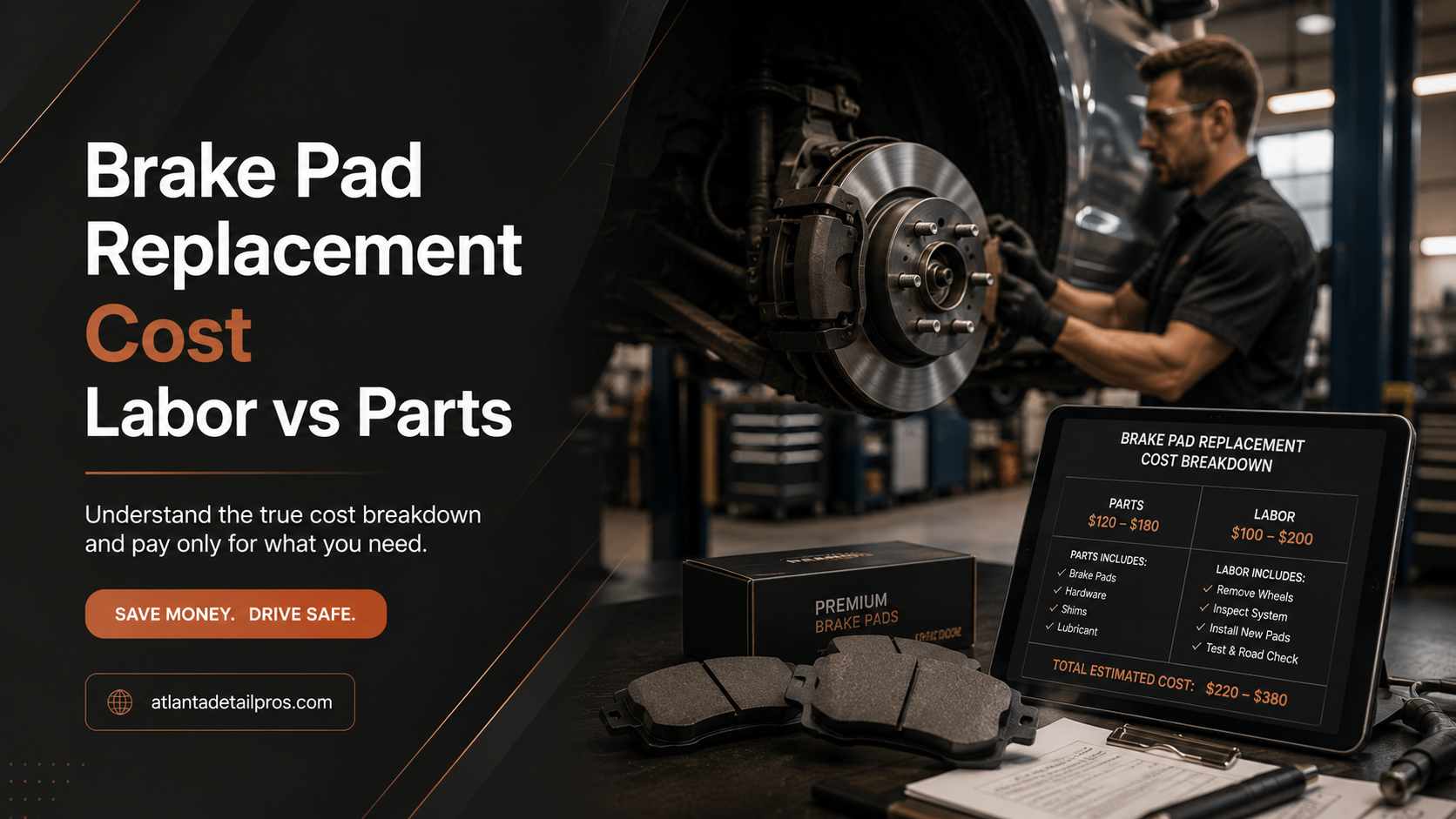
Brake pad replacement runs $150 to $300 per axle at an independent shop and $250 to $500 per axle at a dealership in 2026, with parts accounting for roughly 30 to 50 percent of that total and labor making up the rest. The actual number on your invoice depends on your vehicle, which pad material you choose, and whether the shop can replace pads alone or needs to include rotors.
This guide breaks down exactly what you are paying for, why labor varies so much between shops, how pad type changes the parts cost, and where the bill can jump unexpectedly. If you want to know whether a quote is fair or whether you are being overcharged, the numbers below will tell you.
What You Are Actually Paying For When You Get Brake Pads Replaced
A brake pad replacement invoice has two line items: parts and labor. What most shops do not spell out clearly is what each one actually covers.
Parts include the brake pads themselves (sold per axle, meaning both wheels on one end of the car), brake hardware such as shims and clips, and sometimes caliper lubricant. The pads are the cheap part of this list. A quality set of semi-metallic pads costs $40 to $70 at a parts counter. The shop marks these up, so you will see them billed at $80 to $150 on an invoice.
Labor covers removing the wheel, compressing the caliper piston, swapping the pads, lubricating the slide pins, reinstalling everything, and test-driving to confirm the brakes function correctly. Most shops quote 0.8 to 1.5 hours per axle. At a typical independent shop charging $100 to $140 per hour, that is $80 to $200 in labor. At a dealership charging $150 to $200 per hour, the same job runs $120 to $300 in labor for the same amount of time.
The part that surprises most people: the pads themselves are not expensive. You are largely paying for the technician’s time and the shop’s overhead. On a $250 total brake job at an independent shop, the pads may have cost the shop $50 and the rest is labor, shop supplies, and markup.
Brake Pad Parts Cost by Material
Pad type is the single biggest variable on the parts side of the bill. The table below shows what each type costs and which driving situations each serves best.
Pad Type | Parts Cost (per axle) | Best For | Trade-offs |
|---|---|---|---|
Organic | $25-$50 | Low-mileage driving, older vehicles on a budget | Shortest lifespan, least stopping power, wears faster under heat |
Semi-metallic | $40-$70 | Most everyday drivers, towing, frequent highway use | More brake dust and noise than ceramic; harder on rotors |
Ceramic | $60-$120 | Daily commuters wanting quiet, clean, long-lasting pads | Less cold-weather bite than semi-metallic; not ideal for towing or track use |
OEM / Dealer-spec | $80-$200+ | Luxury and performance vehicles requiring factory spec | Highest parts cost; required on some Euro performance platforms |
For most daily drivers, ceramic pads are worth the modest upgrade over organic. They last longer, run quieter, and produce less brake dust. The extra $20 to $50 in parts cost at the counter often pays back in rotor longevity alone. Semi-metallic is the right call for trucks that tow or anyone who drives aggressively.
Labor: What Different Shops Actually Charge
Labor is where most of the price variation between quotes comes from. The job itself is the same regardless of where you take the car. What changes is the hourly rate.
Independent shops: $80 to $160 per hour is typical across most U.S. markets. A front axle pad replacement runs 1 to 1.5 hours, putting labor at $80 to $200 per axle. Total with parts: $150 to $300.
Dealerships: $150 to $200 per hour is standard at most franchise dealers, and some luxury brands charge more. The same 1 to 1.5 hour job runs $150 to $300 in labor. Total with OEM or dealer-spec parts: $250 to $500 per axle.
National chain shops (Midas, Meineke, Firestone): Rates fall between independent and dealer, typically $100 to $160 per hour. Chains frequently run brake specials that reduce the effective rate, but verify what is included in the promotion before committing.
Mobile brake services: A growing option in metro areas. Because there is no shop overhead, labor rates are often 15 to 25 percent lower than a brick-and-mortar shop. They come to your home or workplace and complete the job on-site. Quality varies, so check reviews before booking.
ALWAYS ask for a written itemized estimate before approving any brake work. The estimate should list the pad brand and material type, the labor hours, the hourly rate, and whether the rotor inspection is included at no charge or billed separately. Shops that refuse to itemize are worth avoiding.
Front vs. Rear Brakes: Why the Price Is Sometimes Different
Front brakes do approximately 70 percent of the stopping work on most vehicles. Because of this load, front pads wear faster and get replaced more frequently than rears. A typical front brake job is also the simpler of the two.
Rear brakes on many modern vehicles integrate the parking brake mechanism into the caliper. On these vehicles, the caliper piston must be wound back with a special tool rather than simply compressed with a C-clamp. This adds time and requires the tool, which some DIYers do not have. At a shop, this typically adds $20 to $50 to the rear labor cost compared to the front on the same vehicle.
Electronic parking brakes, increasingly common on newer midsize and luxury vehicles, require a scan tool to retract the caliper piston before the pads can be changed. The procedure is straightforward for a shop with the right software, but it rules out basic DIY and adds a small amount of labor time. Expect rear brake pad replacement to cost $25 to $75 more than the front on vehicles with this system.
When Rotors Get Added to the Bill
The most common reason a brake pad estimate doubles is the rotors. When pads wear down to near zero and metal contacts the rotor surface, grooves and scoring form. A rotor below its minimum thickness cannot be resurfaced and must be replaced. Even with usable pad life remaining, a warped or heat-spotted rotor will cause brake pedal pulsation and should be addressed.
Rotors cost $30 to $80 each for most passenger cars, or $60 to $150 each for trucks, SUVs, and performance vehicles. A full front axle job with pads and rotors runs $300 to $500 at an independent shop. All four corners with pads and rotors typically totals $600 to $1,000 on a mainstream vehicle.
The decision to replace rotors should be based on measurement, not just age or appearance. Any shop performing a brake job should measure rotor thickness and show you the reading against the minimum spec stamped on the rotor itself. If a shop recommends rotor replacement without measuring, ask them to show you the micrometer reading before you approve the additional work.
Full Cost Breakdown by Vehicle Type and Shop
The table below covers installed total costs (parts plus labor) across the most common brake job scenarios. These are 2026 averages across U.S. markets and will vary by region.
Scenario | Independent Shop | Dealership | DIY Parts Only | Notes |
|---|---|---|---|---|
Economy/compact car, pads only (per axle) | $150-$250 | $250-$400 | $25-$70 | Most common repair |
Midsize sedan or crossover, pads only (per axle) | $175-$300 | $275-$450 | $35-$100 | Average job |
Truck or large SUV, pads only (per axle) | $200-$350 | $300-$500 | $50-$120 | Larger pads |
Luxury or European vehicle, pads only (per axle) | $250-$500 | $400-$700 | $80-$200 | OEM parts cost |
Pads + rotors, average vehicle (per axle) | $300-$500 | $450-$700 | $100-$250 | Most full brake jobs |
These ranges assume standard hardware and no additional repairs. Seized caliper slide pins, a stuck or leaking caliper, or brake fluid that needs flushing will add to any of the figures above.
DIY vs. Paying a Shop: Where the Money Goes
Brake pads are one of the more approachable DIY jobs on a modern car. The tools required are basic: a floor jack, jack stands, a socket set, a C-clamp or brake piston tool, and brake cleaner. Parts cost $25 to $120 per axle depending on type. Most DIYers complete one axle in 45 to 90 minutes after the first time.
The savings are real. A shop job that would cost $200 per axle in labor and parts runs $40 to $80 in parts when you do it yourself. For all four corners, that is $400 to $600 in potential savings.
IMPORTANT: Brakes are a primary safety system. If you have not done this before, watch at least one complete walkthrough for your specific vehicle before starting. Do both wheels on the same axle, never just one side. After the job, pump the brake pedal in the driveway until it feels firm before moving the car. If the pedal feels soft or sinks to the floor, do not drive the vehicle.
When DIY is not the right call: electronic parking brake systems that require a scan tool to retract, vehicles where the caliper is seized and needs rebuilding or replacement, any situation where the brake lines or master cylinder is also suspect. Those jobs require more than basic tools and are better left to a shop.
Signs You Actually Need Brake Pads
Knowing the signs of worn pads protects you from shops that recommend the work prematurely and also from waiting too long and turning a simple pad job into a full brake service.
- Squealing when braking: Most pads have a metal wear indicator tab that contacts the rotor and produces a high-pitched squeal when the pad approaches the replacement threshold. This is the intended early warning.
- Grinding noise: Metal-on-metal contact. The pad is fully worn and the backing plate is contacting the rotor directly. At this point the rotor is being damaged and replacement of both is almost certain.
- Brake warning light: Many vehicles have a sensor embedded in one pad that illuminates a dashboard light when the pad reaches minimum thickness.
- Pad thickness under 3mm: Looking through the wheel spoke at the pad visible behind the rotor, less than the width of two stacked pennies is the replacement signal. New pads are 10 to 12mm thick.
- Pedal pulsation or vibration when braking: More commonly a rotor issue than a pad issue alone, but worth having inspected when brakes are being serviced.
What Drivers Consistently Report Paying
The most common brake pricing complaint is not being overcharged outright, it is accepting the first quote without comparison shopping. Brake pad labor is nearly identical between two shops in the same city, but parts markup and pad quality vary significantly. A shop recommending premium branded pads at $200 on the invoice for a Civic is not performing a different service than a shop billing $70 for pads on the same car. They are selling different margins.
The second consistent finding: the full four-corner brake job sold as a package deal. Shops regularly find that front pads are worn and recommend replacing all four corners at once. Sometimes this is sound advice because the rears are close behind. Other times the rears have 40,000 miles of life remaining. Ask the service advisor what the rear pad thickness measurement was before approving the rear work. A shop that cannot give you a millimeter reading did not measure.
Drivers who get two or three quotes on brake work typically save $50 to $150 on the same job. Calling ahead, describing the vehicle, and asking for an over-the-phone estimate on a basic front pad replacement gives you a fast comparison baseline before you even bring the car in.
Frequently Asked Questions
How much does brake pad replacement cost on average?
For most passenger vehicles in 2026, a professional front brake pad replacement runs $150 to $300 per axle at an independent shop and $250 to $500 at a dealership. Rear brakes are similar but can run $25 to $75 more on vehicles with electronic parking brakes. Budget $300 to $700 total for all four corners at an independent shop on a mainstream vehicle.
What percentage of a brake job is labor vs. parts?
Labor typically represents 40 to 60 percent of the total invoice on a standard brake pad replacement. The pads themselves are inexpensive at the parts counter, $25 to $120 per axle depending on material. The shop marks up parts and adds labor, which is where most of the invoice comes from. At a dealership, parts markup is higher and labor rates are higher, which is why dealer totals run 40 to 60 percent more than independent shops for the same job.
How long does brake pad replacement take?
A standard front axle brake pad replacement takes 1 to 1.5 hours at a shop. Both axles take 2 to 3 hours. If rotors are also being replaced, add 30 to 45 minutes per axle. Electronic parking brake systems add another 15 to 30 minutes for the retraction procedure.
Are ceramic brake pads worth the extra cost?
For most everyday drivers, yes. Ceramic pads cost $20 to $50 more per axle than semi-metallic but last longer, run quieter, and produce significantly less brake dust. The additional rotor longevity often makes ceramic pads the lower-cost choice over the life of the vehicle. They are not the right choice for vehicles that tow frequently or drivers who push their cars hard, where semi-metallic is the better material.
Do I need to replace rotors at the same time as brake pads?
Not necessarily. Rotors should be replaced when they are below minimum thickness, visibly scored or grooved from worn pads, warped enough to cause pedal pulsation, or heat-spotted. If the rotors measure within spec and the surface is in good condition, replacing pads only is the correct repair. Always ask to see the rotor thickness measurement before approving rotor replacement.
Is it safe to only replace front or rear brakes and not both axles?
Yes, as long as you replace both wheels on the same axle at the same time. You should never replace pads on only one side of an axle, left wheel but not right wheel, because this creates an imbalance that pulls the vehicle during braking. Replacing fronts only and leaving the rears is fine if the rear pads have usable life remaining. Ask for the rear pad thickness measurement to confirm.
What is a reasonable price to pay for a brake job?
For a front axle pad replacement on a mainstream sedan or crossover at an independent shop, $150 to $275 is a fair range in 2026. Above $350 per axle for pads only on a standard vehicle warrants a second quote. For pads and rotors together, $300 to $500 per axle is reasonable at an independent shop. Dealership prices 40 to 60 percent above those numbers are normal, not a ripoff, because of higher overhead and parts cost.
How often do brake pads need to be replaced?
Most brake pads last 30,000 to 70,000 miles depending on driving style, vehicle weight, and pad material. City driving with frequent stops wears pads faster than highway driving. Ceramic pads generally last longer than organic or semi-metallic. Many vehicles show a brake wear indicator light or produce a squeal well before pads reach the danger zone, which is why responding to those early warnings keeps a simple pad job from turning into a full brake repair.
The Bottom Line
The parts in a brake pad job are not what you are really paying for. A quality set of semi-metallic or ceramic pads costs $40 to $120 at a parts counter. The invoice is mostly labor, shop overhead, and parts markup. That reality has two practical implications: it means getting two or three quotes matters, and it means DIY saves most of the money on the job.
If you are paying a shop, the fair range for a standard vehicle at an independent shop is $150 to $300 per axle for pads only, or $300 to $500 per axle if rotors are also being replaced. Ask for the rotor thickness measurement before approving rotor work. Ask for the pad brand by name. And never approve work on all four corners without seeing the measurement that justifies the rear axle recommendation.
Brake work is not complicated. What makes it expensive is not knowing what a fair price looks like before you walk into the shop.