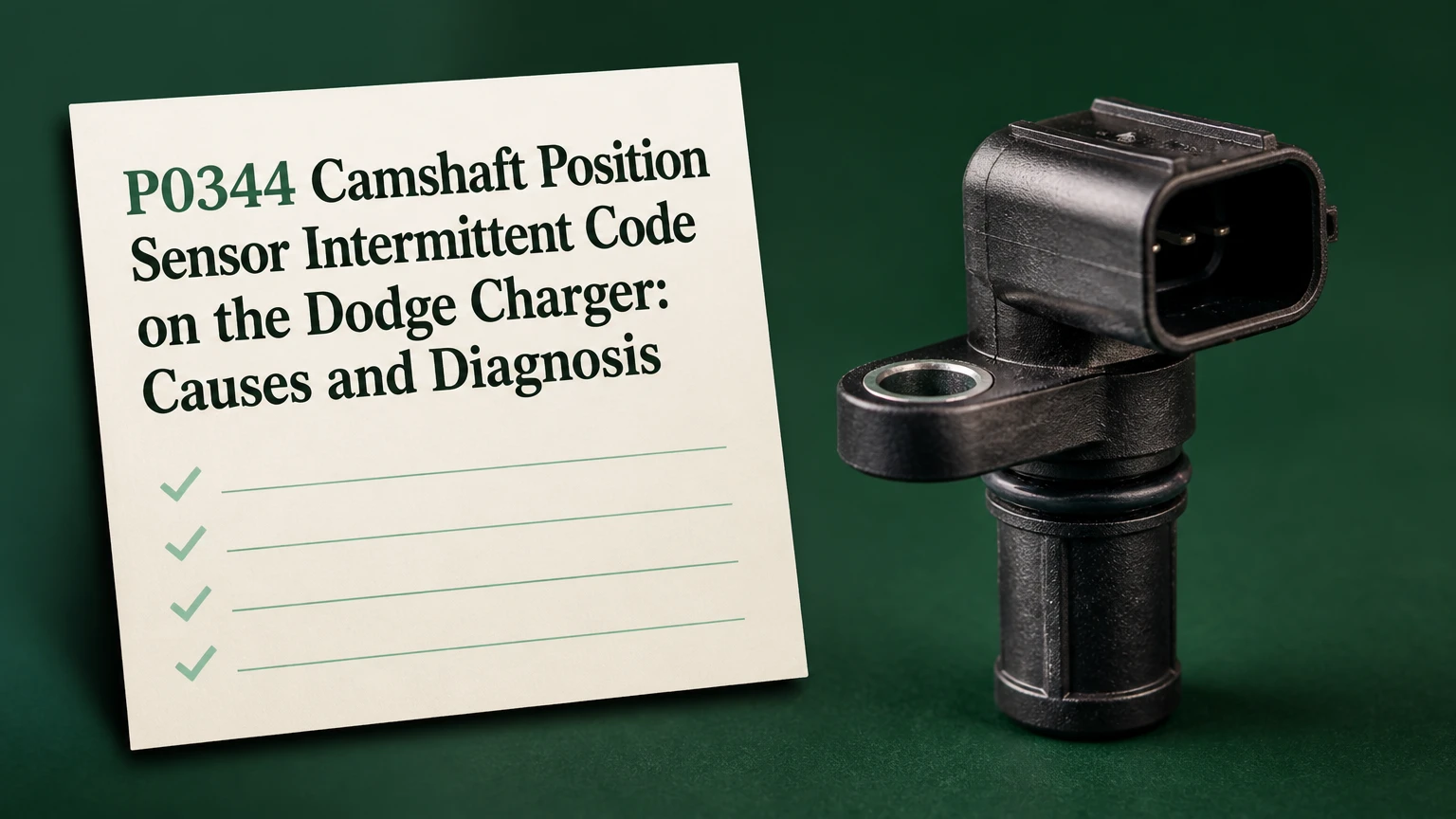
A P0344 code on the Dodge Charger indicates an intermittent signal dropout from the camshaft position sensor on Bank 1, meaning the PCM is receiving the cam signal normally at some times but losing it completely or erratically at others, and the most common cause is a camshaft position sensor whose internal circuitry is failing and producing a dropout under heat or vibration, followed by a damaged or chafed sensor wiring harness that makes intermittent contact.
The intermittent nature of P0344 makes it more challenging to diagnose than a hard-fault cam sensor code (P0340) because the fault does not exist continuously and may not be reproducible on demand.
What P0344 Means vs. P0340
P0340 is a hard-fault camshaft position sensor code: the signal from the cam sensor is absent or completely out of specification continuously. This typically causes a no-start or severe stalling condition because the PCM cannot determine cam position.
P0344 is the intermittent version: the signal is present most of the time but drops out or glitches briefly under certain conditions (heat, vibration, specific engine speeds). The Charger may start and run normally in most situations but stumble, hesitate, stall momentarily, or fail to restart on a hot soak because the cam signal disappears for a fraction of a second at the wrong moment. The engine management system defaults to a stored cam position value when the signal is lost briefly, which may allow continued rough running.
Symptoms: brief hesitation at highway cruise, intermittent stalling at warm idle that restarts immediately, momentary loss of power under hard acceleration, or a Charger that fails to start after a hot soak (parked for 20 to 30 minutes after extended driving) because the cam sensor fails in the high heat of engine soak.
Cause 1: Failing Camshaft Position Sensor
The cam position sensor is a Hall-effect sensor that reads a reluctor wheel (toothed ring) on the camshaft. The sensor contains a small semiconductor element that is vulnerable to thermal cycling failure: at cold temperatures it operates correctly, but at high operating temperature the semiconductor element develops a micro-crack or bonding failure that causes the signal to drop out momentarily. When the engine cools, the crack closes and the sensor operates normally again.
This thermal failure pattern explains why P0344 is often a hot-engine problem: the code sets or the stumble occurs after the engine reaches full operating temperature, and the symptom is worse after a hot soak where underhood temperature is at its maximum.
On the Dodge Charger with the 3.6L Pentastar V6: the Bank 1 cam sensor is located at the front of the engine on the passenger-side cylinder head (Bank 1 is the front bank in the Pentastar V6). The sensor uses a 3-pin connector (power, ground, signal). Replacement sensors cost $30 to $80 for an aftermarket unit or $80 to $150 OEM.
On the Dodge Charger with the 5.7L HEMI: the cam sensor is at the front of the engine near the timing cover. The HEMI also has Variable Cam Timing (VCT) actuators; a failing cam phaser can produce signals that mimic an intermittent sensor code.
Cause 2: Damaged or Chafed Sensor Wiring
The cam sensor wiring harness on the Charger runs along the engine valley or cylinder head and is routed near heat sources and moving components. Over time, the harness insulation can harden, crack, or chafe against the engine block, a bracket, or the timing cover. A wire that is partially broken internally (strands severed but remaining in contact) passes a continuity test but loses contact under vibration or thermal expansion, producing an intermittent signal dropout.
The wiggle test: with the engine running at warm idle, wiggle the cam sensor harness from the connector end toward the PCM, section by section. If the engine stumbles or the cam sensor signal on a scan tool shows a dropout during the wiggle, the broken wire is in the section being flexed. This test must be done carefully to avoid contacting moving engine components.
Connector inspection: disconnect the cam sensor connector and inspect the terminal pins closely. Green oxidation on any terminal causes intermittent high resistance. Pins that are slightly backed out of the connector housing make intermittent contact as the connector vibrates. Clean terminals with electronic contact cleaner, apply dielectric grease, and ensure all pins lock fully into the connector.
Cause 3: Worn Timing Chain Affecting Cam Signal Timing (3.6L Pentastar)
The 3.6L Pentastar V6 uses a timing chain system that includes primary and secondary chains with hydraulic tensioners. As the chains stretch with mileage, the camshaft timing retards from its designed position. The cam position sensor reads the cam reluctor wheel position and compares it against crankshaft position data. When the cam position is sufficiently retarded from the crank reference (due to chain stretch), the PCM may interpret the phase relationship as an intermittent signal error rather than a timing error, setting P0344 rather than a timing chain codes.
This cause is most common on Pentastar engines above 100,000 miles and is often accompanied by a secondary rattling noise at startup (timing chain rattle for the first 2 to 3 seconds until oil pressure builds and the tensioners pump up), rough cold start, or a P0016 or P0018 code indicating cam-to-crank correlation error.
If P0344 occurs alongside P0016 or P0018, prioritize timing chain inspection over sensor replacement: a new sensor on a timing-chain-stretched engine will not clear the root cause.
Cause 4: VVT/Cam Phaser Failure (5.7L HEMI)
The 5.7L HEMI in the Charger uses Variable Valve Timing (VVT) with hydraulically controlled cam phasers. These phasers adjust cam timing based on oil pressure commands from the PCM. A failing cam phaser on Bank 1 can produce erratic cam position readings that the PCM interprets as an intermittent sensor signal, setting P0344. HEMI cam phaser failures are most common on engines with extended oil change intervals that allowed sludge to partially block the phaser oil control passages.
Distinguishing phaser from sensor: a failing phaser often produces a secondary metallic rattling sound at startup (the phaser ratchets against its hydraulic stop when oil pressure is slow to reach it). The rattle disappears after a few seconds of warm running. If P0344 on the HEMI is accompanied by this startup rattle and an extended oil change history, cam phaser failure is the primary suspect rather than the sensor itself.
Cause Hierarchy and Costs
Cause | Engine | Distinguishing Signs | Test Method | Repair Cost |
|---|---|---|---|---|
Failing cam sensor (heat-related) | Both 3.6L and 5.7L | Symptoms appear hot, not cold | Freeze spray on sensor; monitor signal | $80 to $200 (sensor replacement) |
Damaged sensor wiring | Both | Stumble during harness wiggle | Wiggle test with scan tool live data | $80 to $300 (harness repair) |
Corroded sensor connector | Both | Green oxidation on terminals | Visual inspection; clean and retest | $0 to $100 |
Timing chain stretch (3.6L) | 3.6L Pentastar | P0016 or startup chain rattle | Timing chain inspection; cam-crank correlation test | $800 to $2,000 (chain replacement) |
Cam phaser failure (5.7L) | 5.7L HEMI | Startup rattle; extended oil change history | Oil pressure test; phaser actuator test | $400 to $1,200 |
The Freeze Spray Test for Thermal-Related Sensor Failure
With the engine warmed to operating temperature and the cam sensor signal displayed on a scan tool, spray a small amount of freeze spray (available at electronics stores) directly on the cam sensor body. On a sensor that is failing due to thermal stress, the rapid cooling from the freeze spray momentarily restores normal operation and the signal stabilizes, or alternatively, cooling a marginal sensor can cause it to fail immediately if it was temperature-dependent. This test helps distinguish a sensor that is failing from a wiring or timing chain issue. Always be careful not to spray freeze spray on hot exhaust components.
“My Charger would start fine but stall at random while idling after a long drive, then restart right away. No codes at first, then eventually a P0344 appeared. I wiggled the cam sensor harness with the engine running and got a stuttering idle instantly. Followed the wire back about 14 inches from the connector and found a spot where the insulation had worn through against an engine bracket. Spliced in six inches of new wire and heat shrink. Runs perfect now and the code cleared itself.” — Jake Fernandez, 2012 Dodge Charger R/T 5.7L HEMI
Using Live Data to Capture an Intermittent Fault
An intermittent code is best captured using a scan tool with data logging capability. Set the scanner to log cam sensor signal voltage, cam sensor activity state (active/inactive), and engine RPM simultaneously. Drive under the conditions that previously triggered the symptom (typically warm engine, highway speed, or after a hot soak). When the signal dropout occurs, it will be visible in the log as a gap or zero-voltage period in the cam signal channel. This data log can be reviewed at a shop and gives a technician the exact conditions under which the fault appears.
Frequently Asked Questions
Can a P0344 cause a no-start condition on the Dodge Charger?
Yes. If the cam sensor signal is absent at the critical moment during cranking when the PCM needs to establish cam position for injection timing, the engine may crank without starting, or start briefly and immediately stall. A hot-soak no-start on a Charger with P0344 history is a classic symptom of a cam sensor whose heat-related failure is progressing from intermittent to hard fault.
Should I replace the cam sensor even if it tests normal when cold?
If the symptoms and fault pattern are consistent with a thermal cam sensor failure (problems only when hot, no wiring or timing chain issues found), replacing the sensor is a reasonable step even if it tests electrically normal at room temperature. Sensors can pass cold tests and fail under operating heat. For a $30 to $80 sensor, this is a low-cost diagnostic trial when other causes have been ruled out.
Does the 3.6L Pentastar have a cam sensor on both banks?
Yes. The Pentastar V6 has a cam position sensor on each cylinder head: Bank 1 (front bank) and Bank 2 (rear bank). P0344 is specifically Bank 1. The sensors are identical in specification but are located on opposite sides of the engine. Do not confuse the locations when replacing.
Can low oil pressure cause P0344?
On the 5.7L HEMI with VVT, low oil pressure can cause the cam phaser to not hold its position correctly, producing cam position signal anomalies. Check oil level and pressure before condemning the cam sensor on a HEMI with P0344 and an oil change history that is overdue.
The Bottom Line
P0344 on the Dodge Charger requires a different diagnostic approach than a hard-fault code because the fault is not continuously present. Start with the connector inspection and wiggle test, which are free and find a large percentage of intermittent wiring faults. If the wiring is clean and intact, use a scan tool to data-log the cam sensor signal during a conditions-matching drive. On the 3.6L Pentastar with high mileage, check for companion timing chain codes before replacing the sensor. On the 5.7L HEMI, investigate cam phaser condition if a startup rattle is present alongside the P0344.