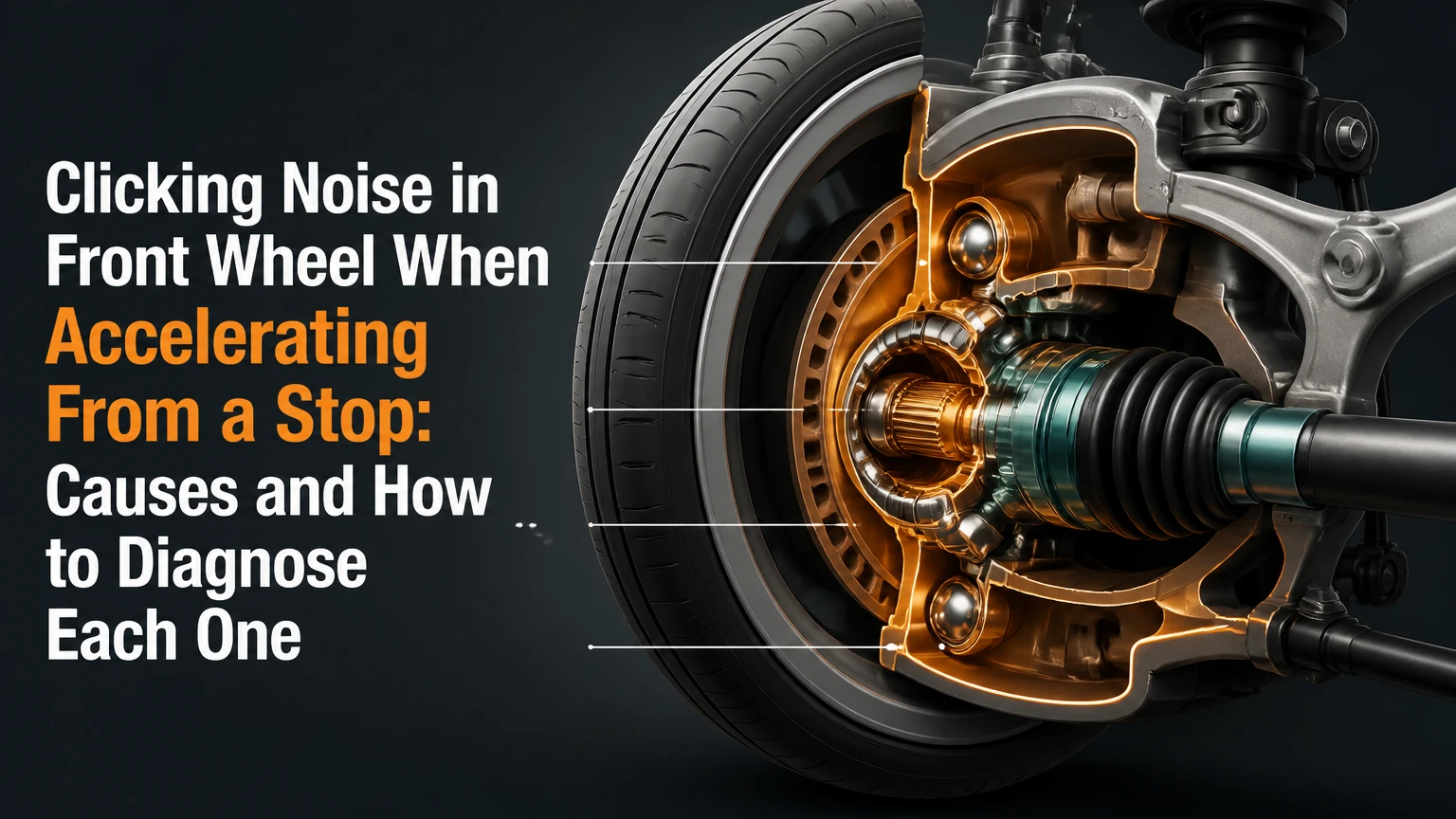
A clicking noise from the front wheel specifically when accelerating from a stop is most commonly a worn outer CV joint, but the exact timing of the click, whether it appears only when turning or also when going straight, and which wheel it comes from are the diagnostic details that separate a CV joint repair from a loose wheel lug nut, a failing strut mount, or a worn inner CV joint.
Getting this diagnosis right matters because the fixes range from a $20 torque job to a $400 axle replacement, and the wrong repair leaves you with the same noise.
Why Acceleration From a Stop Specifically Triggers These Noises
Pulling away from a stop combines two mechanical stresses simultaneously: the drivetrain transitions from zero torque to significant torque (loading the axle joints, mounts, and wheel hardware), and the front wheels are often at a slight steering angle as the driver turns out of a parking space or intersection. This combination of torque loading plus steering angle is the exact operating condition that reveals a failing outer CV joint, because the joint is under its maximum stress when it is transmitting torque through an angle.
A component that holds together under steady cruising or light acceleration can click, pop, or clunk the moment torque is applied from rest, because static friction transitions to dynamic friction and the worn surfaces in a joint slip rather than roll smoothly.
Cause 1: Worn Outer CV Joint (Most Common)
The outer CV joint connects the end of the drive axle to the wheel hub. It allows the axle to transmit power through the changing angle created by steering and suspension movement. When the joint’s internal ball bearings and races wear, the joint develops play that allows it to click as the balls skip over worn grooves on each rotation. The classic symptom is a clicking or popping sound that is worst when turning during acceleration and diminishes or disappears when driving straight.
The distinction: if the clicking only appears when the wheels are turned (any angle away from dead center), the outer CV joint is the primary suspect. If the clicking appears even when driving straight from a stop, the inner CV joint or another cause is more likely.
Physical check: look at the rubber CV boot on each axle where it meets the wheel hub. A torn, split, or collapsed boot means the grease that lubricates the joint has been expelled and contaminated with dirt. A dry, dirty CV joint fails much faster than a properly greased one. A torn boot with visible grease slung around the inner wheel area is strong evidence the outer CV joint has been running dry.
Urgency: Moderate to High. A clicking CV joint will eventually fail completely. Complete outer CV joint failure causes a loss of drive to that wheel. On a FWD vehicle, this can be immediately disabling. The joint typically gives several weeks to a few months of warning through the clicking before it fails.
Cause 2: Worn Inner CV Joint
The inner CV joint connects the axle to the transmission or differential. Unlike the outer joint, it uses a tripod-style design on most vehicles that allows the axle to change length as the suspension moves. When the inner joint wears, it produces a clunking or thudding sound under torque loading, particularly noticeable when applying power after being stopped. This click or clunk often appears when going straight, not just when turning, which distinguishes it from an outer joint issue.
Inner CV joint failure can also cause a vibration under acceleration rather than a discrete click, as the worn tripod rollers create an uneven power pulse. If the clicking is accompanied by a slight shudder during strong acceleration, the inner joint warrants investigation alongside the outer.
Cause 3: Loose Wheel Lug Nuts
A wheel with loose lug nuts produces a clicking or clunking sound when torque is applied because the wheel shifts on the hub as the drivetrain loads it. This is potentially the most dangerous cause on this list: a wheel with significantly loose lugs can separate from the vehicle at speed. The click may appear with each power application from a stop, and the wheel may have slight visible lateral movement when shaken firmly by hand (grab the wheel at 9 o clock and 3 o clock and attempt to rock it).
Check every lug nut on each front wheel with a torque wrench or at minimum a breaker bar before considering any other diagnosis. Proper torque for most passenger vehicles is 80 to 110 ft-lbs; trucks typically 120 to 150 ft-lbs. This takes five minutes and eliminates the most dangerous cause first.
Cause 4: Worn Strut Mount or Spring Seat
The strut mount sits at the top of the front strut assembly and allows the strut to rotate when the steering wheel is turned. When the mount bearing wears or the rubber isolator deteriorates, it produces a clicking, popping, or clunking sound specifically during steering input, including during acceleration while turning out of a parking spot. This sound often originates higher in the wheel well than a CV joint noise and may be reproduced by turning the steering wheel back and forth while stationary with the engine running.
The spring seat can also crack or shift, producing a single loud pop when the suspension loads from a stop. This is often confused with a CV joint click but occurs only once per acceleration event rather than periodically.
Cause 5: ABS Tone Ring Damage
The ABS tone ring is a toothed ring pressed onto the axle or wheel hub that the ABS wheel speed sensor reads. If this ring is cracked, missing teeth, or has debris between it and the sensor, it can produce a clicking sound at low speed that matches wheel rotation frequency. This sound is tied to wheel rotation speed rather than engine RPM or torque, and it does not change character with steering angle.
Diagnosis: The Turn Test and Load Test
The turn test: in a safe area with no traffic, drive slowly while turning the steering wheel to nearly full lock in each direction. A clicking that is loudest at full lock in one direction and quieter or absent at full lock the other direction points to the outer CV joint on the side toward which you are turning (that joint is at maximum angle). A click equally present in both directions or during straight acceleration points toward the inner joint, strut mount, or wheel hardware.
The load test: drive straight from a stop with no steering input. If the click appears during straight acceleration, the outer CV joint is less likely and the inner joint, motor mount, or lug nut scenario is more likely.
The lift test: have a mechanic put the vehicle on a lift and physically inspect the CV boots, shake each axle, and rock the wheel to check for bearing play. This is the definitive test and takes under 20 minutes at most shops.
Cause and Urgency Table
Cause | Click Trigger | Urgency | DIY Check | Repair Cost |
|---|---|---|---|---|
Worn outer CV joint | Turning + accelerating, worst at full lock | High: will fail | Inspect boot for tears and grease sling | $200 to $500 (axle replacement) |
Worn inner CV joint | Straight acceleration; possible shudder | Moderate | Feel for vibration; inspect inner boot | $200 to $500 (axle replacement) |
Loose lug nuts | Any acceleration; wheel rocks by hand | Critical: check immediately | Torque check with breaker bar | $0 to $30 (torque + new studs if damaged) |
Worn strut mount bearing | Steering input from stop; reproducible stationary | Moderate | Reproduce by turning wheel at standstill | $150 to $400 per side |
Cracked spring seat | Single pop per acceleration event | Moderate | Inspect spring seat on lift | $100 to $300 |
ABS tone ring damage | Click tied to wheel speed, not steering | Moderate | Scan for wheel speed sensor codes | $50 to $200 |
Vehicle-Specific Notes
Honda CR-V and Accord (2002-2011, FWD): outer CV joint failure is extremely common on these platforms, particularly the driver’s side. A clicking right turn is the left outer joint; a clicking left turn is the right outer joint (each joint is stressed most when turning in that direction). Remanufactured axle assemblies for these vehicles are widely available for $80 to $150 in parts.
Ford Explorer and Edge (AWD, 2007-2015): the rear inner CV joints on the rear axle shafts develop clunking under acceleration. This is often confused with a differential issue but is an axle shaft inner joint failure.
GM FWD platforms (Equinox, Malibu, Impala): intermediate shaft carrier bearing failure can produce a clicking during acceleration that sounds like a CV joint but comes from the center support bearing. The intermediate shaft connects the transmission to the right-side axle on many GM FWD vehicles.
Frequently Asked Questions
Can I drive with a clicking CV joint?
Yes, for a limited time, but the joint will worsen and eventually fail. A clicking outer CV joint that has been noisy for several weeks typically has weeks to a few months remaining before complete failure. If the clicking has progressed to a loud clunking under any acceleration (not just turning), the joint is near failure. Plan the repair within the next one to two weeks rather than deferring indefinitely.
Does a torn CV boot always mean the joint is bad?
Not immediately. A freshly torn boot that still has grease inside the joint boot means the joint itself may still be serviceable. The boot should be replaced immediately (boot replacement costs $80 to $150) to prevent contamination of the joint. If the boot has been torn for some time and the grease has been flung out and replaced by road grime, the joint is likely already damaged and a full axle replacement is more economical than a boot kit alone.
If I replace both front axles, will the noise definitely be fixed?
Not if the cause is a strut mount, lug nut, or ABS tone ring. Replacing axles for a strut mount click is an expensive miss. Perform the turn test and load test to differentiate the cause before authorizing any parts replacement.
What does a CV joint failure sound like right before it completely fails?
A CV joint approaching complete failure transitions from an intermittent click during turning to a continuous grinding, clicking, or clunking during all driving, including straight-line motion. The noise becomes constant rather than conditional on steering angle. At this stage, replace it immediately. A failed outer CV joint cannot transmit drive and the vehicle will not move under power from the affected wheel.
The Bottom Line
A clicking front wheel when accelerating from a stop is almost always a CV joint issue, and the turn test tells you which joint and which side within minutes of observation. Check lug nut torque first because it takes five minutes and eliminates the only dangerous possibility on this list. Then perform the turn test to isolate the outer joint, straight-acceleration test to evaluate the inner joint, and stationary steering wheel turn to check the strut mount. Take it to a lift for physical inspection before authorizing any parts replacement.