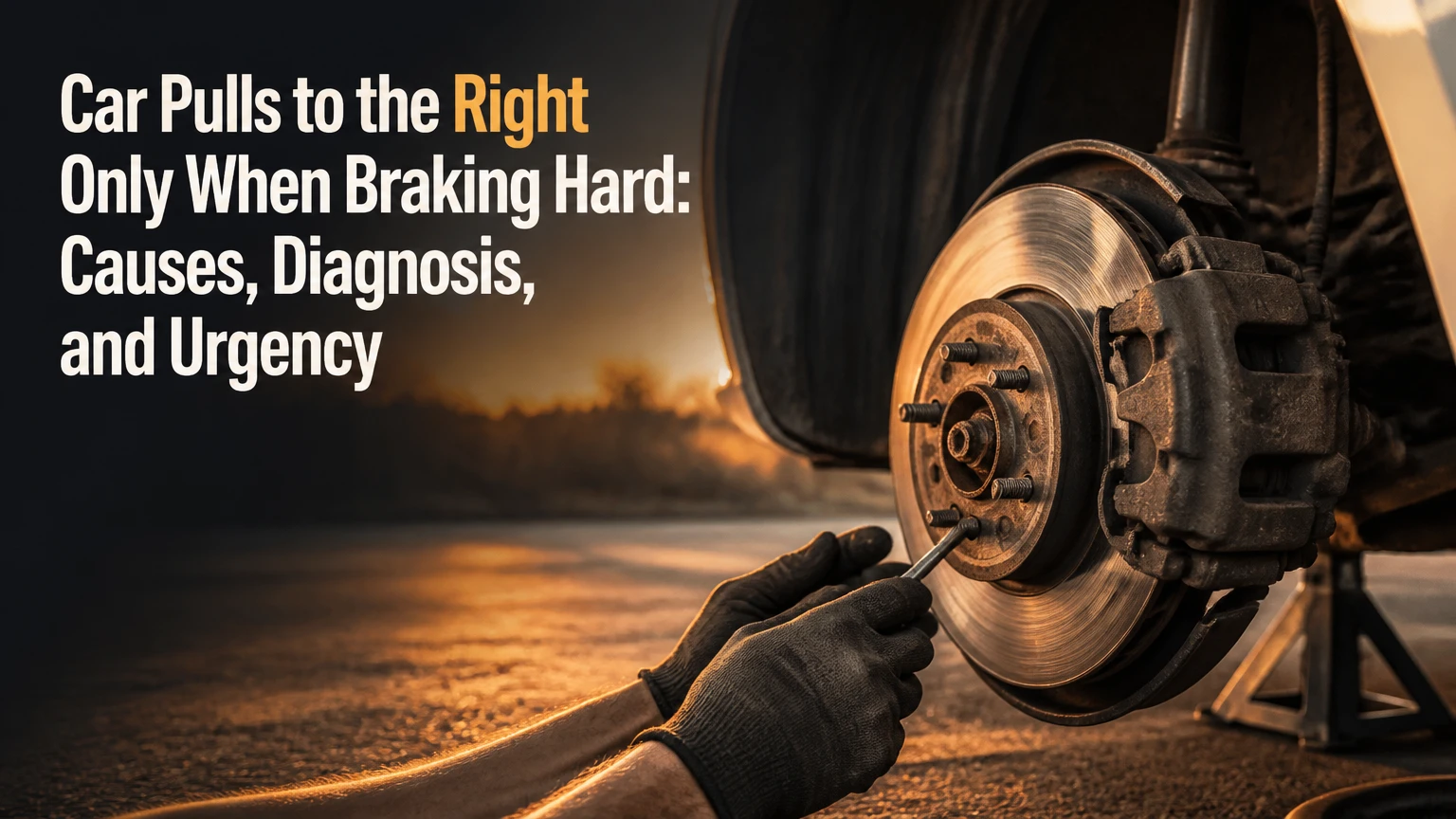
A car that pulls to the right specifically during hard braking but drives straight otherwise has a brake force imbalance between the left and right front wheels, and the most common culprits are a seized or dragging right front caliper, a collapsed flexible brake hose restricting fluid flow to one caliper, or brake friction material contaminated with oil or grease on one side.
The hard-braking-only qualifier is the critical diagnostic clue: it tells you the imbalance only becomes significant when brake forces are high, which points toward a specific set of causes that gentle braking does not reveal.
Why Hard Braking Specifically Reveals Brake Imbalance
During gentle braking, the total braking force is low and even a significant imbalance between left and right creates only a minor steering pull that most drivers correct unconsciously. During hard braking, total braking force may be 10 to 20 times higher than gentle braking. A 30 percent braking force deficit on the right side that was invisible at gentle braking creates a strong pull to the right at emergency brake levels because the vehicle is decelerating much harder on the left than the right.
A car that pulls right during hard braking is braking harder on the left side than the right. The vehicle steers toward the side with more braking force. To have more braking force on the left, either the left is braking normally while the right is braking too little (restricted fluid flow, contaminated pads, seized caliper in the released position) or the left has something causing it to brake too hard (seized caliper in the applied position). The majority of cases are right-side restriction causing the car to pull right.
Cause 1: Collapsed Internal Brake Hose
The flexible rubber brake hose connects the rigid steel brake line (mounted on the chassis) to the caliper (which moves with the wheel). Inside these hoses, the rubber inner liner can deteriorate and form an internal flap or restriction. This flap acts like a one-way valve: it allows hydraulic pressure from the master cylinder to apply the caliper normally, but then traps the pressure rather than allowing it to release when the pedal is released. This produces a dragging caliper.
More relevantly for a hard-braking-only pull: a partially collapsed hose restricts the maximum fluid flow to the caliper under high pressure demand. During gentle braking where fluid demand is low, the restriction does not significantly limit caliper apply pressure. During hard braking where the master cylinder is pushing maximum pressure, the restriction limits how much pressure reaches the right caliper, causing it to apply less force than the left.
The collapsed hose is one of the most frequently missed brake diagnoses. From the outside, the hose looks intact with no external damage. The failure is internal. The diagnostic test: with the car on a lift, a technician opens the bleeder screw on the right caliper and has a helper apply the brake pedal firmly. Healthy fluid flow exits in a strong stream; a collapsed hose produces a weak or intermittent flow even under high pedal pressure.
Cause 2: Seized Caliper Piston or Slide Pin
A seized caliper can cause a pull in two ways. A caliper piston or slide pin that is partially seized in the released position cannot apply adequate braking force on hard stops, causing the vehicle to pull away from that side. A caliper that is seized in the applied position causes the pad to constantly drag against the rotor, which generates heat and reduces friction coefficient at that corner, causing the vehicle to pull toward it under hard braking because the opposite side is braking more efficiently.
The seized-closed (dragging) caliper produces a wheel that is significantly hotter than the others after a drive, a pulling sensation even during normal driving, and a burning smell. The seized-open (non-applying) caliper produces the pull only during hard braking with no hot wheel and no burn smell.
Cause 3: Contaminated Brake Pads or Rotor
Oil, grease, brake fluid, or road film on the brake pad friction surface dramatically reduces the friction coefficient. A contaminated right front pad produces a side with much less braking force than the clean left front, and the vehicle pulls left (away from the low-friction side). Wait: the reader reports pulling RIGHT during hard braking. If the LEFT pads are contaminated, the vehicle pulls right (toward the higher-friction right side). Contamination on the brake friction surface is always on the side AWAY from the pull direction.
Common contamination sources: wheel seal leaking grease onto the rotor, a nearby CV axle boot leaking grease, or brake fluid from a leaking caliper piston seal coating the inner pad. The contaminated pad surface appears glazed, discolored, or has a slick oily sheen. A contaminated rotor surface shows a similar appearance.
Cause 4: Uneven Brake Pad Wear
If one side has significantly thicker pads than the other (from a previous single-side pad replacement or uneven caliper function over time), the thicker pad exerts more force on the rotor when the pedal is pressed, causing the vehicle to brake harder on that side. The pull is toward the side with more aggressive braking. This is confirmed by removing the wheel and comparing pad thickness on both sides.
Cause 5: Brake Proportioning Valve or ABS Modulator Fault
The brake proportioning valve (on older vehicles) or ABS modulator (on modern vehicles) distributes hydraulic pressure among the four brakes. A fault in either can cause asymmetric pressure distribution under high-demand braking. A faulty ABS modulator that applies excessive pressure to the left front under hard braking pulls the car left; one that restricts pressure to the right front pulls right. This is less common than caliper or hose causes but is worth considering when caliper and hose inspection reveals no fault.
Diagnosis Decision Table
Cause | Pull Direction | Hot Wheel? | Key Test | Repair Cost |
|---|---|---|---|---|
Collapsed right brake hose | Right (right caliper underbrakes) | Right wheel cool | Bleeder flow test under pedal pressure | $80 to $200 per hose |
Right caliper seized open | Right (right caliper cannot apply) | Right wheel cool | Measure pad thickness; caliper slide test | $150 to $350 |
Left caliper seized closed | Right (left caliper overbrakes) | Left wheel very hot | Wheel temp check; pad burn smell | $150 to $350 |
Left pad/rotor contaminated | Right (away from contaminated side) | Normal temps | Visual inspection of pad surface | $80 to $250 |
Uneven pad thickness left vs. right | Toward thicker pad side | Normal | Measure pad thickness both sides | $80 to $200 |
ABS modulator fault | Varies | Normal | Scan for ABS codes; professional brake pressure test | $300 to $1,200 |
The Wheel Temperature Test
After a series of firm braking events from highway speed, carefully hold your palm 3 to 4 inches from each front wheel (never touch a hot rotor or caliper). All four wheels should be roughly similar in temperature after equivalent braking. A significantly cooler right front wheel indicates that corner is not braking as hard as it should (collapsed hose, seized-open caliper). A significantly hotter left front wheel indicates that corner is braking harder than it should (seized-closed caliper, ABS pressure fault).
Safety Note: Brake Pull Is a Priority Repair
A car that pulls during hard braking is not responding predictably in emergency conditions. The pull worsens as braking becomes more aggressive, exactly when you need the most control. Schedule a brake inspection immediately. This is not a repair to defer for several weeks.
Frequently Asked Questions
My brakes were recently serviced. Could that have caused this?
Yes. A single-side pad replacement (only replacing one side) creates uneven pad thickness and pull. A caliper that was not properly rebuilt or lubricated during the service can seize shortly after. A brake hose that was pinched or kinked during service can develop an internal restriction. If the pull appeared immediately after a brake service, go back to the shop that did the work.
Can wheel alignment cause pulling during braking?
Alignment affects straight-line tracking but typically causes a constant pull at all times rather than a pull specifically during braking. A brake-induced pull that disappears when the pedal is released is a brake system issue. A pull that is present both when braking and when coasting points more toward alignment or a tire issue.
Could a bad tire cause braking pull?
A significantly underinflated tire on the right side reduces its cornering stiffness and can contribute to a right pull under braking. Check tire pressures on all four corners first. However, a tire-related pull is usually present during acceleration and braking, not just during hard braking. A pull that appears only during hard braking almost always originates in the brake hydraulic system.
Is it dangerous to drive until I get the brake pull fixed?
For normal driving with gentle braking, the pull may be manageable. In an emergency stop, the pull can be severe enough to send the vehicle toward the right lane or the shoulder. Avoid the highway and any situation requiring emergency braking until the cause is identified and repaired.
The Bottom Line
Braking pull to the right is a brake hydraulic asymmetry problem, and the collapsed flexible brake hose is the most frequently missed cause because it looks fine from the outside. Start with the wheel temperature test after hard braking, then proceed to the bleeder flow test on the right caliper. Check pad thickness on both sides and inspect the rotor and pad surfaces for contamination. Schedule the repair immediately: a brake that behaves unpredictably during hard stops is a safety concern, not an inconvenience.