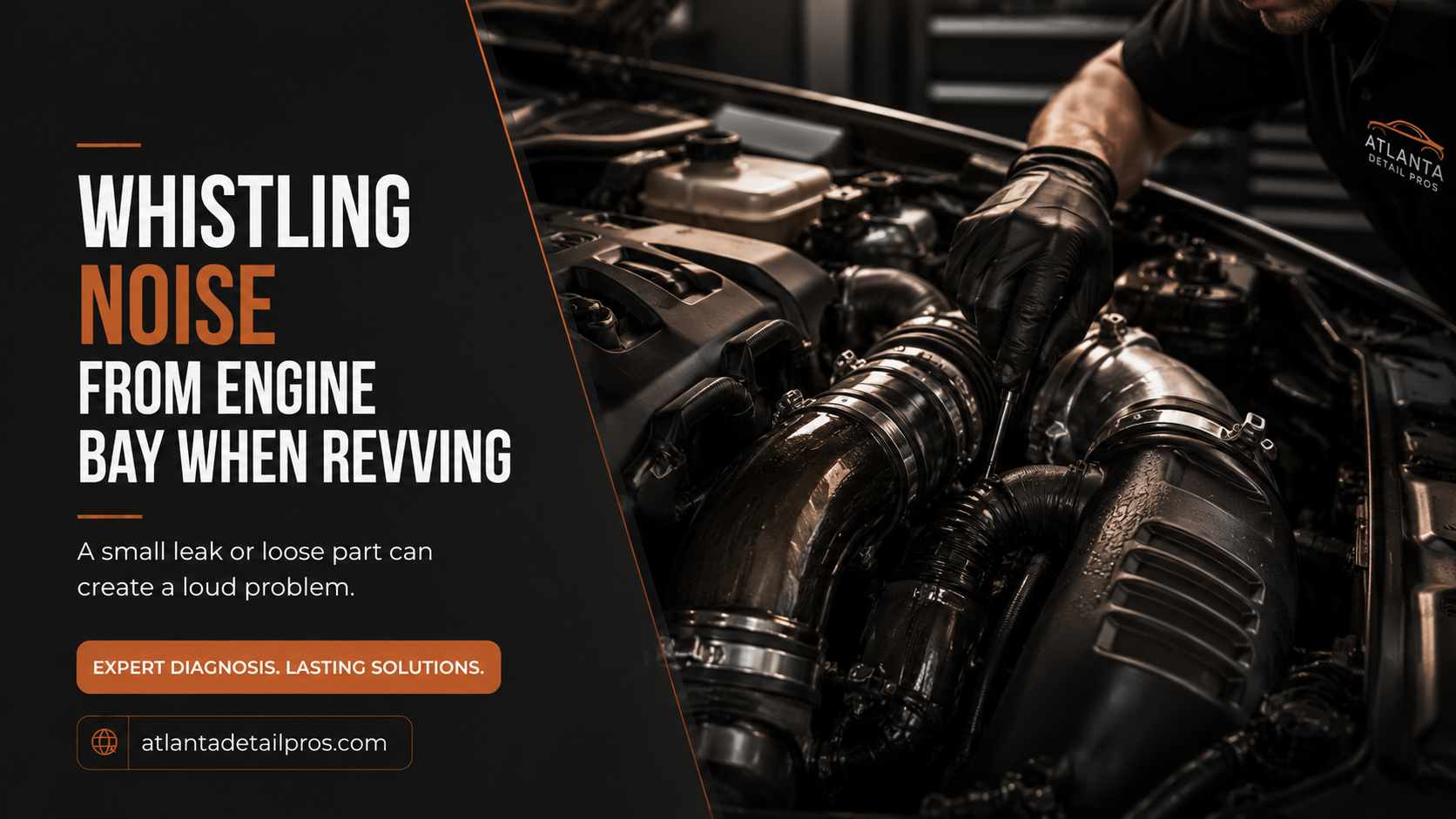
You give the engine a little rev and there it is: a high-pitched whistle that climbs in pitch as the RPMs climb and drops back when you let off. It sounds like air escaping through a tiny hole. Or maybe it is more metallic, like something spinning that should not be. Either way, it was not there before and now it is all you can hear.
A whistling noise that rises and falls with engine speed almost always belongs to one of two categories: air escaping from a sealed system at a pressure that varies with RPM, or a mechanical bearing spinning fast enough to produce a tone. Those two categories have completely different repairs, and the diagnostic tests to separate them take about 15 minutes with tools most people already own.
This guide walks through every realistic cause, how to tell them apart without guessing, and what happens to the engine if the whistle gets ignored.
Air vs. Mechanical: How to Tell Which Category Your Whistle Is In
Before running any test, you can narrow the field with two observations:
It sounds musical or tone-like, like a flute or a tea kettle: Air is escaping through a small opening. The whistle changes pitch smoothly as RPMs change because the pressure differential across the opening changes with engine speed. This is an air or vacuum leak, or a boost leak on turbocharged vehicles.
It sounds metallic, grinding, or has a harsh quality underneath the whistle: A bearing is failing. As engine RPM rises, the bearing spins faster, the damaged rolling elements contact the race more frequently, and the noise increases. This is an idler pulley, tensioner, alternator, water pump bearing, or power steering pump.
The other key observation: does the noise happen only when physically revving the engine in park, or does it also change when the steering wheel is turned? A noise that changes with steering input almost always involves the power steering pump or its pulley, not a vacuum leak. Keep that distinction in mind as you go through the causes below.
Vacuum or Intake Air Leak: The Most Frequent Cause
The engine creates strong suction to pull air into the cylinders with every intake stroke. All of that air is supposed to enter through a sealed path: air filter, intake boot, mass airflow sensor, throttle body, intake manifold, and into the cylinders. Any crack, loose clamp, or failed gasket anywhere in that path creates a small orifice. Air rushes through that orifice at high velocity and produces a tone, exactly like blowing across the top of a bottle.
The whistle changes pitch with RPMs because engine vacuum increases as you rev, which increases the pressure differential across the opening and changes the airflow velocity through it. At idle the whistle may be faint. At 3,000 RPM it becomes clearly audible.
The most common locations for intake and vacuum leaks that produce this whistle:
- The large rubber or plastic intake boot between the air filter housing and the throttle body. Cracks often form in the accordion folds or on the underside where the boot contacts other components.
- Vacuum hose connections at the intake manifold, throttle body, brake booster, PCV valve, and MAP sensor. Rubber hardens and cracks at the fitting connection points.
- The intake manifold gasket, particularly on higher-mileage V6 and V8 engines where the gasket seal between the manifold and the cylinder head degrades.
- The throttle body gasket or O-ring where the throttle body mounts to the intake manifold.
LEFT UNTREATED: An intake air leak allows unmetered air into the engine after the mass airflow sensor. The computer does not account for this air, the mixture runs lean, and the oxygen sensors detect the imbalance. The check engine light will eventually illuminate with a P0171 or P0174 lean code. Extended lean operation causes rough idle, hesitation, and over time can cause engine wear.
Worn Serpentine Belt Idler or Tensioner Bearings
The serpentine belt wraps around every accessory on the engine: alternator, water pump, power steering pump, and air conditioning compressor. To route the belt around all those pulleys, the engine uses smooth metal idler pulleys and a spring-loaded tensioner pulley. Each of those pulleys contains a sealed bearing.
When the bearing grease dries out or the bearing races wear, the rolling elements inside start contacting the damaged surface with each revolution. At low RPM the noise is faint. As engine speed rises, the pulley spins faster, contact frequency increases, and the whistle or whine becomes pronounced. At high RPM the noise can shift from a whistle to a grinding or roaring tone as the bearing damage progresses.
A failing idler or tensioner bearing can also cause visible belt tracking issues. If the belt is not riding centered on all pulleys, or if the tensioner arm is vibrating rather than sitting steady, those are secondary signs that the bearing system is compromised. A bearing that seizes completely will stop the pulley from spinning, which means the belt will shred and you will lose all accessory function immediately.
Alternator Diode Failure: The Electrical Noise That Sounds Mechanical
Inside the alternator, a set of diodes converts AC current generated by the spinning rotor into DC current the car can use. When one or more of those diodes fail, the alternator produces an uneven, rippling electrical output. That ripple creates an electromagnetic whine that exits through the alternator casing and sounds remarkably like a mechanical bearing noise.
The reason it tracks engine RPM so precisely: the alternator spins at a ratio to the crankshaft, and a failing diode produces a tone proportional to its rotational speed. The faster the engine turns, the faster the alternator spins, and the higher the pitch of the electrical whine.
Two signs distinguish alternator diode failure from a bearing noise. First, the alternator casing will be unusually hot to the touch after a drive, because a diode fault causes the alternator to work inefficiently and generate excess heat. Second, the battery will slowly drain over time or overnight, because a failed diode allows current to flow backward through the charging circuit and slowly discharge the battery when the car is parked.
Turbocharger Boost Leak (Turbocharged Vehicles Only)
If your vehicle has a turbocharger, a whistling, screeching, or whooshing sound under hard acceleration points directly to pressurized air escaping the intake plumbing. The turbocharger compresses intake air before it reaches the engine. That compressed air travels through rubber charge pipes and silicone couplers held in place with hose clamps. When a clamp loosens or a coupler splits, the pressurized air blasts out of the gap under boost.
Boost leak noise is distinct from vacuum leak noise in two ways. It only appears under hard acceleration when the turbocharger is actually building pressure. At idle or light throttle, when the turbo is not boosting, the noise may disappear entirely. It is also typically louder and more sudden than a vacuum whistle, because boost pressure is much higher than manifold vacuum. The engine may also feel noticeably down on power at full throttle because the escaping air is reducing the effective boost reaching the cylinders.
Other Sources Worth Ruling Out
Power steering pump: A hydraulic power steering pump that is low on fluid, has air in the system, or has a failing bearing can produce a whistle or whine that increases with engine RPM. The distinguishing characteristic is that the noise changes when you turn the steering wheel. If the whistle gets louder when you turn the wheel toward lock, check the power steering fluid level first. Foamy or low fluid in the reservoir confirms air in the system.
Water pump bearing or shaft seal: The water pump contains a bearing that spins with the engine. A failing water pump bearing produces a rumble or whine that increases with RPM, and the noise sometimes changes when you squeeze the upper radiator hose. A leaking shaft seal leaves coolant residue on the front of the engine block near the pump and may produce a higher-pitched whine as coolant escapes under pressure past the seal.
Use the quick-reference table below to match the character of your whistle to the most likely cause before starting the diagnostic tests.
Cause | Sound Character | Gets Louder When… | Key Confirming Sign |
|---|---|---|---|
Vacuum or intake air leak | Musical whistle or hiss | Revving in park or driving | Engine idle stumbles when spray hits the leak spot |
Worn idler or tensioner bearing | High-pitched metallic whine or squeal | RPMs increase | Screwdriver stethoscope transmits harsh grinding through the handle |
Alternator diode failure | Electrical whine that tracks RPM precisely | Engine RPMs increase and electrical load rises | Alternator casing hot to touch; battery slowly draining overnight |
Turbo boost leak (turbo vehicles) | Screeching or whoosh under hard acceleration | Boost builds under hard acceleration | Power loss at full throttle; only audible when boosting hard |
Power steering pump or low PS fluid | Whine or whistle that changes with steering input | Revving with wheels turned or steering at lock | Foamy or low fluid in reservoir; noise changes when turning steering wheel |
Water pump bearing or shaft seal | Higher-pitched whine, often at warm idle | Engine speed increases | Coolant residue near pump; squeezing upper radiator hose changes the noise |
Engine Bay Whistle During Revving Tests
Test 1: Visual Intake Inspection (Engine Off, Hood Up)
Start here before running the engine for any test. Many intake leaks are visible on close inspection.
1. Locate the large plastic or rubber intake boot running from the air filter housing to the throttle body. Flex the corrugated sections firmly with both hands and look for cracks that only open under pressure. Splits on the underside of the boot are especially common and easy to miss from above.
2. Check both hose clamps at each end of the intake boot. They should be tight. A clamp that has loosened even slightly will allow air to whistle past the connection under vacuum.
3. Trace every small rubber vacuum hose from its source at the intake manifold or throttle body to its destination. Look for hoses that have popped off a nipple entirely, cracks in the rubber near connection points, and any hose that has kinked or collapsed.
4. Look for white or powdery residue around the intake manifold flanges where it meets the cylinder head. This mineral residue from evaporated coolant or oil deposits indicates a leaking gasket surface.
Test 2: The Water Spray Belt Isolation Test (Engine Running)
SAFETY: This test is performed with the engine running. Keep your hands, hair, and clothing completely clear of all spinning pulleys and belts. Never reach across a rotating belt. Stand to the side of the engine, not directly in front.
Start the engine and let it idle in park with the parking brake set. Have an assistant gently rev the engine while you observe the serpentine belt area from a safe position to the side.
Carefully spray a small mist of water from a spray bottle directly onto the ribbed side of the spinning serpentine belt.
- Noise changes, pitch shifts, or disappears immediately when the belt gets wet: the issue is a misaligned belt, a slipping belt, or a worn pulley affecting belt contact. Focus the screwdriver stethoscope test on each pulley.
- Noise does not change at all when the belt gets wet: the belt itself is not the source. The noise is most likely an air or vacuum leak rather than a belt accessory problem.
Test 3: The Screwdriver Stethoscope Test for Bearings (Engine Running)
SAFETY: Keep the screwdriver shaft clear of all spinning components. Touch only the static metal center bolt or bracket housing of each pulley, never the spinning outer ring or the belt. Keep fingers well clear.
This test isolates which specific pulley bearing is producing the noise without needing a professional stethoscope.
Take a long, heavy-duty screwdriver. With the engine idling, touch the metal tip firmly against the non-spinning metal center bolt or bracket of the alternator, then the tensioner pulley bracket, then each idler pulley bracket. After placing the tip on each component, press your ear firmly against the plastic handle of the screwdriver.
- A healthy pulley produces a smooth, quiet hum or vibration through the handle.
- A failing bearing transmits a loud, harsh, grinding, or rough vibration that is clearly different from the others. That component is your noise source.
Work through each pulley systematically and compare what you feel through the handle. The difference between a healthy pulley and a failing one is usually unmistakable once you have a comparison.
Test 4: The Aerosol Spray Test for Vacuum Leaks (Engine Idling)
FIRE RISK: Brake cleaner and electronic parts cleaner are combustible. Use only short, precise bursts. Keep the can away from the hot exhaust manifold, catalytic converter, and any open flame or ignition source. Keep a fire extinguisher accessible. Never spray near the exhaust side of the engine.
This test is performed with the engine idling. The principle: if you spray a combustible aerosol onto a vacuum leak, the engine vacuum pulls it into the intake. The engine briefly runs on the additional fuel, causing the idle to stumble, drop, or momentarily smooth.
Spray very short, precise one-second bursts around the following locations, one at a time:
- The seam where the intake manifold bolts to the engine block at each runner.
- The base of the throttle body where it meets the intake manifold.
- Along every small rubber vacuum hose at both connection ends.
- The brake booster vacuum hose connection at the intake manifold.
After each spray, immediately watch and listen to the idle RPM.
- Idle stumbles, drops suddenly, or briefly changes: the spray entered through a vacuum leak at that exact location. Mark it and continue checking all other points to find every leak before repairing.
- Idle does not change: no leak at that location. Move to the next point.
If all points come back clean and the belt test also showed no belt-related noise, the alternator is the next component to test. Have a shop perform a diode ripple test on the charging system, a five-minute electrical test that definitively confirms or rules out a failing diode.
What Happens If You Leave the Whistle Alone
Vacuum or intake leak: The check engine light appears with P0171 or P0174 lean codes. The idle becomes rough and fuel economy drops. Extended lean operation increases combustion temperature and causes long-term engine wear. The leak rarely seals itself and will grow larger over time as the rubber continues to crack or the gasket deteriorates further.
Failing idler or tensioner bearing: The bearing eventually seizes completely. When it seizes, the pulley locks up and the spinning serpentine belt shreds against the frozen pulley within seconds. A shredded serpentine belt leaves you without alternator charging, power steering, and in many cases water pump function. On engines where the water pump is driven by the serpentine belt, a sudden belt failure can cause rapid overheating. The repair goes from a $60 pulley to a belt, a pulley, and potentially a coolant service.
Alternator diode failure: The alternator runs hot enough to damage its own windings and can cause the battery to drain slowly overnight. Eventual complete alternator failure leaves the vehicle unable to charge the battery, causing a no-start within one to two days of continued driving.
None of these situations improve on their own. The part of the repair that is inexpensive today becomes more expensive the longer the underlying failure is allowed to progress.
Frequently Asked Questions
What causes a whistling noise from the engine when revving?
The two main categories are air escaping a sealed system and a mechanical bearing spinning under load. Vacuum or intake air leaks, turbo boost leaks on turbocharged vehicles, and failing serpentine belt idler or tensioner bearings are the most common causes. Alternator diode failure and water pump shaft seal leaks can also produce a whistling or whining tone that rises with engine RPM.
How do I tell if the whistle is a vacuum leak or a belt bearing?
Spray a small mist of water onto the spinning serpentine belt with the engine running. If the noise changes or disappears when the belt gets wet, the source is in the belt or pulley system. If the noise does not change at all, it is more likely a vacuum or air leak. Confirm the vacuum leak using the aerosol spray test around intake manifold seams and vacuum hose connections while the engine idles.
Why does my engine whistle when I rev it but not at idle?
Vacuum in the intake system is highest at idle and actually decreases slightly during heavy revving. A whistle that appears specifically when revving is more often associated with a bearing noise or a boost leak on turbocharged vehicles, because those noises increase directly with rotational speed and boost pressure. A vacuum leak whistle is usually most audible at idle or light throttle and may actually reduce at high RPM. If the whistle is absent at idle and only appears during revving, start by checking the belt pulleys with the screwdriver stethoscope test.
Is a whistling engine noise dangerous to drive with?
It depends on the cause. A small vacuum hose whistle is not immediately dangerous but will cause lean codes and rough idle over time. A failing idler or tensioner bearing is more urgent because a seized bearing can destroy the serpentine belt without warning, leaving you without power steering and alternator function while driving. If the screwdriver test reveals a harsh bearing noise, treat it as a near-term repair priority rather than something to monitor indefinitely.
How much does it cost to fix a whistling noise from the engine bay?
A vacuum hose replacement is $15 to $50 in parts and minimal labor if you replace it yourself. An idler pulley or tensioner bearing replacement runs $60 to $150 in parts; with labor at an independent shop, expect $120 to $280 for the pulley plus a new serpentine belt since the system is already disassembled. Alternator replacement (if the diode failure is confirmed) typically costs $250 to $550 at an independent shop including the new unit and installation. A boost pipe or coupler on a turbocharged vehicle is $20 to $80 in parts and straightforward to replace at home on most platforms.
Can a whistling noise from the engine cause a check engine light?
Yes, if the cause is a vacuum or intake air leak. The unmetered air entering the engine after the mass airflow sensor causes the fuel trims to go positive as the computer adds fuel to compensate. When the lean condition exceeds the correction threshold, the ECU stores a P0171 (system too lean, Bank 1) or P0174 (system too lean, Bank 2) code and illuminates the check engine light. Fixing the leak and clearing the code resolves it. A bearing noise or alternator diode issue will not directly cause a check engine light.
The Bottom Line
A whistling noise from the engine bay that tracks with RPMs is one of the more diagnosable problems a car produces, because the tests to isolate it are fast, logical, and require minimal tools. Air noises and bearing noises behave differently, respond differently to simple spray tests, and point to completely separate systems.
Start with the visual inspection of the intake boot and vacuum hoses with the engine off. Then spray the belt with water while the engine runs. If the noise does not change, move to the aerosol spray test around the intake manifold. If the noise does change with belt wetting, use the screwdriver stethoscope to isolate which pulley is failing.
Most of these repairs are inexpensive when caught at the noise stage. A failed idler bearing that gets ignored long enough to shred the belt is the one that turns a small job into an emergency. If the screwdriver test shows a harsh bearing noise at any pulley, schedule that repair before it decides the timing on your behalf.