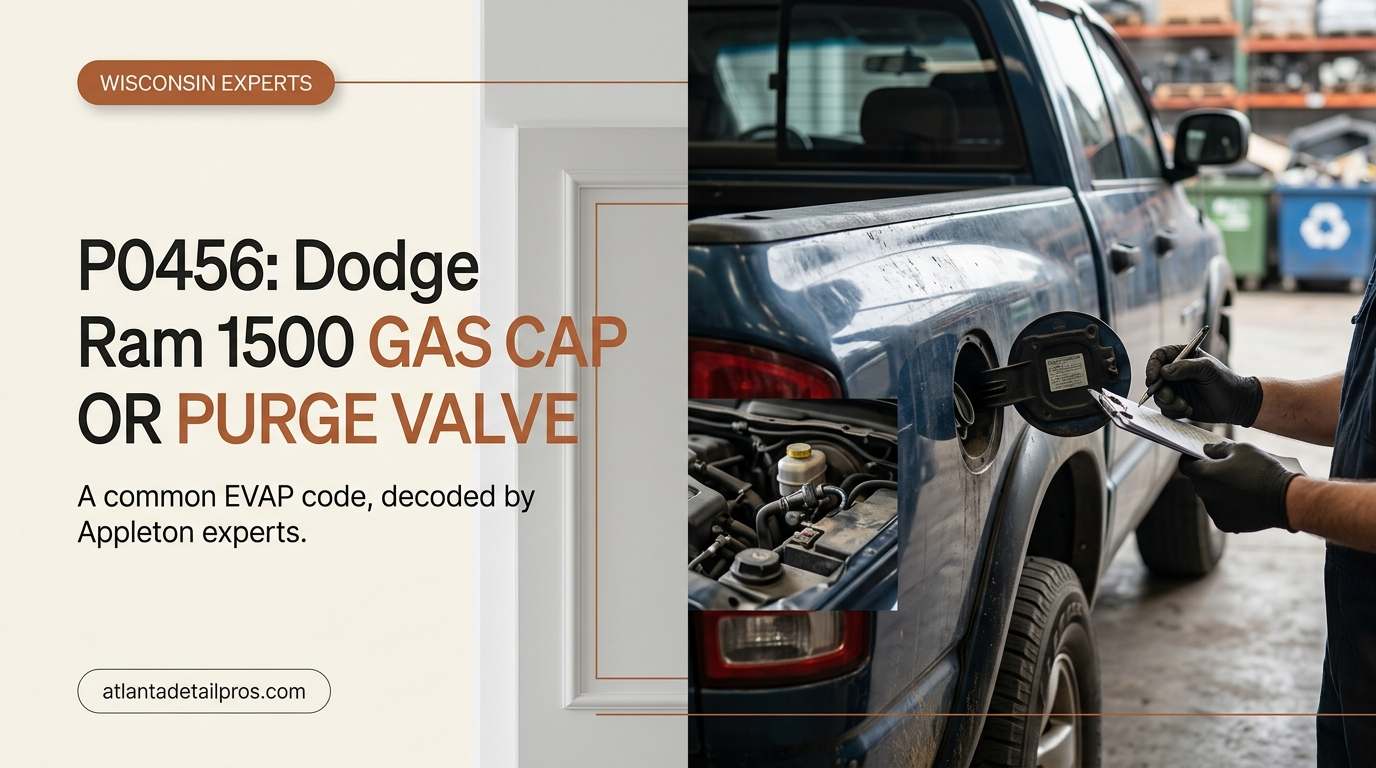
Your Ram 1500 threw a P0456, and now you are staring at that check engine light wondering whether a $15 gas cap will fix it or whether you are in for a bigger repair. The answer: it might be the gas cap, it might be the purge valve, or it might be something else entirely. But there is a logical way to figure out which one before spending anything.
P0456 means “evaporative emission system leak detected: very small leak.” Your truck’s EVAP system is a sealed network that captures fuel vapors from the gas tank and routes them into the engine to be burned. When the ECM runs its pressure self-test and detects a pressure drop, it stores P0456. The leak is tiny by definition, which is both good news (not a big problem) and bad news (tiny leaks are harder to find). Let us work through this systematically.
Start Here: The Free Fixes That Resolve P0456 Most Often
Before spending a dollar on parts or a diagnostic fee, two things are worth checking right now. The first is your gas cap. The second is whether you forgot to tighten it after your last fill-up. This sounds too simple, but a loose or improperly seated gas cap is the single most common cause of EVAP codes including P0456 on the Ram 1500.
Check the Gas Cap First
Remove your gas cap and look at the rubber O-ring seal on the underside. It should be soft, pliable, and free of cracks or debris. If it looks flat, hard, or cracked, the seal cannot form an airtight connection with the filler neck, and the EVAP system will fail its pressure test every time. Reinstall the cap and turn it until it clicks three to five times.
Use only an OEM Mopar gas cap on your Ram. Aftermarket caps are a well-documented cause of repeat EVAP codes on Ram trucks because many do not seal or vent correctly for the Chrysler EVAP system design. An OEM cap costs $25 to $35 from a dealer or online parts retailer. After installing a new cap, clear the code with your scanner and drive for two complete drive cycles (each including a cold start, highway driving, and an idle period). If P0456 does not return, the cap was your fix.
If the Cap Is Good: The Purge Valve Becomes the Next Suspect
The EVAP purge valve (also called the purge solenoid) controls when stored fuel vapors are drawn from the charcoal canister into the intake manifold to be burned. It is normally closed and opens only when the ECM commands it to. On the Ram 1500, particularly on the 5.7L HEMI and the 3.6L Pentastar, a purge valve that is stuck slightly open acts as a constant small leak in the EVAP system, causing P0456 code every time the EVAP self-test runs.
How to Test the Purge Valve at Home
Locate the purge valve. On most Ram 1500 models it sits near the intake manifold or on the firewall side of the engine bay, connected to a small vacuum or vapor hose on each side and a two-wire electrical connector. Disconnect the two vapor hoses. With the connector unplugged and the valve at rest (unpowered), blow through one port of the valve. A healthy, normally-closed purge valve should not allow air through when it is not energized. If you can blow through it freely, the valve is stuck open and needs replacement. A purge valve for the Ram typically costs $30 to $60 and is a 15-minute swap.
What a Stuck-Open Purge Valve Does Beyond Causing P0456
Beyond the check engine light, a purge valve that is stuck open also creates a vacuum leak into the intake manifold. This can cause rough idle, a slightly lean condition (potentially P0171 alongside P0456), and poor fuel economy. If your Ram has been idling rough and you have P0456, the purge valve is worth checking even before doing the gas cap swap.
Other Causes of P0456 on the Ram 1500 Worth Knowing
If the cap and purge valve check out fine, the EVAP system needs a smoke test to find the source of the very small leak P0456 detected. The leak is defined as between 0.010 and 0.040 inches in diameter: small enough that it is invisible to the naked eye in most cases. A smoke machine forces low-pressure smoke into the sealed EVAP system and you watch for smoke seeping out at any point.
Charcoal Canister
The charcoal canister, which stores fuel vapors until the purge valve opens, can crack or develop small holes from road debris impacts. It is located under the truck near the fuel tank on most Ram 1500 configurations. A smoke test will reveal smoke pouring from a cracked canister almost immediately.
EVAP Vent Valve
The vent valve sits near the canister and allows fresh air into the EVAP system during the refueling process. A vent valve that cannot close fully during the EVAP pressure test causes pressure to bleed off even though there is no physical leak. Testing the vent valve requires commanding it closed with a scan tool and observing whether system pressure holds.
EVAP Hoses and Filler Neck
The plastic and rubber hoses connecting the fuel tank, canister, and purge valve can crack from age or heat cycling. On Ram trucks in northern states with road salt exposure, the fuel filler neck can also develop pinhole rust leaks similar to what Subaru Foresters experience. A smoke test reveals these hairline cracks that visual inspection misses entirely.
Check In This Order | How to Test | Cost to Fix | Likelihood |
|---|---|---|---|
Gas cap seal | Inspect O-ring; reinstall correctly; clear code | $25-$35 OEM cap | Very common first cause |
Purge valve stuck open | Disconnect hoses; blow-through test when unpowered | $30-$60 part | Second most common |
Vent valve not closing | Command closed with scan tool; watch pressure hold | $30-$80 | Moderate |
Cracked EVAP hose | Smoke test; visual around canister area | $20-$60 hose | Moderate on high-mileage trucks |
Charcoal canister crack | Smoke test shows canister leak clearly | $80-$200 canister | Less common |
Frequently Asked Questions
Can I drive my Ram 1500 with a P0456 code?
Yes. P0456 does not affect engine performance, fuel delivery, or any safety system. The truck drives and runs normally with this code stored. The practical consequence is a failed OBD-II emissions test if your state requires one, since the check engine light will be on. Fix it within a few weeks rather than ignoring it indefinitely, but there is no urgency from a mechanical safety perspective.
What is the difference between P0456 and P0457 on a Ram?
P0456 is a very small EVAP leak detected. P0457 specifically indicates the gas cap is loose or off. P0440 is a general EVAP malfunction. P0455 is a large leak. If you get P0457, the gas cap is almost certainly your fix. If you get P0456, the gas cap may or may not be the cause, and the leak could be from a different component in the EVAP system.
How do I know if my Ram needs a smoke test for P0456?
If you have replaced the gas cap with OEM, tested the purge valve, and the code returns after two or three drive cycles, you need a smoke test. The very small leak P0456 detects is too small to find reliably without smoke. Most shops charge $75 to $150 for an EVAP smoke test as a diagnostic service.
The Bottom Line
P0456 on the Ram 1500 starts with a $15 gas cap check and a $60 purge valve test. That combination resolves the majority of cases. If both check out fine, smoke test the EVAP system before buying any other parts. The EVAP system on the Ram has multiple components that can cause this code, and guessing on replacements without confirming the leak location is how a $35 repair turns into a $400 one.