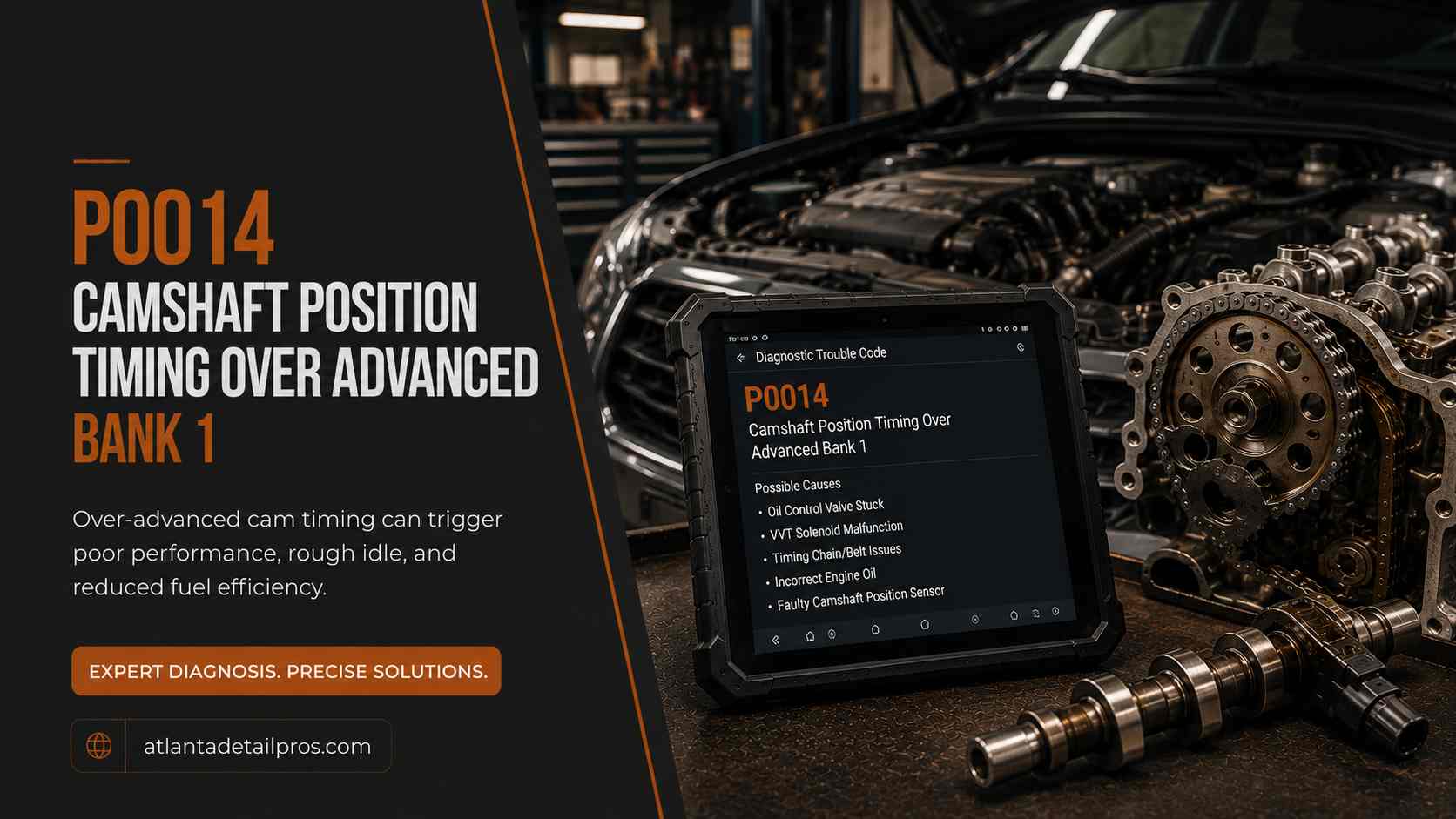
P0014 is one of those codes that looks intimidating on a scan tool but usually has a simple starting point. Before you start thinking about cam phasers and timing chains, check your engine oil. Right now. A significant percentage of P0014 codes are resolved by an oil change, and starting with oil is the correct diagnostic approach because the VVT system that this code monitors runs entirely on oil pressure.
P0014 stands for “Camshaft Position B, Timing Over-Advanced, Bank 1.” Position B typically refers to the exhaust camshaft (some manufacturers use A for intake and B for exhaust, though this varies). Bank 1 is the side of the engine that contains cylinder number 1. The code means the ECM has commanded the exhaust camshaft on that side to a specific timing position, but the cam has moved further in the advance direction than commanded, or the ECM cannot bring it back when it tries to retard timing.
What P0014 Is Telling You About Your Variable Valve Timing System
Modern engines use variable valve timing (VVT) to optimize performance and fuel economy by adjusting the camshaft position in real time. The system uses engine oil pressure, directed by an oil control valve (OCV, also called a VVT solenoid), to hydraulically rotate the cam phaser, a mechanism attached to the camshaft that changes its rotational timing relative to the crankshaft.
When P0014 is stored, the ECM found the exhaust camshaft in an over-advanced position and could not retard it back to where it wanted it. The exhaust valves are opening too early. This disrupts combustion efficiency, causes increased exhaust emissions, and can result in rough idle, poor fuel economy, hard starting, and engine hesitation. Left unaddressed, a stuck cam phaser or ongoing VVT system failure can cause the timing to jump out of synchronization during operation, which is a much more serious mechanical event.
P0014 differs from P0011 in a critical way. P0011 refers to the intake camshaft (Position A) on Bank 1 being over-advanced. P0014 refers to the exhaust camshaft (Position B) on Bank 1 being over-advanced. Both involve the VVT system but affect different camshafts with different consequences for combustion behavior. Confirm which code you have before proceeding with any repair.
Problem 1: Low or Dirty Engine Oil
This is where the diagnosis always starts, and it is where many P0014 cases end. The VVT system uses oil pressure to move the cam phaser. When oil is low, dirty, or the wrong viscosity, the system cannot generate the hydraulic pressure needed to control camshaft position accurately. The cam can drift into the advanced position and the OCV may not have enough pressure to retard it, which is exactly the condition P0014 describes.
Step 1: Check Oil Level and Condition
Pull the dipstick with the engine off and cold or fully warmed but not recently driven hard. The oil level should sit between the MIN and MAX marks. Look at the oil on the dipstick. Fresh oil is amber or golden. Oil past its service life is dark brown to black, smells burnt, and may have a gritty texture from accumulated combustion byproducts. Oil that has developed sludge from neglected changes appears almost tar-like in consistency.
Step 2: Perform an Oil and Filter Change
If the oil level is low, the color is dark, or the last oil change is unknown, do a full oil and filter change immediately using the correct specification for your engine. The oil viscosity specification matters specifically for VVT systems. Many engines that produce P0014 call for 0W-20 or 5W-30 synthetic. Using 10W-30 or a heavier conventional oil can reduce the speed and responsiveness of the VVT system, particularly in cold conditions. After the oil change, clear the P0014 code and drive through two complete drive cycles with highway and city conditions before evaluating whether the code returns.
If the code clears and does not return after two to three drive cycles with fresh oil, the oil condition was the cause. Monitor it going forward and do not allow extended service intervals.
Problem 2: Failed Oil Control Valve (VVT Solenoid)
If the oil is fresh and at the correct level but P0014 persists, the Oil Control Valve is the next most common cause. The OCV directs oil flow into the cam phaser to advance or retard the camshaft position on command from the ECM. When the OCV fails mechanically (stuck spool valve), electrically (coil failure), or by contamination (debris blocking the spool), it cannot control the cam phaser correctly.
Step 1: Locate and Inspect the OCV for Bank 1 Exhaust
The OCV for the Bank 1 exhaust camshaft is typically mounted on the cylinder head or timing cover near the exhaust camshaft. It has one electrical connector and is threaded into the engine with a hex bolt. The exact location varies by engine. On GM Ecotec engines (common in Malibu, Equinox, Traverse), the OCV is at the top of the cylinder head. On Toyota engines, it sits in the valve cover area. Consult your service manual for the precise location.
Step 2: Test the OCV Coil Resistance
Disconnect the OCV electrical connector. Set your multimeter to Ohms. Probe the two terminals of the OCV solenoid. Most OCV solenoids read between 5 and 15 ohms. An OL reading (open circuit) confirms the coil has burned out. A reading near zero indicates an internal short. Either confirms electrical failure requiring OCV replacement. A within-range resistance reading means the coil is electrically intact, but the spool valve inside may still be mechanically stuck.
Step 3: Clean the OCV Filter Screen
Remove the OCV completely. At the oil inlet end of the valve body (the end that threads into the engine) there is a small mesh filter screen. This screen collects oil debris and becomes restricted over time, particularly on engines with sludgy oil history. Remove the screen carefully with a pick or small screwdriver. Clean it thoroughly with clean engine oil and a soft brush, or replace it with a new screen if available. Reinstall the screen and OCV, clear the code, and test.
Step 4: Replace the OCV if Cleaning Fails
If the screen was clean, the resistance was correct, but P0014 persists after reinstalling the OCV, the internal spool valve is either stuck or worn. OCV replacement is the correct repair. Use an OEM or OEM-equivalent part. The OCV for most applications costs $40 to $120. Labor to replace it is typically minimal (15 to 30 minutes) because of its accessible location. Always replace the O-ring seal on the new OCV before installation.
Problem 3: Seized or Stuck Cam Phaser
If the oil is fresh, the OCV has been tested and replaced, and P0014 continues to return, the cam phaser itself may be mechanically seized or worn. The cam phaser is the hydraulic actuator on the end of the camshaft that physically changes timing position. When the phaser’s internal vanes wear, seize from contamination, or lose their sealing ability, it cannot hold or change position accurately regardless of how much OCV pressure is applied.
Step 1: Diagnose a Stuck Cam Phaser with Live Data
Using a scan tool with live data, watch the actual versus desired exhaust camshaft timing angle for Bank 1. The ECM will show both what it is commanding and what the cam sensor is reporting. A healthy VVT system shows the actual timing closely following the desired timing as the ECM adjusts. A stuck phaser shows the actual timing drifting to or stuck at a specific advanced angle regardless of ECM commands. If the actual angle is consistently more advanced than commanded and does not change when the ECM changes its target, the phaser is mechanically stuck.
Cam phaser replacement requires partial engine disassembly, specifically the timing cover and chain, to access the phaser on the camshaft end. This is a significant repair costing $500 to $1,200 at most independent shops. It is not a DIY job for most owners without engine rebuild experience.
Problem 4: Stretched or Jumped Timing Chain
In serious or long-neglected cases, P0014 may indicate that the timing chain has stretched enough to allow the camshaft position to drift out of its correct relationship with the crankshaft. A stretched timing chain is most common on high-mileage engines that have experienced extended oil change intervals, and on certain engine platforms known for timing chain tensioner wear. This is the most expensive diagnosis on this list.
Step 1: Listen for Timing Chain Noise and Check for Related Codes
A stretched timing chain often produces a rattling noise from the front of the engine on cold startup, before oil pressure builds and the chain tensioner tightens. The noise may be brief or sustained. Also check for related codes alongside P0014: codes from the crankshaft position sensor, additional camshaft position codes, or multiple VVT codes on both banks can indicate a timing system problem rather than a single-component failure.
Step 2: Have a Timing Chain Inspection Performed
Confirming timing chain stretch requires removing the valve cover and timing cover to measure chain slack directly. A mechanic can also use a dial indicator on the camshaft to measure actual position against a known crankshaft reference. Timing chain replacement, tensioner replacement, and guide replacement together is a major repair costing $800 to $2,500 depending on the engine and access difficulty. However, catching a stretched timing chain at the P0014 code stage is far better than ignoring it until the chain jumps, which can cause valve and piston contact on interference-design engines.
IMPORTANT: If you hear a rattling sound from the front of the engine on cold starts and you have P0014, do not delay a timing chain inspection. A timing chain that jumps on an interference engine can destroy the engine in seconds. The rattle-plus-P0014 combination is the signal to stop driving and arrange a professional inspection.
Problem | Confirming Sign | Fix | Cost Estimate |
|---|---|---|---|
Low/dirty engine oil | Oil below MIN, dark color, burnt smell | Full oil and filter change with correct spec | $50-$100 |
Clogged OCV filter screen | Debris on screen after OCV removal | Clean or replace screen; reinstall OCV | Free to $20 |
Failed OCV (VVT solenoid) | Resistance OL or zero; or stuck spool valve | Replace OCV with OEM or equivalent part | $40-$120 part + labor |
Seized cam phaser | Actual cam angle stuck advanced on live data | Cam phaser replacement (engine partial disassembly) | $500-$1,200 shop |
Stretched timing chain | Cold start chain rattle; multiple cam/crank codes | Timing chain kit replacement | $800-$2,500 shop |
Frequently Asked Questions
What does P0014 mean?
P0014 means the exhaust camshaft (Position B) on Bank 1 is more advanced than the ECM commanded, or cannot be retarded back to the commanded position. The Variable Valve Timing system controls camshaft position using oil pressure, so P0014 is most commonly caused by low or dirty engine oil, a clogged or failed oil control valve, a seized cam phaser, or on severely neglected engines, a stretched timing chain.
Can I drive with P0014?
For very short distances with fresh oil and no additional symptoms, cautiously. But P0014 should not be ignored for weeks. An over-advanced exhaust cam affects emissions, fuel economy, and engine performance. If P0014 is accompanied by a cold-start rattling noise, rough idle, or hard starting, limit driving to getting the vehicle to a shop. A rattling noise with P0014 suggests timing chain involvement, which requires prompt professional inspection.
What is the difference between P0011 and P0014?
P0011 refers to the intake camshaft (Position A) on Bank 1 being over-advanced. P0014 refers to the exhaust camshaft (Position B) on Bank 1 being over-advanced. Both involve the VVT system and have overlapping causes, but they affect different camshafts and require confirming which OCV corresponds to the affected camshaft before replacing any parts.
Will an oil change fix P0014?
Frequently, yes. The VVT system operates on oil pressure, and degraded, thick, or low oil can prevent the OCV from controlling the cam phaser effectively. Fresh oil with the correct viscosity specification restores proper hydraulic response. If the oil was dark and the code appeared around a service interval, do the oil change first and clear the code. Many P0014 cases end there.
The Bottom Line
P0014 follows a clear diagnostic escalation from cheapest to most expensive. Oil change first: it costs $50 and resolves a significant share of cases. OCV screen cleaning and OCV replacement next: $40 to $120 in parts and minimal labor. Cam phaser inspection if the live data confirms a stuck phaser. Timing chain inspection if a cold-start rattle is present. Work through the steps in order and you avoid the common mistake of replacing expensive mechanical components when an oil change was the actual fix.