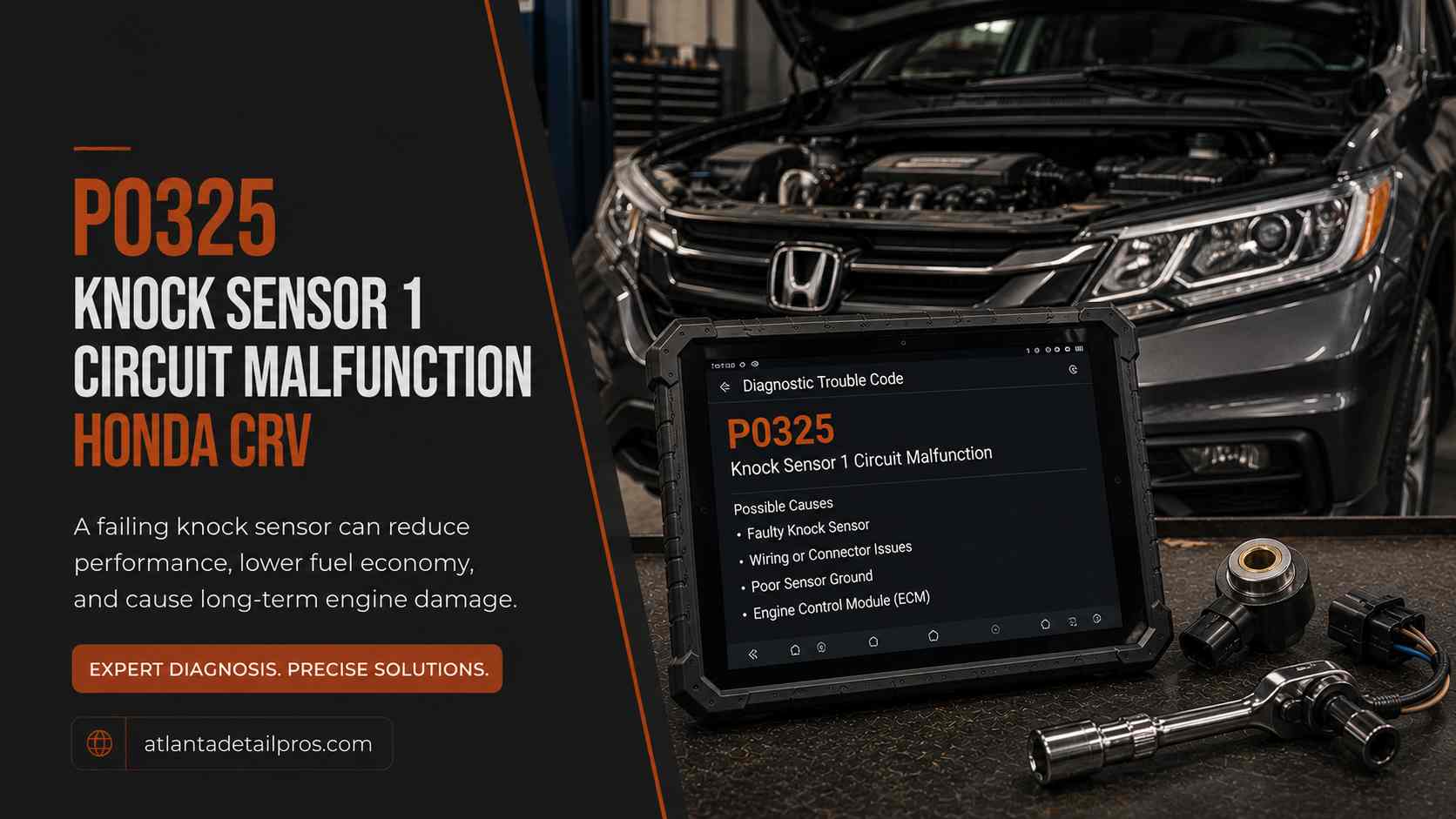
Your Honda CR-V has P0325, and the first thing to understand is that this code does not mean your engine is actually knocking right now. It means the PCM has detected a fault in the knock sensor circuit and can no longer receive the signal it needs to detect knocking if it did occur. Those are two different things, and that distinction matters for how urgently you need to respond.
P0325 is extremely common on Honda CR-V models equipped with the 2.4L K24 four-cylinder engine, and it has a well-documented pattern of causes. The knock sensor on this engine is located at the rear of the engine block in a heat-exposed area, and both the sensor itself and its wiring are vulnerable to the conditions it lives in. The good news is that most P0325 repairs on the CR-V are straightforward, relatively affordable, and completely DIY-accessible if you are comfortable with basic tools and engine bay work.
What the Knock Sensor Does and What You Lose Without It
The knock sensor is a piezoelectric device that mounts directly to the engine block. It detects the specific vibration frequency of engine knock, also called detonation or pinging, which occurs when the air-fuel mixture in a cylinder ignites prematurely before the spark plug fires. Left unchecked, knock damages pistons, rings, and bearings.
When the PCM receives a knock signal, it immediately retards ignition timing on the affected cylinder to stop the detonation. This protection happens in milliseconds, faster than any driver could respond. With P0325 stored and the knock sensor circuit offline, the PCM can no longer perform this real-time adjustment. As a protective measure, the PCM typically retards timing preemptively across the entire engine, which is why you may notice slightly reduced power and worse fuel economy with this code. The engine runs conservatively to compensate for the missing sensor protection.
The engine will not blow up because of P0325 in normal driving, but the protective system is offline. Driving on low-octane fuel or under heavy load without a functional knock sensor is a genuine risk because the PCM cannot respond to real detonation events.
Problem 1: Faulty Knock Sensor (Most Common Cause)
The K24 knock sensor is a bolt-on component mounted to the rear of the engine block. On the CR-V, it sits in a position that exposes it to significant heat cycling and road spray. Over time the internal piezoelectric element degrades and the sensor loses its ability to produce a reliable signal. Honda K24 knock sensors are known to fail at high mileage, and the failure pattern on this engine is well-documented across owner communities.
Step 1: Test the Knock Sensor Resistance
Disconnect the knock sensor electrical connector. Set your multimeter to Ohms. Probe the two terminals of the sensor itself. Most Honda knock sensors read between 120,000 and 560,000 ohms (120K to 560K) at room temperature. A reading of OL (infinite resistance) confirms an open circuit inside the sensor. A reading near zero indicates an internal short. Either confirms sensor failure.
Some Honda knock sensors are not easily testable for resistance alone, and a functional test requires an oscilloscope to verify the sensor produces a signal voltage when tapped. If you do not have access to an oscilloscope, and the wiring tests clean (see Problem 2 below), replacing the sensor is a reasonable conclusion.
Step 2: Locate and Access the Sensor on the CR-V
On the 2002 to 2006 CR-V with the K24A1 engine and the 2007 to 2011 CR-V with the K24A4 engine, the knock sensor is accessible from underneath the vehicle or from the rear of the engine bay. The sensor mounts to the block below and behind the intake manifold. Depending on the model year, you may need to remove the intake manifold for full access, or the sensor may be reachable with a long extension and universal joint from above or below without manifold removal. Confirm your specific access requirements before starting the job.
Step 3: Replace the Sensor with OEM Honda or Denso
Use an OEM Honda knock sensor (part number 30530-PPL-A01 for many K24 applications) or a Denso equivalent (Denso 550-25001). This is one of those repairs where the quality of the replacement part determines whether you do the job once or twice. Budget aftermarket sensors on Honda applications have a documented pattern of causing P0325 to return shortly after installation because their output characteristics do not precisely match Honda ECM expectations. The OEM sensor costs $100 to $200. Budget aftermarket sensors cost $30 to $60 but carry a meaningful risk of repeat failure.
Torque the sensor to specification, typically 23 Nm (17 ft-lb). Over-tightening can crack the piezoelectric element and cause immediate failure.
Problem 2: Damaged Wiring or Connector
The wiring harness that connects the knock sensor to the PCM on the CR-V passes through areas of the engine bay that are exposed to heat, vibration, and on some model years, rodent activity. Wiring problems are the second most common cause of P0325 on the Honda CR-V and produce the same code as a failed sensor. The connector itself is particularly vulnerable to corrosion from moisture.
Step 1: Inspect the Knock Sensor Connector
Disconnect the knock sensor connector and inspect both sides. Green or white corrosion on the terminal pins prevents reliable electrical contact. Use electronic contact cleaner to clean the terminals. Inspect the rubber seal in the connector: if it is damaged or missing, moisture has been entering the connection and corrosion is likely present even if not visible. A damaged connector pigtail requires repair or replacement.
Step 2: Check the Sub-Harness Integrity
The Honda CR-V has a documented issue with the knock sensor sub-harness, the short section of wiring that leads directly to the sensor. This harness is routed through a tight area near the engine block and can be damaged by heat cycling, vibration, and contact with moving components. Inspect the entire length of the sub-harness from the sensor connector to where it joins the main engine harness. Look for melted insulation, cracking, pinching, or exposed bare wire. If the sub-harness is damaged and the damage is accessible, a direct wire repair with solder and heat shrink is appropriate. If the harness routing prevents a clean repair, a replacement sub-harness assembly is required.
Step 3: Test Wiring Continuity to the PCM
With both the sensor connector and the PCM connector unplugged, use a multimeter in continuity mode to probe from the sensor connector terminal through each wire to its corresponding PCM pin. A healthy wire reads near-zero resistance. An OL reading on any wire confirms a break in that circuit. This test catches broken wires inside intact insulation that are invisible on visual inspection.
Problem 3: Rodent Damage to Wiring
This cause of P0325 on the Honda CR-V is more common than most owners expect. Rodents are attracted to the soy-based wire insulation used on many Honda models from the mid-2000s onward, and the knock sensor wiring often passes through areas accessible to rodents sheltering in the engine bay during cold weather. If the code appeared after the vehicle sat for an extended period, or if other electrical codes appeared alongside P0325, inspect the entire engine wiring harness for evidence of rodent activity.
Step 1: Inspect for Rodent Damage
Look along the knock sensor wiring route and the main engine harness for bite marks, stripped insulation, or nesting material. Rodent damage appears as sections where the outer insulation has been chewed through, exposing bare copper or the inner insulation. Even a brief contact between the exposed knock sensor signal wire and ground causes P0325 immediately. Repair requires splicing new wire, applying proper solder and heat shrink at each repair point, and routing the repaired section away from the rodent access area if possible. Honda dealer pest protection tape, which has a capsaicin infusion that deters rodents, can be applied to the repaired harness as a preventive measure.
Problem | How to Confirm | Fix | Cost |
|---|---|---|---|
Failed knock sensor | Resistance OL or zero; or beyond 120K-560K ohm range | OEM Honda or Denso sensor (30530-PPL-A01) | $100-$200 + labor |
Corroded connector | Green/white corrosion visible on terminals | Clean with contact cleaner; replace pigtail | $10-$40 |
Damaged sub-harness | Melted insulation or broken wire near sensor | Wire repair with solder and heat shrink | $30-$100 DIY |
Rodent damage | Bite marks on insulation; bare wire visible | Splice repairs + Honda pest deterrent tape | $50-$200 depending on extent |
Frequently Asked Questions
What does P0325 mean on a Honda CR-V?
P0325 indicates a malfunction in the Knock Sensor 1 circuit. The PCM is not receiving a reliable signal from the knock sensor on the K24 engine. This does not necessarily mean the engine is knocking: it means the monitoring circuit has a fault. The most common causes on the CR-V are a failed knock sensor, corroded wiring connector, damaged sub-harness, or rodent damage to the sensor wiring.
Can I drive my Honda CR-V with P0325?
Yes for short periods, but with caution. The PCM defaults to conservative timing to protect the engine without knock sensor feedback. Avoid heavy loads, prolonged high-RPM driving, and low-octane fuel. The protective detonation detection system is offline: if the engine genuinely begins knocking under load, the PCM cannot respond and engine damage can occur. Fix it within two to three weeks rather than monitoring indefinitely.
Why does my Honda CR-V keep getting P0325 after replacing the knock sensor?
Repeat P0325 after sensor replacement almost always means the problem is in the wiring, not the sensor. Check the sub-harness for damage, inspect the connector for corrosion, and test continuity from the sensor connector to the PCM pins. If you used an aftermarket sensor, consider replacing it with an OEM Honda or Denso unit, as some aftermarket sensors do not match the PCM signal expectations precisely.
How much does it cost to fix P0325 on a Honda CR-V?
Knock sensor replacement on the CR-V K24 engine runs $150 to $500 at an independent shop depending on how accessible the sensor is on your specific model year. If intake manifold removal is required for access, labor increases significantly. DIY replacement costs $100 to $200 in parts. A wiring repair costs $80 to $250 depending on the extent of damage.
The Bottom Line
P0325 on the Honda CR-V is a common code with a predictable set of causes. Test the sensor resistance first. Inspect the connector and sub-harness second. Use an OEM or Denso sensor for the replacement. Do not use budget aftermarket sensors on Honda applications: the probability of doing the job twice with an off-brand sensor is high enough that the savings are not worth it. And if the code keeps returning after a good-quality sensor replacement, the wiring is the problem, not the sensor.