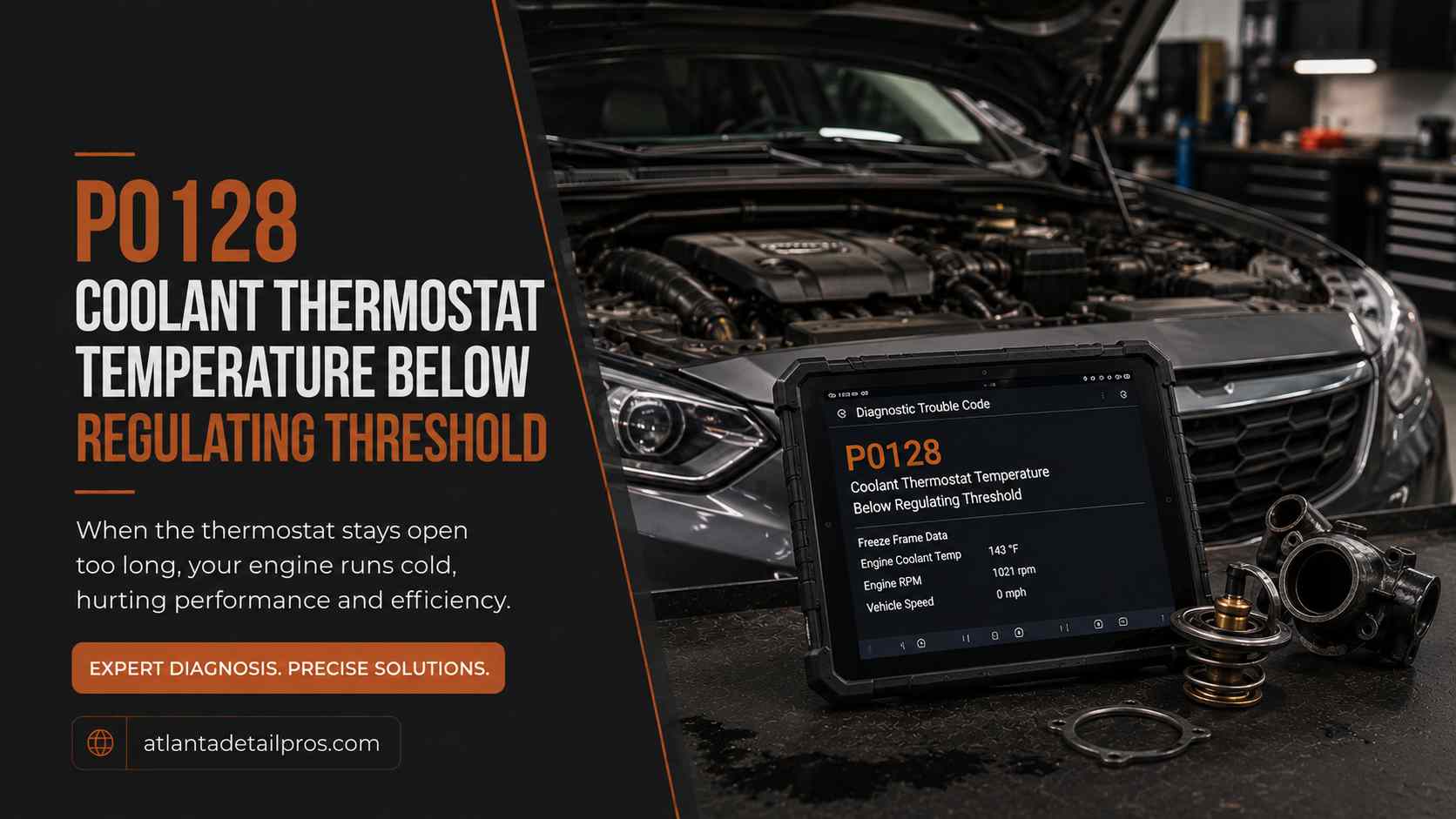
P0128 is easy to dismiss. The car drives fine. The engine seems normal. The only clue is the check engine light and a code that says the coolant temperature is below the thermostat regulating threshold. It sounds like a sensor issue at worst. But what P0128 is actually telling you is that your engine is running cold, and a cold engine causes more problems than most drivers realize.
P0128 means the ECM has detected that coolant temperature is not reaching the expected minimum, typically 160 to 170 degrees Fahrenheit, within the expected warm-up time after a cold start. The most likely cause is a thermostat stuck in the open position, which allows coolant to circulate through the radiator continuously and prevents the engine from ever building up heat. The fix is almost always a thermostat replacement, and it is one of the most affordable repairs associated with any check engine code.
What Your Engine Loses When It Runs Too Cold
Before getting into the diagnosis, understand why this matters beyond the check engine light. An engine designed to run at 200 degrees Fahrenheit does not operate correctly at 160 degrees. Every system in the engine was calibrated around that operating temperature.
Fuel Economy Drops Significantly
A cold engine runs on a richer air-fuel mixture because the ECM compensates for cold combustion conditions. This is normal during warm-up but is only supposed to last a few minutes. With a stuck-open thermostat, the engine never fully reaches operating temperature, so it runs on an enriched mixture continuously. Many drivers with a stuck-open thermostat report 10 to 20 percent worse fuel economy without understanding why.
The Catalytic Converter Struggles
Catalytic converters require temperatures above 400 degrees Fahrenheit to function efficiently. They are designed to reach this temperature quickly after startup. When the engine runs cold from a stuck-open thermostat, exhaust temperatures are lower and the catalytic converter operates below its efficiency threshold for longer periods. Over time this can damage or prematurely age the converter.
The Heater Produces Less Heat
If you notice your cabin heater is weaker than usual, particularly at idle, and you have a P0128 code, the stuck-open thermostat is likely the explanation. The cabin heater draws heat from engine coolant. Cold coolant equals cold or lukewarm cabin heat.
Confirming the Thermostat Is the Problem
Before buying a thermostat, confirm that is the actual issue. The good news: confirming a stuck-open thermostat requires only a scan tool or a careful eye on your temperature gauge, not special equipment.
The Temperature Gauge Live Data Test
Connect a scan tool and watch the engine coolant temperature from a cold start. On a healthy system, coolant temperature should rise steadily and reach 180 to 200 degrees Fahrenheit within 10 to 15 minutes of normal driving. With a stuck-open thermostat, the temperature climbs slowly and then plateaus well below normal. At highway speed it may actually drop: the continuous radiator circulation cools the coolant faster than the engine can heat it.
Also watch the temperature gauge on your dashboard. The needle should rise to its normal midpoint position and hold there throughout driving. If it never reaches the midpoint or sits noticeably lower than usual, the thermostat is not doing its job of holding coolant inside the engine until it reaches operating temperature.
Ruling Out the Coolant Temperature Sensor
Before replacing the thermostat, you can rule out a faulty Coolant Temperature Sensor (CTS) as a false trigger. With the engine cold, disconnect the CTS connector and measure resistance across the sensor terminals with a multimeter. Most automotive CTS units read approximately 2,000 ohms when cold (below 50 degrees Fahrenheit). After the engine warms up, the resistance should drop to approximately 200 to 300 ohms. If the readings are significantly off or the sensor reads infinity (open circuit), the sensor is faulty and may be triggering P0128 with a false reading. However, a failed CTS causing P0128 is much less common than a stuck-open thermostat.
Replacing the Thermostat: A Repair Most DIYers Can Handle
A replacement thermostat is one of the least expensive parts in the automotive cooling system, typically $15 to $40 for a quality unit. On most engines it is accessible within 30 to 60 minutes. The thermostat sits at one end of the large upper radiator hose, inside a housing bolted to the engine. Drain the radiator partially, remove the housing bolts, swap the thermostat, reinstall with a new gasket or O-ring (usually included with the thermostat), and refill with the correct coolant mixture.
Choosing the Right Thermostat
The replacement thermostat must match the opening temperature specification of your vehicle. Most modern gasoline engines use a thermostat that begins opening at 195 degrees Fahrenheit and is fully open by 215 degrees. Installing a lower-temperature thermostat than specified will cause the same cold-running condition that triggered P0128 in the first place. Always use a thermostat that matches or slightly exceeds the OEM specification. Gates, Stant, Motorad, and OEM-branded thermostats are all reliable choices. Avoid no-name budget units: a thermostat failure is inconvenient at minimum and expensive at worst if it causes overheating.
The Bleed Procedure After Replacement
After any cooling system work, bleeding air from the system is essential. Air pockets prevent proper coolant circulation and can cause both overheating and inaccurate temperature readings. With the radiator cap or funnel open, run the engine with the heater on maximum heat and observe coolant bubbling until no more air escapes. Confirm the temperature reaches normal operating range and holds steadily before clearing the code and test driving.
Other Less Common Causes of P0128
A stuck-open thermostat causes the overwhelming majority of P0128 codes, but a few other scenarios produce the same result and are worth knowing.
Cooling Fan Stuck On
An electric cooling fan that runs continuously at full speed can prevent the engine from reaching operating temperature, particularly at low speeds or during light city driving. If the radiator fan is running at all times, even when the engine is cold, a stuck relay or a faulty fan control module is the culprit. Check whether your cooling fan runs from the moment you start a cold engine. It should not engage until the engine reaches operating temperature.
Low Coolant Level
Insufficient coolant can prevent accurate temperature sensor readings and occasionally contribute to P0128, though this is a less common cause than thermostat failure. Check coolant level in the reservoir before doing anything else. If it is below MIN, top it off first and see if the code returns.
PCM Software Update Required
On certain vehicles, particularly some GM and Ford products, P0128 is triggered by PCM software that calculates the warm-up time too conservatively. A software update from the dealer resets the threshold and eliminates the code without any mechanical repair. If you have a newer vehicle with P0128 and a thermostat that visually and functionally appears to be working correctly, check with a dealer for any available TSBs or software updates for this code before replacing the thermostat.
Frequently Asked Questions
What causes P0128?
In the vast majority of cases, a thermostat stuck in the open position. The open thermostat allows coolant to circulate continuously through the radiator, preventing the engine from building heat to its designed operating temperature. The ECM detects that coolant temperature is not reaching the expected threshold and stores P0128. Rare causes include a faulty coolant temperature sensor, a cooling fan stuck on, or very low coolant level.
Can I drive with a P0128 code?
Yes, but you should not ignore it indefinitely. Driving with a cold engine from a stuck-open thermostat causes ongoing fuel economy loss, reduced cabin heat, increased emissions, and can stress the catalytic converter over time. The thermostat is an inexpensive repair. There is no good reason to drive with P0128 for more than a week or two.
How much does a P0128 thermostat replacement cost?
The thermostat part costs $15 to $40 for most vehicles. A shop charges $80 to $200 for the repair including parts and labor, depending on how accessible the thermostat housing is on your engine. It is one of the least expensive check engine repairs you can have done.
Why does my temperature gauge read low with P0128?
The temperature gauge reads low because the engine genuinely is running cold. A stuck-open thermostat prevents the engine from reaching its designed operating temperature by continuously routing coolant through the cold radiator. The low gauge reading is a secondary confirmation that the thermostat is not holding coolant inside the engine long enough to heat it properly.
The Bottom Line
P0128 is one of the most straightforward check engine codes to diagnose and fix. Watch your temperature gauge or scan tool data from a cold start: if the engine takes longer than 15 minutes to reach the midpoint or never reaches it at all, the thermostat is stuck open. Replace it with a quality thermostat matching your vehicle specification, bleed the cooling system, clear the code, and verify normal warm-up on the next cold start. Thirty dollars in parts and an hour of work resolves most P0128 cases.