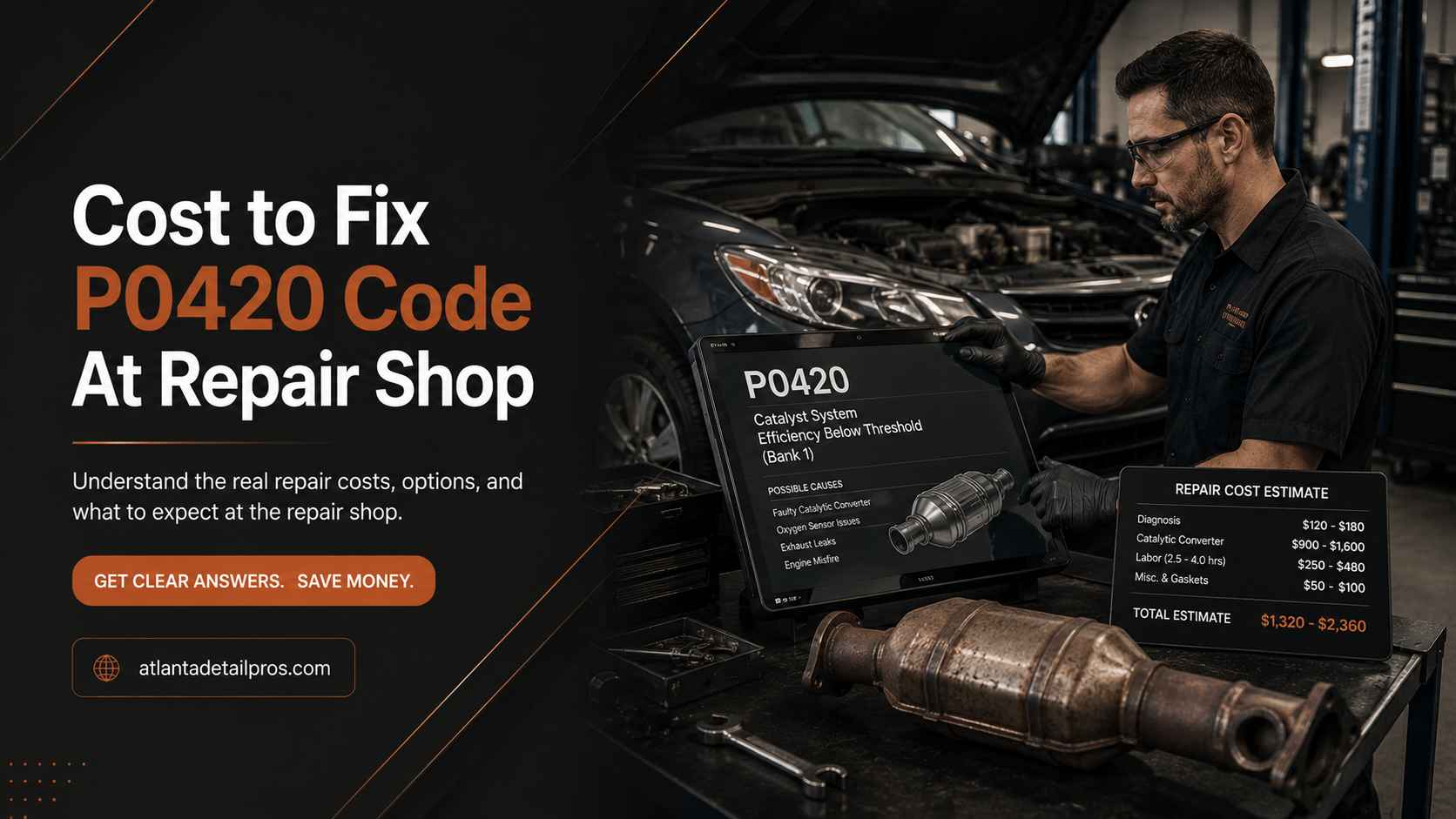
The range of what shops charge to fix a P0420 code is enormous, and most drivers find that out the hard way. You can resolve P0420 for $50 to $150 on a good day, or you can end up with a $2,500 catalytic converter bill on a bad one. The difference between those outcomes is almost always determined by the quality of the diagnosis, not by the quality of the shop.
P0420 means “Catalyst System Efficiency Below Threshold, Bank 1.” It is stored when the ECM determines the catalytic converter is not processing exhaust gases efficiently enough. But as covered elsewhere in this site, a failed converter is not the only cause. A failed downstream oxygen sensor, an exhaust leak near the sensor, or residual damage from an old misfire can all produce the same code. This guide covers what each of those repairs costs at a shop so you know what a fair quote looks like before you hand over your keys.
The Diagnostic Fee: What You Pay Before Any Repair Begins
Most repair shops will not quote a P0420 repair without performing their own diagnostic first, even if you already know the code. This is appropriate: the code tells you a problem exists, not which specific component caused it. The diagnostic process involves connecting to the OBD-II port, reading live data from both oxygen sensors, and evaluating whether the downstream sensor is accurately reporting or malfunctioning.
What the Diagnostic Fee Covers
A P0420 diagnostic at most independent shops runs $85 to $150. At dealerships it runs $125 to $200. This fee covers the labor time to connect the scanner, observe live sensor data through a warm-up cycle and operating temperature, check freeze frame data, inspect for exhaust leaks, and produce a repair recommendation. Ask before scheduling whether the diagnostic fee is credited toward the repair if you approve the recommended work at that shop. Most reputable shops offer this credit.
What a Quality Diagnostic Should Include
A legitimate P0420 diagnostic should include: reading live O2 sensor data at operating temperature (not just pulling the code), specifically watching the Bank 1 downstream sensor voltage behavior over time, checking for active or freeze-frame misfire codes alongside the P0420, and inspecting the exhaust system for leaks near the sensor. If a shop quotes a catalytic converter replacement without mentioning anything about the oxygen sensor or exhaust inspection, ask why those were not evaluated.
Repair Option 1: Fixing an Exhaust Leak Near the Downstream Sensor
An exhaust leak between the engine and the Bank 1 downstream oxygen sensor introduces atmospheric oxygen into the exhaust stream, making the downstream sensor report artificially low oxygen storage, which the ECM interprets as converter inefficiency. Fixing the exhaust leak resolves P0420 without touching the converter or the sensor. This is the cheapest resolution when it is the cause.
What This Repair Costs
The cost depends on where the leak is. A leaking exhaust manifold gasket replacement, which is the most common exhaust leak near the upstream system on many vehicles, runs $200 to $500 at an independent shop including parts and labor. A leaking flex pipe or downpipe connection costs $150 to $400 depending on whether welding is involved. A cracked exhaust manifold requires manifold replacement at $400 to $900 depending on the vehicle and manifold accessibility. In all cases, this is substantially less than converter replacement and worth confirming first.
Repair Option 2: Replacing the Downstream Oxygen Sensor
The downstream O2 sensor (Bank 1, Sensor 2) is the direct measuring device for converter efficiency. A lazy, slow-responding, or failed sensor reports the wrong efficiency data and triggers P0420 with a converter that may be completely functional. This is the second most common cause after exhaust leaks, and the second most affordable fix.
What This Repair Costs
An OEM or equivalent downstream oxygen sensor costs $50 to $150 in parts depending on the vehicle. Labor to replace the rear sensor is typically 0.5 to 1.5 hours depending on accessibility, adding $60 to $200 in labor at an independent shop. Total cost for a downstream sensor replacement runs $110 to $350 at a quality independent shop. Dealers charge more, often $200 to $450 for the same job, reflecting both higher labor rates and OEM-only parts sourcing.
When to Ask for the Sensor Before the Converter
Any shop that quotes a catalytic converter replacement for P0420 without first testing the downstream sensor behavior on live data is skipping a diagnostic step that could save you $1,000 or more. Ask specifically: “Has the downstream oxygen sensor been tested on live data? What was it reading?” A healthy sensor should show a relatively stable voltage between 0.5V and 0.7V. If the shop cannot answer this question or did not test it, request the sensor test before approving the converter.
Repair Option 3: Catalytic Converter Replacement
When the exhaust leak and oxygen sensor have been confirmed healthy and the downstream sensor still mirrors the upstream sensor activity across multiple operating cycles, the converter has genuinely failed. Converter replacement is the correct and unavoidable repair at that point. The cost range is wide and depends heavily on the vehicle and the type of converter used.
Aftermarket Converter Cost at an Independent Shop
At an independent shop using a quality aftermarket converter from Walker, MagnaFlow, or Bosal, most passenger vehicles cost $600 to $1,400 total for parts and labor. The converter itself runs $200 to $700 for a quality aftermarket unit on most common vehicles. Labor to replace it adds 1 to 3 hours at the shop’s hourly rate. In non-CARB states (most states outside California), aftermarket converters are legal and substantially less expensive than OEM units.
OEM Converter Cost and CARB State Requirements
In California and the states that follow CARB (California Air Resources Board) emissions standards, including New York, Massachusetts, Connecticut, Vermont, Maine, Rhode Island, New Jersey, Pennsylvania, Maryland, and Oregon, the replacement converter must be CARB-certified. Non-CARB converters will cause P0420 to return almost immediately because they do not meet the efficiency threshold required by those states. CARB-certified converters cost $500 to $1,500 in parts, and total repair costs at an independent shop run $1,200 to $2,500 depending on the vehicle.
Dealer vs Independent Shop Converter Cost Comparison
Dealers source OEM converters exclusively and charge their higher hourly labor rate. Dealer catalytic converter replacement for P0420 runs $1,500 to $3,500 on most vehicles, with some performance or European vehicles reaching $4,000 or more. For the large majority of vehicles out of warranty, an independent shop using a CARB-compliant or quality aftermarket converter produces equivalent results at 30 to 50 percent lower cost.
Repair Type | Independent Shop Cost | Dealer Cost | When This Is the Fix |
|---|---|---|---|
Diagnostic fee | $85-$150 | $125-$200 | Always required first |
Exhaust leak repair | $150-$500 | $250-$700 | Leak found near downstream sensor |
Downstream O2 sensor | $110-$350 | $200-$450 | Sensor confirmed lazy or failed |
Aftermarket converter (non-CARB state) | $600-$1,400 | N/A | Converter confirmed failed; non-CARB state |
CARB-compliant converter | $1,200-$2,500 | $1,500-$3,500 | CARB state or OEM required |
Frequently Asked Questions
How much does it cost to fix a P0420 code?
It depends on the actual cause, which requires diagnosis to determine. An exhaust leak fix costs $150 to $500. A downstream O2 sensor replacement costs $110 to $350. A catalytic converter replacement at an independent shop costs $600 to $1,400 with an aftermarket converter in non-CARB states, or $1,200 to $2,500 with a CARB-compliant converter. Always start with the diagnostic before authorizing any repair.
Can a P0420 fix itself?
Not permanently. The ECM continuously monitors catalyst efficiency. If the underlying cause of P0420 is still present, the code returns every time the EVAP and catalyst monitors complete their cycle. Clearing the code buys temporary relief but not a fix. Only repairing the actual cause resolves P0420 permanently.
Is there a cheap fix for P0420?
Yes, if the cause is an exhaust leak or a failed downstream oxygen sensor rather than a failed converter. A sensor replacement at $110 to $350 or an exhaust gasket repair at $200 to $500 is dramatically cheaper than a converter replacement. This is why proper diagnosis before repair authorization matters so much with P0420.
The Bottom Line
P0420 has a very wide cost range because it has a very wide range of causes. The cheapest resolution is an exhaust leak fix or a sensor replacement. The most expensive is a CARB-compliant catalytic converter replacement at a dealership. Never authorize a converter replacement without confirming through live oxygen sensor data that the converter is actually the problem. The diagnostic fee you pay to confirm the cause is the best money in any P0420 repair sequence.