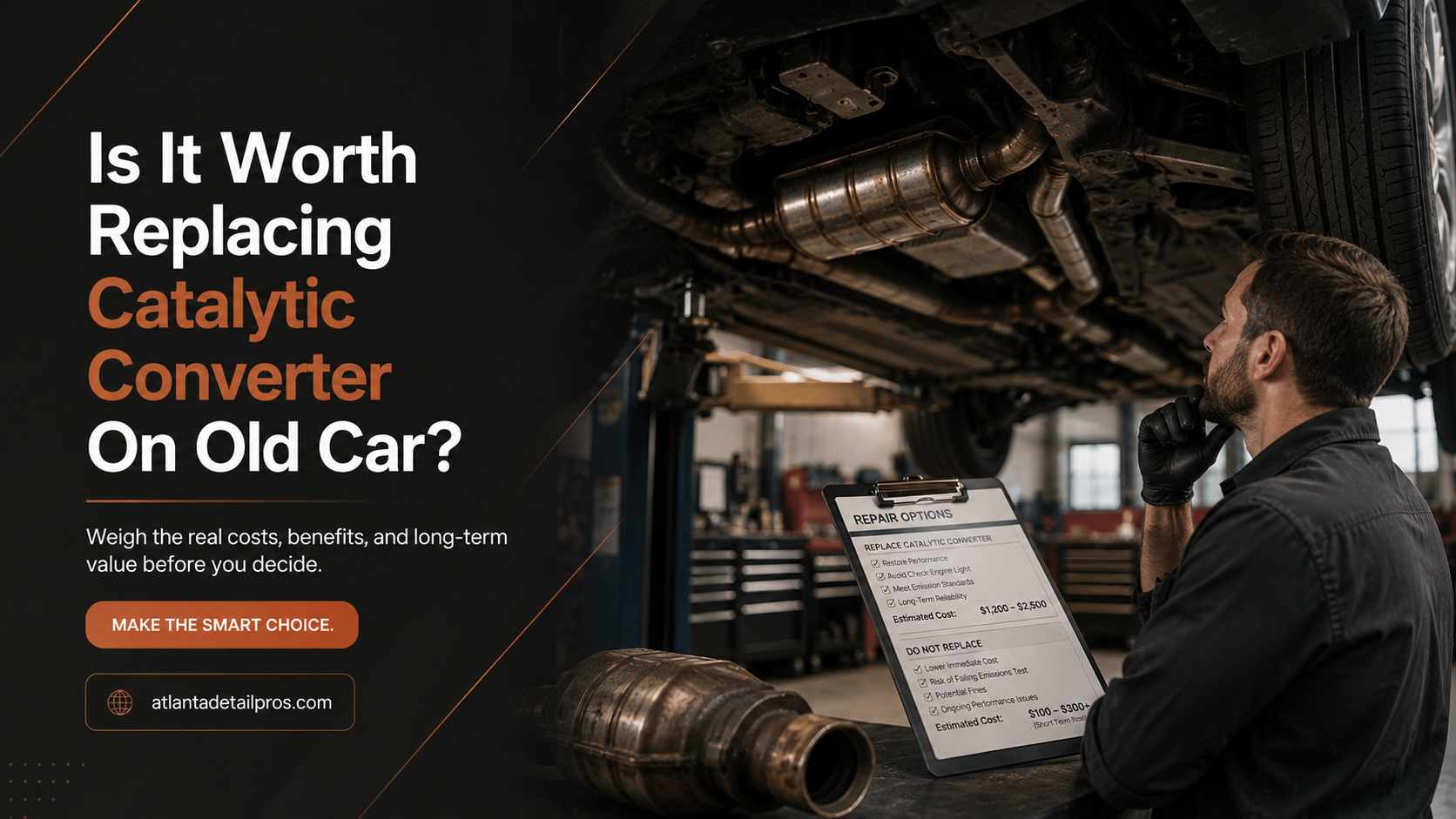
This is one of the most common repair dilemmas in automotive ownership, and it deserves a better answer than you will get from most guides. The honest answer is: it depends on a calculation that most people never actually do. Before you say yes or no, you need three numbers: the current market value of your car, the total cost of the converter replacement, and the total cost of everything else the car needs. Those three numbers together make the decision almost automatic.
Catalytic converter replacements on older vehicles typically run $800 to $2,500 depending on the vehicle, the part type, and your location. On a car worth $3,000, that math looks very different than on a car worth $12,000, even if the car is the same age. This guide walks through the complete decision framework so you leave knowing exactly what to do.
The 50 Percent Rule: How to Calculate Whether the Repair Makes Financial Sense
The most widely used benchmark in automotive finance for evaluating major repairs on older vehicles is the 50 percent rule: if a single repair costs more than 50 percent of the vehicle’s current market value, the financial case for repair weakens significantly. This is not a hard rule, but it is a reliable starting point that forces you to confront the actual numbers rather than making a gut-feel decision.
Step 1: Find the Real Current Market Value of Your Car
Do not estimate this from memory. Look it up right now using one of three sources: Kelley Blue Book (kbb.com), Edmunds (edmunds.com), or the NADA Guide. Enter your vehicle’s year, make, model, trim level, mileage, and an honest condition rating. Use the private party value, not the trade-in value (which is lower) and not the dealer retail value (which is higher). The private party value is what your car would realistically sell for between two private individuals today.
Step 2: Get the Full Repair Cost, Not Just the Converter Price
The price of the converter itself is only part of the repair cost. Add the labor to replace it (typically $150 to $400 depending on access difficulty), the cost of any accompanying oxygen sensors that are being replaced simultaneously, and the diagnostic fee if you are paying for it. If the shop has quoted you a total number, use that. If not, ask for a complete written estimate before agreeing to anything.
Step 3: Apply the Calculation
Divide the total repair cost by the current market value. Multiply by 100 to get a percentage. If the converter repair costs $1,200 and the car is worth $4,000, that is 30 percent of the car’s value. The repair is reasonable and almost certainly worth doing if the car is otherwise sound. If the repair costs $1,800 and the car is worth $2,500, that is 72 percent of the car’s value. That is a strong signal to think carefully before proceeding.
Beyond the Numbers: The Questions That Change the Answer
The percentage calculation is a starting point, not the final answer. Several real-world factors push that decision in one direction or the other regardless of what the math says. Every one of these questions deserves an honest answer before you decide.
Question 1: Does Your State Require Emissions Testing?
If you live in a state with mandatory emissions testing, a failed catalytic converter is not optional to fix. Without a functioning converter, your car will fail the emissions test and you cannot legally register or drive it. In this situation, the decision is not really whether to fix it but whether to fix it or sell the car. Check your state’s testing requirements at your DMV website. States with mandatory OBD-II emissions testing include California, New York, Texas, Georgia, Virginia, Illinois, and many others.
Question 2: What Else Does the Car Need?
A catalytic converter is only worth replacing on a car that is otherwise mechanically sound, or at least sound enough to justify the investment. Before authorizing the converter replacement, ask your mechanic to do a full vehicle inspection and give you an honest list of what else needs attention in the next 12 to 24 months. If the converter repair is $1,200 and the inspection reveals another $2,000 in upcoming brake, suspension, and engine work, you are looking at $3,200 invested in a car that might be worth $4,500. That math becomes much harder to justify.
Question 3: Are You Making a Car Payment Elsewhere?
A paid-off car, even with repair costs, is almost always cheaper than buying a replacement. A $1,500 converter repair is a one-time expense. A $400 per month car payment runs for 48 to 60 months, totaling $19,200 to $24,000. Even a series of repairs over two years rarely approaches that cost. If your old car has no payment and is otherwise dependable, repairing it almost always wins the financial comparison even at relatively high individual repair costs.
When Replacing the Converter Is the Right Decision on an Older Car
There are clear circumstances where replacing the catalytic converter makes sense even on a high-mileage or older vehicle. The right answer is replace when these conditions are true.
Condition 1: The Car Is Otherwise Mechanically Reliable
If the engine runs well, the transmission shifts cleanly, the brakes are serviceable, and the known upcoming maintenance is routine and affordable, a converter replacement keeps a reliable car on the road. A car with 180,000 miles that has been well-maintained and has no other imminent large repairs is a very different proposition from a car with 180,000 miles that also needs a transmission and head gasket.
Condition 2: Aftermarket Converter Costs Are Reasonable for Your Vehicle
Not every catalytic converter costs $1,500 to $2,500. For many older, simpler vehicles, a quality aftermarket converter from a reputable manufacturer costs $200 to $600 in parts, with labor bringing the total to $400 to $900. At those numbers, the repair is reasonable on almost any vehicle worth more than $2,500. Get the aftermarket quote before accepting the OEM quote as the only option, particularly on vehicles over 8 years old where OEM warranty coverage no longer applies.
Condition 3: You Have a Confirmed Diagnosis
Before authorizing converter replacement, confirm through proper diagnosis that the converter is actually the problem. As discussed in other articles, P0420 and P0430 codes can be caused by a failed downstream oxygen sensor or an exhaust leak rather than a failed converter. A $150 downstream sensor replacement versus an $800 to $2,500 converter replacement is a significant difference. Confirm the diagnosis before the repair.
When to Skip the Repair and Walk Away
There are equally clear circumstances where the converter replacement is not the right call and the money is better directed toward a different vehicle.
Signal 1: The Repair Cost Exceeds the Car’s Value
If the total repair estimate runs higher than the private party market value of the car, you are spending more than the car is worth to fix it. The only exception to this logic is sentimental or rare vehicles where replacement cost would be substantially higher than market value suggests. For a standard economy car or sedan, paying more than the car is worth to fix it is rarely a sound financial decision.
Signal 2: The Car Has Multiple Large Pending Repairs
Stack the converter repair against the full list of upcoming repairs the mechanic identified. If the converter is the first domino in a series of expensive repairs over the next year, the calculation changes dramatically. Many experienced automotive advisors use a rolling rule: if a vehicle needs more than one year of equivalent car payments in repairs within a 12-month window, serious consideration of replacement is warranted.
Signal 3: The Car’s Reliability Has Become Unpredictable
A car that has become unpredictable regardless of the specific repair needed introduces a risk cost that does not show up in any estimate. If the car has left you stranded twice in the past year, or if the mechanic expresses genuine uncertainty about what will fail next, the converter repair buys you a functioning emissions system but not necessarily reliability. Safety and predictability have value beyond repair cost comparisons.
Frequently Asked Questions
Is it worth replacing a catalytic converter on a car with over 150,000 miles?
Mileage alone does not answer this question. A well-maintained vehicle with 150,000 miles may have another 50,000 to 100,000 miles of reliable service ahead of it. Mileage matters only in the context of what condition those miles have left the car in overall. Have a full inspection done. If the engine and transmission are solid, high mileage does not automatically disqualify a converter repair.
Should I use OEM or aftermarket on an older car?
For vehicles out of warranty and over 7 to 8 years old, a quality aftermarket converter from Walker, MagnaFlow, or Bosal is almost always the appropriate choice. OEM converters make sense on newer vehicles under manufacturer warranty or when a CARB-compliant converter is required in California and similar states. The price difference between OEM and quality aftermarket can be $400 to $1,200 on the same repair.
Can I drive without fixing the catalytic converter?
In most states, legally no, because you cannot pass emissions testing without a functional converter. Mechanically, a failed converter that is not completely blocked allows the car to operate, though with reduced fuel economy and increased emissions. A converter with a melted or broken substrate creates exhaust backpressure that reduces engine power and can eventually damage the engine. Do not drive indefinitely on a confirmed failed converter.
The Bottom Line
Replacing a catalytic converter on an old car is worth it when the repair cost is less than 50 percent of the vehicle’s current market value, the car is otherwise mechanically reliable, and no other large repairs are immediately pending. It is not worth it when the repair approaches or exceeds the vehicle’s value, or when it would be the first in a series of major repairs. Do the three-number calculation. Get a full inspection alongside the repair quote. And confirm the diagnosis before authorizing any converter replacement.