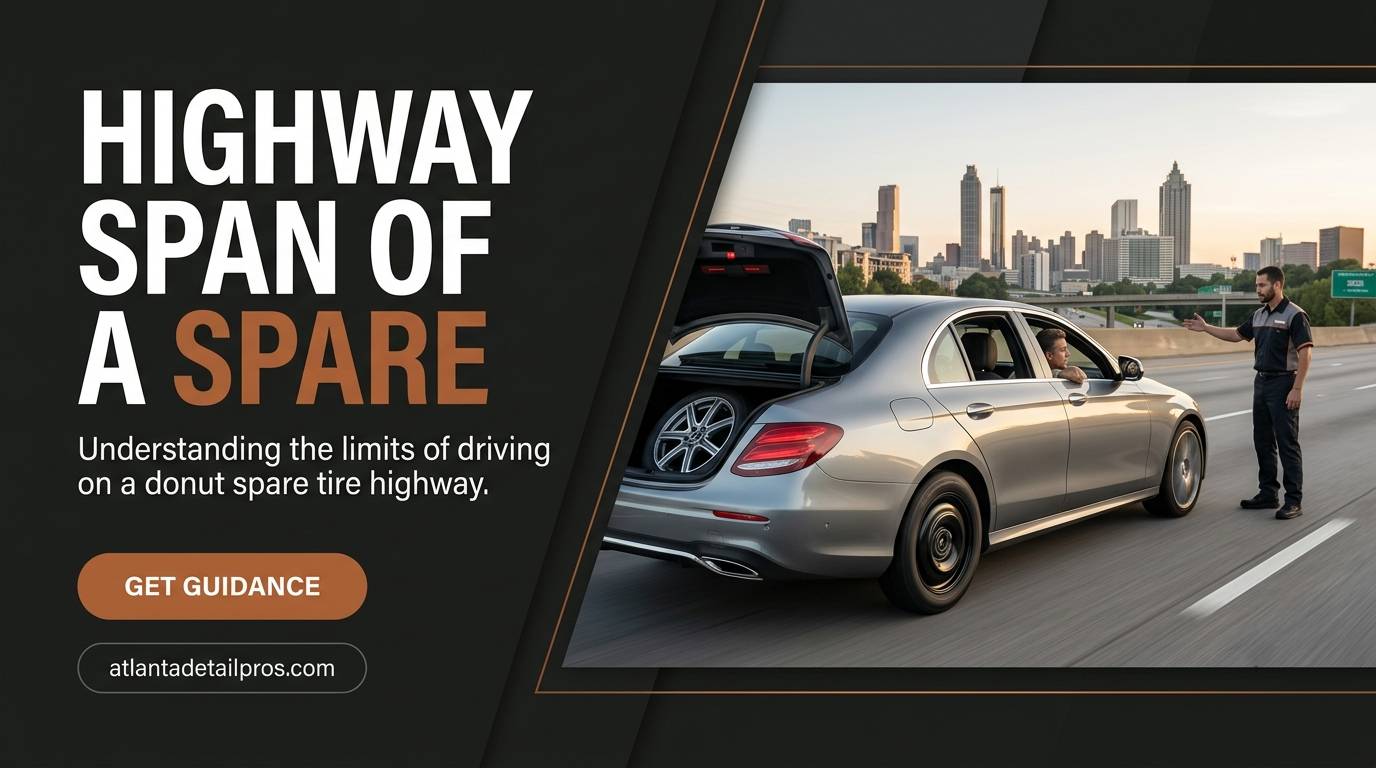
The short answer printed on most donut spare tires: 50 miles at no more than 50 mph. That is the manufacturer limit and it is not a conservative suggestion with hidden margin. It reflects the actual structural and thermal design limits of a tire that was built to be as small and light as possible, not to perform at highway speeds for extended distances.
This guide explains why those numbers exist and what actually happens when you exceed them, what the real-world decision looks like when you are already on a highway with no nearby exit, and why all-wheel drive and four-wheel drive vehicles have an additional set of restrictions that most drivers do not know about until it is too late.
What a Donut Spare Is Actually Designed For
A temporary compact spare, commonly called a donut, is engineered as a single-purpose emergency tool: getting you from where you got a flat to the nearest tire shop. It is not a backup daily driver. It is not built to the same specifications as your regular tires. The rubber compound is thinner, the tread is shallower, the structure is lighter, and critically, it has no built-in cooling capacity to manage the heat generated at sustained highway speeds.
The 50 mph speed limit is primarily a thermal limit, not a traction limit. At highway speeds, the smaller donut heats up far faster than a standard tire because of its reduced mass and thinner construction. Heat is what kills tire rubber. Exceed the rated speed for an extended period and the tire can develop internal structural weakness or blow out without warning. The 50-mile distance limit exists because that is approximately how far the tire can travel before accumulated heat and wear begin to compromise structural integrity under ideal conditions.
The 50/50 Rule and Why Both Numbers Matter Equally
The 50/50 rule, 50 mph and 50 miles, is the universal benchmark for temporary compact spare use. Most drivers understand the speed limit but underestimate the importance of the distance limit. Both constraints exist independently, and exceeding either one increases risk even if you are within the other.
Speed Is the More Critical of the Two Constraints
Speed matters more than distance for one specific reason: heat generation increases exponentially, not linearly, with speed. Driving at 70 mph on a donut does not generate 40 percent more heat than driving at 50 mph. It generates significantly more, because rolling resistance and friction scale with velocity. A driver who covers 40 miles at 70 mph on a donut has subjected that tire to more heat stress than a driver who covered 50 miles at 45 mph. Stay under 50 mph even if you feel the car handling fine, because internal heat damage is not visible or detectable while it is happening.
Distance Limits Reflect Cumulative Wear, Not Just a Mileage Countdown
The distance limit exists because the donut tread wears rapidly. The tread compound is not designed for extended high-mileage use, and the tread depth is already minimal from the factory. A worn donut has even less grip and water evacuation capacity than a new one. If you must exceed 50 miles in a genuine emergency, keep speed well below 50 mph to reduce heat load, avoid sharp braking and acceleration, and understand that you are operating outside the designed safety margin.
What Actually Happens If You Drive Faster Than 50 mph on a Donut
At speeds above 50 mph, several risks compound simultaneously. This is not theoretical: documented incidents of donut tire failures at highway speeds exist, and the consequences are the same as any high-speed blowout.
- Heat buildup: Internal tire temperature rises rapidly, weakening the rubber compound and internal structure. The progression from warm to dangerously hot happens within minutes at 65 to 70 mph.
- Reduced contact patch stability: Donut tires are narrower than standard tires, giving less contact area with the road. At speed, any stability degradation from heat is amplified.
- Blowout risk: A structurally weakened tire can fail suddenly without progressive warning. At 65 to 70 mph, a blowout results in immediate handling instability.
- Braking compromise: The donut does not match the braking characteristics of your three remaining full-size tires. Emergency braking causes uneven deceleration forces, with the donut side stopping less effectively.
The AWD and 4WD Warning Most Drivers Learn the Hard Way
This is the section that gets omitted from almost every donut spare article, and it causes expensive drivetrain damage every year. If your vehicle has all-wheel drive or four-wheel drive, driving on a donut spare creates a critical size mismatch between axles that can damage the transfer case, center differential, or rear differential.
All-wheel drive systems continuously compare the rotational speed of all four wheels. The AWD system expects all four tires to be the same size, rotating at approximately the same speed. A donut spare is significantly smaller in diameter than a standard tire, so it rotates faster than the other three tires for every mile driven. On vehicles with full-time AWD or those that cannot fully disable 4WD, this speed difference forces the transfer case or center differential to continuously compensate for the mismatch. Over even a short highway drive, this can cause significant heat damage to the differentials or center coupling.
AWD/4WD OWNERS: Check your owner manual before driving on a donut spare for more than a very short distance. Many manufacturers require that AWD be disabled or require calling for a tow rather than using a donut spare. Failure to follow this guidance can cause transfer case or differential damage that costs $1,000 to $4,000 to repair.
Highway-Specific Strategy: What to Do When You Get a Flat on a Highway
Getting a flat on a highway presents a different set of decisions than getting one on a surface street. The following sequence applies this guide to a real highway flat situation.
1. Install the donut safely away from traffic. Do not rush the installation. A donut improperly torqued is a second immediate problem. Most donut spares require 60 PSI; verify pressure with the gauge in your kit or at the nearest gas station.
2. Plan your exit immediately. Open maps and find the nearest tire shop or service station within 50 miles. Do not plan to reach your original destination on the donut unless it happens to be within that range.
3. Merge to the right lane and stay there. Keep speed at or below 50 mph. If the flow of traffic is significantly faster and lane changes put you at risk, exit the highway as soon as possible and take surface streets.
4. If AWD or 4WD: pull over at the first safe area and call for assistance or a tow unless you can fully disable the AWD or 4WD system and verify it is disengaged.
5. Do not use the donut to complete a long road trip with a detour. The detour math often puts you over 50 miles of donut use before you realize it.
How to Tell If Your Spare Tire Is Actually a Full-Size Matching Spare
Not every car comes with a donut. Some vehicles, particularly older models and certain trucks, have a full-size spare that matches the other four tires in size and construction. A full-size matching spare has no meaningful speed or distance restriction beyond normal tire operating limits. The quick check is visual: if the spare looks identical in size and width to your regular tires and is mounted on the same style of wheel, it is a full-size spare. If it is visibly narrower and mounted on a smaller, thinner wheel, it is a donut.
Some vehicles carry a full-size spare that is the same diameter but a different brand or tread pattern. On AWD vehicles, even a full-size spare with a mismatched tread depth from wear can cause differential strain. Replace or rotate your full-size spare into regular rotation periodically so it stays in good condition.
Frequently Asked Questions
How long can you drive on a donut spare on the highway?
The manufacturer limit for most donut spare tires is 50 miles at a maximum of 50 mph. On a highway where traffic moves at 65 to 70 mph, you should avoid extended highway driving on a donut and instead exit at the first opportunity to find a tire shop or take surface roads. If you must use the highway, stay in the right lane at 50 mph and plan for the nearest exit.
Can I drive 70 mph on a donut spare?
No. The speed rating on virtually all donut spare tires is 50 mph. At 70 mph, heat builds rapidly inside the smaller, thinner tire and creates blowout risk. The tire does not warn you before it fails. The 50 mph limit is a structural and thermal limit, not a conservative suggestion.
How long can a donut spare last if I drive carefully?
Under ideal conditions at 50 mph or below, a donut spare is designed for 50 to 70 miles. Some drivers have gone further in emergencies without incident, but every mile beyond 70 increases the risk of structural failure. The tread is shallow by design and wears quickly. The tire is not intended for regular use and should be replaced with a proper tire as soon as possible.
Can a donut spare damage my car?
Yes, in two ways. On AWD vehicles, the size mismatch between the donut and the other three tires causes the differential or transfer case to work continuously against the rotational speed difference, potentially causing expensive drivetrain damage. On any vehicle, driving on a donut for extended periods stresses the braking system unevenly and can affect alignment if the mismatch is significant.
The Bottom Line
A donut spare is an emergency bridge, not a replacement tire. The 50/50 rule is the outer limit, not the target. If you are already on a highway when the flat occurs, exit as soon as it is safe, keep the speed under 50 mph in the meantime, and have the original tire repaired or replaced the same day. If you drive an AWD vehicle, read your owner manual before using the donut for more than a mile or two. The cost of ignoring the AWD restriction is measured in differential damage that costs more than a new tire ever would have.