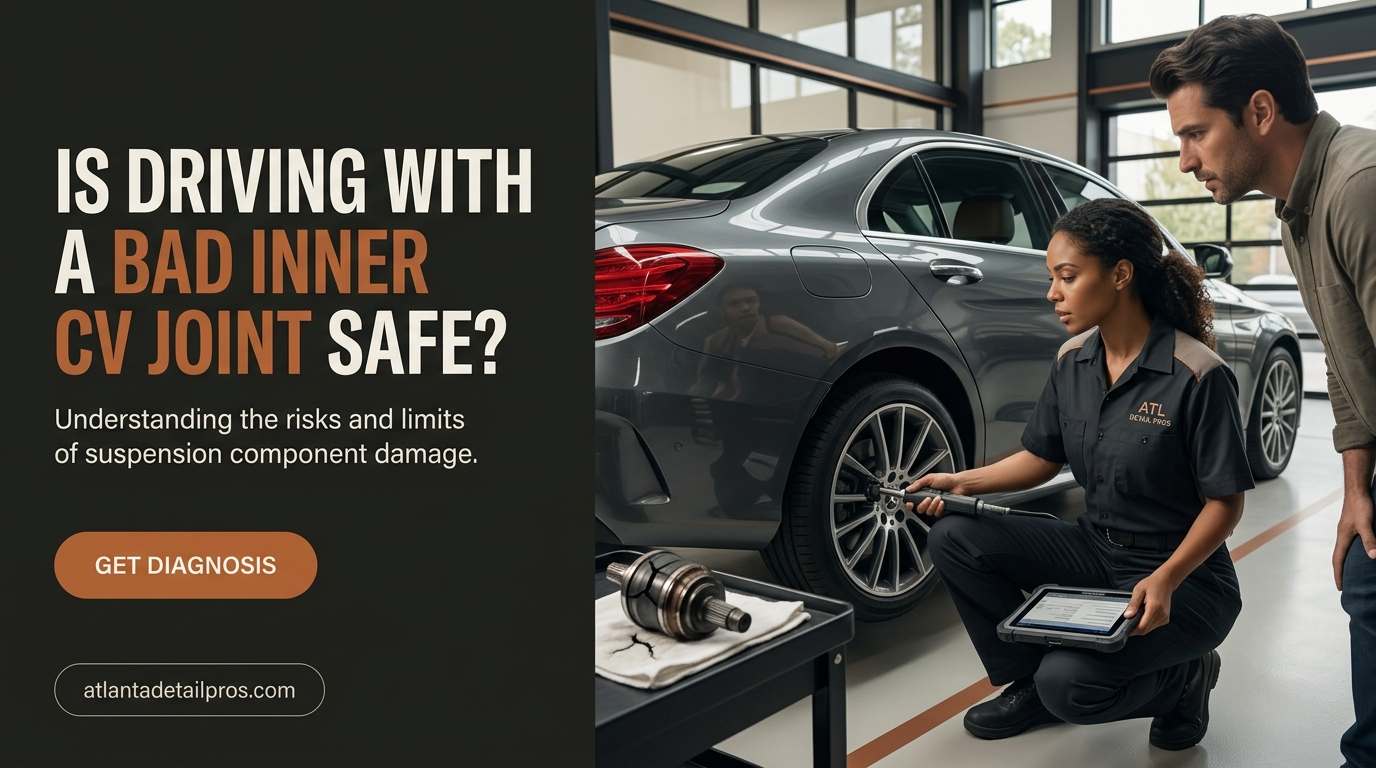
The answer is: it depends on how bad, and the answer changes quickly. A CV joint with a torn boot but intact bearings gives you a short window. A joint that is already clunking or vibrating under acceleration does not. The honest risk with inner CV joint failure is not just getting stranded. At the extreme end, a disintegrating axle shaft can cause a sudden loss of drive that, at highway speed or mid-corner, becomes a vehicle control problem.
This guide tells you exactly what stage of failure your joint is in based on what you are hearing and feeling, what the safe driving window looks like at each stage, and why the inner joint fails and behaves differently from the outer one most drivers have heard about.
Inner vs. Outer CV Joint: Why the Distinction Matters for Your Diagnosis
Most articles about CV joint failure focus on the outer joint because it is the one that produces the classic symptom everyone recognizes: a clicking or popping sound during sharp turns. The inner joint fails more subtly and produces different symptoms entirely, which is why inner joint problems are more often misdiagnosed or caught later than outer joint problems.
What the Inner CV Joint Does
The inner CV joint is the joint at the transmission end of the axle shaft. Its job is to accommodate the plunging motion of the suspension as it compresses and rebounds, and the angular changes as the drivetrain transfers power to the wheel. Unlike the outer joint, which must also accommodate full steering lock turns, the inner joint handles primarily the in-out plunging motion. This is why it does not typically produce clicking during turns.
How Inner CV Joint Failure Sounds and Feels
An inner CV joint that is beginning to fail produces vibration or shuddering during acceleration, particularly on front-wheel drive vehicles when pulling away from a stop. You may feel it through the floor, the seat, or the steering wheel. As the joint deteriorates further, a clunking or knocking sound appears during load transitions: when you shift from acceleration to coasting, or when you accelerate from a complete stop. These symptoms are easy to confuse with worn motor mounts, a loose driveshaft, or transmission issues, which is why inner joint failures are frequently misdiagnosed.
The Four Stages of Inner CV Joint Failure and What You Can Do at Each
CV joint failure does not happen instantly. It progresses through predictable stages, and the safe driving window is very different at each stage. Identifying which stage applies to your situation is the most important step in this diagnosis.
Stage 1: Boot Tear Only, Joint Still Intact
The CV boot is a rubber accordion-shaped sleeve that keeps grease inside the joint and contaminants out. When it tears, grease begins to fling outward under rotation. You may see dark grease spattered on the inside of the wheel or along the axle shaft. At this stage, the joint itself may still be completely healthy. If caught early, a boot replacement ($100 to $200) saves the joint. If left alone, dirt and moisture enter the exposed joint and begin accelerating wear. You can typically drive for a few weeks to months at Stage 1, but the window narrows each day the joint runs without grease and protection.
Stage 2: Joint Contaminated, Mild Vibration Under Load
Once debris has entered the joint, internal wear begins. Vibration or slight shuddering under acceleration is the first mechanical symptom. The joint still functions but with reduced smoothness. At this stage you can drive, but you should limit hard acceleration, avoid high-speed driving, and schedule repair within days to one or two weeks rather than months. The joint will deteriorate faster on rough roads and under load.
Stage 3: Noticeable Clunking on Acceleration and Load Changes
When the clunk appears, the joint has developed internal play. Metal surfaces are contacting each other rather than riding smoothly on the ball bearings. Each load cycle, every time you accelerate, decelerate, or shift gears, increases the internal damage. At this stage, the window is measured in days, not weeks. Avoid highway driving, avoid hard acceleration, and get the axle replaced at the earliest opportunity. Driving to a shop a few miles away is reasonable. Planning a road trip is not.
Stage 4: Severe Vibration, Grinding, or Loss of Drive
Complete joint failure is imminent or has occurred. At this stage the vehicle may not be drivable at all. If it is still moving, the joint is on the verge of separation. A separated inner CV joint on a front-wheel drive vehicle can drop the axle shaft and produce sudden, total loss of drive power. At highway speed this transition from powered to unpowered can affect vehicle stability. Do not drive the vehicle. Have it towed.
WARNING: A completely failed CV joint can drop the axle in a way that causes it to contact the ground or the wheel well. In rare but documented cases, this has caused loss of vehicle control. If the vibration or clunking has become severe or the car is struggling to move smoothly, stop driving and tow.
The table below gives you a fast reference by symptom stage.
What You Observe | Stage | Safe to Drive? | How Long / What to Do |
|---|---|---|---|
Grease on inside of wheel, no noise | 1 | Yes, carefully | Weeks. Book boot/axle replacement soon |
Vibration under acceleration, no clunk | 2 | Short distances only | Days. Avoid highway. Repair within the week |
Clunking when accelerating or decelerating | 3 | Minimal essential trips only | 1-2 days max. Go directly to shop or tow |
Severe grinding, lurching, or no drive | 4 | Do not drive | Immediate. Tow to shop. |
What Makes the Inner Joint Fail Faster Than Normal
Not all CV joint failures are just mileage-related wear. Several conditions accelerate inner joint deterioration significantly, and knowing them helps you gauge urgency more accurately based on your situation.
- High mileage: Most inner CV joints are designed to last 80,000 to 150,000 miles under normal conditions. Above 100,000 miles, any torn boot should be treated as an imminent joint replacement rather than a boot-only repair.
- Modified vehicles with a lifted or lowered suspension: Extreme suspension angles increase the operating angle of the inner joint beyond its design range, accelerating wear dramatically.
- Vehicles that frequently tow or carry heavy loads: Additional drivetrain stress accelerates inner joint wear, particularly in front-wheel drive vehicles where the joint handles both power delivery and steering.
- A boot that was already torn and driven on for an unknown period: If you bought a used vehicle and noticed a torn boot, assume the joint has been contaminated for an extended period and inspect or replace the full axle assembly.
Inner CV Joint vs. Full Axle Shaft Replacement: What the Repair Actually Involves
On most modern vehicles, replacing just the inner CV joint as a standalone part is less common than it used to be. The standard repair in 2026 is to replace the entire CV axle shaft as an assembly, which includes both the inner and outer joints pre-assembled on a new shaft. A remanufactured or aftermarket axle shaft costs $60 to $150 for most passenger vehicles. Labor to swap it runs $150 to $300 at an independent shop for a total job of $250 to $500.
This is actually favorable compared to the old approach of rebuilding just the joint, which required pressing out bearings and was only cost-effective on high-end or specialty applications. Replacing the full axle also eliminates the outer joint at the same time, which on a high-mileage vehicle is a reasonable preventative measure.
Frequently Asked Questions
Can you drive with a bad inner CV joint?
For short distances and at low speeds, yes, if the symptoms are in Stage 1 or 2. Once clunking appears during acceleration or load changes (Stage 3), limit driving to essential trips to the shop and avoid highway speeds. At Stage 4, with severe vibration or intermittent loss of power, do not drive the vehicle. The risk of complete joint separation increases with each mile.
How do I know if my inner or outer CV joint is bad?
Outer joint failure produces clicking or popping during sharp, slow-speed turns. Inner joint failure produces vibration or shuddering under acceleration and clunking during load transitions such as accelerating from a stop or lifting off the throttle. If the noise changes based on turning angle, suspect the outer joint. If it changes based on throttle load, suspect the inner joint.
How much does inner CV joint repair cost?
Replacing a full CV axle shaft assembly, which is the standard repair on most vehicles, typically costs $250 to $500 at an independent shop. Dealer prices run higher, $400 to $800. A boot replacement only (if the joint is still healthy) costs $100 to $200 but should only be done if the joint shows no signs of wear or vibration.
The Bottom Line
A bad inner CV joint is not a symptom you can watch indefinitely and act on when it is convenient. The stage it is in determines your urgency. Grease on the wheel with no noise: you have time to schedule it. Clunking under acceleration: you do not. Assess your stage, limit driving to what is necessary, and replace the axle shaft before the decision is made for you by the side of the road.