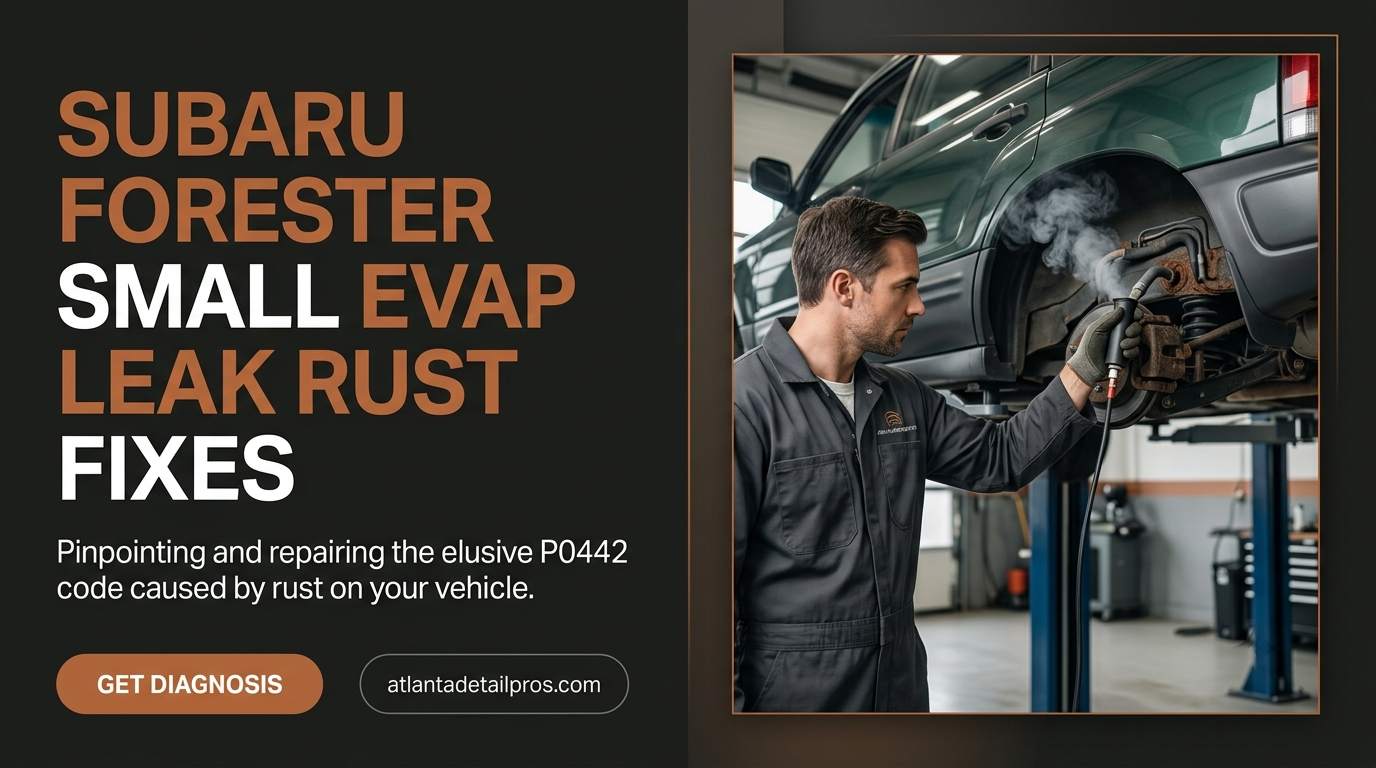
P0442 means the EVAP system self-test detected a small leak between 0.020 and 0.060 inches in diameter. On a Subaru Forester with any meaningful mileage, especially one driven in a state that uses road salt, rust is the most likely cause of that leak, and the fuel filler neck is the most likely location. Before you buy an OEM gas cap, a new purge valve, or a charcoal canister, the 10-minute inspection sequence in this article will tell you which part is actually responsible.
This guide is written specifically for the Forester. The EVAP system architecture, the known failure points, the rust-specific failure mechanisms, and the exact locations to inspect are all covered here. P0442 on a Forester is one of the most solvable codes in the Subaru ecosystem once you know where to look.
What P0442 Means and Why It Is Safe to Drive While You Diagnose It
The EVAP (evaporative emission control) system captures fuel vapors from the gas tank and routes them into the intake manifold to be burned during normal engine operation. Every modern vehicle runs a self-test of this sealed system. During the test, the ECU closes the vent valve, commands the purge solenoid, and monitors fuel tank pressure. If pressure drops faster than expected, it calculates a leak and stores the P0442 code. The malfunction indicator lamp turns on.
P0442 does not affect engine performance, fuel delivery, or any safety system. The car drives identically with or without the code stored. The practical consequences are two: the check engine light is on, which will fail most OBD-II emissions tests, and small fuel vapor leaks contribute to emissions. You can continue driving and diagnosing without urgency, but the code will not clear itself until the leak is repaired.
Why Subaru Foresters Get P0442 From Rust Specifically
Subaru Foresters, Outbacks, Legacies, and Imprezas produced roughly between 2000 and 2018 are well-documented for fuel filler neck corrosion in rust-belt states. The filler neck is a metal tube that runs from the fuel filler cap opening at the quarter panel down to the fuel tank. It passes through or near the wheel well area where road salt, moisture, and road debris accumulate. The metal filler neck corrodes from the outside in.
How a Rusted Filler Neck Causes P0442
The fuel filler neck has a machined metal sealing surface at the cap opening where the gas cap O-ring seats. As rust develops on this sealing surface, the smooth ring of metal that the gas cap gasket presses against becomes pitted, uneven, and covered with scale. Even a new, perfect gas cap cannot seal reliably against a corroded sealing surface because the gasket cannot conform to the irregular, pitted metal. The EVAP system pressure test then fails because vapor leaks past the gas cap even though the cap itself is technically fine. This is one of the most commonly misdiagnosed scenarios in Subaru EVAP diagnosis: the owner replaces the gas cap repeatedly, the code keeps returning, and the filler neck is never inspected.
The Second Rust Failure Mode: Pinhole Leaks in the Neck Body
Beyond the sealing surface corrosion, the body of the filler neck can rust through entirely in severe cases. A pinhole in the neck body allows both liquid fuel and fuel vapor to escape. The EVAP test detects the vapor loss as a small leak and stores P0442. In more advanced rust-through cases, P0440 (large EVAP leak) or P0455 may also appear alongside P0442. Fuel smell from the wheel well or quarter panel area is a sign that the neck has progressed beyond surface corrosion to actual perforation.
A perforated fuel filler neck that allows liquid fuel to leak near the wheel well is a fire hazard. If you smell raw fuel from the rear quarter panel area during or after filling, do not drive the vehicle until the neck has been inspected and replaced. A spark from the wheel in that area can ignite accumulated fuel vapor.
The Forester-Specific P0442 Diagnosis Sequence: Start Here Before Buying Parts
This sequence follows the probability order for a Forester with P0442. Work through it in order. The first check costs nothing. Each subsequent step adds minor tool requirements. A smoke machine confirms any remaining small leak that cannot be found visually.
Step 1: Gas Cap Inspection and OEM Replacement
Remove the gas cap and inspect the rubber O-ring gasket on its underside. Look for cracks, flattening, debris embedded in the rubber, or a gasket that has hardened and lost its original pliability. A gas cap that has been in service for more than five years on a Subaru should be considered a candidate for replacement regardless of apparent condition. Reinstall the cap and turn it until it clicks three to five times.
If replacing the cap: use only OEM Subaru. Aftermarket gas caps are one of the most common causes of repeat P0442 codes on Foresters because many aftermarket caps have slightly incorrect O-ring profiles or venting pressures that prevent a proper seal during the EVAP self-test. The OEM Subaru cap costs $25 to $40 and eliminates the cap as a variable permanently. After installing a new OEM cap, clear the code and drive through at least two complete drive cycles before evaluating whether the code returns.
Step 2: Filler Neck Sealing Surface Inspection
This is the most important Forester-specific check and the one most often skipped. You do not need to remove anything for the initial inspection. With a flashlight, look at the metal sealing surface inside the fuel filler opening, the circular rim that the gas cap seats against. On a clean filler neck this surface appears as a smooth, bright ring of metal. On a corroded filler neck it will show orange or brown rust scale, pitting, or visible flaking.
For a complete filler neck inspection including the body of the tube, remove the right rear wheel and the plastic inner fender liner panel (typically held by plastic push-pin fasteners). The full length of the filler neck becomes visible. Look for heavy rust, perforations, soft spots in the metal, or wet fuel staining. A severely corroded filler neck requires replacement regardless of whether P0442 is the presenting code, because the structural integrity of a rusted neck is compromised and fuel leaks from a perforation can develop at any time.
Step 3: Purge Valve (Solenoid) Test
The purge valve, also called the purge solenoid or canister purge valve, controls the flow of fuel vapor from the charcoal canister into the intake manifold. On the Forester, it is typically located on or near the intake manifold at the front of the engine. It has one electrical connector and two vacuum or vapor hoses. A purge valve that sticks open acts as a constant small EVAP leak because the system cannot hold pressure when the valve is allowing vapor to flow continuously.
To test it without special tools: disconnect both hoses from the purge valve. Blow through one port. With the valve unpowered (engine off, connector disconnected), a healthy purge valve should not allow air through. If you can blow through it freely, the valve is stuck open and needs replacement. Purge valves for the Forester cost $20 to $60 depending on generation and supplier.
Step 4: Charcoal Canister and Vent Valve Check
The charcoal canister stores fuel vapors from the tank until the purge valve opens and the engine draws them in. On the Forester, the canister is mounted in the engine bay or near the fuel tank depending on the generation. Inspect the plastic housing for cracks, particularly along seams and near where hoses connect. The vent valve, attached to or near the canister, is normally open and closes during the EVAP pressure test. A vent valve that cannot close prevents the system from building pressure and will store P0442 or P0440.
Overfilling the gas tank repeatedly (filling past the first click of the pump nozzle) can saturate the charcoal canister with liquid fuel, damaging the activated carbon inside. A saturated canister cannot store vapors properly. If the Forester has a history of being overfilled, canister replacement may be necessary. Canister replacement is the most expensive item on this list at $100 to $200 in parts.
Step 5: Smoke Test for Any Remaining Small Leak
If the gas cap, filler neck sealing surface, purge valve, and canister all appear normal but P0442 keeps returning, a smoke test is the only reliable method to find a small EVAP leak. A smoke machine introduces vapor into the sealed EVAP system at low pressure and any opening larger than approximately 0.010 inches shows smoke escaping. Small cracks in EVAP hoses, hairline cracks in the canister housing, and marginal sealing at hose clamps are visible immediately during a smoke test but cannot be reliably found by visual inspection alone.
Affordable smoke machines are available for $80 to $150 for DIY use, or most shops charge $75 to $150 to perform the smoke test as a diagnostic service. Given the low cost of most EVAP components, having the smoke test done professionally before buying parts is a sound investment.
| Cause | Probability on Forester | How to Confirm | Part Cost |
| Corroded filler neck sealing surface | Very high in rust-belt states | Visual inspection of sealing rim with flashlight | $100-$250 for filler neck assembly |
| Worn or incorrect gas cap | High (especially aftermarket) | Inspect O-ring; replace with OEM only | $25-$40 OEM |
| Stuck-open purge valve | Moderate | Blow-through test with hoses disconnected | $20-$60 |
| Cracked EVAP hose | Moderate on high-mileage vehicles | Visual inspection; confirm with smoke test | $5-$30 per section |
| Saturated or cracked charcoal canister | Lower; linked to overfilling | Inspect housing; check canister for fuel smell | $100-$200 |
| Vent valve stuck closed | Lower | Test with scan tool commanding valve | $25-$80 |
Filler Neck Replacement on the Forester: What the Job Involves
Replacing the fuel filler neck on a Subaru Forester is a moderate DIY job that takes two to four hours for a first-time repair. The procedure requires removing the right rear wheel, the inner fender liner, and disconnecting the filler hose from the fuel tank. The fuel tank does not need to be dropped for this job on most Forester generations. A fuel-safe hose clamp, safety glasses, and nitrile gloves are the minimum safety requirements since residual fuel is present in the filler hose.
Replacement filler neck assemblies for the Forester are available from Subaru dealers at $200 to $350, or as aftermarket parts from $80 to $150. The OEM part is the preferred choice given that corrosion resistance of aftermarket filler necks varies significantly. After replacement, clear the P0442 code and confirm the EVAP system seals correctly with a drive cycle that includes a cold start and highway driving to allow the EVAP monitor to run.
Frequently Asked Questions
What causes P0442 on a Subaru Forester?
On a Forester, particularly in states where road salt is used, the most common cause is corrosion on the fuel filler neck sealing surface that prevents the gas cap from forming an airtight seal during the EVAP pressure self-test. A worn or non-OEM gas cap is the second most common cause. Other causes include a stuck-open purge valve, cracked EVAP hoses, a damaged charcoal canister, or a faulty vent valve.
Is it safe to drive a Subaru Forester with a P0442 code?
Yes. P0442 does not affect engine performance, fuel delivery, or any safety system. The car drives identically with the code stored. The practical consequences are a failed emissions test in states that require OBD-II testing, and minor increased fuel vapor emissions. However, if the filler neck is rust-perforated and leaking liquid fuel, driving safety is affected by the fire risk from a fuel leak near the wheel. Confirm whether the leak is a vapor leak (safe to drive) or a fuel liquid leak (do not drive) before treating P0442 as a non-urgent code.
Why does my Subaru Forester keep getting P0442 after replacing the gas cap?
The most likely reason is a corroded filler neck sealing surface. A gas cap cannot seal against a pitted, rusty metal surface regardless of its condition. Inspect the metal rim inside the filler opening with a flashlight. If rust scale or pitting is visible, the filler neck needs replacement, not another gas cap. Using a non-OEM gas cap is the second likely reason, as aftermarket caps frequently produce repeat P0442 codes on Subaru models.
How much does it cost to fix P0442 on a Subaru Forester?
If the cause is a gas cap: $25 to $40 for OEM. If the cause is a rusted filler neck: $100 to $250 in parts plus $100 to $200 in labor at a shop, or $100 to $250 in parts DIY. If the cause is a purge valve: $20 to $60 in parts plus minimal labor. A professional smoke test to confirm the leak location costs $75 to $150 as a diagnostic service. The total repair cost on most Foresters is $200 to $450 once the specific cause is confirmed.
The Bottom Line
P0442 on a Subaru Forester is almost always a sealed system that has been compromised by age, rust, or a failed gas cap. In rust-belt states, the fuel filler neck sealing surface is the most likely culprit and the first physical component to inspect after confirming the OEM gas cap seats properly. Do not replace the charcoal canister, the purge valve, or multiple hoses before inspecting the filler neck. That one inspection eliminates the most common and most frequently overlooked cause and prevents the most expensive wrong-part replacement on this code.