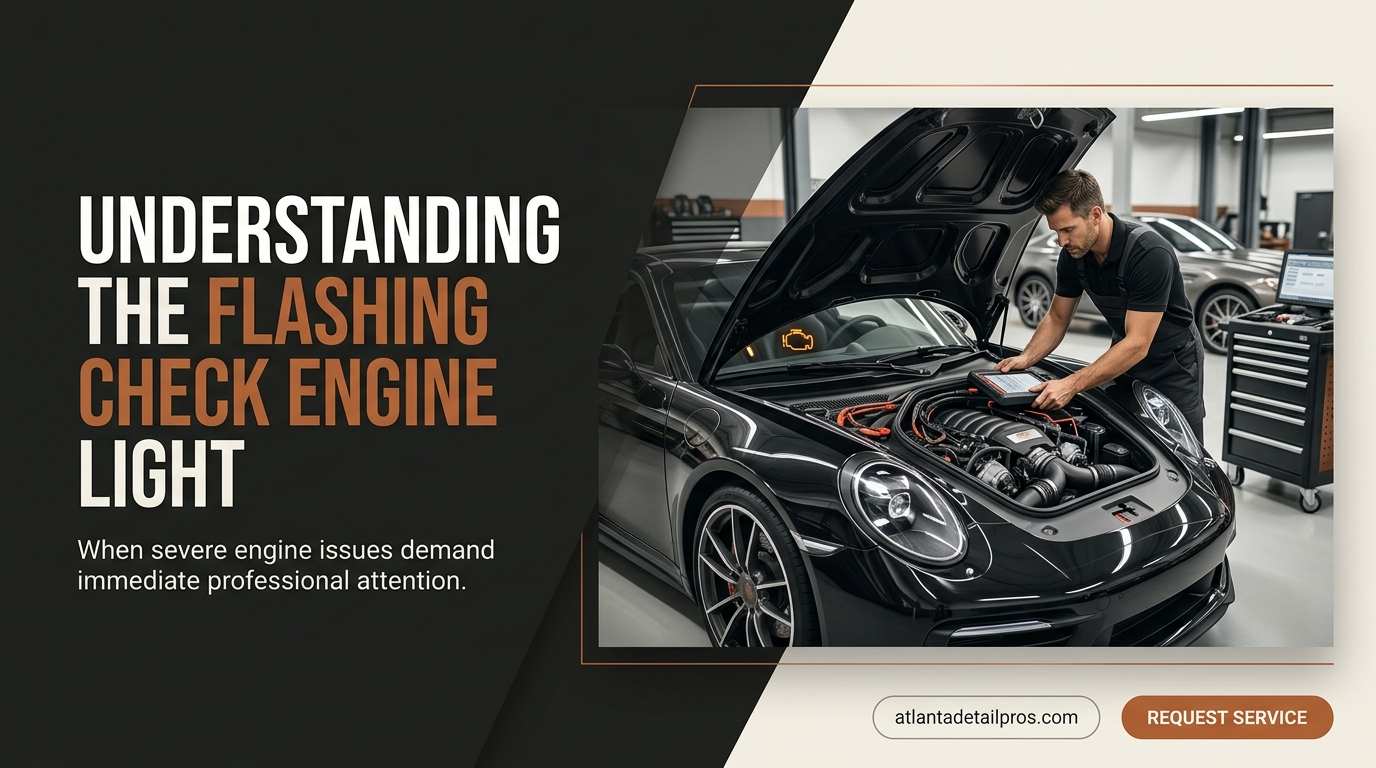
A solid check engine light and a flashing check engine light are not the same warning. They look identical on the dashboard but carry completely different levels of urgency. A solid light means the car has detected a problem and stored a trouble code for a mechanic to read. A flashing or blinking check engine light means the engine is actively misfiring right now, and unburned fuel is entering the catalytic converter at this moment. Every additional mile you drive in that condition causes real, measurable damage.
This article covers exactly what happens inside the engine when the check engine light flashes, what to do if it starts flashing while you are already driving, the most common causes, and the specific repair costs involved if you stop quickly versus if you keep going.
The Critical Difference Between a Flashing and Solid Check Engine Light
Understanding this distinction is the most important thing in this article. Most drivers do not know it, and it is the difference between a repair that costs $150 and one that costs $1,500.
Solid Check Engine Light: Drive Carefully, Diagnose Soon
A steady, continuous check engine light, also called the malfunction indicator lamp or MIL, indicates a fault that the OBD-II system has detected and stored. The car may run normally or with slight symptoms. The code has been set but the condition is not necessarily happening at this exact moment. Common causes of a solid light include a loose gas cap triggering an EVAP code, a failing oxygen sensor, a degraded catalytic converter (P0420), or a minor fuel system issue. Driving to a shop within a day or two is typically acceptable. The vehicle is not destroying itself while you do so.
Flashing Check Engine Light: Stop as Soon as Safely Possible
A flashing or blinking check engine light is the OBD-II system signaling an active, severe misfire. The specific code typically stored is P0300 (random misfire) or P030X (cylinder-specific misfire). During a misfire, the air-fuel mixture in one or more cylinders fails to ignite. That unburned fuel, soaked in raw hydrocarbons, passes through the exhaust valves and enters the hot catalytic converter. Inside the converter, the unburned fuel ignites on the catalyst substrate, creating temperatures far beyond the converter’s designed operating range. The substrate, a honeycomb ceramic structure coated in precious metals including platinum and palladium, begins to melt and fuse. Continued driving completes the destruction.
What Physically Happens to the Catalytic Converter When You Keep Driving
The catalytic converter is the most expensive collateral casualty of a misfire-related blinking check engine light. Most drivers do not realize this is happening because the car may still be running, still drivable, and the only symptom they notice is the flashing dashboard light.
The Thermal Destruction Process
A catalytic converter operates normally at 1,200 to 1,600 degrees Fahrenheit. Unburned fuel entering the converter and combusting inside it can spike temperatures to 2,000 degrees or beyond. Aluminum melts at 1,220 degrees Fahrenheit, but the converter substrate is ceramic, not aluminum. However, at 2,000-plus degrees, even the ceramic lattice begins to crack and fuse. The passages that allow exhaust gas to flow through the converter collapse, the precious metal catalyst coating burns away, and the substrate becomes a solid mass of melted ceramic.
From Misfire Repair to Catalytic Converter Replacement
A single bad ignition coil or worn spark plug that triggers a misfire can be repaired for $80 to $300. Ignore the flashing light and drive on it, and you are converting that modest repair into a catalytic converter replacement at $800 to $2,500 depending on the vehicle and whether it requires a CARB-compliant converter. On many vehicles, the converter is integral to the exhaust manifold, making the replacement substantially more expensive. The sequence from cheap fix to expensive fix plays out in minutes to hours of continued driving, not days or weeks.
What to Do If Your Check Engine Light Is Flashing Right Now
If the light is currently flashing as you read this, the sequence of actions matters. Here is the correct order of operations regardless of where you are when it starts.
If You Are on the Highway When It Starts Flashing
1. Reduce throttle immediately. Take your foot off the gas gradually. Reducing engine load decreases the severity of the misfire and slows the rate of catalytic converter damage. Do not brake hard.
2. Activate your hazard lights and move to the right lane. Signal and move over safely.
3. Take the next exit or pull to a wide highway shoulder at the nearest safe location.
4. Turn the engine off. Stopping the engine stops the misfire and stops unburned fuel from reaching the converter immediately.
5. Wait 30 seconds and restart. In some cases, the misfire is caused by a temporary condition such as water contamination in a single cylinder. If the light restarts as solid rather than flashing, you may be able to drive carefully to a shop at low speed. If it continues flashing on restart, do not drive further.
If the Light Is Flashing and the Car Is Also Shaking
A shaking or vibrating car combined with a flashing check engine light means a severe, multi-cylinder misfire or a very significant single-cylinder misfire. This is the scenario where catalytic converter damage is most rapid. Do not attempt to drive to a shop. Pull over and arrange a tow. Every revolution of the engine in this state is delivering unburned fuel to the converter.
The Most Common Causes of a Flashing Check Engine Light
Knowing the common causes helps you understand the repair estimate you will receive and whether it sounds accurate. Every cause below produces the same immediate danger to the catalytic converter, but the repair cost varies significantly.
Cause | Common Codes | Symptoms Alongside Flashing Light | Typical Repair Cost |
|---|---|---|---|
Failed ignition coil | P030X misfire | Shaking at idle, rough acceleration, one cylinder misfiring | $80-$200 per coil |
Worn spark plugs | P0300, P030X | Rough idle, slow acceleration, poor fuel economy | $100-$300 for full set |
Fuel injector failure | P030X, injector codes | Rough idle, cylinder-specific misfire, fuel smell | $200-$500 per injector |
Low compression (mechanical) | P0300, multiple codes | Severe shaking, significant power loss, smoke | $500-$2,000+ depending on failure |
Vacuum leak causing lean misfire | P0171, P0174, P030X | Rough idle, possibly smooth at speed, lean codes | $50-$400 depending on location |
Flashing Check Engine Light After a Tune-Up: What This Specific Scenario Means
One of the most common calls mechanics receive is from a driver whose check engine light started flashing shortly after a spark plug or coil replacement. This almost always means one of three things: a plug was cross-threaded during installation and is not seating correctly, a coil connector was not fully seated, or an incorrect plug gap is causing intermittent misfire under load. If your light begins flashing within the first few hundred miles of ignition system work, take the car back to whoever performed the service before assuming you need a catalytic converter.
Frequently Asked Questions
Is it safe to drive with a flashing check engine light?
No. A flashing or blinking check engine light indicates an active engine misfire that is sending unburned fuel into the catalytic converter in real time. Every mile driven in this state risks permanent catalytic converter damage. Reduce throttle, pull over safely, turn off the engine, and arrange a tow or a very short low-load drive to the nearest shop. Do not drive normally with a flashing CEL.
What is the difference between a flashing and a solid check engine light?
A solid check engine light means a fault has been detected and stored. The vehicle can typically be driven carefully to a diagnostic appointment within one to two days. A flashing check engine light means the engine is actively misfiring at this moment, with unburned fuel entering and potentially melting the catalytic converter. The flashing light is an emergency. The solid light is an urgent service reminder.
Can a flashing check engine light fix itself?
Occasionally. If the cause was a temporary condition such as water contamination in a fuel injector or a single bad spark firing event, turning the engine off and restarting may resolve the immediate misfire and change the light from flashing to solid. If the flashing restarts after the engine is restarted, the underlying fault is active and persistent. Do not drive on a persistent flashing light hoping it resolves itself.
How much damage can a flashing check engine light cause?
The primary damage is to the catalytic converter. A replacement catalytic converter costs $800 to $2,500 on most passenger vehicles, significantly more on performance and European vehicles. The original misfire cause, typically a coil or spark plug, costs $80 to $300. Driving on a flashing light turns a $150 repair into a $1,500 one. Secondary damage from severe misfires includes piston ring wear from unburned fuel washing the cylinder walls, and in extreme cases, valve damage from thermal stress.
The Bottom Line
The check engine light has two modes and they require two completely different responses. Solid: drive carefully and get it scanned within a day or two. Flashing: stop as soon as safely possible, turn off the engine, and arrange a tow if the misfire persists after a brief restart. The catalytic converter is an $800 to $2,500 part. A coil pack is $80 to $200. The flashing light is telling you which future you are in at this exact moment, and you have the ability to choose the cheap one by pulling over.