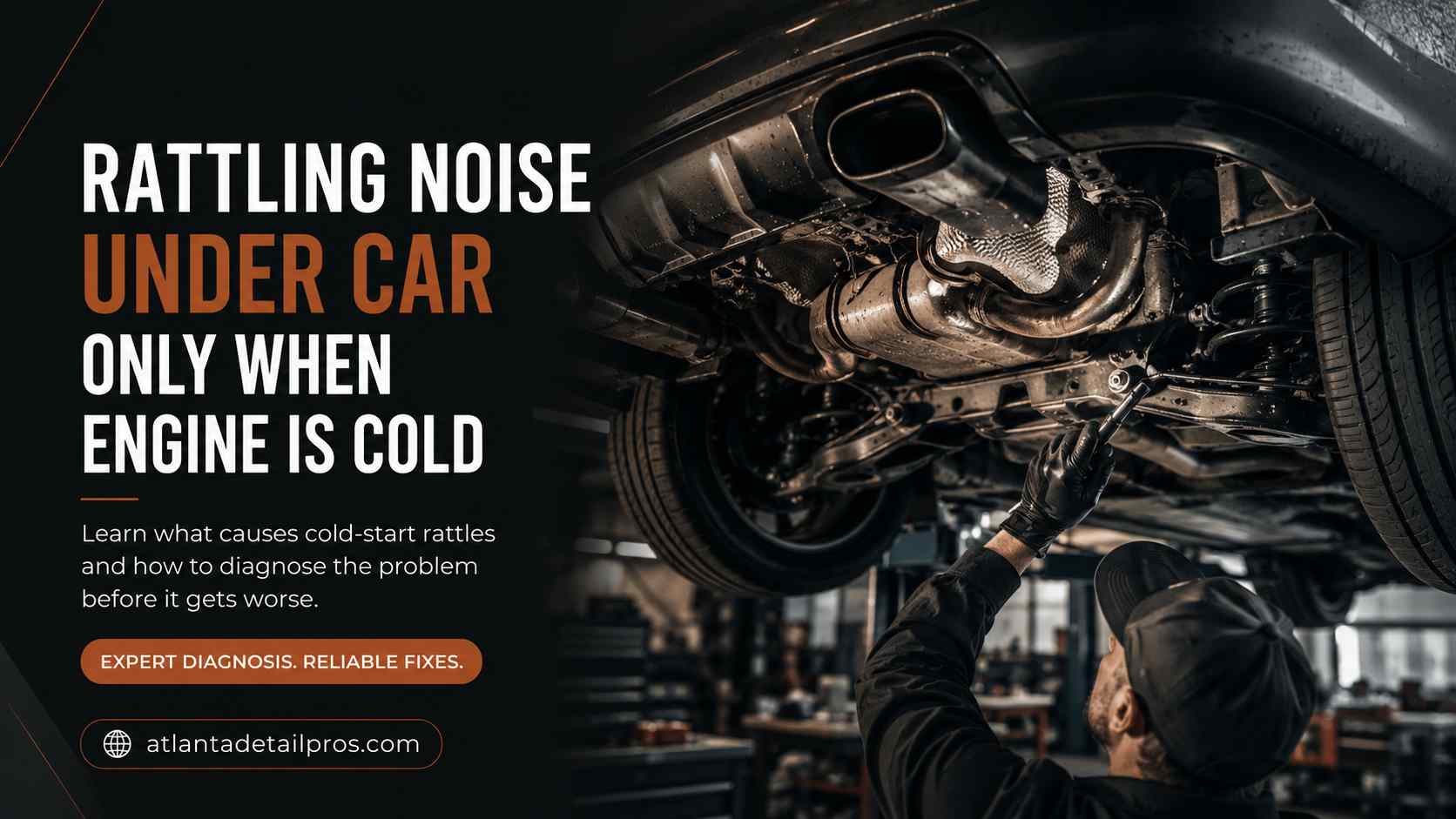
A rattling sound from beneath the vehicle that occurs when the engine is cold and disappears as the engine warms up is the acoustic signature of a component that vibrates at cold-idle conditions and settles as thermal expansion changes the fit between parts. The exhaust system is the primary source of this symptom because its components undergo the greatest thermal expansion from cold to operating temperature of any system in the vehicle.
The most common cause of a cold-only rattle from under the car is a loose or corroded exhaust heat shield. Heat shields are thin metal covers that protect nearby components from exhaust heat. They are attached to the exhaust pipe or catalytic converter with small clips or spot welds that corrode over time, allowing the shield to become loose. At cold idle, engine vibration causes the loose shield to rattle against the exhaust pipe or nearby metal. As the exhaust heats up and the metal expands, the shield either tightens against its mounting or changes its resonant frequency, and the rattle stops.
This guide covers every cause of a cold-only under-car rattle in order of likelihood, how to confirm each cause, whether any require urgent attention, and the repair options from simple to complex.
Why the Cold-Only Pattern Points to Heat-Affected Components
The exhaust system experiences the most dramatic temperature change of any vehicle system. From a cold start, the exhaust manifold, catalytic converter, and exhaust pipes heat from ambient temperature to 800 to 1,600 degrees Fahrenheit at the manifold and 400 to 800 degrees at the downstream pipes, all within the first few minutes of operation. This temperature change causes significant thermal expansion in every metal component involved.
A component that rattles when cold but not when hot is either a component whose loose fit tightens with thermal expansion (the heat shield case) or a component whose vibration characteristics change with temperature (the catalytic converter substrate case). Both behaviors are explained by the thermal physics of metal and ceramic components responding to temperature change.
The Most Common Cause: Loose or Corroded Heat Shields
Every catalytic converter, and most sections of exhaust pipe near heat-sensitive components, is covered by one or more heat shields. These are typically thin steel covers attached by spot welds, stamped clips, or exhaust clamps. Over years of thermal cycling, the connection points corrode and fatigue, allowing the shield to separate partially from its mounting while remaining physically attached by the last connection point.
A partially detached heat shield rattles against the exhaust pipe, nearby frame members, or itself at engine idle frequencies. The rattle is typically described as a metallic buzzing or tinny rattling that changes or stops when the exhaust temperature rises. It may also change with engine RPM: higher RPM may cause or stop the rattle depending on the resonant frequency of the loose shield.
Diagnosis: with the engine cold and running at idle, crawl under the vehicle and listen for the rattle source. With the engine off and cold, push and shake heat shields along the exhaust path; a loose one will move and rattle when manually shaken. Heat shields cannot be safely touched when hot; perform this inspection only when the exhaust is cold.
Repair options: a heat shield that is partially detached but structurally intact can often be secured with a heat-resistant clamp or exhaust repair clamp available at auto parts stores for under $20. A heat shield that is significantly corroded or deteriorated requires replacement, which a shop typically charges $75 to $200 to handle including parts and labor.
Catalytic Converter Internal Substrate Rattling
The catalytic converter contains a ceramic honeycomb substrate coated with precious metal catalysts. This ceramic structure is held in place within the converter housing by a ceramic mat material that compresses around the substrate. When the mat material degrades or the ceramic substrate cracks from thermal stress, physical impact (grounding the undercarriage), or age, the substrate can move within the housing and produce a rattle.
A rattling catalytic converter substrate produces a metallic clanking or shaking sound that comes specifically from the catalytic converter location rather than from sections of bare exhaust pipe. Unlike a heat shield rattle, a substrate rattle does not necessarily stop completely at operating temperature; it may change in character but persist as heat cycles progress.
This cause is more serious than a heat shield rattle because: a deteriorating substrate affects emissions compliance and can cause the vehicle to fail an emissions test; a badly degraded substrate can shed ceramic fragments that are pulled into the engine or restrict exhaust flow; and catalytic converter replacement is a significant repair costing $200 to $1,200 depending on whether aftermarket or OEM replacement is used and the vehicle platform.
Exhaust System Loose Connections and Hangers
The exhaust system is suspended from the chassis by rubber hangers at multiple points. When a hanger breaks, deteriorates, or pulls through, the section of exhaust it was supporting drops slightly and may contact the chassis, floor pan, or other components during vibration. This contact produces a rattle, clunk, or knocking sound that may be cold-only if the thermal expansion of the exhaust changes the clearance between the exhaust pipe and the component it is contacting.
Inspection: walk along the exhaust system from the engine back and locate each rubber hanger. Pull the exhaust pipe gently sideways; if it moves more than a small amount, a hanger is missing or broken. Replacement rubber exhaust hangers typically cost $5 to $20 each and can be replaced without special tools in most cases.
Loose exhaust joints or failed exhaust clamps also cause rattling that may be cold-only if the clamp provides adequate sealing when hot but allows movement when cold. An exhaust clamp that can be moved by hand while the exhaust is cold is not properly securing the joint.
Engine and Transmission Mounts
Engine and transmission mounts are rubber cushions that isolate the powertrain from the chassis. They absorb engine vibration and prevent it from transmitting to the vehicle body. When a mount deteriorates, cracks, or collapses, the engine or transmission moves excessively in response to engine vibration, and that movement can cause the powertrain to contact nearby chassis components, exhaust connections, or fluid lines.
A failed engine mount that causes a cold-only rattle typically reflects the higher vibration amplitude of a cold engine running at a richer fuel mixture compared to a warm engine at normal idle. As the engine warms, fuel trim stabilizes and idle smoothness improves, reducing the vibration amplitude enough that a partially failed mount no longer causes contact.
Engine mount inspection: with the engine running at idle, observe the engine from the side (keep hands clear of all moving components). Excessive engine movement (rocking more than a centimeter during normal idle) suggests a failed mount. A mechanic can verify this on a lift by using a pry bar to apply load to the mount and checking for collapse or separation of the rubber.
Plastic Under-Engine Covers and Splash Guards
Most modern vehicles have plastic covers under the engine that protect components from road debris and improve aerodynamics. These covers are attached with plastic clips, bolts, or screws that corrode or break over time. A cover that is partially detached can vibrate against the chassis at idle, producing a rattling sound that may change as the exhaust heats adjacent components and causes slight thermal expansion.
This is the least serious cause of a cold-only under-car rattle and one of the easier to check. Inspect the underside of the engine area for any plastic covers that are hanging lower than they should be or that have missing fasteners. Replacement clips cost $1 to $5 each at auto parts stores, and replacement splash guards are typically $20 to $80 for the part alone.
How to Diagnose Without a Shop Visit
Diagnosis Test | What to Do | What It Tells You |
|---|---|---|
Cold shake test | With exhaust cold, manually shake heat shields along the exhaust path | A shield that rattles when shaken is the rattle source; check all shields from cat to tailpipe |
Cold idle listen from underneath | With car safely on level ground, crawl under and listen while cold | Localize noise to exhaust vs engine vs chassis area |
RPM change test | Rev engine gently from idle to 1,500 rpm and release | If rattle starts or stops at specific RPM, it is resonance-driven: heat shield or exhaust |
Drive and warm test | Drive normally for 5 minutes; does rattle stop completely? | Stops completely: thermal expansion cause (heat shield likely). Persists: substrate or mount |
Visual hanger inspection | Walk the exhaust from engine to tailpipe; pull each pipe sideways gently | Missing or broken hanger shows as excessive exhaust pipe movement |
Under-cover inspection | Look at plastic engine covers and splash guards | Any hanging lower than expected or missing fasteners identifies that source |
These tests can be performed safely at home in a driveway. The most important safety rule: never inspect or touch exhaust components while they are hot. Allow at least 30 to 45 minutes of complete cooling after any driving before crawling underneath to inspect or shake the exhaust system.
Frequently Asked Questions
What causes a rattling noise under the car when the engine is cold?
The most common cause is a loose or corroded exhaust heat shield, which vibrates against nearby metal at cold-idle frequencies and stops rattling as the exhaust heats and expands. Other causes include a deteriorating catalytic converter substrate (more serious), loose exhaust hangers, a failed engine or transmission mount, and loose plastic under-engine covers.
Is a cold-engine rattle under the car serious?
The seriousness depends on the cause. A loose heat shield is not a mechanical risk to the vehicle but the shield should be secured before it falls off completely or contacts a tire or brake component. A rattling catalytic converter substrate is more serious because it indicates converter deterioration that affects emissions and can damage the engine. Engine mount failure is moderate urgency. Loose plastic covers are the least serious.
How do I find the source of a rattle under my car?
With the exhaust completely cold (allow 45 minutes of cooling after driving), crawl under the vehicle and manually shake each heat shield along the exhaust path. A loose shield rattles when shaken. Also listen to the rattle while the engine is at cold idle to identify whether the sound is coming from the exhaust area, the engine area, or a chassis-mounted component. Changes in rattle with engine RPM point toward an exhaust or engine-resonance cause.
What does a rattling catalytic converter sound like?
A rattling catalytic converter produces a metallic shaking or clanking sound from beneath the vehicle in the area where the converter is located (typically under the front portion of the vehicle or under the passenger compartment depending on the vehicle). Unlike a heat shield rattle, catalytic converter substrate rattling may persist at operating temperature as well as when cold. A very loose or deteriorated substrate sounds like rattling marbles inside a can.
Can a loose heat shield cause any damage?
A loose heat shield that is still physically attached does not cause mechanical damage in most cases. However, a shield that falls off completely can contact a tire or brake component, which is a more serious problem. A shield that is missing exposes nearby components (fuel lines, brake lines, floor insulation) to higher heat levels from the exhaust. Securing or replacing a loose shield promptly is good practice.
How much does it cost to fix a heat shield rattle?
A heat shield that is loose but intact can often be secured with an aftermarket exhaust clamp or heat shield clamp for under $20, which can be installed at home. A shop will charge $75 to $200 to secure or replace a heat shield including parts and labor. A catalytic converter replacement, if the substrate is the cause, costs $200 to $1,200 depending on the vehicle and whether aftermarket or OEM parts are used.
Why does the rattle under the car stop when the engine warms up?
A cold-only rattle typically stops because thermal expansion changes the physical relationship between the rattling component and whatever it was contacting. A loose heat shield may tighten against its mounting point as the metal expands with heat, eliminating the play that caused the rattle. The exhaust system as a whole also changes its resonant frequency with temperature, which can cause a cold rattle at one frequency to disappear once the system heats to operating temperature.
Can exhaust hangers cause a rattle?
Yes. A broken or missing exhaust hanger allows that section of exhaust pipe to drop slightly toward the chassis. Vibration from the engine then causes the exhaust pipe to contact the floor pan, frame, or adjacent components, producing a rattling or clanking sound. This contact may be more pronounced when cold because the exhaust pipe has not yet expanded to its warm dimensions, which can change clearances slightly.
The Bottom Line
A cold-only rattle from under the car is most commonly a loose heat shield, which is one of the least serious mechanical issues a vehicle can have. The shield rattles at cold-idle frequencies and settles as temperature changes the physical relationship between the shield and its mounting. Securing or replacing it is a low-cost repair.
The cold-only rattle that warrants more urgency is one that comes from the catalytic converter location and either persists slightly at operating temperature or is accompanied by a check engine light for catalytic converter efficiency. Substrate deterioration is a more involved repair.
Perform the cold shake test on the heat shields before scheduling any shop visit. If the rattle source can be identified and confirmed as a heat shield, the repair options range from a $15 clamp to a $150 shield replacement, both of which are accessible to any independent shop and straightforward to diagnose. If the cold shake test does not identify the source, a professional inspection on a lift is the efficient next step.