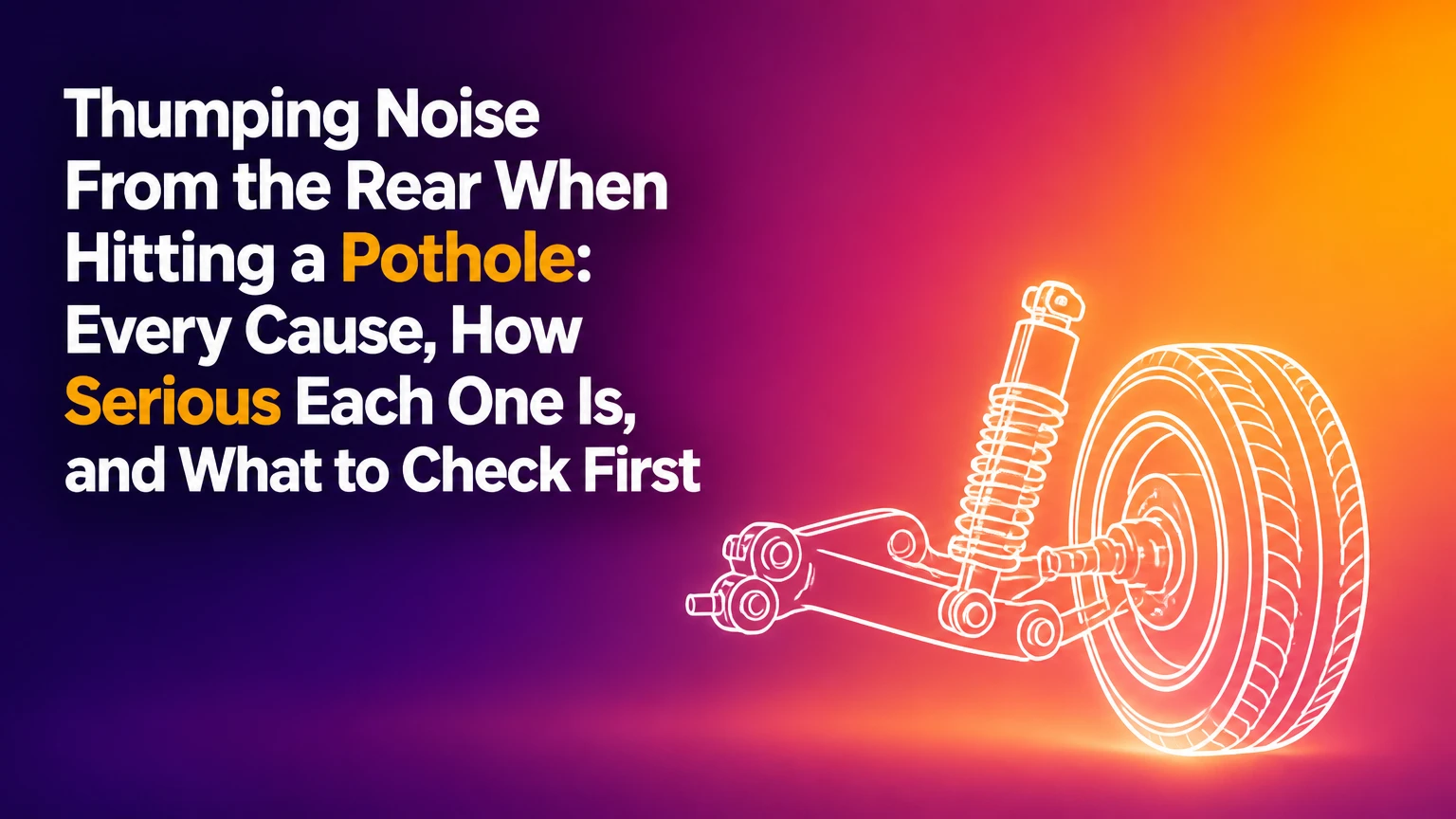
A thumping noise from the rear of the car when hitting a pothole is most commonly caused by a failing shock absorber or strut that has lost its ability to control suspension rebound, causing the wheel to thump against the bump stop or the spring to bottom out under the large, sudden load of a pothole impact.
Other common causes include a broken coil spring, a severely worn trailing arm or control arm bushing, or a worn shock mount that allows excessive movement at the top of the shock assembly.
What distinguishes the pothole thump from smaller bump noises is the severity of the suspension input. A pothole compresses the suspension rapidly to near its full travel limit, testing every component through its complete range in a fraction of a second. Components that survive normal driving because they have some residual function will fail this test and produce the thump.
This guide covers every rear thumping cause by probability, the specific diagnostic steps to identify which component has failed, the safety implications of each cause, and the repair costs you should expect.
Worn or Blown Shock Absorbers: The Primary Suspect
A shock absorber controls the speed at which the suspension moves. When you hit a pothole, the shock is meant to resist the rapid compression and then control the rebound so the tire returns to the road smoothly. A worn shock absorber that can no longer resist rapid movement allows the suspension to compress fully and the wheel to impact the rubber bump stop at the bottom of suspension travel with a thump. On rebound, a blown shock allows the suspension to extend rapidly, and the same thump can occur as the shock reaches full extension without control.
How to identify worn shocks without a shop visit: park on a level surface and push down firmly on each rear corner of the vehicle, then release. A good shock absorbs the energy and the corner returns smoothly to ride height in one motion. A worn shock allows the corner to bounce two or more times before settling. This jounce test is not perfectly accurate for all shock designs but gives a reliable indication of severely degraded shock function.
Shock absorber replacement on most passenger vehicles costs $250 to $500 per axle (both rear shocks together) at an independent shop for standard equipment. Performance or electronically controlled shocks cost significantly more. Most shops recommend replacing shocks in pairs on the same axle to maintain balanced handling.
Broken Rear Coil Spring
A broken coil spring is a more urgent finding than a worn shock absorber because a spring fracture changes the ride height on the affected corner and can cause the broken spring end to contact the tire during turning. A broken rear spring typically produces a single, loud thump over large bumps and may also cause the rear of the vehicle to sit noticeably lower on one side.
How to identify a broken spring: inspect each rear spring visually by looking between the coils from above and the side. A broken spring will show a clean fracture through one coil, with the two portions of the broken coil separated. This inspection requires looking into the wheel well area and may require a flashlight and some maneuvering to see the lower coil where breaks most commonly occur.
A broken rear coil spring is a safety issue if the broken end contacts the tire. Have the vehicle inspected promptly if a broken spring is suspected. Repair cost for rear coil spring replacement: $200 to $450 per side including parts and labor at an independent shop. Most shops replace both rear springs together because if one has failed from age and material fatigue, the other is likely to follow soon.
Trailing Arm and Control Arm Bushing Failure
Rear suspension geometry is maintained by control arms or trailing arms that connect the rear axle or wheel carrier to the chassis. These arms pivot through rubber bushings that absorb vibration and allow controlled movement. When the bushings crack, tear, or collapse from age and fatigue, the arm has excessive movement at its pivot, and a large input like a pothole causes the arm to move beyond its design range, producing a thump as it contacts adjacent metal or reaches the end of its allowable travel.
Trailing arm bushing failure is more likely on older vehicles and typically affects vehicles that have seen significant mileage on rough roads. The thumping from bushing failure is often accompanied by reduced directional stability in corners and a vagueness in the steering when weight shifts in the rear of the vehicle. Alignment abnormalities (rear toe or camber out of specification) are often found alongside bushing failure.
Bushing replacement cost: $200 to $500 per side for bushing-only replacement. Full trailing arm replacement (arm plus bushings as an assembly) runs $250 to $600 per side at an independent shop. This is the preferred approach on high-mileage vehicles where the arm itself may have sustained damage from operating with worn bushings.
Shock Absorber Mount and Upper Bearing Failure
The shock absorber or strut is attached to the vehicle body at the top through a mount that typically includes a rubber cushion and, on struts, a bearing that allows rotation during steering. When the upper mount deteriorates, the shock absorber can knock or thump at its mounting point during large suspension inputs. A broken upper mount isolator can also allow the shock shaft to contact the mount housing directly, producing a sharp metallic thump.
Upper mount failure is most common on high-mileage vehicles and often occurs alongside worn shock absorbers. Shops typically replace upper mounts at the same time as shock absorbers because both components are exposed to the same age and stress conditions.
Loose Spare Tire, Exhaust, and Easy Checks First
Before assuming a suspension component has failed, verify the following: the spare tire under the floor or mounted externally is fully tightened to its carrier; the exhaust system hangers are intact and the exhaust is not loose enough to contact the floor pan over large bumps; and there are no unsecured heavy items in the trunk or cargo area.
A spare tire that has loosened in its under-vehicle carrier produces a thumping sound over bumps that is frequently mistaken for a suspension problem. This check takes 60 seconds and sometimes eliminates the need for a shop visit entirely. Tighten the spare tire thumbscrew located in the trunk or cargo floor, then test-drive over the same road surface.
Urgency Rating and What Happens Without Repair
Cause | Safety Risk | Urgency | Repair Cost Range |
|---|---|---|---|
Worn shock absorbers | Moderate: reduced stability; longer stopping distance | Repair within 30 to 60 days | $250 to $500 per axle |
Broken coil spring | High: spring end may contact tire; corner drops | Repair within 1 week or sooner | $200 to $450 per side |
Trailing arm bushing failure | Moderate: alignment and handling affected | Repair within 30 days | $200 to $600 per side |
Upper shock mount failure | Moderate: shock movement affects control | Repair with next shock service | $100 to $250 per side (with shock) |
Loose spare tire | Very low: non-structural noise | Immediate: free to fix | No cost |
Frequently Asked Questions
What causes a thumping noise from the rear when hitting a pothole?
The most common cause is a worn or blown shock absorber that allows the suspension to reach its travel limit during the pothole impact, causing the wheel to thump against the bump stop. Other causes include a broken rear coil spring, failed trailing arm bushings, a loose shock mount, or the much simpler case of a loose spare tire in its carrier.
Is a thumping rear suspension dangerous?
The safety risk depends on the cause. Worn shock absorbers increase stopping distance and reduce stability in emergency maneuvers but do not cause immediate vehicle control loss. A broken coil spring is more urgent because the broken end can contact the tire during turns. Severely worn trailing arm bushings affect alignment and handling predictability. Any rear suspension thump warrants inspection.
How do I know if my rear shock absorbers are blown?
The jounce test provides a quick assessment: push down firmly on each rear corner of the vehicle and release. If the corner bounces more than once before settling, the shock absorber has lost its damping function. Visual inspection of the shock absorber body for oil leaks (a wet or oily appearance around the shock shaft) also indicates a failing shock. A vehicle that wallows, bounces excessively over bumps, or feels loose over rough roads typically has worn shocks.
How much does it cost to fix a rear thumping noise?
Cost depends on the cause. Shock absorber replacement: $250 to $500 for both rear shocks. Coil spring replacement: $200 to $450 per side. Trailing arm bushing replacement: $200 to $600 per side. Upper shock mount: $100 to $250 per side added to a shock replacement. A shop diagnosis typically adds $80 to $150 if the cause is not immediately obvious.
Can a pothole break a car spring?
Yes. A severe pothole impact can fracture a coil spring, particularly on older vehicles where the spring material has been weakened by corrosion and fatigue from years of thermal cycling and load stress. A broken spring is a more severe symptom than shock wear and warrants prompt inspection because the broken spring end can contact the tire.
Why does the rear thump only on large bumps and not small ones?
Large bumps and potholes compress the suspension through a larger range of motion in a very short time. Components that retain some residual function during normal driving are overwhelmed by this sudden large input and fail at the extremes of their range. A shock absorber that provides adequate damping during small bumps may allow full suspension travel bottoming during a pothole, producing the thump at the travel limit.
How long can I drive with a thumping rear suspension?
Worn shock absorbers allow several months of cautious driving before the safety impact becomes urgent, but the ride quality and handling continue to degrade. A broken coil spring should be repaired within days. In all cases, avoiding potholes and rough road surfaces minimizes further damage during the period before repair. The repair should be scheduled promptly rather than deferred indefinitely.
Should rear shocks be replaced in pairs?
Yes. Automotive engineers and most mechanics recommend replacing shock absorbers in pairs on the same axle because both sides have experienced the same service life, mileage, and stress conditions. Replacing one side while leaving the other worn creates an imbalance in damping between the two rear wheels, which can cause uneven handling, particularly during emergency braking or evasive maneuvers.
The Bottom Line
A rear thump over potholes points directly to the suspension components designed to control large-load inputs: shock absorbers, coil springs, and the bushings and mounts that hold them. The jounce test at each rear corner, the visual inspection for a broken spring, and the 60-second check of the spare tire carrier identify the most likely causes without any tools or shop visit.
The repair urgency varies by cause. A broken spring is the most time-sensitive finding; worn shocks allow more time but should not be deferred for months because handling degradation continues and eventual handling in emergency situations is genuinely compromised. Schedule an inspection within a week of first noticing a consistent rear thump over large inputs.