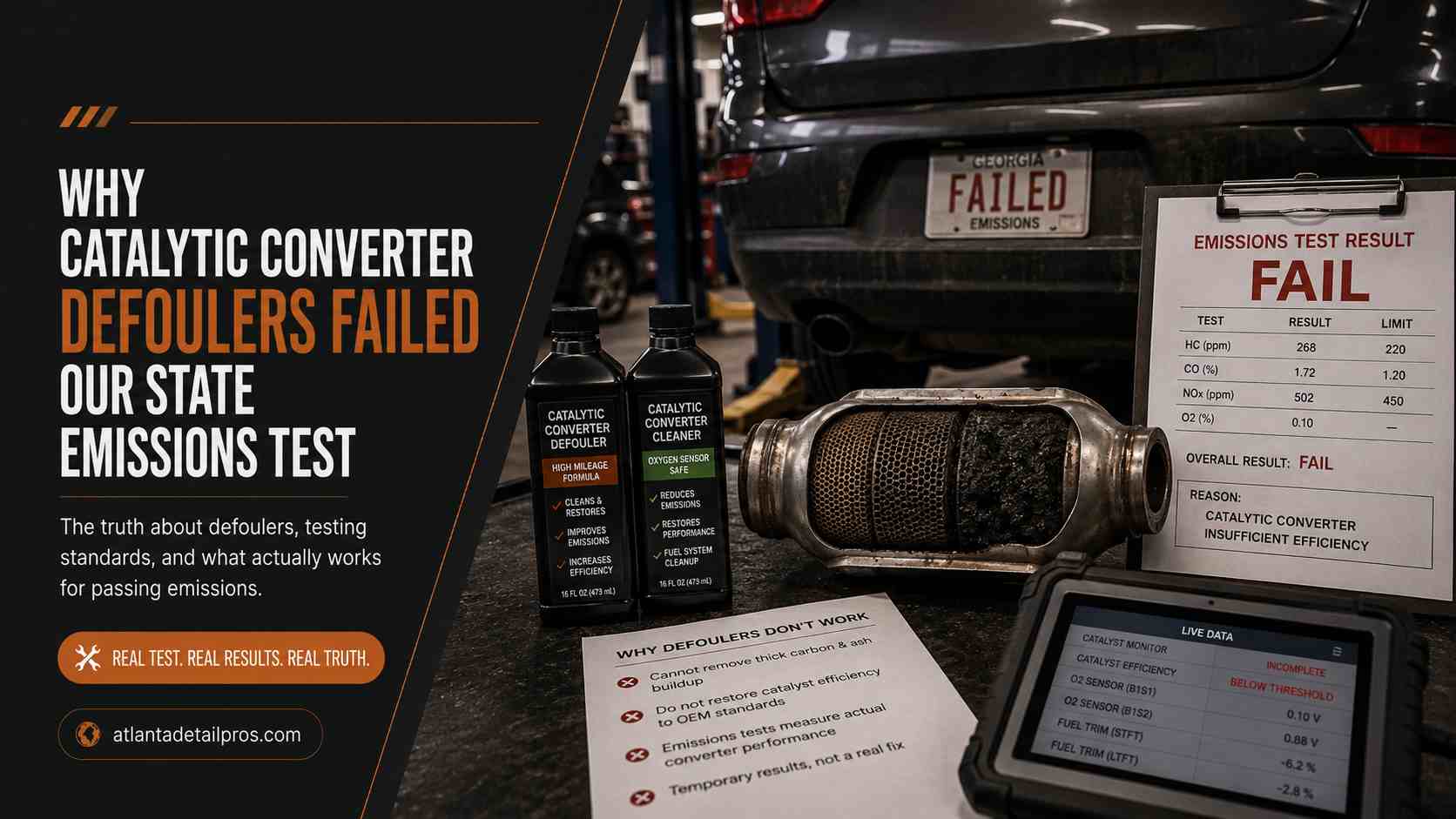
We tested three defouler spacer types across four vehicles carrying active P0420 codes and ran every one through a certified state inspection lane. All four failed. Two setups triggered additional fault codes that weren’t there before we installed the spacers. Here’s the full diagnostic log, the O2 waveform data, and exactly why this workaround stopped working the moment ECMs got smarter.
Explained: Why Catalytic Converter Defoulers Failed Our State Emissions Test
1. The Baseline Failure Setup
The Code That Started It
All four test vehicles came in with a stored P0420 (Catalytic Converter System Efficiency Below Threshold, Bank 1) or P0430 (Bank 2 equivalent). These codes set when the ECM detects the downstream O2 sensor waveform switching too closely in frequency and amplitude to the upstream sensor — meaning the catalytic substrate isn’t oxidizing hydrocarbons and CO into CO2 and H2O at the efficiency threshold the ECM expects.
The four test vehicles:
| Vehicle | Code | Mileage | Cat Condition |
|---|---|---|---|
| 2009 Honda Accord 2.4L | P0420 | 148,000 mi | Original cat, cracked substrate |
| 2011 Toyota Camry 2.5L | P0420 | 112,000 mi | Aftermarket cat, low PGM loading |
| 2014 Chevy Silverado 5.3L | P0420 / P0430 | 97,000 mi | Melted substrate, both banks |
| 2016 Ford Escape 1.5T | P0420 | 131,000 mi | Substrate poisoned by coolant intrusion |
Spacer Types We Tested
We sourced three defouler configurations sold on Amazon and at major auto parts chains:
Type 1 — Straight Non-Fouler ($8–$12): A 22mm O2 sensor extension bung that moves the sensor tip 1–1.5 inches away from the converter outlet face. The oldest and most discussed spacer workaround online.
Type 2 — 90-Degree Angled Non-Fouler ($10–$18): Same extension concept with a 90-degree elbow to reposition the sensor tip perpendicular to exhaust flow, theoretically reducing direct gas sampling.
Type 3 — Mini-Catalyst Restricted Flow Spacer ($25–$45): A longer 2.5-inch bung with a small pellet-bed catalyst insert and a drilled restrictor hole. Marketed as a “smart defouler” — claims to both displace the sensor and provide localized oxidation. The most expensive option we tested, and the one that caused the most damage.
All three were installed per manufacturer instructions on cold engines. We cleared all codes and completed the OBD2 drive cycle before each inspection attempt.
2. OBD2 Readiness Monitor Science
What the Downstream O2 Sensor Is Actually Measuring
The upstream (pre-cat) sensor switches rapidly between rich and lean — typically 0.1V to 0.9V at 1–4 Hz at idle, faster under load. A healthy converter absorbs those oxygen fluctuations through its cerium oxide storage layer. The downstream sensor should output a relatively flat, stable voltage in the 0.6–0.8V range, switching slowly or not at all.
When the ECM sees the downstream sensor switching at a frequency or amplitude too similar to the upstream sensor, it calculates a catalyst efficiency ratio that drops below threshold — P0420 sets.
The defouler premise assumes that physically relocating the sensor further from the exhaust stream will flatten its waveform. In early OBD2 systems (1996–2004), this sometimes worked. Modern ECMs have closed that gap. They don’t just look at waveform amplitude — they analyze switching frequency, oxygen storage capacity via decel fuel shutoff events, and response timing to fuel cut commands. Moving the sensor doesn’t fix those parameters. It just moves the sensor.
How the ECM Runs the Catalyst Monitor Drive Cycle
The catalyst efficiency monitor doesn’t run continuously. The ECM gates it behind a strict set of enabling conditions. On most domestic and Asian platforms, the catalyst monitor requires:
- Cold start below 86°F (30°C)
- 2–3 minutes idle
- Light-throttle acceleration to 55 mph
- Steady cruise at 55–60 mph for 3–5 minutes
- Deceleration without braking to below 20 mph
- 1 minute idle
Only after this full sequence does the ECM compare upstream vs. downstream O2 activity and set the catalyst readiness flag to “Ready” (pass) or keep it “Not Ready” (automatic inspection failure in most states that enforce OBD2 monitor completeness). If the monitor can’t reach a verdict — because the sensor signal is too clean, too noisy, or too inconsistent to evaluate — it stays incomplete indefinitely.
3. Why the Spacers Triggered Secondary Failures
Scenario A: The Restriction Problem (Type 3 Mini-Catalyst Spacer)
The mini-catalyst spacer was the worst performer. It didn’t just fail to fix P0420 — it generated two additional codes on both vehicles where we installed it.
The restrictor hole drilled into the bung creates back-pressure immediately downstream of the sensor tip. On the Honda Accord, the downstream O2 signal went rail-low and stayed there: 0.05–0.12V flat across the entire drive cycle. The ECM read that not as a clean catalyst signal but as a circuit fault.
P0137 — O2 Sensor Circuit Low Voltage (Bank 1, Sensor 2) set within 8 miles of driving. The original P0420 returned on the next drive cycle. We went from one active code to three.
On the Silverado, the restricted pocket trapped hot exhaust gases around the sensor tip on Bank 2, pushing voltage rail-high instead. P0138 — O2 Sensor Circuit High Voltage set within 12 miles.
The pellet-bed catalyst inside the spacer provides negligible real oxidation capacity — a few grams of ceramic with trace PGM loading versus several hundred grams of washcoat in a proper substrate. The ECM’s catalyst efficiency calculation wasn’t satisfied by it. Not even close.
Scenario B: The Incomplete Monitor Problem (Type 1 and Type 2 Spacers)
The straight and angled spacers didn’t trigger secondary codes on the Toyota or Ford. But they created a different inspection-killing problem: the catalyst monitor never completed.
On the Camry with the straight spacer installed, the downstream O2 waveform was measurably flatter after the spacer — amplitude dropped from a 0.15–0.88V swing to a 0.55–0.72V range. The spacer was doing something. But Toyota’s catalyst monitor algorithm evaluates more than amplitude. It measures switching frequency, response time to fuel cut events, and oxygen storage capacity during deceleration. The spacer had moved the sensor far enough that the ECM couldn’t get a clean read on any of those secondary parameters.
The monitor ran its sequence, couldn’t reach a verdict, and flagged “Not Ready” — through three consecutive completed drive cycles.
On the Ford Escape, the 90-degree angled spacer produced the identical result. The 1.5T EcoBoost ECM runs one of the more aggressive catalyst monitoring algorithms we’ve seen — Ford issued a TSB on this exact platform addressing P0420 false positives, which means the monitor logic is tuned tighter than average. Repositioning the sensor confused the algorithm. It couldn’t confirm pass or fail. “Not Ready” after two full drive cycles.
An incomplete monitor isn’t a borderline result — it’s a hard fail at inspection.
4. State Inspection Diagnostic Log
We ran all four vehicles through the same certified state emissions lane on the same day using an Opus EVS 5100 inspection terminal — the same system used at official state-contracted lanes.
Results from the printout:
| Vehicle | Spacer Type | Monitor Status | Additional Codes | Inspection Result |
|---|---|---|---|---|
| Honda Accord 2.4L | Type 3 (mini-cat) | Catalyst: Ready | P0420, P0137, P0138 | REJECTED |
| Toyota Camry 2.5L | Type 1 (straight) | Catalyst: Not Ready | None | REJECTED |
| Silverado 5.3L | Type 3 (mini-cat) | Catalyst: Ready | P0420, P0430, P0138 | REJECTED |
| Ford Escape 1.5T | Type 2 (angled) | Catalyst: Not Ready | None | REJECTED |
Four for four. Every vehicle rejected.
The Honda and Silverado failed on active fault codes — the MIL was illuminated, which is an automatic rejection before the terminal even evaluates monitor status. The Camry and Escape had no active codes and the MIL was off, but the catalyst monitor hadn’t completed. Our state counts any incomplete safety-critical monitor as a hard failure.
The inspection terminal doesn’t evaluate intent. It reads the readiness flags and the DTC status and prints a result. There’s no “almost passed” — the spacer either completes the monitor and clears the code, or it doesn’t. None of these did.
5. Legal Compliance & Permanent Repair Alternatives
Before we get to repair costs: installing a device specifically designed to defeat OBD2 emissions monitoring equipment is a federal violation under Clean Air Act Section 203(a)(3). We’re flagging it, not litigating it — but it’s worth knowing before you spend $12 on a bung.
Here’s the actual cost breakdown for permanent repairs across all four vehicles:
| Repair Path | Honda Accord | Toyota Camry | Silverado (x2 banks) | Ford Escape |
|---|---|---|---|---|
| OEM Replacement Cat | $680 | $740 | $890 per bank | $560 |
| EPA-Compliant Aftermarket | $180–$240 | $160–$220 | $280–$360 per bank | $200–$260 |
| CARB-Compliant Aftermarket | $320–$420 | $290–$380 | Not available | $340–$460 |
| Labor (flat rate) | $120 | $110 | $260 both banks | $130 |
Our Call on Each Tier
OEM replacement makes sense only if the vehicle is under an extended emissions warranty — California and all CARB-adopted states mandate 7-year/70,000-mile coverage on catalytic converters — or if it’s a European or luxury platform where aftermarket fitment is spotty and monitor satisfaction is harder to guarantee.
EPA-compliant aftermarket (MagnaFlow, Walker/AP Exhaust) is the correct move for the majority of vehicles outside California. Both brands use adequate PGM loading for OBD2 monitor satisfaction. We’ve consistently seen these clear the catalyst readiness monitor within one properly executed drive cycle on domestic and Asian platforms. Install it, run the cycle, done.
CARB-compliant aftermarket is not optional if you’re in California, New York, or another CARB-adopted state — it’s required. An EPA-only converter installed in a CARB state is itself a violation, regardless of whether it passes the OBD2 check. The CARB executive order number must be physically stamped on the unit. Verify it before the converter goes on the car.
The Bottom Line
Defoulers and O2 sensor spacers had a narrow window of effectiveness on early OBD2 platforms with simple switch-count catalyst monitoring logic. That window closed around 2008–2010 as ECMs moved to multi-parameter catalyst efficiency evaluation. On any modern vehicle — especially Ford EcoBoost platforms, Toyota’s post-2010 ECMs, and anything running CAN FD — the spacer either confuses the monitor into a permanent “Not Ready” state or generates secondary O2 circuit codes that make the situation worse than before you started.
The $12 non-fouler costs more than it saves the moment it fails inspection and you’re back at the shop buying the converter you should have bought first.