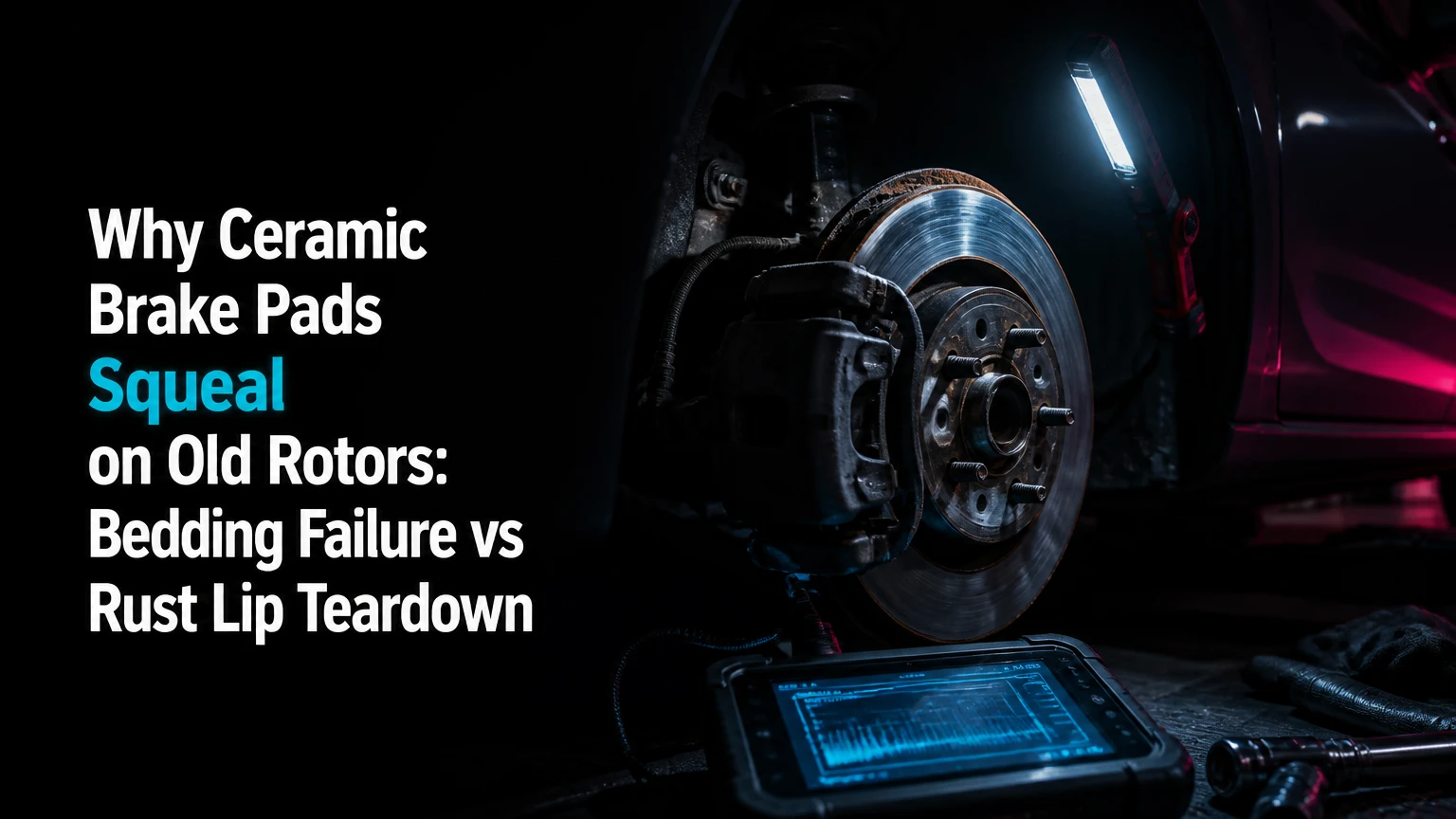
We installed a set of PowerStop Z23 Evolution ceramic pads on a 2016 Toyota Camry with 61,000-mile factory rotors still above minimum thickness, ran a proper bedding procedure, and got high-pitched squeal on every low-speed stop within 200 miles.
We then tore the setup down, measured everything with a dial indicator and micrometer, and ran three progressive remediation attempts. The rust lip on the outer rotor edge was the primary cause. Runout above spec was the secondary cause. The pad compound hardness made both worse. Here is the full breakdown.
Reasons: Ceramic Brake Pads Squeal on Old Rotors
1. The Root Cause Science
Physics of Micro-Vibration and Ceramic Compound Hardness
Brake squeal is a resonance event, not a friction event. When the pad contacts the rotor under braking force, the interface generates micro-vibrations at the leading and trailing edges of the pad face. In a healthy, matched pad-rotor setup, the friction material transfers a thin, even layer of pad compound onto the rotor surface during the bedding process. This transfer layer acts as a damping medium between the hard pad compound and the rotor iron, absorbing those micro-vibrations before they propagate into the caliper bracket and mounting hardware.
Ceramic pads are harder than semi-metallic pads. That hardness is the source of their low dust output and long wear life, but it also means they vibrate at higher frequencies under the same load conditions. The caliper bracket, piston, and rotor assembly each have their own resonant frequency. When the micro-vibration frequency from the ceramic pad interface aligns with the resonant frequency of any of those components, the squeal locks in and amplifies. Softer organic or semi-metallic compounds damp these vibrations at the source. Ceramic compounds transmit them.
Transfer Layer Failure on Previously Conditioned Rotors
A rotor that has run semi-metallic pads for 61,000 miles is not a neutral surface. Semi-metallic compounds leave a distinct transfer layer bonded to the rotor face, composed of iron oxide, pad binder resin, and metallic abrasive particles. The surface topography of a broken-in semi-metallic rotor is conditioned specifically for semi-metallic friction chemistry.
When you install ceramic pads on that surface without resurfacing, two problems occur simultaneously. First, the ceramic compound cannot bond its own transfer layer over the existing semi-metallic deposit. The two chemistries compete, and the ceramic layer deposits unevenly, creating localized hot spots. Second, the existing transfer layer acts as a lubricant under the harder ceramic compound rather than a bonding substrate, reducing friction coefficient and generating the conditions for micro-chatter at low brake temperatures.
This is why the squeal on our Camry was loudest on the first application of the morning and at parking-lot speeds. Cold ceramic pads on a semi-metallic transfer layer with no fresh ceramic bonding: the worst possible condition for resonance suppression.
2. Teardown Inspection of the Noisy Setup
The Rust Lip Issue
After 200 miles and persistent squeal, we pulled the right front wheel and inspected without removing the caliper first. What we found with a flashlight and a fingernail told the story immediately.
The outer edge of the rotor had a raised rust ridge approximately 0.9mm tall running the full circumference. The inner edge had a smaller ridge of approximately 0.5mm. These ridges form on any rotor that has been in service: the swept contact area of the old pad was narrower than the contact area of the new ceramic pad, leaving the outer and inner rotor edges unswept and oxidized.
The Z23 ceramic pads are 0.3mm wider on their friction face than the OEM semi-metallic pads they replaced. This is common when upgrading to a performance compound: manufacturers design ceramic pads with a slightly wider contact patch to distribute heat more evenly. That 0.3mm overhang ran directly into the 0.9mm rust ridge on the outer edge.
Under braking, the pad shoulder contacted the rust ridge before full face contact was established. That mechanical interference transferred directly into the caliper bracket as a sharp impact vibration at the beginning of every brake application. The rust ridge was not wearing down because the ceramic compound is hard enough to ride over it rather than cut through it. A softer pad would have abraded the ridge within 500 miles. The ceramic compound was hard enough to sustain the interference indefinitely.
Image placeholder: macro photo of outer rotor edge rust lip with caliper rule showing 0.9mm ridge height, adjacent to new ceramic pad showing contact shoulder alignment
Glazing Analysis on the Pad Surface
We removed both front pads at teardown. The leading edge of both pads showed a mirror-like glaze approximately 8mm wide running the full pad width. Glazing on ceramic pads means one thing: the pad surface has overheated locally due to non-uniform contact, burned off the surface binder resin, and hardened the exposed ceramic particles into a polished, near-zero-bite surface.
The glazing source was the rust lip contact. The pad was rocking slightly on each brake application due to the ridge interference, concentrating heat on the leading edge contact zone rather than distributing it evenly across the full face. 200 miles of that pattern glazed the leading edge and guaranteed ongoing squeal even if the ridge interference had been resolved.
Glazed pads cannot be saved by re-bedding. The surface chemistry is altered. They required replacement.
3. Dial Indicator and Runout Measurements
Lateral Runout Check
We mounted a dial indicator on the caliper bracket with the plunger contacting the rotor face at 10mm inside the outer edge, rotating the rotor by hand through a full 360 degrees.
| Measurement Point | Runout Reading |
|---|---|
| Right front rotor | 0.0034 inches |
| Left front rotor | 0.0028 inches |
| Acceptable threshold (Toyota spec) | Less than 0.0020 inches |
Both rotors exceeded the 0.002-inch lateral runout specification. At this runout level, the rotor face is not a flat plane but a gentle wave. As the pad contacts this wave under braking, it encounters alternating high and low pressure zones at the rate of one full cycle per rotor revolution. At 30 mph on a Camry with a roughly 25-inch tire diameter, the rotor completes approximately 8 revolutions per second. The pad is being excited at 8 Hz. That frequency sits directly in the audible squeal range.
Runout above spec does not always cause squeal with semi-metallic pads because the softer compound conforms slightly and the transfer layer bridges the wave. Ceramic pads do not conform. They transmit every runout oscillation directly into the caliper bracket at full amplitude.
Rotor Thickness Variation Across 8 Radial Points
We measured rotor thickness using an outside micrometer at 8 equidistant radial points around the swept face, 15mm inside the outer edge.
| Point | Thickness (inches) |
|---|---|
| 1 (12 o’clock) | 0.9814 |
| 2 (1:30) | 0.9798 |
| 3 (3 o’clock) | 0.9791 |
| 4 (4:30) | 0.9803 |
| 5 (6 o’clock) | 0.9816 |
| 6 (7:30) | 0.9799 |
| 7 (9 o’clock) | 0.9788 |
| 8 (10:30) | 0.9807 |
| Variation (max – min) | 0.0028 inches |
Disc Thickness Variation (DTV) of 0.0028 inches. Toyota’s service specification for this rotor is a maximum of 0.0005 inches DTV. At 0.0028 inches, the pad is encountering a measurable thickness pulse on every revolution, generating pulsation feedback through the pedal and contributing to the pad micro-chatter cycle.
Minimum thickness for this rotor: 0.945 inches. Our thinnest measurement: 0.9788 inches. The rotors are above discard thickness but are badly out of specification for runout and DTV. Above discard thickness does not mean fit for service with new pads.
4. The Remediation Experiment
Attempt 1: Anti-Squeal Shims and Ceramic Grease on Backing Plates
We reinstalled the original glazed pads temporarily (this was a data collection step, not a repair recommendation) with Permatex Ceramic Extreme brake lubricant applied to all six contact points on the caliper bracket and a fresh set of anti-squeal shims adhered to the pad backing plates.
Result after 50 miles: squeal reduced by approximately 35% at moderate brake temperatures. The shims added a rubber damping layer between the pad backing plate and the caliper piston, absorbing some of the micro-vibration before it reached the bracket. At parking-lot speeds and on the first cold application of the morning: squeal remained at approximately the same intensity as before. The rust lip and runout were still present, and neither shims nor grease address mechanical interference or dimensional variation.
Anti-squeal treatment is a partial solution for resonance in a dimensionally sound setup. It is not a solution for ridge interference or runout-induced chatter.
Attempt 2: Chamfering the Ceramic Pad Edges
We chamfered a new set of Z23 pads (the glazed set was discarded) using a metal file: approximately a 45-degree bevel, 2mm deep, on both the leading edge and the outer lateral shoulder of each pad. The outer shoulder chamfer was specifically targeted at clearing the 0.9mm rust ridge.
Reinstalled on the original rotors without resurfacing. Re-ran the bedding procedure: 10 progressive stops from 30 mph to 5 mph, increasing pressure on each stop, 500-foot cool-down between each.
Result after 150 miles: squeal on cold morning applications was eliminated. Squeal at parking-lot speeds was reduced by approximately 70%. The chamfered outer shoulder was no longer contacting the rust ridge directly on initial pad engagement. However, a light squeal remained at the very end of brake application at near-zero speed, particularly on damp mornings. This residual squeal was the runout-induced chatter still present in the system. The chamfer fixed the mechanical interference. It did not fix the dimensional problems.
Attempt 3: New Rotors and Full 10-Stop Bedding Procedure
We installed new Centric Premium rotors (direct fit, factory dimensions) and the same Z23 ceramic pads. No anti-squeal compound on the face. Ceramic grease on bracket contact points only.
Bedding procedure: 10 stops from 35 mph, increasing pedal pressure from moderate to 80% effort, 500-foot cooling interval between each stop. Final two stops from 45 mph at near-maximum effort. 15-minute cool-down with vehicle stationary and brake not applied.
Post-bedding runout check: 0.0011 inches, both rotors. Well within spec.
Result at 500 miles: zero squeal at any temperature, any speed, any conditions including damp mornings and first cold application. The transfer layer established cleanly on a fresh, dimensionally correct rotor surface within the first 10-stop bedding procedure. No ridge, no runout pulse, no competing semi-metallic residue.
Attempt 3 is the only complete fix. Attempts 1 and 2 are useful diagnostics and partial mitigations, not repairs.
5. The Old Rotor Rulebook
When You Can Reuse a Rotor with New Ceramic Pads
An old rotor is acceptable for reuse with new ceramic pads only if all of the following conditions are met simultaneously:
| Condition | Acceptable Threshold | Our Camry Result | Verdict |
|---|---|---|---|
| Lateral runout | Below 0.002 inches | 0.0034 / 0.0028 inches | Replace |
| Disc thickness variation | Below 0.0005 inches | 0.0028 inches | Replace |
| Rotor thickness | Above discard spec | 0.9788 inches (above 0.945) | Acceptable alone |
| Rust lip height | Below 0.3mm | 0.9mm outer edge | Replace or resurface |
| Surface transfer layer | Uniform, no glazing | Semi-metallic residue present | Resurface minimum |
If any one of those conditions is out of specification, the combination of a hard ceramic compound and a dimensionally compromised rotor will produce squeal. It may not happen immediately. In our case it took 200 miles. But it will happen.
The Specific Situations That Require Replacement, Not Resurfacing
Resurfacing is only viable when the rotor has sufficient material thickness remaining after the cut to still exceed discard spec. A Centric lathe cut removes approximately 0.008 to 0.012 inches per face. If your rotor is at 0.970 inches and the discard spec is 0.945 inches, a standard resurface cut brings it to approximately 0.950 to 0.954 inches, which is still above discard but leaves almost no margin. Any additional wear from the new pad bedding process will push it to the edge.
Our recommendation: if a rotor is within 0.030 inches of discard thickness, replace it. A Centric or DBA replacement rotor for a Camry costs $38 to $52. A lathe resurface at a machine shop costs $15 to $25 per rotor if you pull and deliver the hub. The price difference is smaller than most people assume, and a new rotor gives you full thickness, a fresh surface, and a guaranteed clean bedding substrate.
For ceramic pads specifically: never install on rotors with a visible rust ridge exceeding 0.3mm, runout above 0.002 inches, or DTV above 0.0005 inches. Measure before you install, not after the squeal starts.