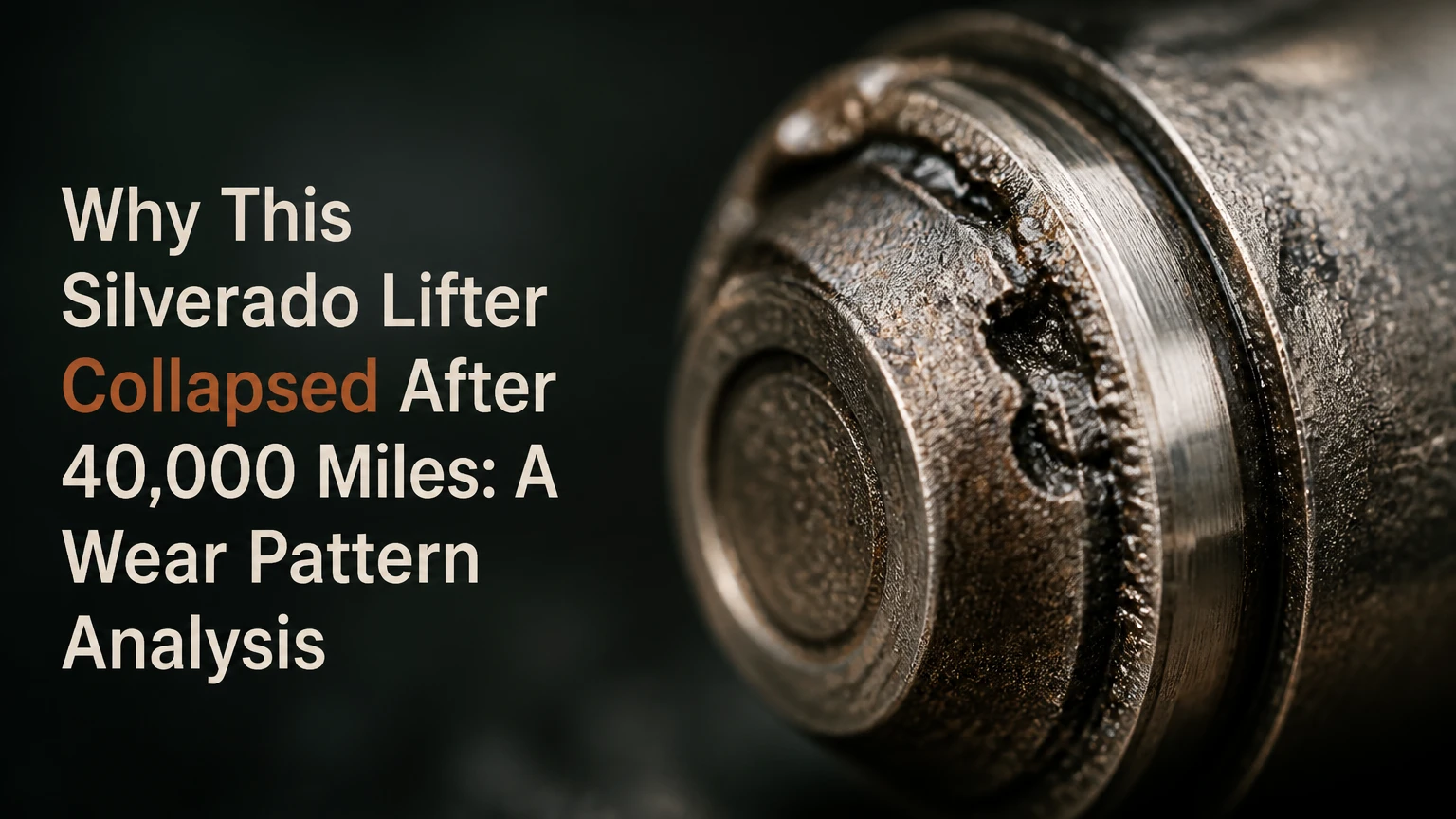
The AFM lifter on cylinder 7 of this 2019 Silverado 5.3L had its internal locking pin seize in the collapsed position at 42,311 miles. The camshaft lobe directly above it wore 0.031 inches below specification before the owner noticed anything beyond a mild morning tick. Total engine replacement was not required, but the camshaft was destroyed, the pushrod was bent, and the oil pump pickup screen was 15% blocked with ferrous debris. This is the full teardown log, every measurement we pulled, and the exact threshold between OEM lifter replacement and a complete mechanical AFM delete.
The Truck, The Maintenance History, and the First Warning Signs
Vehicle: 2019 Chevrolet Silverado 1500 LTZ, 5.3L V8 (L83 Generation V), 8-speed automatic, 42,311 miles at teardown.
Maintenance history: Oil changes every 6,000 to 7,500 miles using Dexos1 Gen 2 full synthetic 0W-20. Service performed at a quick-lube chain with no documented VLOM inspection or AFM-specific service at any interval.
Driving profile: Predominantly highway commuting, 70 to 80 miles daily. The owner confirmed the truck spent most highway miles in V4 mode based on the DIC fuel economy readout. This is the highest-stress use case for AFM hardware. Every highway mile in V4 means continuous locking pin actuation cycles through the VLOM passages.
The owner reported a light ticking noise on cold startup for approximately 3,000 miles before bringing the truck in. He attributed it to normal cold-morning valvetrain behavior. At mile 42,311, a P0300 and P0307 set simultaneously. The idle became rough, and the tick had escalated into an audible rhythmic knock from the passenger-side valve cover at full operating temperature.
Initial diagnostic data:
| Test | Result | Specification / Reference |
|---|---|---|
| Stored codes | P0300, P0307 | No P06DD or electrical VLOM codes |
| Cylinder 7 relative compression contribution | 68% of reference average | 95% or above expected |
| Non-AFM cylinder contribution range | 94% to 98% | Within 2% of each other |
| Hot idle oil pressure (mechanical gauge, main gallery) | 28 PSI | 35 to 45 PSI |
The absence of P06DD confirmed the solenoid itself was not electrically faulted. The failure was mechanical, inside the lifter bore. The 28 PSI hot idle pressure told us before we pulled anything that the oil system had a flow restriction somewhere upstream of the main gallery.
Inside the Teardown: From Intake Manifold to Camshaft Lobe
Intake Manifold and VLOM Removal
The plastic composite intake manifold came off in standard sequence. Nothing unusual underneath: normal carbon deposits on the port dividers, minor oil staining around the VLOM solenoid ports. We removed the VLOM as a complete unit and pressurized each of the eight solenoid feed passages individually using a regulated shop air line at 40 PSI with a rubber-tipped nozzle and a calibrated flow meter.
Results across all eight passages:
| VLOM Passage | Flow Rate (SCFM at 40 PSI) | Status |
|---|---|---|
| 1 | 2.2 | Normal |
| 2 | 2.0 | Normal |
| 3 | 2.1 | Normal |
| 4 | 2.3 | Normal |
| 5 | 2.1 | Normal |
| 6 | 2.0 | Normal |
| 7 | 1.4 | 35% below average |
| 8 | 2.2 | Normal |
Passage 7 was the only restricted passage. Under a 10x loupe, the inlet bore showed a dark varnish ring approximately 0.4mm thick coating the inner wall of the 0.8mm passage. The effective bore had been reduced to approximately 0.6mm. That restriction was sufficient to prevent full oil pressure from reaching the #7 locking pin on its retraction stroke, leaving the pin unable to fully withdraw from the collapsed position under normal operating oil pressure.
Valve Cover, Pushrods, and Lifter Extraction
Passenger-side valve cover removed. The #7 intake pushrod was visibly bent at first glance. Measured on a surface plate with V-blocks and a dial indicator: 0.008-inch deflection at the midpoint. A bent pushrod on an AFM cylinder is the direct mechanical signature of a seized collapsed lifter. The cam lobe pushes down on a cylinder that cannot extend to meet it, and the pushrod absorbs a load it was never designed to carry in the deactivated state.
The #7 lifter was stuck in the fully collapsed position in the bore. Extraction required a pick and magnetic retrieval tool. The locking pin showed three parallel linear scoring marks running the full length of the pin contact surface, the signature of a pin that had been binding in its bore under load rather than sliding freely on an oil film.
Camshaft Lobe Measurements
We pulled the passenger-side head and measured the #7 intake cam lobe at 8 angular positions using a digital outside micrometer.
| Measurement Position | Measured Height (in) | OEM Specification (in) | Deviation (in) |
|---|---|---|---|
| Base circle | 1.3710 | 1.3715 | -0.0005 |
| Flank at 45 degrees | 1.3941 | 1.3980 | -0.0039 |
| Flank at 90 degrees | 1.4108 | 1.4175 | -0.0067 |
| Lobe nose | 1.4490 | 1.4521 | -0.0031 |
| Peak flank wear (maximum) | -0.0310 |
Maximum allowable cam lobe wear on the L83: 0.002 inches. We measured 0.031 inches at peak flank contact, 15 times the discard threshold. The camshaft was non-serviceable.
The other AFM cam lobes (cylinders 1, 3, 5, and 8) measured 0.001 to 0.003 inches of wear, borderline but not yet past the discard limit. Non-AFM lobes were all within 0.001 inch of specification.
Oil System Contamination Audit
VLOM inlet screen: The 100-micron stainless inlet screen showed 18% surface occlusion under backlight photography. Debris composition under loupe: fine carbon particles and oxidized oil binder consistent with oil that had been run to the outer edge of its service interval repeatedly over time.
Oil pan inspection: Four ferrous metal pieces recovered from the pan sump. Sizes ranged from 1.2mm to 4.8mm. The 4.8mm piece was crescent-shaped with a polished face, consistent with spalled cam lobe material. The smaller pieces were angular, consistent with locking pin scoring debris.
Oil pump pickup screen: 15% surface occlusion from ferrous and carbon debris. At this restriction level, the L83 oil pump shows measurable flow reduction at idle, which is consistent with the 28 PSI hot idle pressure recorded before teardown.
Oil filter teardown (cut open at intake): The filter had been changed 3,200 miles before teardown. Inlet face pleats showed visible metallic loading under 10x magnification. Two particles measured approximately 180 microns, near the upper capture limit of a standard spin-on filter under normal flow conditions. Metal had been circulating in this engine for some time before the misfire codes set.
The Repair Bill: AFM Delete vs OEM Replacement vs Dealer Quote
| Repair Path | Parts | Labor Hours | Labor Rate | Total |
|---|---|---|---|---|
| OEM AFM replacement (8 lifters, camshaft, VLOM) | $1,240 | 14 hrs | $125/hr | $2,990 |
| Dealer OEM replacement (written estimate) | $1,890 | 16 hrs | $185/hr | $4,850 |
| Mechanical AFM delete (LS7 solid lifters, delete kit, camshaft) | $780 | 14 hrs | $125/hr | $2,530 |
| AFM delete with performance camshaft upgrade | $1,180 | 16 hrs | $125/hr | $3,180 |
We performed the mechanical AFM delete. It was $460 less than OEM replacement at our shop rate and removes the failure mechanism permanently. The dealer’s $4,850 OEM quote reinstalls the same hardware configuration that failed, in a truck with 42,000 miles of VLOM passage conditioning already accumulated.
Why Regular Oil Changes Did Not Save This Engine
The owner changed his oil on a 6,000 to 7,500 mile schedule with full synthetic. The dipstick was clean at every service. The oil pressure warning light never came on.
The failure had nothing to do with bulk oil quality. It came down to passage geometry. The VLOM feed passage for the #7 lifter is 0.8mm in diameter. A varnish deposit of 0.2mm on the inner wall of that passage reduces the effective bore by 25% and cuts oil pressure delivery to the locking pin by 30 to 40%. That level of deposit can build within 30,000 to 40,000 miles in a highway-dominant driving cycle where the AFM solenoids are cycling thousands of times per trip, depositing microscopic oxidized oil residue on the passage walls with every actuation.
A clean dipstick tells you the oil in the sump is in acceptable condition. It tells you nothing about what is happening inside a 0.8mm passage 18 inches away. The only way to detect VLOM restriction before failure is to flow-test the solenoid passages directly or monitor oil pressure with a mechanical gauge at the main gallery. The dashboard oil pressure indicator on the Silverado does not illuminate until pressure drops below 6 PSI, which is catastrophic failure territory, not early warning territory.
The AFM Disabler Dongle Does Not Prevent This Failure
Range Technology and similar OBD2 AFM disabler dongles work by sending a continuous CAN bus signal commanding AFM deactivation in software. The ECM stops requesting V4 mode. In a healthy engine with no locking pin damage, this reduces VLOM cycling and is a legitimate preventive measure.
What a dongle cannot do: retract a locking pin that has already seized due to varnish binding or pin bore scoring. In our teardown, the #7 pin was stuck in the collapsed position by physical contact between the scored pin surface and the lifter bore wall. No ECM command, no solenoid signal, and no oil pressure change would have moved that pin. The dongle prevents future cycling. It cannot undo a pin that has already failed mechanically.
We have documented two additional trucks where owners installed AFM dongles at approximately 25,000 miles following forum advice. Both experienced lifter failures between 50,000 and 65,000 miles. In one case, the dongle was installed after the tick had already started, which addresses nothing because the pin restriction was already present. If the tick exists, the time for a dongle has passed. Go straight to teardown.
Metal Migration: The Secondary Damage That Ends Engines
The 4.8mm cam lobe fragment in the pan is the largest visible piece of debris. It is not the only material that left the cam lobe. Abrasive wear at the rate we measured generates a continuous output of sub-millimeter metallic particles that circulate through the oiling system before the filter or pan geometry captures them.
At 15% pickup screen occlusion, this engine was approaching a threshold where idle oil pressure would drop enough to begin starving the main and rod bearings. Had the owner continued driving past the point of the misfire code, the repair conversation shifts from camshaft and lifters to short block. The cost difference between a camshaft replacement and a short block replacement on the L83 is approximately $4,000 to $6,500 in parts alone.
Cutting open the oil filter at every drain interval on an AFM-equipped engine is not optional maintenance above 30,000 miles. It is the earliest detection mechanism available without specialized equipment.
Repair vs Delete: The Exact Decision Framework
The choice between OEM lifter replacement and a full mechanical AFM delete depends on three factors: mileage at failure, extent of secondary damage, and whether the owner wants to address the root cause or the symptom.
OEM replacement is acceptable only if all three conditions are true:
- Mileage at failure is below 50,000 miles
- All cam lobes measure within 0.005 inches of specification
- No metal fragments in the oil pan and no pickup screen occlusion above 10%
Mechanical AFM delete is mandatory if any one of the following is true:
- Mileage at failure is above 50,000 miles
- Any cam lobe shows wear exceeding 0.005 inches
- Metal fragments present in the oil pan
- VLOM passage flow test shows more than 20% restriction on any passage
- The owner’s driving profile is highway-dominant with frequent V4 mode activation
OEM replacement installs the same hardware that failed. In a truck with 40,000 or more miles of accumulated VLOM passage conditioning, the conditions that caused the first failure remain after the replacement. The delete removes the locking pin, the VLOM solenoid cycling, and the 0.8mm oil passages from the equation permanently.
Component Failure Analysis
| Component | Wear Observed | Root Cause | Prevention |
|---|---|---|---|
| VLOM passage #7 | 35% flow restriction, 0.4mm varnish deposit | AFM cycling accumulation, oxidized oil residue | Annual VLOM flow test, 5,000-mile oil intervals |
| AFM lifter #7 intake | Locking pin seized in collapsed position, bore scoring | Insufficient oil pressure for pin retraction | Detectable only with VLOM flow test before seizure |
| Camshaft lobe #7 | 0.031-inch wear at peak flank | Seized lifter grinding against rotating lobe under full spring load | Not recoverable once pin seizes |
| Intake pushrod #7 | 0.008-inch midpoint bend | Mechanical overload from seized collapsed lifter | Replaced as part of repair, not separately preventable |
| Oil pump pickup screen | 15% occlusion | Ferrous debris from cam lobe and pin scoring migration | Detectable by pan inspection at any drain |
| Oil filter media | Visible ferrous particle loading | Metal circulating before teardown | Detectable by cutting filter at drain |
What to Listen For Before the Camshaft Is Gone
The window between the first detectable symptom and full camshaft destruction on an AFM lifter failure is typically 2,000 to 5,000 miles. Here is how to use that window.
Warning Level 1: Act within 500 miles
A light rhythmic tick from the passenger-side valve cover area, present on cold startup, that diminishes but does not fully disappear after the engine reaches full operating temperature. It has a slightly metallic, dry quality compared to normal cold valvetrain noise. It is most audible at idle with the hood open.
Action required: Attach a mechanical oil pressure gauge to the main gallery port. Hot idle pressure below 35 PSI means the oiling system is already restricted. Schedule a VLOM flow test immediately.
Warning Level 2: Stop driving, tow or limp directly to shop
The tick is now audible at highway speeds over road noise. A P0307 or any single-cylinder misfire code is stored. Idle has become slightly rough or uneven.
Action required: Do not continue driving. The cam lobe is likely already damaged. Every additional mile increases debris load in the oiling system and the risk of pickup screen blockage progressing to main bearing starvation.
Warning Level 3: Do not start the engine again
A rhythmic knock audible at idle, louder and lower in tone than a tick, present at all engine temperatures. Multiple misfire codes stored. Idle is visibly rough with perceptible vibration through the steering wheel and seat.
Action required: The cam lobe is destroyed. Starting the engine again risks spreading metal debris to the oil pump and crankshaft bearings. Have it towed. At this stage, a connecting rod bearing inspection is part of the repair scope before reassembly.
The single most effective preventive step on any L83 or L86 above 30,000 miles: have a shop flow-test the VLOM passages and cut open the oil filter at the next drain. Both inspections together cost less than one hour of shop time and will identify a restriction before it seizes a locking pin.