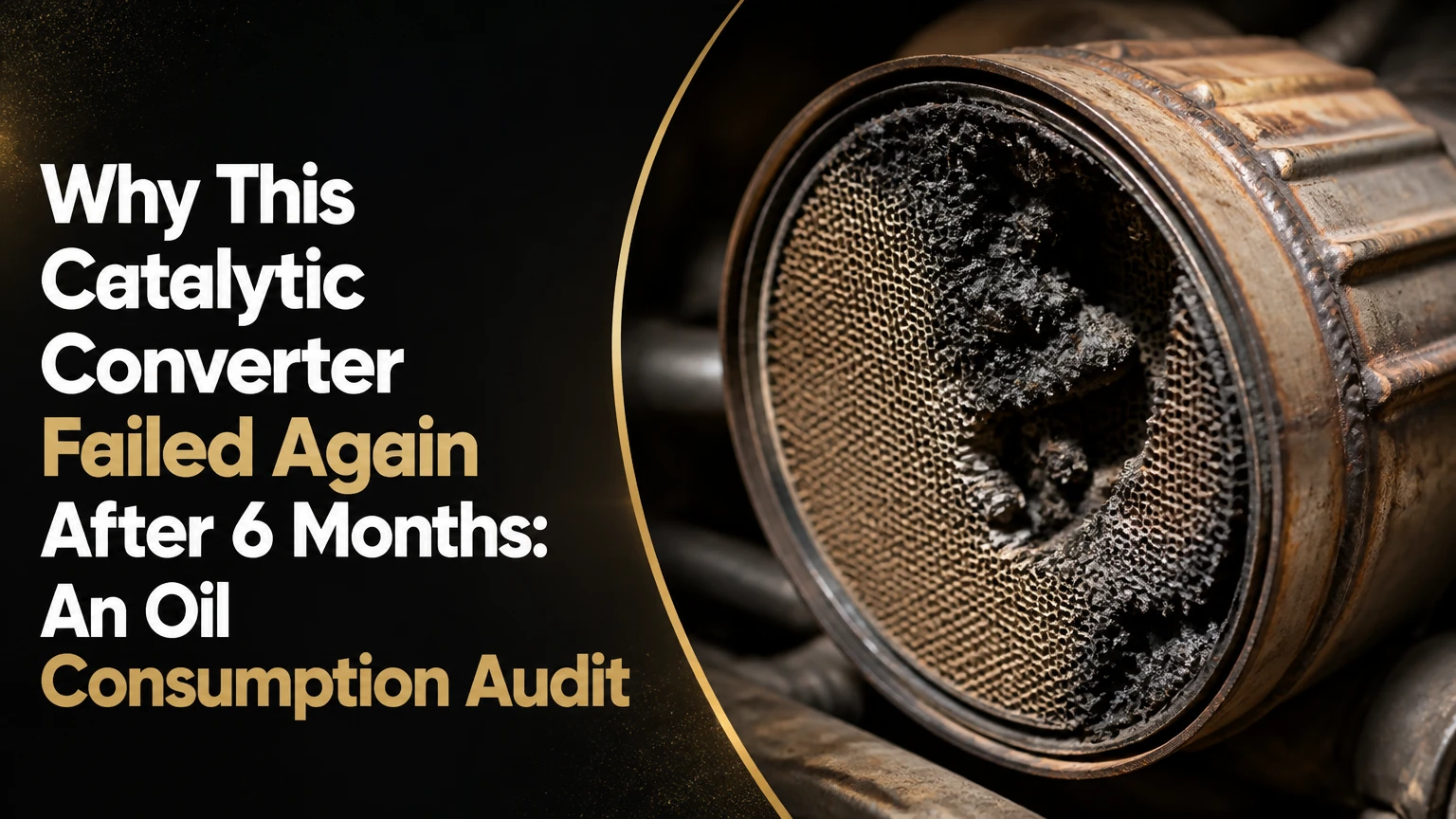
The second converter failed the same way the first one did: P0420 code, high exhaust backpressure, and a borescope image showing channels packed with gray-white ash. The customer had spent $780 on two catalytic converters in eleven months and was standing in our shop asking why.
The answer took us about 45 minutes to find: his engine was burning 1.2 quarts of oil every 1,000 miles through stuck piston oil control rings, the combustion byproducts were coating the catalyst substrate with phosphorus and zinc ash from the oil additives, and the converter was choking to death from the inside on every tank of fuel. Nobody had checked the engine before either converter was installed. Here is the full audit.
The Vehicle and the Repeat Failure History
Vehicle: 2014 Chevrolet Equinox LT, 2.4L Ecotec (LEA), 115,400 miles at our inspection.
Failure history: – Month 1: P0420 stored, first catalytic converter replaced at an independent shop. OBD2 monitors cleared, vehicle returned to owner. – Month 7: P0420 returned. Second catalytic converter replaced at a different shop. Warranty claim on first unit denied. – Month 11: P0420 returned again. Owner brought the vehicle to us.
What neither previous shop documented: Any measurement of oil consumption, any cylinder leakdown test, any borescope inspection of the combustion chambers, or any investigation into why a converter would fail on a 115,000-mile engine within six months of installation.
Borescope Inspection: What the Converter Looked Like Inside
Before doing anything else, we inserted a borescope through the pre-cat oxygen sensor bung with the engine off and the exhaust cool. What the camera showed explained the repeat failure in one image.
A healthy catalytic converter substrate under borescope looks like a uniform honeycomb of open square channels, each approximately 1mm across, with clean ceramic walls. The substrate on this vehicle’s second converter, installed seven months prior, looked like this:
The channel walls were coated with a thick grayish-white crystalline deposit. The deposit had a chalky, matte surface under the borescope light, distinct from the dark carbon soot of a rich-running engine. Several channels near the center of the substrate face were partially or completely blocked. The substrate face itself had a brownish discoloration indicating localized overheating from restricted exhaust flow through the blocked section.
That deposit is the ash signature of burned engine oil. Gasoline combustion leaves carbon. Engine oil combustion leaves an ash residue from its additive package: phosphorus from the zinc dialkyldithiophosphate (ZDDP) anti-wear additive, zinc from the same compound, and calcium from the detergent package. These elements do not burn off. They accumulate as solid crystalline deposits on any surface they contact in the exhaust stream, including the catalyst washcoat.
Oil Consumption Measurement Over 3,000 Miles
We established a baseline oil level with a fresh fill of Dexos1 Gen 2 full synthetic 5W-30 to the full mark, documented with a dipstick photograph. We returned the vehicle to the owner with instructions to drive normally and return at each 1,000-mile interval for a level check. No top-offs between checks.
| Interval | Oil Level at Check | Oil Lost | Cumulative Loss |
|---|---|---|---|
| Baseline (0 miles) | Full mark (8.0 mm on dipstick above ADD line) | – | – |
| 1,000 miles | 1.3 mm above ADD line | 1.1 quarts | 1.1 quarts |
| 2,000 miles | ADD line exactly | 1.2 quarts | 2.3 quarts |
| 3,000 miles | 1.4 mm below ADD line | 1.3 quarts | 3.6 quarts |
The engine consumed 1.2 quarts per 1,000 miles on average. GM’s acceptable oil consumption threshold for this engine is 1 quart per 2,000 miles. This engine was consuming oil at 2.4 times the acceptable rate.
There was no visible blue exhaust smoke from the tailpipe at any point during the test. The owner had specifically checked for smoke and seen none. This is characteristic of the Ecotec oil ring failure mode: oil enters the combustion chamber in quantities large enough to poison a catalyst but small enough to combust completely without producing visible smoke under most driving conditions. The absence of blue smoke on this engine does not indicate normal oil consumption.
Exhaust Backpressure Test
We measured exhaust backpressure at the pre-cat O2 sensor port using a calibrated gauge at 2,500 RPM steady state. We then compared the result to a factory specification and to a vehicle with a known-good converter for baseline reference.
| Condition | Backpressure at 2,500 RPM | Specification |
|---|---|---|
| This vehicle (second converter, 7 months old) | 4.5 PSI | Under 1.0 PSI |
| Same vehicle after new converter installation | 0.6 PSI | Under 1.0 PSI |
| Completely blocked converter (for reference) | Above 8.0 PSI | Over 8.0 PSI indicates collapse |
At 4.5 PSI, the partially blocked substrate was creating enough exhaust restriction to reduce engine power, increase exhaust gas temperatures upstream of the converter, and accelerate the thermal degradation of the remaining open substrate cells. The engine was effectively running against a partial blockage on every combustion cycle.
Why the Oil Control Rings Failed on This Engine
The 2.4L Ecotec uses a low-tension piston ring design intended to reduce internal friction and improve fuel economy. The oil control rings in this design have a lower contact pressure against the cylinder wall than traditional ring designs. Under normal conditions with fresh oil and clean ring lands, this works as intended.
The failure mode is carbon accumulation in the oil ring grooves. As combustion deposits and oxidized oil residue build up in the groove behind the oil control ring, the ring loses its ability to flex inward on the compression stroke. A ring that cannot flex inward cannot scrape oil from the cylinder wall effectively. Oil that is not scraped from the wall enters the combustion chamber on the intake stroke, burns with the fuel charge, and sends its additive ash directly into the exhaust stream.
This specific failure pattern on the 2.4L Ecotec has been documented widely in owner forums and is the subject of GM technical service bulletins. It typically develops between 80,000 and 130,000 miles. It progresses gradually, which is why the oil consumption rate often increases slowly enough that owners attribute it to normal aging rather than a specific failure.
Why the Converter Warranty Was Denied
Both previous converter manufacturers denied warranty claims when presented with the failed units. The rejection reason on both written denials was identical: contamination damage not covered under warranty. The substrate face on a converter that has been poisoned by oil ash shows a characteristic brownish-gray deposit pattern that converter manufacturers and their warranty evaluators recognize immediately.
Converter warranties, whether 12 months or 3 years, uniformly exclude damage caused by engine oil or coolant contamination. Installing a new converter without identifying and resolving the source of contamination does not reset the warranty clock in any meaningful way. It starts a new failure cycle.
The Before-You-Replace-P0420 Checklist
Every P0420 case should clear these tests before a converter is purchased. If any of these return an abnormal result, the upstream problem must be resolved before or alongside the converter replacement.
Step 1: Check oil consumption over 1,000 miles. Establish a fresh-fill baseline and measure loss at 1,000 miles. Above 1 quart per 2,000 miles on a normally aspirated engine is cause for investigation before any converter work.
Step 2: Borescope the combustion chambers. Grayish-white ash on the piston crown or cylinder head indicates oil burning. Black carbon buildup alone indicates a rich condition, not oil burning.
Step 3: Measure exhaust backpressure. Above 1.5 PSI at 2,500 RPM indicates a partially blocked substrate. This test identifies how damaged the current converter is, which informs whether a cleaner or a replacement is needed.
Step 4: Perform a cylinder leakdown test. Above 15% leakdown on any cylinder, combined with air escaping from the crankcase breather, confirms ring seal failure as the oil path into the combustion chamber.
Step 5: Inspect for blue exhaust smoke. Absence of smoke does not clear the engine. Run the vehicle to full operating temperature, then hold a white cloth behind the tailpipe at 3,000 RPM for 30 seconds. A bluish-gray tint on the cloth in the absence of visible tailpipe smoke indicates oil vapor at sub-visible concentrations.
Engine Restoration Options and the Real Cost Math
| Option | Cost Range | Expected Outcome | Best For |
|---|---|---|---|
| Piston ring soak treatment (Seafoam, BG 109) | $25 to $80 | Possible partial improvement if rings are stuck, not worn | Early-stage stuck ring, under 1 qt per 1,500 miles |
| Top-end carbon cleaning (walnut blast, chemical decarbonize) | $300 to $600 | Removes combustion chamber deposits, may free rings | Moderate consumption, confirmed ring land carbon |
| New catalytic converter without engine repair | $350 to $700 | P0420 returns within 6 to 12 months | Never the right choice with confirmed oil burn |
| Piston ring replacement (short block rebuild) | $2,200 to $3,500 | Resolves oil consumption if rings are the only issue | Consumption above 1 qt per 1,000 miles, clean bores |
| Engine replacement (used or reman) | $3,500 to $5,500 | Complete resolution | High mileage, multiple issues, cost exceeds rebuild |
| Vehicle replacement | Varies | Complete resolution | When repair cost approaches or exceeds vehicle value |
On this specific vehicle, with 115,000 miles, a consumption rate of 1.2 quarts per 1,000 miles, and confirmed ring failure via leakdown test, we recommended against a short block rebuild. The vehicle’s trade-in value was approximately $6,800.
A ring replacement job, plus a new converter, plus an alignment check and deferred maintenance items we found during inspection, approached $4,200. That math does not work in favor of keeping the car. We presented the numbers and let the owner decide. He opted for a used engine at $2,800 installed with a 90-day warranty, plus a new converter installed simultaneously, for a total of $3,600. The P0420 has not returned in 14,000 miles of subsequent driving.