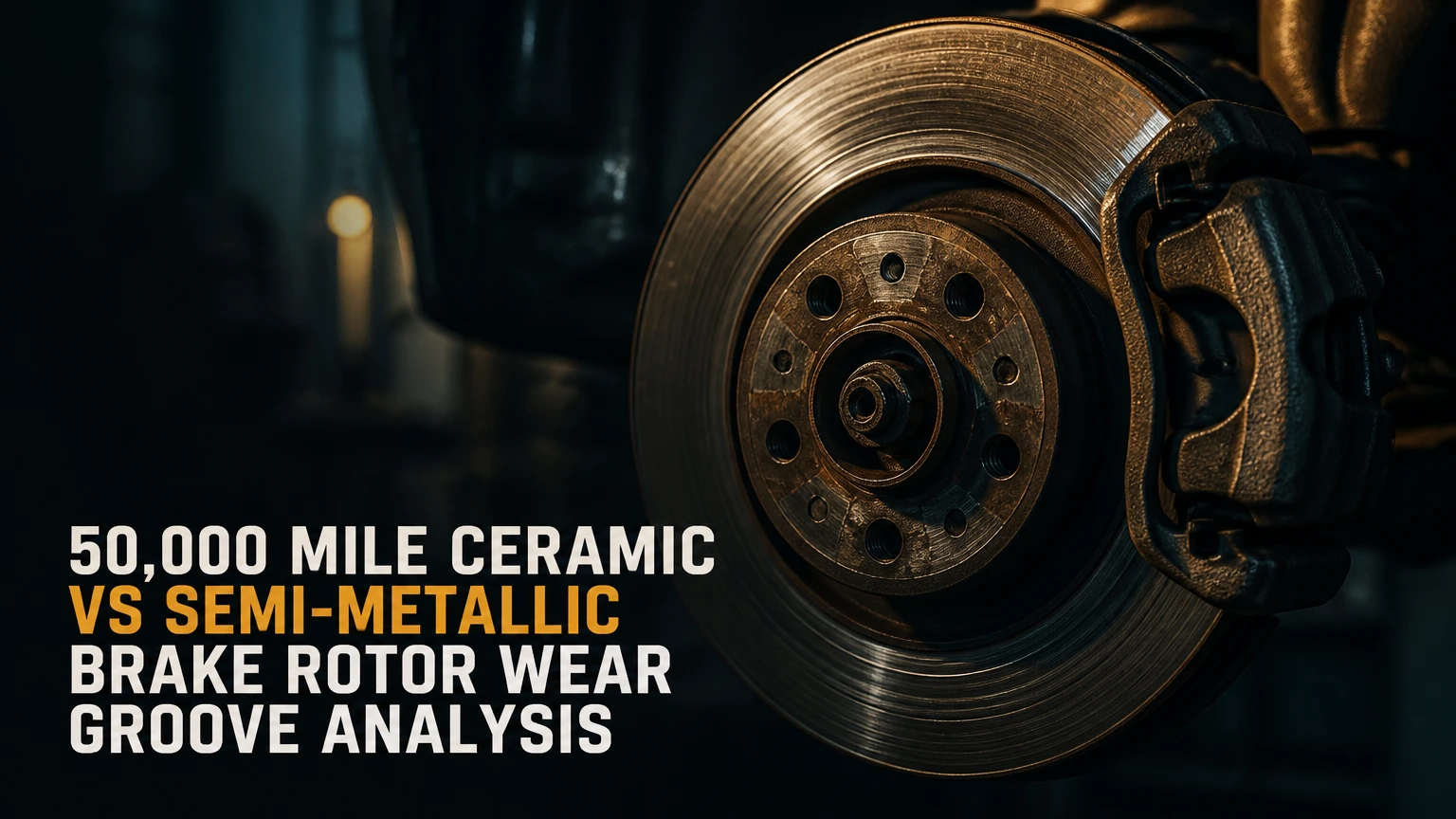
Two identical 2018 Toyota Camrys. Same model year, same trim, same Centric Premium rotors on the front axle at the start of this test, same daily highway commute driven by two colleagues at the same company. One car ran Wagner ThermoQuiet ceramic pads for 50,000 miles. The other ran Wagner Severe Duty semi-metallic. We pulled both sets of rotors at the 50,000-mile mark, put them on the bench, and measured every number that matters. What we found was not what either driver expected.
The ceramic rotor looked cleaner. The semi-metallic rotor had deeper grooves, a taller rust lip, and twice the disc thickness variation. But the ceramic rotor had four pedal-pulsating transfer spots that the semi-metallic rotor did not, and it had failed its bedding-in properly on a commuter driving cycle that never got the rotors hot enough to establish a uniform transfer layer. Both setups had a problem. They were just different problems.
Here is every measurement, every finding, and the one rule that determines which compound belongs on your car.
How the Test Was Set Up
Both vehicles: 2018 Toyota Camry XLE, 2.5L four-cylinder, front rotors only tested (rear drums on these trim levels). Centric C-TEK Premium rotors, part 120.44143, installed new on both cars at the same time with a verified 0.001-inch lateral runout at installation.
Pad compound on Car A: Wagner ThermoQuiet QC465B ceramic, $52 per front axle.
Pad compound on Car B: Wagner SevereDuty SD465 semi-metallic, $44 per front axle.
Driving profile: 22-mile round-trip highway commute, 60% interstate, 40% suburban arterials. Neither driver tows. Both cars park outside overnight year-round in a mid-Atlantic climate with cold winters, road salt from November through March, and humid summers. Measurements taken at 0 miles, 25,000 miles, and 50,000 miles.
At each interval we measured rotor thickness across 8 radial points, lateral runout, surface groove depth, rust lip height, and recorded a 60-to-0 mph stopping distance on the same flat industrial road section.
What the Rotors Looked Like at 50,000 Miles
Thickness and DTV: The Semi-Metallic Rotor Won Here, Then Lost
At 25,000 miles, both rotors were nearly identical in thickness and DTV. By 50,000 miles, the divergence was significant.
Car A (Ceramic) rotor thickness at 50,000 miles:
| Point | Thickness (mm) |
|---|---|
| 1 (12 o’clock) | 26.84 |
| 2 (1:30) | 26.76 |
| 3 (3 o’clock) | 26.81 |
| 4 (4:30) | 26.73 |
| 5 (6 o’clock) | 26.80 |
| 6 (7:30) | 26.74 |
| 7 (9 o’clock) | 26.82 |
| 8 (10:30) | 26.75 |
| DTV (max minus min) | 0.11 mm |
Car B (Semi-Metallic) rotor thickness at 50,000 miles:
| Point | Thickness (mm) |
|---|---|
| 1 (12 o’clock) | 26.41 |
| 2 (1:30) | 26.19 |
| 3 (3 o’clock) | 26.38 |
| 4 (4:30) | 26.22 |
| 5 (6 o’clock) | 26.40 |
| 6 (7:30) | 26.21 |
| 7 (9 o’clock) | 26.39 |
| 8 (10:30) | 26.20 |
| DTV (max minus min) | 0.22 mm |
Toyota’s DTV rejection threshold for this rotor is 0.060mm. Both rotors are outside specification. The semi-metallic rotor is outside spec by nearly 4 times the ceramic rotor. It is also 0.57mm thinner on average, meaning it has consumed more rotor material over the same mileage.
The semi-metallic compound’s metallic fiber content is abrasive in a way ceramic compounds are not. Every brake application removes a small amount of rotor iron from the swept surface, and the abrasive action of the semi-metallic compound is uneven across the rotor face depending on local temperature variations, caliper clamping force distribution, and pad contact geometry. The result is the 0.22mm DTV pattern: the rotor face is not a flat plane at 50,000 miles. It is a gentle wave that produces pedal pulsation at highway speeds.
Discard thickness on this rotor is 25.0mm. The ceramic rotor has approximately 1.76mm of usable life remaining. The semi-metallic rotor has approximately 1.25mm remaining. The ceramic pads extended rotor life by a measurable margin.
Surface Groove Depth and Rust Lip Height
We measured groove depth in the friction track using a depth gauge at 12 equidistant points around the rotor circumference. We also measured the outer rust lip height, the raised ridge at the outer edge of the swept area where no pad contact occurs.
| Measurement | Ceramic (Car A) | Semi-Metallic (Car B) |
|---|---|---|
| Average groove depth | 0.08 mm | 0.21 mm |
| Maximum groove depth at any point | 0.13 mm | 0.34 mm |
| Outer rust lip height | 0.6 mm | 0.9 mm |
| Inner rust lip height | 0.3 mm | 0.5 mm |
The semi-metallic rotor has grooves averaging 2.6 times deeper than the ceramic rotor at identical mileage. The 0.34mm maximum groove is deep enough to be felt through the brake pedal as a subtle roughness during slow-speed stops. The 0.9mm rust lip on the semi-metallic rotor means any future ceramic pad upgrade would immediately contact the ridge with its wider contact patch, explaining exactly why ceramic-on-old-rotor squeal is so common: the semi-metallic rotor builds a rust lip faster.
Stopping Distance Decay Over 50,000 Miles
We ran identical 60-to-0 mph stops using a GPS data logger on the same road section at installation, 25,000 miles, and 50,000 miles. Ambient conditions were logged and matched as closely as possible across sessions (dry pavement, 65 to 72°F).
| Test Interval | Car A (Ceramic) Stopping Distance | Car B (Semi-Metallic) Stopping Distance |
|---|---|---|
| 0 miles (new pads, bedded) | 132 feet | 129 feet |
| 25,000 miles | 135 feet | 136 feet |
| 50,000 miles | 143 feet | 162 feet |
At the 50,000-mile mark, the ceramic setup still performed within 11 feet of its new condition. The semi-metallic setup had degraded by 33 feet, a 26% increase in stopping distance from the combination of rotor surface roughness, DTV-induced pad chatter, and pad compound hardening from 50,000 miles of heat cycling.
This is the finding that matters most to a driver. The ceramic setup loses stopping performance slowly and predictably. The semi-metallic setup maintained performance well through mid-life and then fell off a cliff in the second half.
The Two Failure Modes Nobody Talks About
Semi-Metallic: The Cold-Climate Rust Weld
During the second winter of the test, the driver of Car B began reporting a grinding sensation during the first 4 to 5 brake applications every morning after overnight parking. It lasted about a quarter mile and then went away. He assumed it was normal cold-weather behavior.
It was not. When we inspected the rotor mid-test at 30,000 miles, we found four distinct circular transfer spots on the rotor face, each 15 to 22mm in diameter and raised 0.04 to 0.06mm above the surrounding rotor surface. These are rust-weld deposits: patches where the iron fibers in the semi-metallic pad surface had micro-bonded with the iron rotor surface during overnight damp parking at temperatures near freezing. When the driver applied the brakes the next morning, the pads tore free from the rotor surface, leaving a chunk of friction material bonded to the rotor face.
These deposits do not cause immediate structural damage. What they cause is localized rotor imbalance: a 0.05mm raised patch on a rotor face is the equivalent of a small DTV step at that angular position, generating pedal pulsation at the frequency of one pulse per rotor revolution. At highway speed, this is felt as a rhythmic vibration through the brake pedal that most drivers attribute to warped rotors. The rotors are not warped. They have transfer spots.
This failure mode is specific to semi-metallic pads in cold, damp climates. It does not occur with ceramic pads because ceramic compounds do not contain iron fibers capable of micro-bonding with rotor iron.
Ceramic: The Failed Transfer Layer
The driver of Car A took primarily short highway trips: 11 miles each way, mostly at highway speed with light braking for traffic and exits. The bedding procedure we performed at installation required 10 progressive stops from 35 mph. That procedure established an initial transfer layer.
What we found at 25,000 miles surprised us. The transfer layer on the Car A rotor was non-uniform. In two zones covering approximately 30 degrees of the rotor circumference each, the transfer layer had thinned to near zero and been replaced by a glassy-smooth ceramic glazing. In the remaining 300 degrees of the swept area, the transfer layer was intact and functioning normally.
The mechanism: a commuter who never performs a hard brake application does not generate enough heat to maintain and refresh the ceramic transfer layer uniformly. The light, repeated braking of highway exit ramps concentrates heat loading on the leading edge of the pad contact zone. Over 25,000 miles, the leading-edge zones refreshed the transfer layer regularly while the center and trailing zones saw insufficient heat to do the same. The glazed zones had essentially zero friction coefficient compared to the transfer-layer zones.
The result at 25,000 miles was mild pedal pulsation at low speeds, not from DTV but from a rotor face with alternating high-grip and low-grip zones at the angular position of the glazed areas.
We corrected this with a 10-stop bedding refresh from 40 mph, which re-established the transfer layer uniformly. The pulsation cleared within 50 miles. This is a recoverable failure mode. The rust-weld spots on Car B required machine resurfacing to correct.
The Decision Table
| Factor | Ceramic Compound | Semi-Metallic Compound |
|---|---|---|
| Rotor wear rate at 50,000 miles | 0.37 mm average loss | 0.94 mm average loss |
| DTV at 50,000 miles | 0.11 mm (above spec) | 0.22 mm (2x above spec) |
| Groove depth | 0.08 mm average | 0.21 mm average |
| Rust lip formation | 0.6 mm | 0.9 mm |
| Stopping distance decay at 50,000 miles | 8.3% increase | 25.6% increase |
| Cold-climate rust weld risk | None | Present in damp winters |
| Transfer layer maintenance | Requires periodic bedding refresh | Automatic with normal use |
| Noise level | Low, unless transfer layer fails | Moderate, especially morning squeal |
| Towing / high-heat performance | Limited (under 600°F) | Effective to 900°F+ |
| Rotor life extended? | Yes, meaningfully | No |
The One Rule That Determines Your Choice
If your vehicle never tows, lives in a warm or dry climate, and will see the rotors for 50,000 or more miles: run ceramic. The rotor savings alone, at $85 to $120 per rotor replacement, offset the slightly higher pad cost many times over at this mileage.
If your vehicle tows anything above 3,500 lbs, lives in a cold damp climate with regular winter parking, or is a truck or SUV where brake temperatures routinely exceed 600°F in normal use: run semi-metallic. Accept the faster rotor wear as the cost of having a compound that maintains coefficient of friction at temperatures that turn ceramic pads into glass.
The driver who gets into trouble is the one who chooses semi-metallic for a light commuter car because they read that it stops faster, or chooses ceramic for a tow rig because they read that it produces less dust. Neither choice kills anyone. But neither performs well either. Match the compound to the thermal demand of the application. Everything else follows from that.