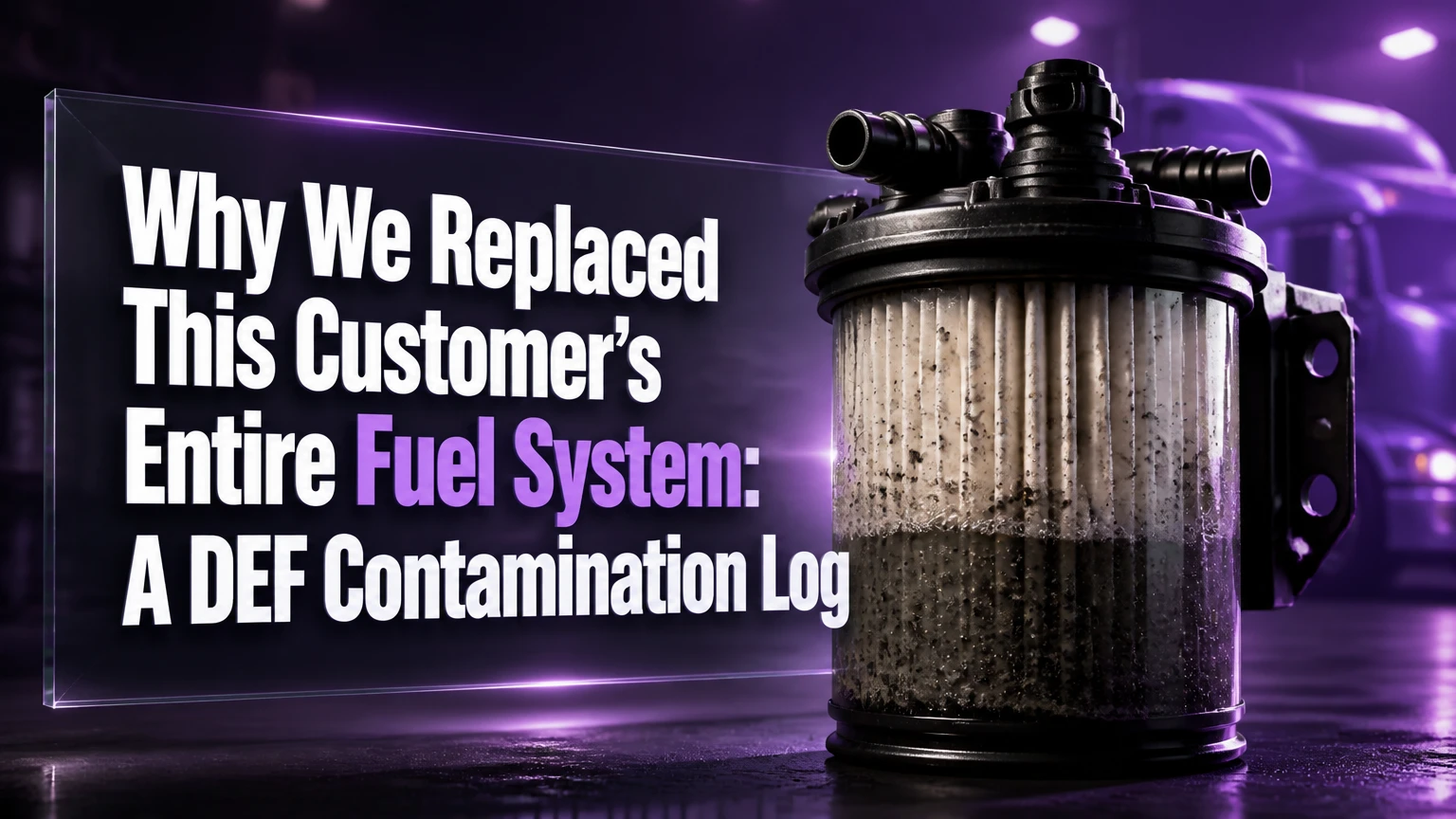
One gallon of DEF into the fuel tank of a 2021 Ford F-250 6.7L Powerstroke. Key turned to “On” to check for a warning light. The lift pump ran for 6 seconds. In those 6 seconds, urea-contaminated fuel moved from the tank through the lift pump, through the primary fuel filter, and into the inlet side of the CP4.2 high-pressure fuel pump.
The engine never started. The repair bill was $12,200. This is the complete teardown log, the crystallization audit at each system stage, and the exact decision points that determined what could be saved and what had to be replaced.
Vehicle Parameters and Arrival Condition
Vehicle: 2021 Ford F-250 Super Duty Lariat, 6.7L Power Stroke diesel, 35,200 miles. Towed in on a flatbed, engine not started since the misfueling event.
Event timeline as reported by owner:
The owner had been adding Diesel Exhaust Fluid to the DEF tank through the blue DEF filler cap on the driver’s side of the bed. He mistakenly poured approximately one gallon of DEF into the primary diesel fuel filler on the passenger side before recognizing the error by the smell and the nozzle size difference. He stopped immediately, replaced the fuel cap, and turned the key to “On” to check for any warning messages on the instrument cluster. He did not attempt to start the engine. He shut the key off after approximately 6 to 8 seconds and called a tow truck.
The decision to turn the key to “On” rather than attempting to start the engine was the right instinct. The outcome of that decision, however, was determined entirely by how the 6.7L Powerstroke’s fuel priming system operates.
What Happens During a 6-Second Key-On Prime Cycle
Diesel fuel systems on modern trucks use a low-pressure lift pump to prime the fuel lines and fill the high-pressure fuel pump inlet before cranking. On the 6.7L Powerstroke, key-on triggers an automatic prime cycle of 5 to 10 seconds. During this cycle:
- The lift pump in the tank activates and draws fuel (now contaminated) from the tank sump.
- The contaminated fuel travels through the pickup tube, through the tank outlet line, and into the lift pump body.
- From the lift pump, contaminated fuel continues to the primary fuel filter/water separator housing.
- Contaminated fuel then flows to the inlet port of the CP4.2 high-pressure pump, filling the low-pressure feed galleries inside the pump body.
At no point does the engine need to start for this sequence to complete. The key-on prime cycle does it automatically in under 10 seconds.
DEF is a water-based solution: 67.5% deionized water, 32.5% urea. Water has zero lubricity and is incompatible with the CP4.2’s roller-and-cam lubrication system, which relies entirely on the diesel fuel film for component protection. Even a brief exposure of the CP4.2 internal surfaces to DEF-contaminated fuel begins the damage process. Urea in contact with aluminum fuel system components in the presence of heat initiates a crystallization process as the water fraction evaporates, leaving solid urea deposits that are insoluble in diesel and mechanically abrasive.
The Teardown: Component by Component
We disassembled the fuel system in sequence from tank to injector, photographing each component before and after inspection.
Fuel Tank
Findings: Tank interior showed a visible layer of cloudy, stratified fluid at the tank sump. We extracted a 500 mL sample for the phase separation test.
Phase separation jar test: The 500 mL sample placed in a clear glass jar showed distinct phase separation after 20 minutes of settling. Bottom layer: a clear aqueous phase, approximately 140 mL, consistent with the water/urea fraction of DEF. Top layer: diesel fuel with a slightly cloudy appearance from urea contamination.
The tank itself showed no crystallization because DEF had not been in contact with heated surfaces long enough to initiate urea precipitation. The tank was drained, inspected for structural damage (none), and reused.
Lift Pump
Findings: We removed the in-tank lift pump and fuel sending unit assembly. The pump body inlet screen was partially clogged with fine white crystalline material. Inside the pump body, the vane-type pump rotor showed white crystalline deposits in the vane slots and on the pump housing inner surface. The vane slot deposits were hard enough to resist scraping with a plastic pick.
Urea crystallization at the lift pump was expected. The pump had circulated the contaminated fuel mixture through its internal passages during the 6-second prime cycle, and any residual moisture on the internal surfaces had begun evaporating and leaving urea crystals.
Decision: Replace. Crystalline deposits in the vane slots create clearance issues and will contaminate any clean fuel introduced into the system.
Primary Fuel Filter and Housing
Findings: The filter element showed white urea crystal deposits on the element face and inside the housing bowl. The filter element itself was replaced as part of the repair protocol regardless of condition. The housing bowl and threaded ports showed no damage.
Decision: Replace element, retain housing after cleaning with deionized water flush.
CP4.2 High-Pressure Fuel Pump
This was the inspection we anticipated most and the finding that determined the scope and cost of the entire repair.
The CP4.2 is a cam-driven roller pump operating at pressures up to 29,000 PSI. Its internal cam lobes, roller lifters, and high-pressure piston bores are lubricated exclusively by the diesel fuel passing through them. The clearances between the rollers and the cam surface are measured in microns. Urea crystals, even sub-micron particles in suspension, are mechanically abrasive at these tolerances and at the contact pressures generated by the cam-roller interface.
We disassembled the CP4.2 and inspected the cam lobes and roller surfaces under a 40x bench magnifier.
Findings: All three cam lobe surfaces showed fine linear scoring marks running perpendicular to the lobe rotation direction. The roller bearing surfaces showed corresponding scoring marks. This is metal-on-metal galling caused by contamination of the lubricating fuel film. The pump had been lubricated by DEF-contaminated fuel during the 6-second prime cycle. That was enough.
We also found white urea crystal deposits inside the pump’s low-pressure feed gallery, visible as a thin white film on the gallery walls.
Decision: Replace. A scored CP4.2 in service will shed metal particles into the high-pressure fuel circuit, contaminating injectors and fuel rails. A CP4.2 with scored cam and roller surfaces will also fail prematurely under operating loads. No serviceable condition exists for this component once galling is present.
Fuel Rails and High-Pressure Lines
Findings: Both high-pressure fuel rails showed white crystalline deposits at the injector inlet ports. The high-pressure lines connecting the CP4 to the rails showed deposits at the rail-side fittings. The rail internal bores were clean beyond the first 15mm at each port, indicating the contamination had not fully traveled through the rail volume during the short prime cycle.
Decision: Replace rails and high-pressure lines. Any crystalline deposit in a 29,000 PSI fuel circuit is a contamination risk for injectors. We do not flush and reuse high-pressure fuel rails when contaminated DEF-sourced deposits are present at the injector ports.
Injectors
Findings: All 8 Bosch piezoelectric injectors showed urea crystal deposits at the inlet filter screens. Two injectors showed deposits visible at the solenoid body port under borescope inspection. No injectors showed tip-end contamination because the high-pressure fuel had not been pressurized through the injector body during the prime cycle.
Decision: Replace all 8. Ford’s powertrain engineering position on CP4 contamination events is to replace all injectors regardless of individual tip condition. A contaminated inlet screen that is not replaced will release trapped urea crystals into the injector body once the vehicle returns to service. The cost of an in-service injector failure on a Powerstroke, including the diagnostic time, towing, and replacement cost, exceeds the cost of replacement at initial repair.
Itemized Repair Cost
| Component | Part Cost | Labor | Total |
|---|---|---|---|
| Fuel tank drain and fluid disposal | $0 (retained tank) | $85 | $85 |
| In-tank lift pump and sender assembly | $380 | $210 | $590 |
| Primary fuel filter element | $65 | Included | $65 |
| CP4.2 high-pressure fuel pump | $2,840 | $480 | $3,320 |
| High-pressure fuel rails (both) | $620 | $320 | $940 |
| High-pressure fuel lines (full set) | $340 | Included in rail labor | $340 |
| Fuel injectors x8 (Bosch OEM) | $5,200 | $1,680 | $6,880 |
| Fuel system purge and prime (clean fuel) | $45 materials | $120 | $165 |
| Diagnostic documentation for insurance | – | $185 | $185 |
| Total | $9,490 | $2,880 | $12,370 |
Why Flushing Is Not an Option
Every owner who hears this diagnosis asks whether the system can be flushed rather than replaced.
The answer is no, for two specific reasons.
First, urea crystallizes as its water component evaporates. Once crystallized, urea is chemically stable in diesel fuel and cannot be dissolved by any solvent compatible with diesel fuel system components. Diesel, naptha, and kerosene-based flushing agents do not dissolve urea crystals. The crystals must be physically removed. In a fuel injector with internal tolerances below 5 microns, physical removal is not possible without disassembly that costs more than replacement.
Second, the CP4.2 cam and roller scoring is a mechanical damage condition, not a contamination condition. A scored cam lobe does not become unscored after a solvent flush. The pump must be replaced.
Insurance and Documentation
This repair was covered under the owner’s comprehensive auto insurance policy as an accidental misfueling event. The key to successful coverage was documentation. Our shop provided:
- A written diagnostic report specifying the contaminating substance (DEF), the sequence of events, and the specific component findings at teardown.
- Photographs of the phase-separation jar test, the urea crystal deposits at each component, and the CP4 cam lobe scoring under magnification.
- A written statement that the contamination was consistent with accidental DEF introduction into the diesel fuel tank.
The insurance adjuster accepted the claim without dispute. The deductible was $500. The owner paid $500 on a $12,370 repair.
The Misfueling First-Response Protocol
If DEF enters the diesel fuel filler neck on a modern diesel truck:
Do not turn the key. Do not open the driver’s door on vehicles with an automatic door-unlock on approach. On some trucks, approaching with the key fob can trigger an automatic accessory-on sequence that activates the lift pump. Keep the key away from the vehicle.
Call a tow immediately. The truck needs to be at a shop with the fuel tank drained before any electrical activation occurs.
Do not attempt to dilute. Adding diesel fuel to the tank does not neutralize the DEF contamination. It dilutes the mixture but does not prevent urea from contacting fuel system components once the lift pump activates.
| Key Status at Discovery | System Spread | Components at Risk | Cost Range |
|---|---|---|---|
| Key never turned on | Tank only | Tank drain and refill | $150 to $300 |
| Key on, no start, under 5 seconds | Tank, lift pump, filter | Lift pump replacement + filter | $800 to $1,200 |
| Key on, no start, 5 to 30 seconds | Tank through CP4 inlet | Lift pump, filter, CP4 pump | $4,000 to $5,500 |
| Engine started and run | Full system | Complete fuel system replacement | $9,000 to $15,000+ |
| Engine run to stall | Full system plus injector tips | Complete system + possible injection coding | $12,000 to $18,000+ |
The cost column is the clearest argument for keeping the key in your pocket the moment you realize what happened.