It was supposed to be a spark plug.
The owner of this 2017 Ford F-150 2.7L EcoBoost had already replaced the cylinder 3 plug twice in eight months. Both times, the P0303 cleared, the rough idle smoothed out, and the truck drove normally for a few weeks before the misfire came back. The third time it came back, it was worse. Hard acceleration at highway speeds produced a shudder and a flash of the traction control light. He brought it to us.
We pulled the plug. It was black, wet, and smelled of raw fuel. That smell was the tell. A spark plug fails from heat or carbon. A plug that smells like a fuel injector is a different problem entirely.
We did not replace the plug a third time. We ran a compression test.
What the Compression Test Found
Dry compression across all four cylinders, engine at operating temperature:
| Cylinder | Dry Compression | Wet Compression | Difference |
|---|---|---|---|
| 1 | 182 PSI | 184 PSI | +2 PSI |
| 2 | 178 PSI | 181 PSI | +3 PSI |
| 3 | 28 PSI | 31 PSI | +3 PSI |
| 4 | 181 PSI | 183 PSI | +2 PSI |
Cylinder 3 was at 28 PSI dry. Adding a tablespoon of engine oil to the bore and retesting moved it to 31 PSI: a 3 PSI improvement. This is the critical number. When oil is added to a cylinder with worn rings, the wet compression rises significantly because the oil temporarily seals the ring gap. On cylinder 3, the wet test produced almost no improvement, which means the leak was not past the rings. The rings were either intact or the leak path bypassed the ring zone entirely.
We ran a cylinder leakdown test next. We applied 100 PSI of regulated shop air to the spark plug bore with the piston at top dead center on the compression stroke and listened for where it escaped.
Cylinder 3 leakdown: 91%. Air was escaping simultaneously from the crankcase breather (past the rings) and from the intake port (past the intake valve). Two leak paths. That finding pointed to structural damage to the piston itself, not ring wear, not a valve seat problem in isolation. A cracked piston land creates a leak path that bypasses the ring zone while also allowing combustion pressure to blow past the rings through the crack.
We needed the borescope.
Inside Cylinder 3: The Borescope Log
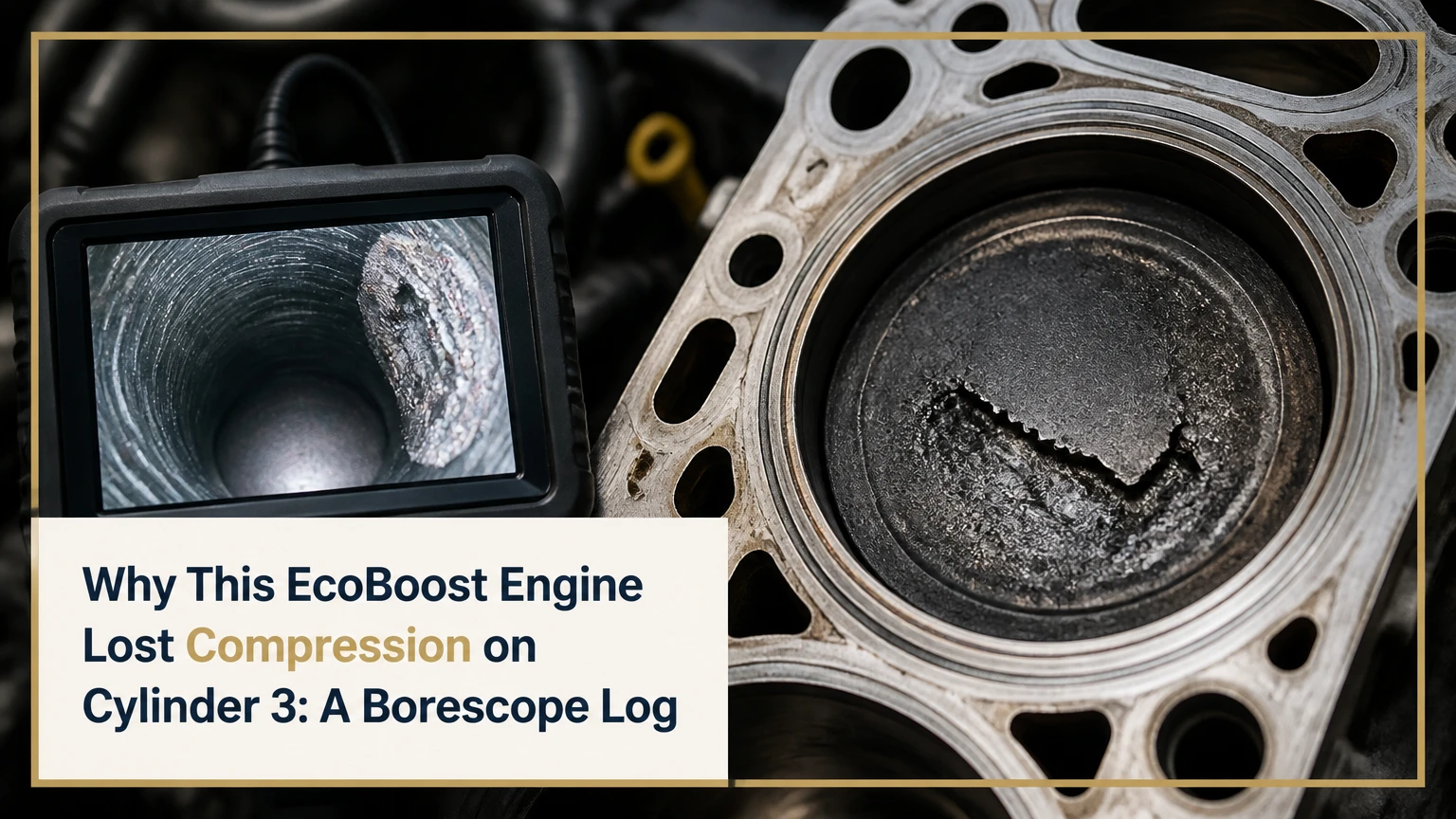
We removed the intake manifold and pulled the cylinder 3 coil, plug, and injector for access. The borescope went in through the spark plug bore. What the camera showed answered every question and raised one new one.
Piston crown: A crack ran across the first land, the narrow band of piston material between the piston crown and the top ring groove. The crack measured approximately 22mm in length under the borescope and ran fully through the land thickness at its widest point. The piston crown surface around the crack showed a dark, rough, eroded texture consistent with prolonged combustion chamber detonation stress. The area surrounding the crack had a slightly melted appearance at the edges, with tiny pits in the aluminum that indicate repeated micro-detonation events had been occurring in that zone over an extended period.
Cylinder wall: The cross-hatch honing pattern on the upper bore was completely destroyed. Normal cylinder wall cross-hatch looks like a diamond grid scored into the bore surface at a consistent angle. On cylinder 3, the upper 60mm of bore showed vertical scoring marks running straight down the bore, parallel to piston travel. These marks are the signature of metal-to-metal contact between a mechanically compromised piston and the cylinder wall under combustion loading. The lower bore retained most of its cross-hatch, consistent with the damage being concentrated in the zone of peak combustion pressure.
Intake valve: Heavy, thick carbon crust on the back of the intake valve and the port walls. This is characteristic of a GDI engine without port injection running extended oil change intervals. The carbon itself was not the primary problem but confirmed the engine had been running at the outer edge of its maintenance discipline.
Cylinder 3 bore, lower section: Dark, wet appearance. Raw fuel had been pooling on the piston crown and draining past the rings into the crankcase. This is the washed cylinder wall: an oil film that no longer exists because fuel has continuously displaced it.
The Injector Nobody Checked
Here is the thing about a spark plug that keeps fouling: it keeps fouling because something is soaking it with fuel. On a port-injected engine, a rich mixture can do it. On a direct-injection engine where the injector sprays directly into the combustion chamber, a mechanically leaking injector does it faster and more specifically.
We removed all four injectors and sent them to a local injector flow bench for testing.
Injector flow test results at 3.0 bar:
| Injector | Flow Rate (mL/min) | Factory Spec (mL/min) | Post-Shutdown Drip Test |
|---|---|---|---|
| Cylinder 1 | 181 | 178 to 186 | 0 drops in 60 seconds |
| Cylinder 2 | 183 | 178 to 186 | 0 drops in 60 seconds |
| Cylinder 3 | 191 | 178 to 186 | 8 drops per minute |
| Cylinder 4 | 180 | 178 to 186 | 0 drops in 60 seconds |
The cylinder 3 injector was leaking past its needle seat at shutdown. Eight drops per minute does not sound catastrophic. In the context of a direct-injection combustion chamber where the injector tip is positioned approximately 15mm above the piston crown, it means the injector was dripping raw gasoline directly onto the piston crown every time the engine was turned off. Over 8 hours of overnight parking, that is 3,840 drops. The fuel pools on the piston, runs into the ring grooves, and drains down the cylinder wall, stripping the oil film from the bore surface every single night.
A cylinder wall without an oil film is being lubricated by nothing during the first few seconds of each cold start, before oil pressure builds and ring contact forces the fresh oil into the bore. On a healthy engine, cold start wear is minimized because the residual oil film from the previous run coats the bore until the oil pump pressurizes. On cylinder 3, there was no residual oil film. There was residual gasoline.
How LSPI Cracked the Piston Land
This truck’s owner admitted to regular mountain driving on a specific route, climbing a long grade at 2,000 RPM in 6th gear under moderate to high load. He described it as “just driving,” and he was not wrong. It is how people drive trucks.
Low-Speed Pre-Ignition (LSPI) is an abnormal combustion event that occurs specifically when a boosted direct-injection engine is operated at low RPM under high load: exactly the condition of climbing a grade in a high gear at low engine speed. In this condition, oil droplets and fuel droplets accumulate in the combustion chamber before the spark fires. Under sufficient cylinder pressure and temperature, one of these droplets auto-ignites before the spark event, creating a pressure wave that collides with the flame front from the spark. The resulting pressure spike is many times higher than normal combustion pressure.
A single LSPI event can produce peak cylinder pressure exceeding 200 bar. Normal peak combustion pressure on a gasoline engine is 50 to 70 bar. The piston crown is designed to withstand normal combustion pressure with an appropriate safety margin. It is not designed to withstand a 200-bar spike.
The sequence on this truck was:
- The cylinder 3 injector drips fuel onto the piston crown overnight.
- The driver starts the engine cold and drives normally. Oil pressure builds. Most of the fuel evaporates or burns off within the first few minutes.
- On the grade climb at 2,000 RPM in 6th gear, cylinder pressures and temperatures are high from boost. The fuel-washed piston crown, combined with elevated cylinder temperature and a small residual raw fuel droplet from the dripping injector, creates the LSPI trigger condition.
- An LSPI event occurs. The pressure spike cracks the first land on the piston.
- The crack creates the leak path that causes 91% leakdown and 28 PSI compression.
- The exposed bore surface below the crack accelerates the cylinder wall scoring.
- The spark plug kept fouling because cylinder 3 was filling with raw fuel from the dripping injector and blowing unburned fuel into the combustion chamber through the cracked piston.
Two spark plug replacements cleared the code temporarily because a fresh plug could fire in the contaminated cylinder long enough for the misfire monitor to stop tripping. The underlying mechanism never changed.
The Cost Escalation Nobody Wants to Read
Had the injector been identified and replaced on the first misfire diagnosis, the total repair cost would have been $148 for an OEM injector plus $85 in labor to remove and replace it with a flow test. Total: $233.
The actual cost at the point of our diagnosis:
| Repair Item | Cost |
|---|---|
| Short block engine (Ford Motorcraft remanufactured) | $4,200 |
| Cylinder 3 fuel injector (replace all 4 while apart) | $320 |
| Timing system inspection and seal replacement | $185 |
| Coolant system service | $95 |
| Labor: engine removal, short block installation, setup | $1,840 |
| Alignment check post-install | $95 |
| Total | $6,735 |
The cost difference between diagnosing the injector on the first visit and diagnosing the cracked piston after three plug replacements: $6,502.
The Diagnostic Sequence That Prevents This
When a GDI turbocharged engine presents a cylinder-specific misfire code with a wet, fuel-smelling spark plug, run this sequence before ordering a plug:
Step 1: Perform a dry and wet compression test on all cylinders. If the misfiring cylinder is below 150 PSI dry, stop. A compression problem is not a spark plug problem.
Step 2: If compression is acceptable (above 150 PSI dry) but the plug is fuel-soaked, remove the injector from that cylinder and send it to a flow bench for a drip test. A dripping injector at shutdown is the diagnosis.
Step 3: If the injector is confirmed dripping, replace it and run a cylinder leakdown test before reinstalling the plug. If leakdown is below 10%, the cylinder is mechanically sound. If leakdown is above 20%, use the borescope before going further.
Step 4: If the borescope shows cylinder wall scoring, piston crown erosion, or any crack in the piston land, the diagnosis is engine mechanical damage. No amount of injector replacement or spark plug replacement recovers a cracked piston.
A wet, fuel-soaked spark plug is not the problem. It is the symptom of a problem that the spark plug has nothing to do with.