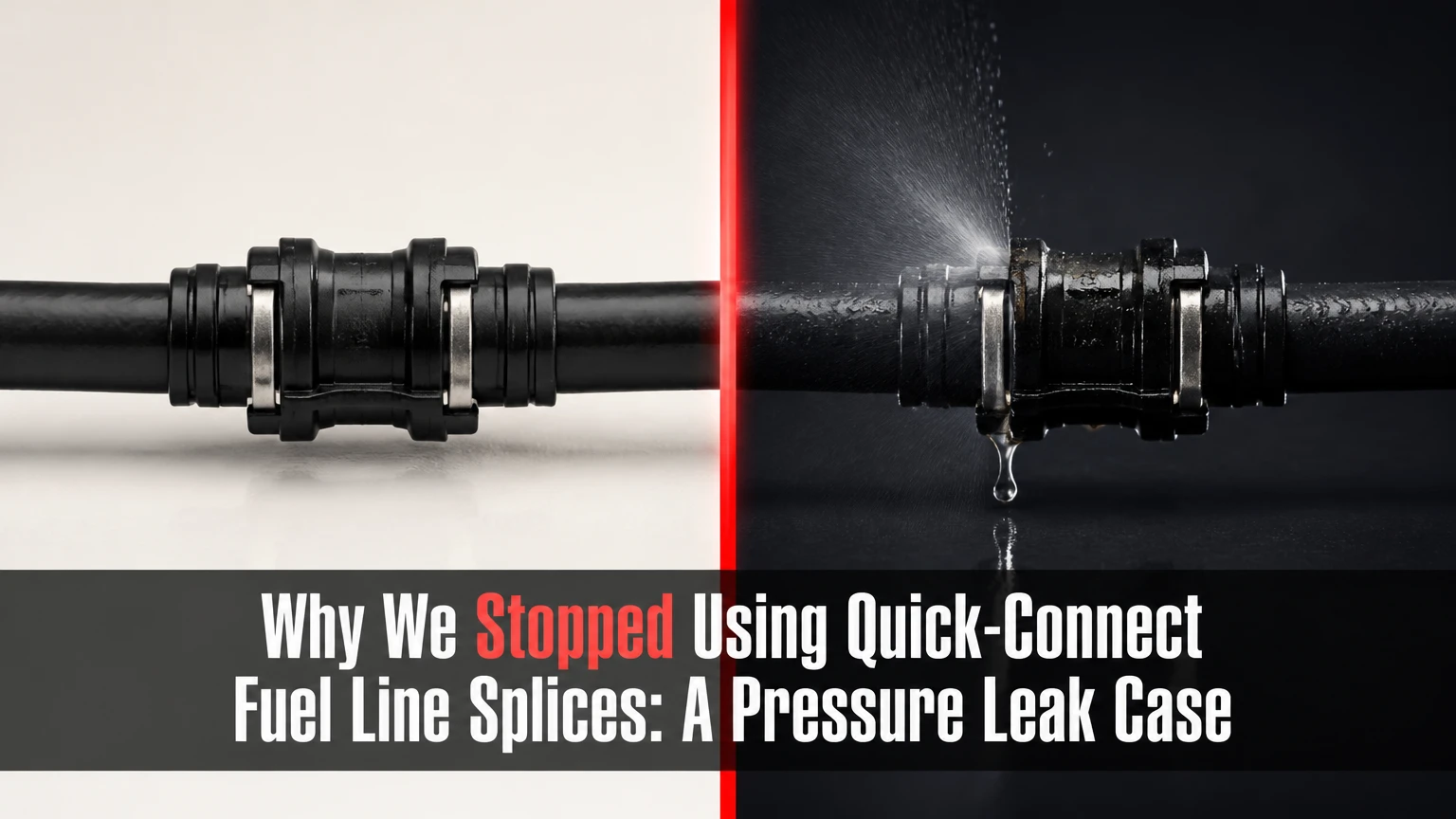
The smell hit us before the hood was fully open. Not a faint fuel odor. A sharp, immediate gasoline smell that meant active fuel in the engine bay, somewhere near a heat source. The 2018 Silverado 5.3L had been at a quick-lube chain eight months earlier for a fuel line repair.
We found the repair immediately: a plastic push-connect splice kit, the kind sold in blister packs at every auto parts store, installed in the main fuel supply line approximately four inches upstream of the fuel rail. The splice was weeping a fine fuel mist from its inlet fitting directly onto the exhaust manifold heat shield.
We have not installed a plastic push-connect fuel line splice since that day.
What Was Under the Hood and Why It Mattered
Vehicle: 2018 Chevrolet Silverado 1500, 5.3L V8, 67,200 miles at inspection. Returnless EFI fuel system operating at 58 PSI static fuel rail pressure.
The original fuel line had developed a rust-through pinhole in a section of steel hard line near a frame bracket, a common failure point on salt-belt trucks in their fifth or sixth winter. The previous shop had cut out the corroded section, approximately 3 inches of 5/16-inch steel line, and bridged the gap with a plastic nylon push-connect splice kit purchased at a parts store. The repair appeared professionally done: the fittings were fully seated, the cut ends were clean, and the line routing was correct.
Eight months and roughly 9,000 miles later, the fitting was spraying atomized gasoline onto an exhaust component running above 800°F at idle.
The Pressure Decay Test
We installed a fuel pressure gauge at the Schrader valve on the fuel rail and pressurized the system to 58 PSI by cycling the key to “On” without cranking. We then switched the key off and monitored pressure decay over 24 hours.
A healthy returnless fuel system on this engine holds static rail pressure above 45 PSI for a minimum of 30 minutes post-key-off. Most healthy systems hold above 50 PSI for several hours.
| Time After Key-Off | Fuel Rail Pressure |
|---|---|
| 0 minutes | 58 PSI |
| 3 minutes | 51 PSI |
| 8 minutes | 39 PSI |
| 12 minutes | 14 PSI |
| 18 minutes | 0 PSI |
The system lost all pressure in 18 minutes. The leak rate was not a drip. Under operating conditions with the pump maintaining 58 PSI continuously, the fitting was spraying atomized fuel at a rate sufficient to coat the nearby heat shield with a visible wet film within 60 seconds of engine start.
The O-Ring Autopsy
We cut the fitting apart and extracted the internal O-ring seal, a small NBR (nitrile) rubber ring approximately 6mm in cross-section. Under a 10x loupe, the degradation was immediately visible.
The O-ring had swelled to approximately 1.4 times its original cross-section diameter. The surface showed a network of fine surface cracks perpendicular to the ring circumference, and the material had a slightly tacky, gummy texture that is the signature of chemical attack from ethanol in the fuel. The modern E10 and E15 fuel blends at this pump location had degraded the NBR compound from the inside out over 9,000 miles of exposure.
NBR rubber is rated for gasoline service. It is not rated for ethanol-blended fuels above approximately 5% ethanol concentration. E10, sold at virtually every US pump, is 10% ethanol. E15, increasingly available, is 15% ethanol. Every plastic push-connect splice kit sold in a blister pack at a chain parts store uses NBR O-rings unless the packaging specifically states fluorocarbon (Viton) or HNBR compatibility. Most do not state it. Most use NBR.
The fitting body itself, a glass-filled nylon polymer, had developed microcracks at the point where it met the flexible rubber fuel line section upstream. We flexed the fitting by hand and heard audible cracking sounds from the nylon body. Eight months of engine vibration transmitted through the rubber line to the rigid nylon splice had initiated fatigue cracking at the stress concentration point where the two materials met.
The Temperature Cycle Problem
We tested a fresh splice kit from the same product line using a heat gun and thermal cycling. The fitting was pressurized to 58 PSI in a bench fixture and cycled from ambient temperature to 220°F (representative of underhood temperatures near the exhaust manifold area) and back, 20 cycles.
At cycle 8, pressure at the inlet O-ring began dropping. At cycle 14, a visible fuel leak appeared at the fitting interface. The fitting had not been exposed to ethanol, vibration, or any condition beyond thermal cycling. Twenty cycles at engine-bay temperatures were sufficient to cause seal failure on a brand-new fitting.
An engine bay experiences a full thermal cycle every time the vehicle is driven and parked. Twenty cycles is 20 drive sessions. For a daily-driven truck, that is three weeks.
What Belongs in a Fuel Line Repair
We now specify the following hierarchy for any fuel line repair, and we document the reasoning on the repair order so the customer understands why we are not using the $8 blister pack.
Option 1 – OEM replacement hard line: The correct repair for any corroded or damaged section on a vehicle that will be kept. Labor intensive but the system returns to factory specification. No O-rings, no fittings, no compatibility questions.
Option 2 – Dorman steel compression fittings with SAE J30 R9 fuel hose bridging: Steel body fittings with copper compression ferrules and fluorocarbon-compatible seals. The J30 R9 specification is the SAE designation for fuel hose rated for EFI pressure and ethanol blends. This combination holds pressure reliably and resists both ethanol and thermal cycling.
Option 3 – Aeroquip or equivalent braided stainless hose with steel AN fittings: Higher cost, appropriate for applications requiring flexibility or custom routing. All-metal sealing surfaces.
Never: Plastic push-connect nylon splice kits from blister packs at chain parts stores, regardless of stated pressure rating. The stated pressure ratings are tested at room temperature with pure gasoline. They are not tested at underhood temperatures with E15 fuel over thermal cycles. The gap between the stated rating and the real-world performance is what ended up spraying fuel on an exhaust manifold on a 2018 Silverado.
Fuel Line Repair Comparison
| Repair Type | Pressure Rating | Ethanol Compatible | Heat Cycle Durability | Cost (3-inch repair) |
|---|---|---|---|---|
| Plastic push-connect blister kit | 80 PSI (room temp) | No (NBR seals) | Poor, under 20 cycles | $8 to $14 |
| Dorman steel compression + J30 R9 hose | 100 PSI continuous | Yes | Excellent | $28 to $45 |
| OEM hard line replacement | 100 PSI+ continuous | Yes | Full service life | $85 to $180 parts + labor |
| Braided stainless AN hose | 250 PSI+ | Yes | Excellent | $60 to $120 |
The plastic splice costs $8. The alternator replacement, intake manifold cleaning, and fuel injector flushing that follow an underhood fuel fire cost considerably more. We stopped accepting that trade-off.