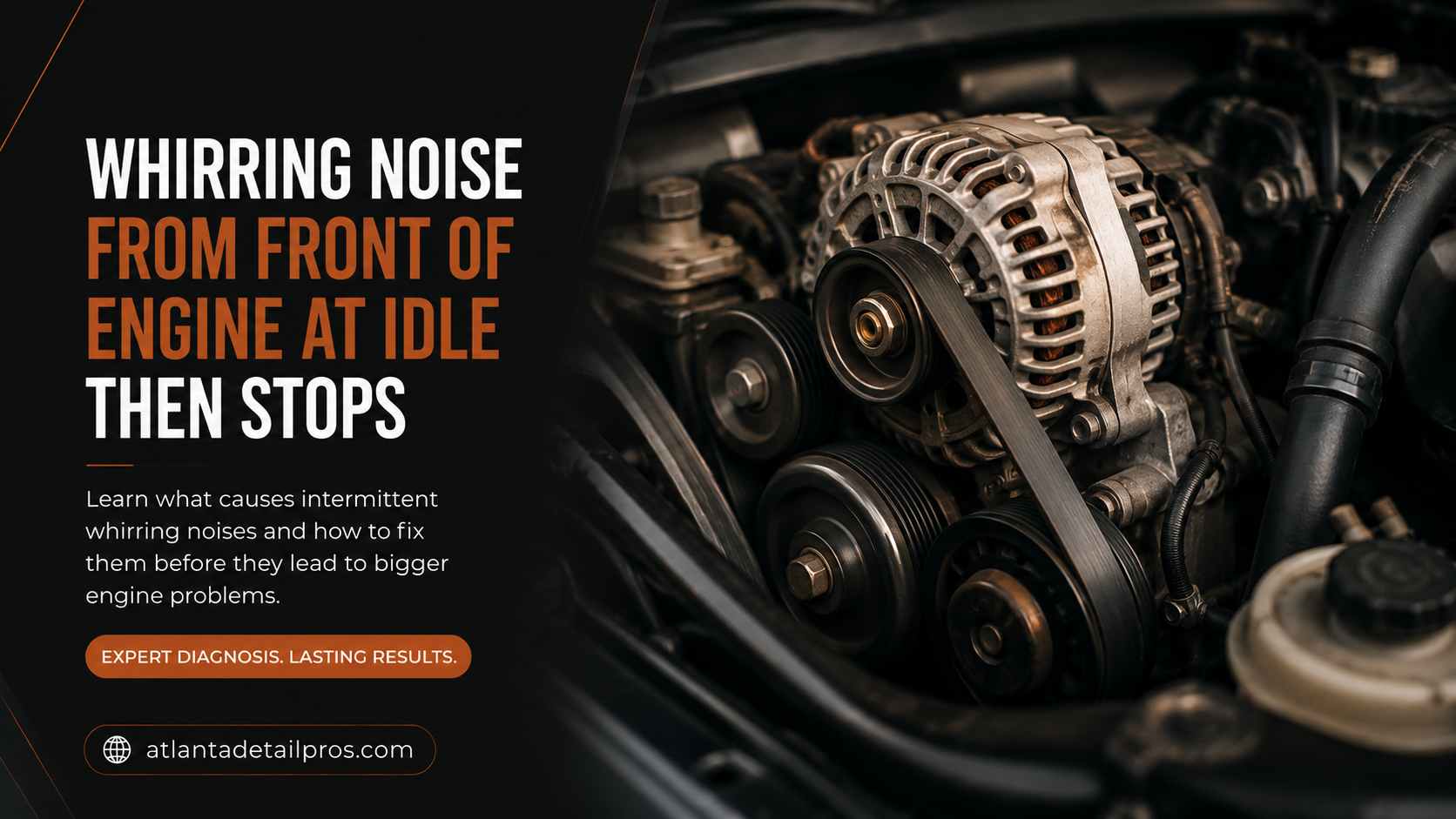
A whirring noise from the front of the engine at idle that stops is most commonly caused by a failing serpentine belt tensioner pulley bearing or idler pulley bearing that produces noise at idle but quiets when engine RPM increases and the bearing operating conditions change.
The front of the engine is where all accessory drive components are belt-driven, including the alternator, power steering pump, air conditioning compressor, and water pump. A failing bearing in any of these components, or in the tensioner and idler pulleys that route the belt, produces a whirring or humming that changes or stops when operating speed or load on that component changes.
The “then stops” part of this symptom is the most diagnostically valuable clue. A noise that stops at a specific condition: when the engine warms up, when you turn off the air conditioning, or when engine RPM rises above idle: directly implicates the component whose operating conditions changed at that moment.
What “Then Stops” Actually Tells You: Decoding the Qualifier
| When the Whirring Stops | What Changed | Most Likely Failing Component |
|---|---|---|
| After 2 to 3 minutes of idling | Engine oil reached components; temperature rose | Hydraulic tensioner or water pump bearing |
| When AC is turned off | AC compressor clutch disengaged; compressor stopped rotating | AC compressor front clutch bearing |
| When engine RPM increases above idle | Changed frequency moved past resonance; belt load changed | Tensioner pulley or idler pulley bearing |
| After replacing serpentine belt recently | New belt changed tension or pulley contact | Accessory pulley bearing now contacted at different tension |
| Intermittently; stops on its own then returns | Early-stage bearing failure; thermal-dependent condition | Idler or tensioner bearing in early failure |
Pay close attention to the AC relationship. Turn on the air conditioning and listen for whether the whirring appears or intensifies. Then turn the AC off and note whether the noise stops or changes. This single test identifies or rules out the AC compressor clutch bearing as the cause in under 30 seconds: one of the most common sources of accessory drive whirring at idle.
Serpentine Belt Tensioner: The Most Common Source
The serpentine belt tensioner is a spring-loaded arm with a pulley that maintains consistent tension on the serpentine belt. The pulley contains a bearing that rotates continuously with the belt. When this bearing begins to fail, it produces a whirring, chirping, or growling noise that is most pronounced at idle where belt load and speed conditions are different from higher RPM. A failing tensioner bearing may produce a noise that changes with engine RPM because the noise frequency changes as the pulley speed changes, moving in and out of audible ranges. The tensioner arm spring can also fail: a spring that has lost tension allows the belt to run loose, causing belt slip that produces a chirping or squealing.
Diagnosis: a mechanic can use a stethoscope or automotive listening tool to isolate the noise to the tensioner pulley while the engine is running. The tensioner pulley should spin smoothly with no roughness when spun by hand with the belt removed.
Repair cost: $150 to $350 at an independent shop including parts and labor.
Idler Pulley Bearing Failure
Idler pulleys are simple bearings mounted on fixed bolts that guide and route the serpentine belt around the accessory drive layout. Like the tensioner pulley, they rotate continuously with the belt and their sealed bearings eventually wear. A failing idler pulley bearing produces a whirring or growling sound that is proportional to belt speed. Most serpentine belt systems have one to three idler pulleys. When an idler bearing is beginning to fail, it may only produce noise at specific operating conditions such as at cold idle or only during very light loads, then stop as conditions change. This intermittent early-stage noise is often dismissed but is valuable information that the bearing is approaching failure.
Replacement cost: $80 to $200 at an independent shop. Shops often recommend replacing both idler pulleys and the tensioner together at high mileage because they have equivalent service lives.
AC Compressor Clutch Bearing
The air conditioning compressor clutch uses an electromagnetic clutch to engage and disengage the compressor from the serpentine belt. The front bearing of this clutch rotates continuously with the belt even when the AC is off, maintaining the pulley in contact with the belt. When this bearing fails, it produces a whirring or grinding noise whether the AC is on or off.
The diagnostic test: with the engine running and AC off, listen for the whirring. Then engage the AC and note whether the noise changes in character. If the noise correlates directly with AC operation, the compressor clutch bearing or compressor body is involved. If the noise is identical whether the AC is on or off, only the front bearing is involved rather than the compressor body.
Repair cost: Clutch bearing replacement only: $150 to $350. Full AC compressor replacement if the compressor body has failed: $500 to $1,200 at an independent shop.
Water Pump Bearing
The water pump is belt-driven on most engines and circulates coolant throughout the cooling system. A failing water pump bearing produces a whirring or growling sound most audible at idle that may change in character with RPM.
The critical diagnostic indicator for water pump bearing failure: coolant leaking from the water pump weep hole, which is a small hole in the pump body designed to allow coolant to drain visibly rather than leak internally and damage the bearing. If there is evidence of coolant residue beneath the water pump while the whirring is present, the water pump bearing is a strong suspect. A failing water pump is an urgent repair. The water pump circulates coolant for engine temperature control, and complete failure leads to engine overheating within minutes.
Repair cost: $200 to $600 at an independent shop depending on whether the timing belt or chain must be disturbed for access.
Alternator Bearing
The alternator produces electrical power for the vehicle’s systems. A failing alternator bearing produces a whirring that is proportional to alternator shaft speed: at idle the shaft is slower, and the noise from a failing alternator bearing typically becomes louder and higher-pitched as RPM increases rather than stopping. A whirring that stops at higher RPM is less commonly an alternator bearing. An alternator bearing that has progressed further may also produce a growling sound and, eventually, electrical symptoms as the alternator output drops. A battery warning light appearing alongside a whirring noise from the front of the engine indicates alternator output may already be compromised.
Frequently Asked Questions
What causes a whirring noise from the front of the engine at idle that stops?
The most common causes are a failing serpentine belt tensioner pulley bearing, an idler pulley bearing, or an AC compressor clutch bearing. The noise stops when the operating condition of the specific failing component changes: when RPM shifts the operating frequency, when the AC compressor clutch engages or disengages, or when the engine warms and bearing characteristics change.
How do I know if the AC compressor is causing the whirring noise?
Turn on the air conditioning and note whether the whirring appears, disappears, or changes character. Then turn the AC off. If the noise correlates directly with AC operation, the compressor clutch bearing or compressor body is involved. If the noise is identical whether the AC is on or off, the AC compressor is less likely to be the cause.
Is a whirring noise at idle serious?
The seriousness depends on the component. A failing tensioner or idler pulley bearing is moderate urgency: the bearing can eventually fail completely, causing the serpentine belt to lose tension or come off, which disables all belt-driven accessories. Water pump bearing failure is more urgent because pump failure leads to overheating. Address any persistent accessory drive noise within a few weeks.
What happens if I ignore a failing belt tensioner?
A tensioner bearing that fails completely can seize, which causes the serpentine belt to skip or come off the pulley. Without the belt, the alternator stops charging the battery, the power steering pump stops (if hydraulic), and the water pump stops circulating coolant. The vehicle will gradually lose electrical function over 20 to 40 minutes as the battery discharges.
How much does it cost to fix a whirring noise from the front of the engine?
Idler pulley replacement: $80 to $200. Tensioner assembly replacement: $150 to $350. AC compressor clutch bearing: $150 to $350. Water pump: $200 to $600. Alternator: $250 to $600. Replacing the entire accessory drive kit (tensioner, idler pulleys, and belt) at once is typically $300 to $600 and is cost-effective on vehicles over 100,000 miles.
My whirring noise appears when the weather is cold and stops after the engine warms. What does this mean?
Cold-only whirring that stops at operating temperature is characteristic of a bearing that becomes less noisy as the grease inside it warms and flows better. Tensioner and idler pulley bearings, AC compressor clutch bearings, and water pump bearings can all exhibit this behavior in early failure stages. It is less urgent than constant noise but is an early warning that bearing replacement will be needed within the next year.
The Bottom Line
A whirring from the front of the engine that stops is a failing bearing in the accessory drive system that produces noise at idle conditions but becomes inaudible when the specific operating condition that excites the noise changes. The most reliable diagnostic step is the AC test: turn AC on and off and observe the noise change. If there is no AC correlation, the tensioner and idler pulleys are the primary suspects.
None of the accessory drive bearing failures are immediate emergencies, but none should be deferred for months because the progression from early noise to complete failure is unpredictable. Schedule an inspection within two to three weeks of first noticing the noise, describe the specific stop condition to the mechanic, and the diagnosis will be faster and more accurate.