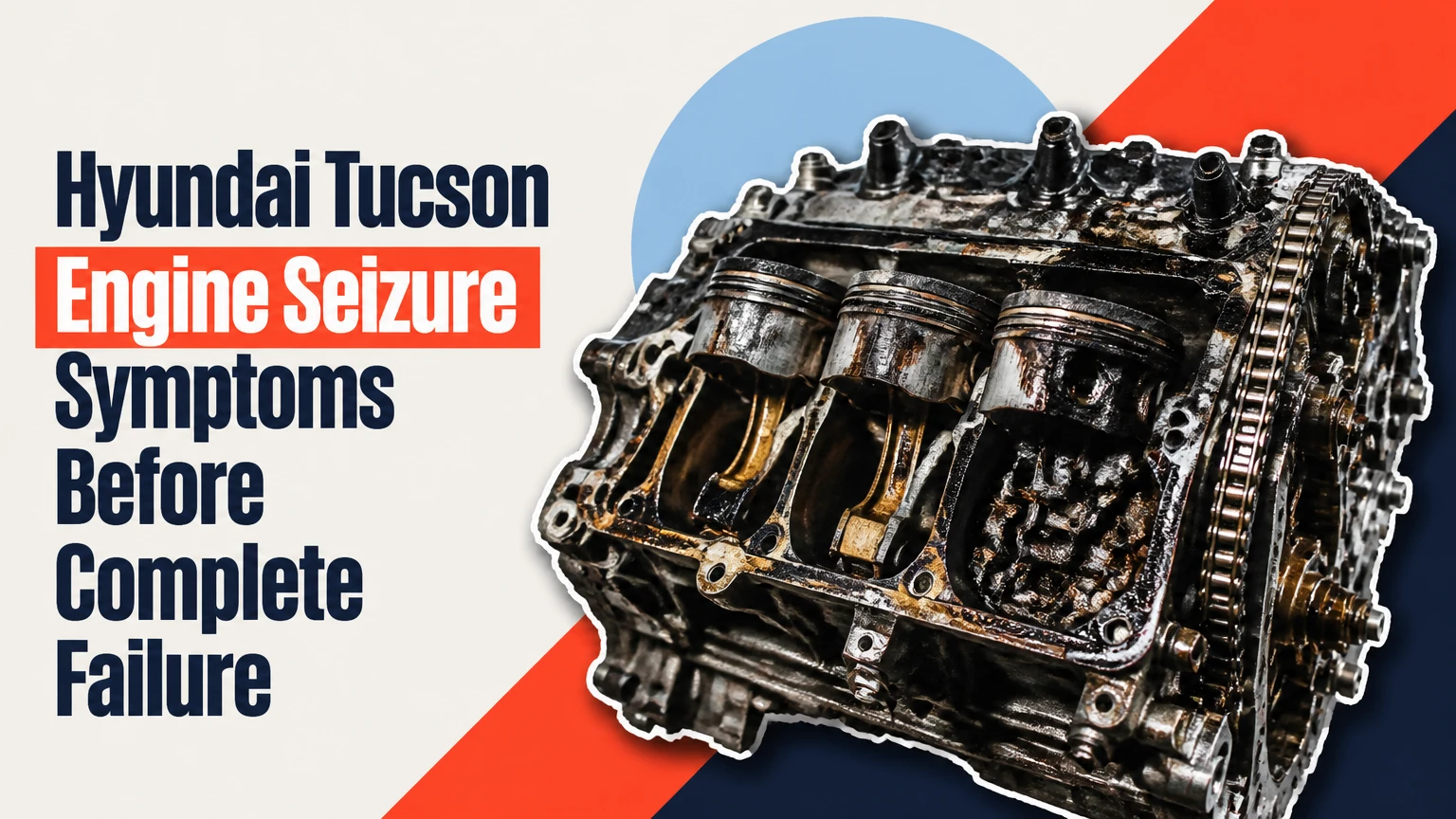
Hyundai Tucson engine seizure produces several warning signs before complete failure that every owner of a 2010 to 2019 Tucson with the 2.4L Theta II GDI or 2.0L Nu engine must know: abnormal oil consumption exceeding one quart per 1,000 miles, a rhythmic knocking or rattling sound that worsens under load, metal shavings visible on the oil drain plug magnet or in the drained oil, an oil pressure warning light that flickers at idle before staying on, and in the final stage before seizure, a sudden loss of engine power accompanied by a loud metallic knock from the lower engine.
These symptoms represent a bearing failure progression that, once past the first warning sign, can advance to catastrophic seizure within hundreds to a few thousand miles depending on driving conditions and response time. The Theta II GDI engine in the Tucson has been the subject of multiple class action lawsuits, NHTSA investigations, and a Hyundai extended warranty program (HSA) specifically because this failure sequence was documented on a scale that required a manufacturer response.
The root cause of the Theta II failure is a manufacturing defect in a subset of engines where metal debris from the machining process remained in the oil passages during assembly. This debris circulates through the engine oil and abrades the connecting rod bearing surfaces, leading to premature bearing failure that can result in a spun bearing, connecting rod failure, or complete engine seizure. Not all Theta II engines are affected, but the failure rate is high enough that any owner of an affected model year should know this symptom sequence.
Which Engines and Model Years Are Affected
The Tucson engine seizure concern is not universal across all model years or all engines. Knowing precisely which engine your Tucson has determines the risk level and the applicable warranty coverage.
2.4L Theta II GDI (Most Affected)
Used in the 2011 to 2019 Tucson (2.4L designation, non-turbocharged). This engine was manufactured at a facility where the machining debris contamination occurred. Hyundai’s own investigation identified a manufacturing window during which the contamination risk was highest, and the Knock Sensor Detection System (KSDS) software update and extended warranty program were specifically developed for this engine.
2.0L Nu GDI
Used in the 2016 to 2019 Tucson (base 2.0L designation). The Nu engine has lower reported failure rates than the Theta II but shares the direct injection design that produces higher-carbon intake valve deposits and slightly elevated oil consumption compared to port-injected predecessors.
1.6L Turbocharged (Gamma T-GDI)
Used in the Sport trim from 2016 onward. The turbocharged 1.6L has not been subject to the same bearing failure pattern as the Theta II but does require strict oil change adherence due to the turbocharger’s oil feed and cooling requirements.
The Theta II Failure Mechanism in Detail
Understanding the failure mechanism explains why the early symptoms progress at the rate they do and why monitoring oil consumption is the single most important early warning action.
The machining debris that remained in oil passages during Theta II assembly is typically aluminum swarf (fine metal particles from the cylinder bore machining process). Over time, this debris accumulates at the rod bearing surfaces, which are the most precision-critical surfaces in the engine. The bearing surfaces are designed with very small tolerances that allow a continuous oil film to separate the bearing shell from the crankshaft journal. When debris abrades these surfaces, the tolerance increases, the oil film becomes inconsistent, and metal-to-metal contact begins occurring at each engine revolution.
This metal-to-metal contact generates additional metal debris, which circulates in the oil and abrades additional surfaces. The failure is self-accelerating: each bearing event generates more debris that causes more bearing events. This is why the symptom progression from early knock to catastrophic seizure can be so rapid once it begins in earnest.
Early Warning Signs in Detail
Each warning sign represents a specific stage in the bearing failure progression. Acting at the first sign is critical.
Abnormal Oil Consumption
The first and most actionable early warning is oil consumption above one quart per 1,000 miles. Establish your baseline: perform an oil change, note the exact mileage, and check the dipstick every 500 miles for the first 3,000 miles. If you are adding oil between changes at a rate faster than one quart per 3,000 miles, document this with photos of the dipstick reading and the mileage at each check. This documentation is essential for any warranty claim.
The Theta II’s oil consumption can be related to the bearing failure (bearing surfaces that have been abraded allow more oil passage) or to the direct injection carbon deposits that allow oil to pass the piston rings. Either cause of elevated consumption is a red flag on this engine.
Rhythmic Knocking Under Load
A rod bearing that has lost its oil film produces a deep, rhythmic knock that is most pronounced during acceleration under load and during cold starts before oil pressure fully builds. This knock has a specific character: it is consistent with engine RPM (not with valve train speed, which is half engine speed) and it worsens when the engine is under load (acceleration, climbing a grade) because the connecting rod forces are highest under load. At idle the knock may be faint: under hard acceleration it becomes unmistakable.
Metal Shavings in Oil or on Drain Plug Magnet
When performing an oil drain, examine the drain plug for magnetic deposits. The magnetic drain plug (if equipped) or a magnetic drain plug upgrade ($5 to $15 at auto parts stores) captures ferrous metal particles circulating in the oil. Visible metallic debris on the magnetic surface confirms active metal generation inside the engine. Any metallic debris beyond the fine gray haze of normal wear is a critical warning sign requiring immediate engine-off and tow.
Oil Pressure Warning Light
An oil pressure light that flickers at idle and then remains steady (or stays on) indicates that the oil pressure has dropped below the minimum threshold the engine requires for the lubrication film at the bearing surfaces. At this stage, the bearing clearances have increased enough from wear that the oil pump cannot maintain the required pressure. Driving with an oil pressure light on causes rapid additional bearing damage: stop the engine immediately and arrange a tow.
Sudden Power Loss and Loud Knock
The final stage before or during seizure: a connecting rod bearing fails completely, the rod either seizes to the crankshaft journal or breaks free. Either event produces a sudden loss of power on the affected cylinder and a violent, loud knock that is audible over all other noise. If the rod breaks free and penetrates the engine block, the engine is destroyed immediately. If the bearing seizes, the crankshaft stops rotating. Do not attempt to restart the engine after this symptom.
Warning Sign Progression Table
Warning Sign | Stage | Action Required |
|---|---|---|
Oil consumption above 1 quart per 1,000 miles | Early | Document and contact dealer for oil consumption test |
Faint deep knock under hard acceleration | Developing | Stop non-essential driving, dealer inspection same week |
Metal shavings on drain plug | Advanced | Do not drive: tow to dealer immediately |
Oil pressure light flickering at idle | Critical | Stop engine immediately, tow, do not restart |
Sudden power loss and loud knock | Catastrophic | Engine has failed: tow, do not attempt restart |
Hyundai’s Extended Warranty Program and KSDS Update
Hyundai implemented two primary responses to the Theta II failure: the Knock Sensor Detection System (KSDS) software update and the extended warranty program.
KSDS Software Update
The KSDS update programs the ECU to monitor knock sensor data for patterns consistent with early bearing failure. When the system detects these patterns, it illuminates the check engine light and stores a specific code, giving the driver a warning before the failure progresses to catastrophic seizure. The update does not repair the engine or eliminate the failure risk: it is an early warning layer. All affected Theta II Tucsons should have this update applied.
To check whether the KSDS update has been applied to your vehicle, visit a Hyundai dealer with your VIN. The update is applied at no charge regardless of mileage or ownership history.
Extended Warranty Program
Hyundai extended the powertrain warranty on affected Theta II engines to 10 years or 100,000 miles from the original in-service date for engine short block components (pistons, connecting rods, crankshaft, and bearings) on vehicles that have had the KSDS update applied and maintained oil changes as specified.
Any Tucson owner experiencing the symptoms described in this article who is within the 10-year or 100,000-mile coverage window should contact Hyundai Consumer Affairs (1-800-633-5151) and their nearest dealer before authorizing any paid engine repair. A covered engine replacement costs nothing to the owner. An out-of-warranty engine replacement costs $5,000 to $9,000 at a dealer.
“My 2013 Tucson 2.4 started burning about a quart of oil every 1,200 miles at 95,000 miles. I almost ignored it. Then I noticed a faint knock during hard acceleration. Contacted Hyundai Customer Care and they had the dealer perform an oil consumption test. The test came back qualifying for a covered engine replacement at no cost under the extended warranty. The process took about three weeks but I got a complete short block replacement.” : Nina Burkhart, 2013 Hyundai Tucson 2.4L GDI owner
What to Do Right Now
If you own a 2011 to 2019 Tucson with the 2.4L Theta II, complete these steps in order regardless of whether you have symptoms.
First, verify whether the KSDS software update has been applied to your VIN at a Hyundai dealer or through the Hyundai owner portal. This is free and takes under 30 minutes.
Second, establish an oil consumption baseline over the next 3,000 miles by checking the dipstick every 500 miles and documenting each reading with the mileage.
Third, save all oil change receipts. Hyundai’s extended warranty coverage requires documented oil change history at the manufacturer-specified interval to be eligible. Gaps in documentation weaken any warranty claim.
Fourth, if you notice any of the warning signs in this article, stop driving the vehicle and contact Hyundai Consumer Affairs before visiting any shop. Authorizing a paid engine repair at an independent shop on a vehicle that qualifies for covered warranty replacement forfeits the warranty coverage.
Repair Cost Reference (Out of Warranty)
Repair | Typical Cost |
|---|---|
KSDS software update | Free at dealer |
Long-block engine replacement (dealer, out of warranty) | $5,000 to $9,000 |
Long-block engine replacement (independent shop, remanufactured) | $3,500 to $6,000 |
Short block replacement only (if heads are undamaged) | $2,500 to $4,500 |
Used engine installation (salvage, higher risk) | $1,500 to $3,000 |
FAQs
How do I know if my Tucson has the affected Theta II engine?
Any 2011 to 2019 Tucson with the 2.4L engine designation is a Theta II GDI. The engine displacement is listed on the window sticker, the owner’s manual, and the NHTSA VIN lookup database. You can also check your VIN against Hyundai’s recall and service campaign database at the NHTSA website (nhtsa.gov/recalls) to see all applicable campaigns for your specific vehicle.
Does Hyundai’s extended warranty transfer to a new owner?
Yes. The 10-year or 100,000-mile extended warranty for Theta II short block components follows the vehicle, not the original owner. A used Tucson that was purchased from the original owner is still covered under the extended warranty if it is within the time and mileage limits. Verify coverage through a dealer before any purchase of a used affected Tucson.
Can I continue driving if I have mild oil consumption and no knock?
Mild oil consumption (under one quart per 1,500 miles) without any knock or oil pressure symptoms puts you in the monitoring phase rather than the emergency phase. The correct response is to apply the KSDS update, establish a consumption baseline, maintain oil level rigorously (never let the level drop below the MIN mark), and schedule an oil consumption test at a dealer. Continue driving cautiously but reduce extended high-load driving (highway trips with sustained high RPM) until the dealer inspection is completed.
What happens if the engine seizes while driving?
If the connecting rod bearing fails catastrophically while the vehicle is moving, the engine will stop producing power suddenly. Do not attempt to restart the engine. Guide the vehicle safely to the roadside, shift to neutral if the engine is still turning and apply brakes to slow down, and come to a controlled stop. Turn on hazard lights and call for a tow. Attempting to restart a seized or severely damaged engine causes additional catastrophic damage and creates a safety risk.
Bottom Line
Hyundai Tucson engine seizure before complete failure is detectable through abnormal oil consumption, a bearing knock under load, metal debris in the oil, and an oil pressure warning light, and the window for intervention before catastrophic failure is weeks to months depending on how quickly these early signs are acted upon.
Every affected Tucson owner should verify the KSDS software update status immediately and establish an oil consumption baseline before waiting for symptoms.
If symptoms are already present, contact Hyundai Consumer Affairs before visiting any shop. The 10-year or 100,000-mile extended warranty on Theta II short block components is among the most significant coverage programs any manufacturer has offered for a known defect, and it is forfeited the moment a paid repair is authorized at an independent shop on a covered vehicle.