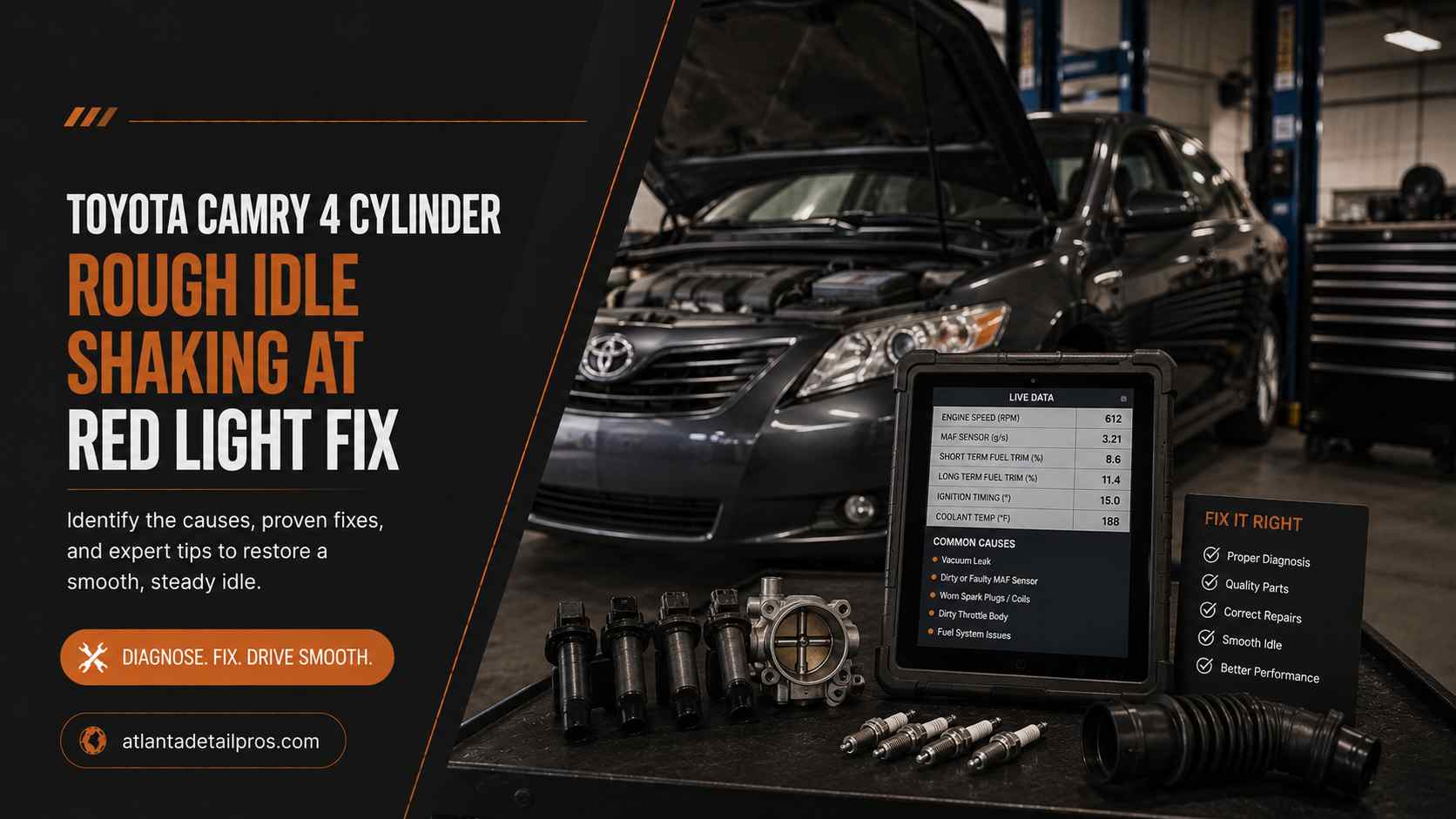
Toyota Camry 4-cylinder rough idle and shaking at a red light is most commonly caused by a failed ignition coil or fouled spark plug on one or more cylinders, with ignition coil failure being the dominant cause on 2AZ-FE and 2AR-FE engines above 80,000 miles, followed by a dirty or failing mass airflow sensor, a vacuum leak in the intake system, or a degraded idle air control function from carbon buildup on the throttle body.
The shaking is a misfire: one or more cylinders is not completing its combustion cycle, and the resulting power imbalance causes the entire engine to vibrate at idle when the engine is under its lowest load condition. At a red light, the misfire that might be masked at driving speed becomes fully apparent because there is no drivetrain momentum to smooth the vibration.
The Toyota Camry 4-cylinder has been produced in several distinct generations with different engines and slightly different failure patterns. The 2002 to 2011 Camry with the 2AZ-FE 2.4L four-cylinder, the 2012 to 2017 with the 2AR-FE 2.5L, and the 2018 to present with the A25A-FKS 2.5L direct-injection engine each have a characteristic rough idle cause pattern that reflects their design. Knowing which engine you have focuses the diagnosis before any parts are purchased.
Identifying Your Engine and Its Known Failure Pattern
The correct repair sequence starts with knowing which 4-cylinder engine your Camry has, since the failure patterns differ by generation.
2002 to 2011 Camry: 2AZ-FE 2.4L
This engine has a documented history of ignition coil failure that is well-established in the Camry owner community and confirmed by Toyota service data. The 2AZ-FE coils degrade between 70,000 and 120,000 miles, and the failure is often intermittent at first: rough idle only on cold mornings, or only under air conditioning load. Fouled spark plugs are the secondary cause, particularly when the coil failure has been intermittent and unburned fuel has contaminated the plug on the misfiring cylinder.
This engine also has a known history of oil consumption from a design issue with the piston rings on certain build dates (2006 to 2011 model years). Excessive oil consumption leads to oil-fouled spark plugs that cause misfires. If the Camry is consuming more than one quart of oil per 2,000 to 3,000 miles, oil fouling of the plugs must be investigated alongside the ignition components.
2012 to 2017 Camry: 2AR-FE 2.5L
The 2AR-FE improved on the 2AZ-FE’s oil consumption issues but retained similar ignition coil sensitivity. Rough idle on this engine is most commonly caused by: failed ignition coil (same presentation as the 2AZ-FE), a dirty mass airflow sensor from extended filter service intervals, or a failing VVT-i system (variable valve timing) that produces a rough cold idle that smooths out as the engine warms.
2018 to Present Camry: A25A-FKS 2.5L (Dynamic Force Engine)
This direct-injection engine introduces intake valve carbon buildup as a significant rough idle cause that was not present on the port-injected 2AZ-FE and 2AR-FE. Direct injection does not wash the intake valves with fuel, allowing carbon deposits to accumulate on the valve face and seat over time. By 60,000 to 80,000 miles, significant carbon buildup can reduce air flow through affected cylinders and cause rough idle and misfires. Walnut blasting (pressurized walnut shell media cleaning of the intake valves) is the correct remedy for this engine’s carbon deposits.
Cause Hierarchy by Frequency
These causes are ranked by how commonly they produce rough idle and shaking on a Toyota Camry 4-cylinder, based on documented repair patterns.
Cause | Affected Engines | Typical Mileage at Failure | DIY or Shop |
|---|---|---|---|
Failed ignition coil (one or more) | 2AZ-FE, 2AR-FE | 70,000 to 130,000 miles | DIY accessible |
Fouled or worn spark plugs | All engines | 60,000 to 100,000 miles | DIY accessible |
Dirty mass airflow (MAF) sensor | 2AZ-FE, 2AR-FE | 60,000 to 100,000 miles | DIY accessible |
Vacuum leak (intake manifold, hose) | All engines | Any mileage | DIY possible |
Dirty throttle body (carbon at idle air port) | All engines | 60,000 to 100,000 miles | DIY accessible |
Intake valve carbon buildup | A25A-FKS (2018+) | 60,000 to 80,000 miles | Shop required |
VVT-i solenoid or oil pressure fault | 2AR-FE, A25A-FKS | 80,000 to 120,000 miles | Shop recommended |
Clogged fuel injector | All engines | 80,000 to 120,000 miles | DIY or shop |
Failing engine mount (amplifies vibration) | All engines | 100,000 to 150,000 miles | Shop recommended |
Step-by-Step Diagnosis
These steps are sequenced from lowest-cost and highest-probability to more involved tests. Work through them in order before replacing components.
Step 1: Check for Stored Codes (Free at Parts Store)
Take the vehicle to any major auto parts store for a free OBD-II code read. A P0301 to P0304 misfire code identifies the specific misfiring cylinder. A P0300 (random misfire) indicates the misfire is not consistent to one cylinder. MAF sensor codes (P0100 to P0104) and VVT codes (P0010, P0011) identify those systems as contributors. Write down all codes before clearing anything.
Step 2: Perform the Coil Swap Test
On a 4-cylinder with coil-on-plug ignition, swap the coil from the suspected misfiring cylinder (identified by the misfire code) to an adjacent cylinder and clear the code. Drive the vehicle and check whether the misfire code moves to the new cylinder or stays on the original cylinder. If it moves, the coil is faulty. If it stays, the spark plug or injector on the original cylinder is the cause.
Step 3: Inspect and Replace Spark Plugs
Remove and inspect all four spark plugs. Look for oil fouling (wet, black oily deposits), carbon fouling (dry black soot), white or gray deposits (lean condition or overheating), or worn electrodes with a large gap. The Toyota 2AZ-FE and 2AR-FE use iridium plugs that are specified for replacement at 60,000 miles. Plugs run past 80,000 to 100,000 miles on these engines are commonly worn beyond their reliable ignition threshold. Replace the full set regardless of which cylinder is misfiring.
Step 4: Clean the MAF Sensor
Remove the MAF sensor from the air intake housing (it sits between the air filter and the throttle body). Spray the sensing wire element with dedicated MAF sensor cleaner (not carb cleaner or brake cleaner, which damage the sensing wire). Allow to dry completely before reinstalling. A dirty MAF sensor causes incorrect air mass readings that make the ECU inject too much or too little fuel, producing a rough idle that is present at all speeds but most noticeable at red lights.
Step 5: Inspect for Vacuum Leaks
With the engine idling, listen for a hissing sound near the intake manifold, throttle body, PCV hoses, and brake booster vacuum line. An unmetered air leak past any of these connections causes a lean idle condition. Spray short bursts of throttle body cleaner or brake cleaner near each connection while listening for RPM changes: an RPM increase when the spray contacts a specific point confirms a vacuum leak at that location. Common locations on the 2AZ-FE include the intake manifold gasket near cylinder 4 and the PCV hose at the valve cover fitting.
Step 6: Clean the Throttle Body
Remove the intake air duct from the throttle body. With the ignition off, spray throttle body cleaner on a clean rag and wipe the inside bore of the throttle body and the throttle plate. Carbon deposits at the idle air bypass port restrict airflow at idle and cause a rough, unstable idle RPM.
Check Engine Light Codes for the Camry 4-Cylinder Rough Idle
Code | Meaning | Action |
|---|---|---|
P0301 to P0304 | Misfire on cylinder 1, 2, 3, or 4 | Coil swap test, then plug inspection |
P0300 | Random multi-cylinder misfire | Check fuel pressure, vacuum leak, MAF |
P0100 to P0104 | MAF sensor malfunction | Clean MAF, replace if cleaning fails |
P0171 | System too lean, Bank 1 | Check vacuum leaks, MAF, fuel pressure |
P0010 / P0011 | VVT-i circuit or performance fault | Inspect VVT solenoid, check oil level and quality |
P0340 | Camshaft position sensor circuit | Check sensor and wiring |
Engine Mount Contribution to Idle Shake
A worn engine mount does not cause a misfire but significantly amplifies the vibration from a rough idle at red lights. The Camry 4-cylinder sits on three or four mounts that isolate the engine’s normal firing pulses from the cabin. A mount that has torn or collapsed transfers more vibration to the body, and a rough idle that might be barely perceptible with good mounts becomes obvious shaking at the steering wheel and through the seat.
If spark plugs, coils, MAF cleaning, and vacuum leak checks have been performed and the rough idle persists but only vibrates noticeably inside the cabin, inspect the engine mounts. A collapsed mount is visible as crushed or torn rubber between the mount brackets. Replacement cost for an engine mount on the Camry 4-cylinder runs $120 to $280 per mount at an independent shop.
“My 2009 Camry was shaking badly at red lights and the dealer wanted $850 to diagnose and replace multiple parts. I went to an independent shop that did a code read first: P0302 on cylinder 2. They did a coil swap, confirmed it was the coil, and replaced all four coils and plugs for $380. Smooth as new within the same afternoon.” : Melissa Tanaka, 2009 Toyota Camry 4-cylinder owner
Repair Cost Summary
Repair | Parts Cost | Total Cost (Independent Shop) |
|---|---|---|
Single ignition coil replacement | $30 to $60 each | $80 to $160 |
All four ignition coils replaced | $120 to $220 total | $220 to $380 |
Full set spark plugs (iridium, 4-cylinder) | $30 to $80 | $100 to $200 |
Coils and plugs together | $150 to $280 total | $280 to $500 |
MAF sensor replacement (if cleaning fails) | $60 to $150 | $120 to $250 |
Throttle body cleaning | $10 to $20 supplies | $80 to $130 shop |
Vacuum leak repair (hose) | $10 to $30 | $60 to $150 |
Intake valve carbon cleaning (A25A-FKS) | N/A (shop equipment) | $400 to $700 |
Engine mount replacement (one) | $40 to $120 | $120 to $280 |
FAQs
Why does the rough idle get worse at red lights specifically?
At red lights, the engine is at its lowest load condition and lowest RPM. A misfire that produces a power imbalance in the firing order is most noticeable at idle because there is no additional throttle input or drivetrain momentum to mask the vibration. The same misfire may be imperceptible at highway speed because the engine speed is high enough that the firing frequency of the good cylinders overwhelms the vibration from the misfiring one.
Should I replace all four coils or just the failed one?
On the 2AZ-FE and 2AR-FE, replacing all four coils at the same service interval is strongly recommended once one has failed. These coils age at the same rate and are made from the same materials. A second coil failure within 6 to 12 months of the first is common on these engines if only the failed coil is replaced. The additional cost of the remaining three coils (approximately $90 to $160) is far less than a return diagnosis and labor visit.
Can the rough idle damage the catalytic converter?
Yes. A significant misfire that sends unburned fuel into the exhaust overheats the catalytic converter rapidly. The check engine light flashing (rather than steady) is the indicator that the misfire is severe enough to risk catalyst damage. If the check engine light is flashing, do not drive the vehicle hard or at highway speed until the misfire is corrected.
How often should the spark plugs be replaced on a Toyota Camry 4-cylinder?
Toyota specifies iridium spark plug replacement at 60,000 miles on the 2AZ-FE and 2AR-FE. Many technicians recommend staying close to this interval on these engines due to the coil-to-plug sensitivity: a worn plug increases the coil’s electrical demand and accelerates coil degradation. Running the plugs to 80,000 to 100,000 miles is common but increases the risk of both plug and coil failure.
What if replacing the coils and plugs does not fix the rough idle?
If a confirmed coil swap test shows the misfire does not follow the coil and a fresh plug does not resolve the misfire on the same cylinder, the next steps are a fuel injector resistance and spray test for that cylinder (a clogged injector produces a lean misfire that behaves identically to an ignition failure in symptom but not in coil swap result) and a compression test on the misfiring cylinder to rule out a mechanical compression issue.
Bottom Line
Toyota Camry 4-cylinder rough idle and shaking at a red light is almost always caused by a failed ignition coil or worn spark plugs, and the coil swap test combined with a free OBD-II code read at a parts store identifies the specific misfiring cylinder in under 15 minutes at no cost.
Replace all four coils and the full set of iridium spark plugs when one coil has been confirmed failed: the remaining coils are at the same mileage point and a return misfire within months is the predictable alternative.
The complete coil and plug replacement costs $280 to $500 at an independent shop and is the correct first repair on any 2AZ-FE or 2AR-FE Camry with rough idle above 70,000 miles. If cleaning the MAF, fixing a vacuum leak, and replacing the ignition components do not resolve the rough idle, escalate to a fuel injector test and a compression check before authorizing any further parts replacement.