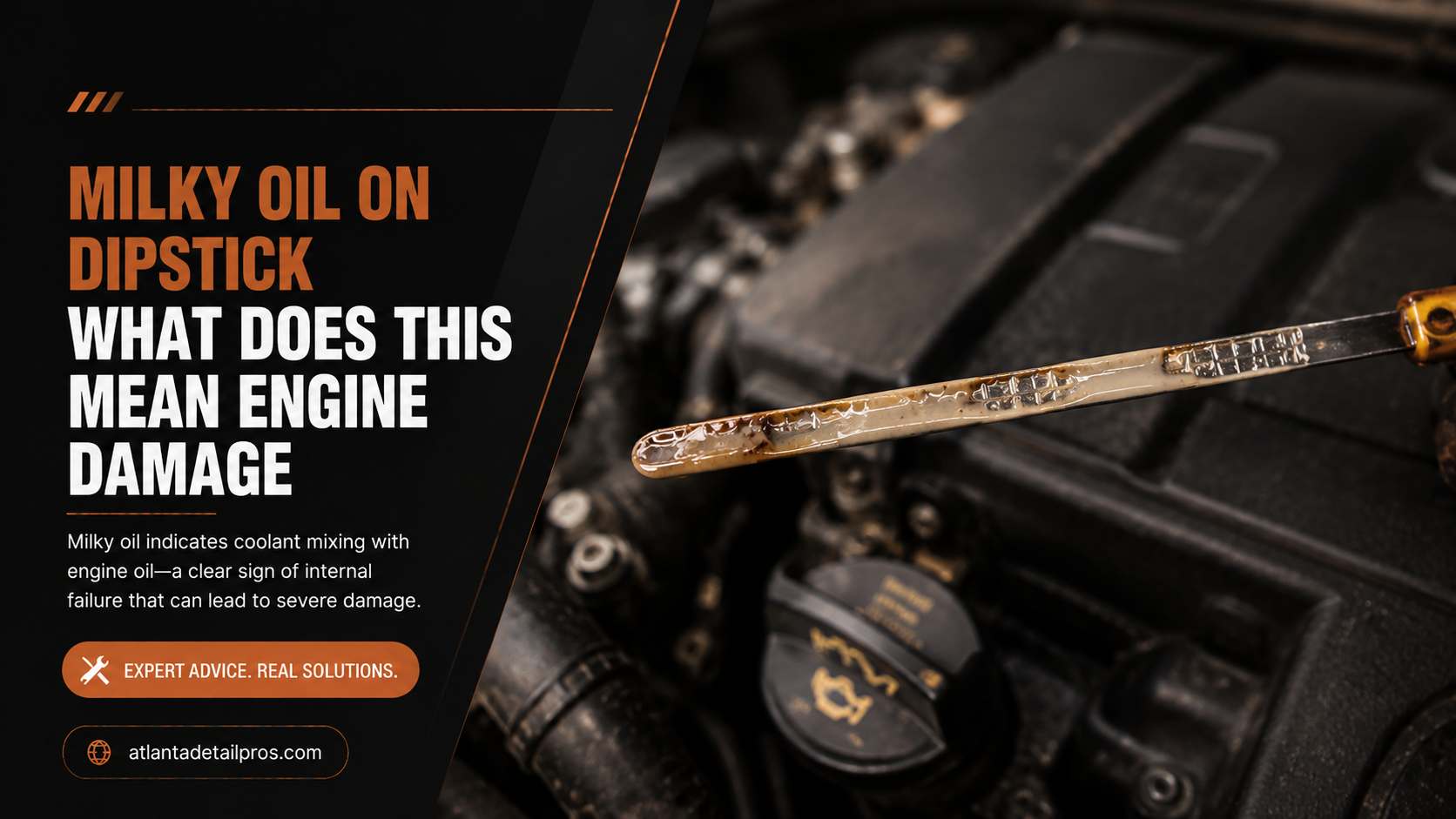
Milky, creamy, or frothy oil on the dipstick means coolant has mixed with engine oil, and the most common cause is a blown head gasket allowing coolant to cross from the water jacket into the oil passages.
The milky appearance is an emulsion: coolant and oil mixed under heat and agitation produce a tan, cream, or light brown froth that looks nothing like normal engine oil. This is not a minor issue and it does not resolve on its own. Every mile driven with coolant in the engine oil accelerates bearing wear, since the coolant dilutes the oil’s lubricating properties and the ethylene glycol in antifreeze is directly corrosive to soft metal bearing surfaces.
The degree of engine damage already present when you find milky oil depends entirely on how long the contamination has been there. A driver who noticed the symptom within a day or two faces a head gasket repair. A driver who has been seeing frothy oil for weeks without acting may face crankshaft bearing replacement or a short block rebuild in addition to the gasket repair.
This article covers every potential source of coolant in engine oil, how to assess the severity of what you are looking at, and what the repair path and costs look like depending on what caused it.
Why Oil Turns Milky When Coolant Enters It
Engine oil and coolant do not mix on their own. Under the heat and agitation of a running engine, however, they emulsify into a stable mixture that looks like a milkshake. This emulsified mixture is far less effective as a lubricant than either fluid alone: it does not maintain the oil film thickness required to protect crankshaft bearings, camshaft journals, and cylinder walls.
The ethylene glycol component of antifreeze is particularly destructive to bearing metal. It strips the protective surface layer from soft bearing shells and attacks the overlay on rod and main bearings, accelerating wear to the point where bearings can fail within a few hundred miles of contaminated operation.
Common Sources of Coolant in Engine Oil
Blown Head Gasket
The head gasket seals the combustion chamber, oil passages, and water jacket passages at the cylinder head-to-block junction. When it fails at the seam between a water jacket passage and an oil passage, coolant enters the oil circuit directly. This is the most common cause of milky oil on the dipstick. Head gasket failures can be internal with no external coolant leaks visible and may not produce white exhaust smoke if the coolant is entering the oil rather than the combustion chamber.
Cracked Cylinder Head
A cracked cylinder head allows coolant from the water jacket to enter an oil passage or the combustion chamber. Cracked heads are more common on aluminum cylinder heads subjected to overheating, since aluminum expands at a higher rate than cast iron and develops fractures when thermal limits are exceeded. The symptom presentation is identical to a head gasket failure.
Cracked Engine Block
A cracked block is less common but possible, particularly after a severe overheat event or freeze damage from coolant that was too diluted and froze inside the block. Block repair or replacement is significantly more expensive than a head gasket repair.
Failed Oil Cooler or Oil Cooler Gasket
Many engines route engine oil through a cooler that uses engine coolant as the cooling medium. When the oil cooler fails or its gasket fails, coolant and oil mix at the cooler rather than at the head gasket. This is an important alternative diagnosis because the repair cost ($200 to $500 for an oil cooler) is much lower than a head gasket repair. Confirm this possibility before authorizing any head gasket work.
Condensation (False Positive)
Short-trip driving in cold weather can produce condensation on the dipstick and inside the valve cover that appears milky. This is water vapor from combustion that has not been burned off because the engine never fully warmed up. If the milky appearance is very light and faint rather than thick and creamy, and if the coolant level is not dropping, drive the vehicle on a 20-minute highway run and recheck. True coolant contamination will persist or worsen. Condensation will clear.
Severity Assessment Table
Dipstick Appearance | Coolant Level Status | Engine Behavior | Likely Severity |
|---|---|---|---|
Faint froth, light tan tinge | Normal | Normal | Low: possibly condensation, recheck after highway drive |
Clearly milky, creamy texture | Slightly low | Normal or minor rough idle | Moderate: head gasket or oil cooler, repair now |
Thick cream, tan throughout dipstick | Noticeably low | Rough idle or overheating | High: significant intrusion, repair immediately |
Brown sludge or gel consistency | Very low or empty | Overheating, knock | Severe: bearing damage likely, do not drive |
How to Confirm the Source Before Repair
Check the Coolant Level and Condition
Remove the reservoir cap and radiator cap with the engine cold. If the coolant level has dropped without any visible external leak, the coolant is going somewhere internal. Also look at the coolant itself: oil contamination of the coolant appears as an oily film on the surface or a brownish tint to the fluid.
Oil Cooler Quick Test
On vehicles equipped with an oil cooler (common on diesel engines, V6 and V8 GM engines, many European vehicles), confirm whether the oil cooler is the source before assuming head gasket failure. This is a faster and cheaper starting point on engines known for oil cooler issues.
Combustion Gas Test
A combustion gas test over the radiator filler can reveal combustion gas intrusion that confirms the head gasket as the failure point. A positive test combined with milky oil confirms the gasket diagnosis with high reliability.
Compression Test
A compression test with low compression in two adjacent cylinders alongside milky oil strongly suggests a head gasket failure between those cylinders. Even compression across all cylinders with milky oil points toward the oil cooler or an internal water jacket crack rather than a combustion chamber gasket failure.
Repair Cost Table
Repair Required | Typical Cost Range |
|---|---|
Oil cooler and gasket replacement | $200 to $500 shop |
Head gasket replacement (4-cylinder) | $800 to $1,500 shop |
Head gasket replacement (V6 or V8) | $1,200 to $2,500 shop |
Cylinder head resurfacing if warped | $200 to $500 additional |
Crankshaft bearing replacement if damaged | $500 to $1,500 additional |
Short block replacement if severe damage | $2,500 to $5,000 additional |
“Found milky oil when I checked the dipstick before a long road trip. Did some research and assumed it was the head gasket. The mechanic found it was actually the oil cooler gasket on my 3.6L Colorado. Cost $380 to fix versus the $1,600 I was mentally prepared to spend. Worth getting the diagnosis right before authorizing any repair.” : Rob Szymanski, 2016 Chevrolet Colorado owner
Vehicle-Specific Notes
GM 3.6L V6 engines (Equinox, Traverse, Colorado, Sierra) have a known oil cooler gasket failure pattern that produces milky oil. This should be the first thing checked on these vehicles before assuming head gasket failure.
BMW N52 and N54 engines (3 Series, 5 Series) develop valve cover gasket failures and oil cooler gasket failures that can produce mild frothy oil. The head gasket on these engines is less commonly the culprit than the oil cooler.
Subaru EJ-series flat-four engines (Forester, Outback, Legacy) have a documented head gasket failure pattern between the oil passage and coolant passage on the external gasket perimeter. This produces milky oil without significant overheating in many cases.
Toyota 2AZ-FE engines (Camry, RAV4, 2009 to 2013) have a known head gasket issue specifically at the oil passage-to-coolant passage junction that produces milky oil without white exhaust smoke.
FAQs
Can I drive with milky oil on the dipstick?
No. Coolant-contaminated oil does not protect engine bearings. Every mile driven with milky oil accelerates wear on crankshaft bearings, camshaft journals, and cylinder walls. Tow the vehicle to a shop for diagnosis. Driving it there yourself risks bearing failure en route.
Can I do an oil change and drive normally while waiting for repair?
A fresh oil change removes the contaminated oil and temporarily restores some lubrication, but coolant will continue to enter the oil circuit and contaminate the fresh oil within miles of driving. An oil change is not a solution and does not buy meaningful time.
How quickly does bearing damage occur with coolant in the oil?
It depends on the concentration and operating conditions. Heavily contaminated oil (thick cream or brown sludge) can cause detectable bearing wear within a few hundred miles. Mildly contaminated oil is less aggressive but still destructive over time. There is no safe mileage threshold for operating with coolant in the oil.
Does a head gasket repair always fix milky oil?
If the head gasket is confirmed as the source, yes. The key is confirming the correct source first. On engines with oil coolers, that failure produces identical symptoms at a fraction of the head gasket repair cost. Confirm the diagnosis with a combustion leak test, compression test, and oil cooler inspection before authorizing gasket work.
Is a car with milky oil worth repairing?
It depends on the vehicle’s age, mileage, overall condition, and the extent of any secondary bearing damage. A head gasket repair on a low-mileage vehicle in otherwise good condition is almost always worthwhile. A head gasket repair on a high-mileage vehicle with bearing damage approaching the cost of a used engine replacement is worth calculating more carefully before committing.
Bottom Line
Milky oil on the dipstick is coolant mixing with engine oil through a failed head gasket, cracked head, cracked block, or failed oil cooler, and bearing damage begins immediately.
Do not drive the vehicle. Do not perform an oil change and continue driving. The correct response is to tow the vehicle to a shop for a combustion gas test, compression test, and oil cooler inspection to identify the exact failure point before authorizing any repair.
Caught early with the source correctly identified, milky oil situations range from a $300 oil cooler repair to a $1,500 head gasket job. Caught after weeks of driving with contaminated oil, the same diagnosis may require crankshaft bearing replacement or a short block, turning a manageable repair into a vehicle-replacement conversation.