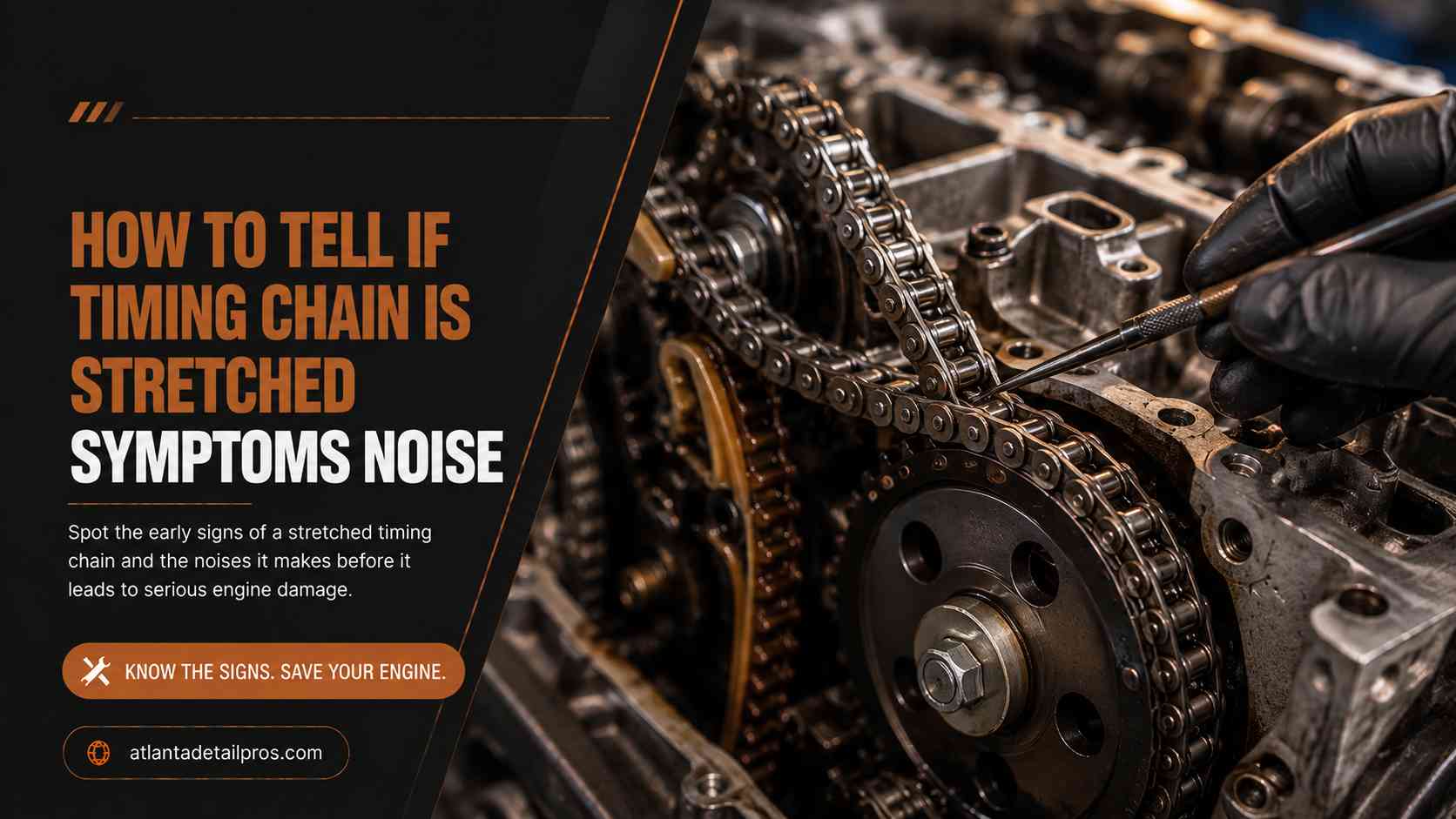
A stretched timing chain produces a characteristic rattling or clattering noise from the front of the engine on cold start that diminishes or disappears after 30 to 60 seconds of running, often combined with stored trouble codes P0016, P0017, P0018, or P0019 (camshaft-to-crankshaft correlation codes) and retarded ignition timing.
The cold-start rattle is the most reliable acoustic indicator: a slack chain slaps against the timing cover and tensioner guide rails at startup before oil pressure fully loads the tensioner. As oil pressure builds, the tensioner takes up most of the slack and the noise reduces, which is why many drivers hear it only on cold mornings and assume it is minor.
A timing chain that is stretching does not stabilize. The chain lengthens incrementally with each heat cycle, the timing correlation between the camshaft and crankshaft drifts further from specification, and engine performance degrades progressively until the chain skips a tooth on the sprocket or breaks entirely. Either outcome at operating speed can cause piston-to-valve contact on interference-design engines, which means bent valves, damaged pistons, and a repair bill that starts at $2,000 and climbs significantly from there.
This article covers every symptom of timing chain stretch, how to confirm the diagnosis at home, and the specific vehicles most commonly affected.
How a Timing Chain Works and Why It Stretches
The timing chain connects the crankshaft sprocket to one or both camshaft sprockets, keeping valve opening and closing events synchronized with piston position. Unlike a timing belt, which is replaced on a scheduled interval, a timing chain is designed to last the life of the engine under normal conditions. In practice it does not always achieve that.
Timing chain stretch is not true tensile stretching: what actually occurs is wear at the chain pin-and-link contact points. Each chain link is held together by a steel pin. As the chain operates under tension, the pins and the bores they ride in wear microscopically with each revolution. Over millions of revolutions this pin wear accumulates and the effective length of the chain increases. The chain tensioner, which is a spring or oil-pressure loaded device, takes up slack as it develops. Once the tensioner reaches its maximum extension it can no longer compensate, and the chain goes slack.
Primary Symptoms of a Stretched Timing Chain
Cold-Start Rattle or Clattering
This is the first and most common symptom. The rattle comes from the slack chain slapping the timing cover or guide rails before the tensioner fully pressurizes with oil. It is most prominent after the vehicle has sat overnight or for several hours. The sound is metallic and rapid from the front of the engine (the timing cover side). It reduces significantly within 30 to 60 seconds as oil pressure builds.
A noise that lasts only 30 seconds or less suggests the tensioner is still compensating. A noise that persists for several minutes or is present at full operating temperature indicates the tensioner has reached maximum extension.
Check Engine Light with Camshaft Correlation Codes
Modern engines with variable valve timing (VVT) are particularly sensitive to timing chain slack because the VVT system relies on precise crankshaft-to-camshaft angle data. Even a few degrees of chain stretch triggers the correlation codes: P0016 and P0017 on Bank 1, and P0018 and P0019 on Bank 2. These codes appear because the VVT solenoid is commanding a camshaft position that the ECU cannot achieve due to chain slack affecting the relationship between the crank and cam sensors.
Rough Idle and Reduced Power
As chain stretch worsens, ignition timing retards because the camshaft is running behind its correct position relative to the crankshaft. The combustion event occurs later than optimized, reducing power output and producing an uneven idle. The engine may feel flat on acceleration with a hesitation from a stop.
Poor Fuel Economy
Retarded ignition timing and degraded VVT function reduce combustion efficiency. Drivers with a stretched chain often see a 10 to 20 percent fuel economy reduction before other symptoms become obvious.
Symptom Severity Table
Symptom | Onset Stage | Urgency |
|---|---|---|
Cold-start rattle only, clears within 60 seconds | Early stretch | Schedule inspection within 2 weeks |
Cold-start rattle plus P0016 or P0017 stored code | Moderate stretch | Repair within 1 week |
Rattle present warm and cold | Advanced stretch | Repair immediately |
Rough idle plus correlation codes plus power loss | Severe stretch | Do not drive long distances: chain may skip |
Engine noise changes to metal-on-metal knock | Chain has jumped or is failing | Do not drive: tow immediately |
At-Home Confirmation Tests
Step 1: Listen at Cold Start
Before starting the engine after an overnight sit, open the hood. Start the engine and immediately listen for a rattle or clatter from the front of the engine (the side with the belt, pulley, and harmonic balancer). Time how long the noise lasts before diminishing. A noise that largely disappears within 60 seconds suggests the tensioner is still compensating. A noise that persists for several minutes or is audible at full operating temperature indicates the tensioner has reached maximum extension.
Step 2: Read Stored Codes Free at a Parts Store
Many auto parts stores offer free OBD-II code reading. Visit any major chain with the check engine light on and ask for a free scan. P0016, P0017, P0018, or P0019 codes confirm camshaft-to-crankshaft correlation errors consistent with timing chain stretch on engines with VVT. No scanner purchase required.
Step 3: Check Oil Level and Quality
A timing chain system that is wearing generates fine metal particles from pin and link contact that circulate in the oil. Check the oil level: a low oil level accelerates chain tensioner failure since the tensioner is oil-pressure operated. Change the oil if it is past due. Fresh oil at the correct viscosity is one of the only things that meaningfully slows chain wear progression from this point forward.
Step 4: Observe Idle Quality When Fully Warm
A severely stretched chain causes ignition timing retard that produces a rough, uneven idle more pronounced when the engine is fully warm. Start the engine, let it reach full operating temperature, and observe the idle quality. Consistent misfiring or roughness that was not present before, combined with the cold-start rattle, confirms the timing is drifting.
“The truck had a faint rattle on cold start for about two winters. Then the check engine light came on with a P0016 code. The shop showed me that the chain tensioner was completely maxed out and the chain had a full inch and a half of slack. Would have been a $400 repair early on. At that point it was $1,200 because the chain guides had worn through too.” : Dave Cramer, 2009 Chevrolet Silverado 5.3L owner
Vehicles Commonly Affected
GM 5.3L and 6.0L V8 engines (2007 to 2014 Silverado, Sierra, Tahoe, Yukon, Suburban) are among the most commonly affected platforms in North America. Timing chain stretch combined with AFM (Active Fuel Management) cylinder deactivation wear is a documented high-mileage failure pattern. The repair includes the chain, both guide rails, the tensioner, and in many cases the AFM lifters if they are also causing issues.
Ford 3.5L and 2.7L EcoBoost engines (2011 to 2017 F-150, Explorer, Edge) develop timing chain stretch on the secondary chains (phaser chains) rather than the primary chain. The P0016 code on these engines frequently points to the phaser chain on one bank. Repair requires valve cover removal to access the secondary chain.
BMW N20 and N26 four-cylinder engines (2012 to 2016 3 Series, 5 Series) have a well-documented timing chain stretch problem that begins as early as 60,000 miles. The tensioner guide rail can crack and dramatically accelerate the condition.
Toyota 2GR-FE V6 engines (Camry, RAV4, Highlander, Sienna) are generally robust but develop timing chain rattle after 150,000 miles if oil change intervals have been extended. Using the correct oil viscosity (0W-20 or 5W-20 as specified) is critical for these engines.
Honda 3.5L V6 (Odyssey, Pilot, Ridgeline) develops timing chain issues particularly when oil changes have been deferred. The VCM (Variable Cylinder Management) system on these engines places additional stress on the chain during transitions between 3- and 6-cylinder operation modes.
Repair Cost Table
Repair Scope | Typical Cost Range (Shop) |
|---|---|
Timing chain, tensioner, and guides (4-cylinder) | $600 to $1,100 |
Timing chain, tensioner, and guides (V6 or V8, single chain) | $900 to $1,600 |
Complete timing system (V8 with dual chains and phasers) | $1,200 to $2,500 |
Engine replacement if chain has jumped and bent valves | $3,000 to $6,000+ |
FAQ
How long can I drive with a stretched timing chain?
If the only symptom is a brief cold-start rattle that clears quickly and no correlation codes are stored, you may have weeks to months before the situation becomes critical depending on driving conditions and mileage accumulation. If correlation codes are stored, the rattle persists into warm operation, or you are experiencing rough idle and power loss, do not drive long distances and schedule the repair within days.
Can a stretched timing chain fix itself or stabilize?
No. Chain wear is cumulative and irreversible. The slack that has developed will only increase with additional mileage. Once the tensioner reaches maximum extension the rate of symptom development accelerates rapidly because the tensioner is the last line of defense.
Will regular oil changes prevent timing chain stretch?
Using the correct oil viscosity specified by the manufacturer and maintaining oil change intervals significantly slows the rate of chain pin wear. Low oil pressure from dirty or depleted oil is a primary accelerator of timing chain and tensioner wear. Regular oil changes are the single most effective preventive measure available.
Is a timing chain rattle the same as a bad VVT solenoid?
The symptoms overlap. A stuck or dirty VVT solenoid can cause a correlation code (P0016 or similar) without chain stretch. The cold-start metallic rattle that diminishes with oil pressure is characteristic of chain slack, not a solenoid issue. A solenoid problem typically produces the code without the acoustic rattle. A shop inspection that includes a mechanical chain slack measurement distinguishes between the two definitively.
Can I drive on the highway with a stretched timing chain?
Highway driving at sustained RPM places more stress on the timing chain system than city driving because the chain operates at higher speeds for extended periods without relief. If you already have correlation codes and idle roughness, avoid highway driving until the repair is completed. A chain that skips a tooth at 70 mph on an interference engine causes immediate catastrophic valve and piston damage.
Bottom Line
A stretched timing chain announces itself with a cold-start rattle from the front of the engine, P0016 or similar codes when VVT is fitted, retarded timing, and progressively rough idle and power loss. The cold-start rattle is the most accessible early indicator and should trigger an inspection before codes appear. By the time codes and idle roughness are present together, the tensioner has typically reached maximum extension and the chain is at risk of skipping under load.
Repair costs at the early rattle-only stage are $600 to $1,600 depending on the engine. Repair costs after a jumped chain has damaged valves start at $3,000 and may exceed the vehicle’s value. The window between early warning and catastrophic failure is measured in months to a year for most drivers, but that window closes faster on the high-risk platforms listed above and on any engine with deferred oil changes.