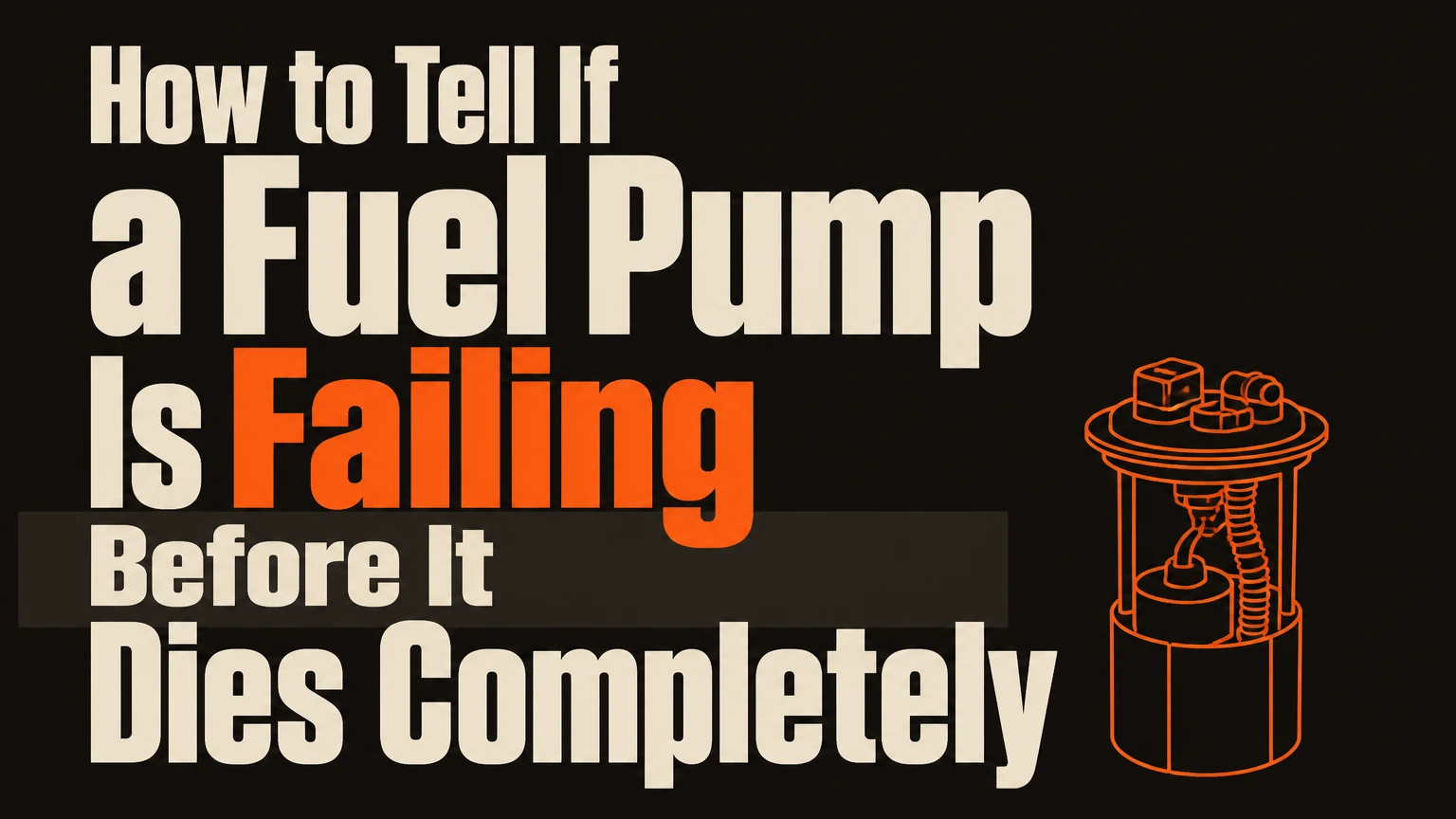
A failing fuel pump gives several early warning signs before complete failure: extended cranking time before the engine starts, engine sputtering or surging at highway speed under steady throttle, hesitation or stumble during hard acceleration, and a tendency to stall or lose power in hot weather after extended idling.
These symptoms appear because the pump’s internal motor is wearing and losing the ability to maintain correct fuel pressure and flow volume under varying demand. At low load the degraded pump keeps up. At high demand or high temperature, which thins the motor’s lubrication, it cannot, and the engine starves for fuel.
The failure pattern of an electric fuel pump is rarely a sudden shutdown from a fully healthy state. The internal brushes and commutator wear progressively, the motor draws increasing current as efficiency drops, and the pump produces less pressure and volume over time. This progressive phase can last weeks to months and gives you a diagnostic window before the pump fails completely at the worst possible moment.
How a Fuel Pump Fails
The in-tank electric fuel pump used on most modern vehicles is a centrifugal pump driven by a small DC motor. The motor’s brushes and commutator wear with use. The check valve (anti-drainback valve) at the pump outlet degrades and allows fuel to drain back into the tank after shutdown. The fuel strainer (pre-filter sock inside the tank) clogs with sediment and restricts the pump’s inlet, making it work harder for the same output. Any of these wear points produces symptoms before causing complete pump failure.
Early Warning Signs | Fuel Pump Is Failing
Extended Cranking Before Start
This is often the first symptom drivers notice. On a healthy fuel system, the pump primes the rail to full pressure during the 2-second prime cycle when the key is first turned to ON. If the check valve has degraded, fuel drains back into the tank overnight and the pump must re-prime from near-zero pressure. This produces a long initial crank (3 to 5 seconds) before the engine fires on a cold start, where it previously started in 1 second.
The double-prime test confirms this: turn the key to ON without cranking, wait 2 seconds, turn key off, key to ON again for 2 seconds, then crank. If the engine starts significantly faster on the second prime, the check valve is degraded and the pump is the suspect.
Sputtering or Surging at Steady Highway Speed
A pump that maintains adequate pressure at low load but loses volume at sustained highway speed produces a characteristic surge or stutter at 60 to 70 mph under light to moderate throttle. The engine cuts out momentarily, the driver lifts slightly off the throttle, and it recovers. This pattern is distinct from a misfire (which is a sharp jolt) and from a transmission slip (which is an RPM flare without a stumble).
Hesitation During Hard Acceleration
A pump that cannot deliver peak volume under high-demand acceleration produces a flat spot or stumble when the throttle is opened quickly from low or mid-RPM. The engine hesitates for 0.5 to 1 second before pulling normally. This symptom is also produced by clogged injectors, a failing MAF sensor, and a dirty throttle body, which is why a fuel pressure gauge test is important to isolate the pump before replacing other components.
Stalling After a Hot Soak
Electric fuel pump motors generate heat during operation. In a vehicle that has been driven for an extended period and then parked briefly (a hot soak), heat builds in the fuel tank. A pump with a degraded motor may not restart after a hot soak because the motor’s internal resistance has increased with temperature. The vehicle starts normally on a cold morning but stalls and will not restart after a short stop in hot weather. This is a well-known failure pattern for fuel pumps approaching end-of-life.
Whining or Humming Noise From the Fuel Tank
A healthy fuel pump produces a quiet hum that is barely audible with the engine off and the key in ON. A failing pump often produces a louder, higher-pitched whine as the motor works harder to maintain pressure. Turn the key to ON without cranking and listen near the rear of the vehicle. A distinct whine or hum that is louder than you remember is a valid early warning sign.
Early Warning Symptom Table
Symptom | When It Occurs | Likely Pump Condition |
|---|---|---|
Long crank on first start of the day | Cold mornings, overnight park | Check valve degraded: early warning |
Sputtering at steady highway speed | 55 to 75 mph, light throttle | Pump losing volume under sustained load |
Hesitation during quick acceleration | Any speed, rapid throttle opening | Pump insufficient for peak demand |
Stall after hot soak, hard to restart | Short stop after long drive in heat | Motor heat soak: advanced warning |
Loud whine from tank area at key-on | Any time, particularly audible when cold | Motor bearing wear: replace soon |
Engine runs rough then smooths out | First 30 seconds of highway driving | Intermittent pressure drop recovering |
At-Home Tests to Confirm a Failing Pump
Test 1: The Double-Prime Cold Start Test
Monitor how many seconds the engine cranks before firing on a cold start after the vehicle has sat overnight. Normal is 1 to 1.5 seconds of cranking. If it is taking 3 or more seconds consistently, perform the double-prime: key to ON for 2 seconds, key off, key to ON again for 2 seconds, then crank. If the engine starts faster on the second cycle, the pump’s check valve is degraded and the pump is approaching failure.
Test 2: Fuel Pressure Gauge Under Load
Connect a fuel pressure gauge (borrow from a parts store) and perform the wide-open throttle snap test. A pump that drops more than 5 to 8 PSI below specification at wide-open throttle and does not recover within one second is failing under high-demand conditions. A pump that shows normal idle pressure but fails the snap test is in the early-to-moderate failure stage.
Test 3: Current Draw Test
A failing fuel pump motor draws higher current than a healthy pump as it compensates for internal wear. Using a clamp-style ammeter around the fuel pump power wire, compare the reading to the specification for your vehicle. Most in-tank fuel pumps draw 4 to 8 amps at operating temperature. A pump drawing 10 to 12 amps on the same circuit is working significantly harder than designed and is near the end of its service life.
“My Tacoma started taking forever to start on cold mornings. No codes, no check engine light. I did the double-prime test and the difference was obvious: 3-second crank without it, 1-second crank with it. Did a fuel pressure test and the pump dropped 12 PSI below spec at wide-open throttle. Replaced the pump before it stranded me. Best decision I’ve made on that truck.” : Kaitlyn Reeves, 2010 Toyota Tacoma owner
Conditions That Accelerate Pump Wear
Running the fuel tank below one-quarter frequently accelerates pump wear on in-tank electric pumps. The pump uses the fuel in the tank as both a coolant and a lubricant for the motor. Running on a low tank means the pump motor runs hotter and with less lubrication, shortening its life significantly. Keeping the tank above one-quarter is one of the most actionable preventive measures available.
Using low-quality or contaminated fuel deposits sediment on the pump inlet strainer and increases the inlet restriction the pump must overcome, causing it to draw higher current and generate more heat.
Ford Ranger and Expedition V8 models (1997 to 2004) are known for in-tank fuel pump failures in the 80,000 to 120,000 mile range. GM trucks of the same era with Vortec engines follow a similar pattern. Toyota trucks and SUVs with the 4.0L V6 typically develop pump issues between 150,000 and 200,000 miles on well-maintained vehicles.
Repair Cost Table
Repair | Typical Cost Range |
|---|---|
In-tank fuel pump replacement (most domestic trucks) | $300 to $600 shop labor and parts |
In-tank fuel pump replacement (most import cars) | $250 to $500 shop labor and parts |
Fuel filter replacement (if external and accessible) | $60 to $120 shop |
DIY fuel pump replacement (parts only) | $80 to $250 depending on vehicle |
FAQs
How long does a fuel pump last?
Most in-tank electric fuel pumps are designed for 100,000 to 150,000 miles under normal operating conditions. Frequent low-tank operation, contaminated fuel, and high-heat environments shorten this range significantly. Many pumps on well-maintained vehicles reach 200,000 miles without failure.
Can a failing fuel pump damage the catalytic converter?
Yes. A pump that intermittently under-delivers fuel causes lean misfires. Unburned fuel from lean misfires can reach the catalytic converter and overheat it. Prolonged lean operation accelerates catalyst degradation and in severe cases physically damages the substrate inside the converter.
Will a fuel pump failure show a code on OBD-II?
Not typically in the early stages. A pump that is weakening but still maintaining some pressure will not trigger a code. The P0087 (fuel rail pressure too low) code appears when pressure falls outside a defined threshold, by which point the pump is often close to complete failure. Early-stage pump degradation is almost entirely a physical symptom diagnosis.
Is it worth replacing the fuel filter before the pump?
On vehicles with an external, serviceable fuel filter, yes. A clogged fuel filter can produce symptoms identical to a failing fuel pump by restricting flow. Replace the filter first, then retest with a pressure gauge. If pressure is now within spec at all conditions, the filter was the cause. If pressure is still low under load, the pump needs replacement.
Can the pump fail suddenly with no prior warning?
Yes, though it is less common than a gradual progressive failure. A pump with a sudden internal short circuit or a failed pump relay can die without prior symptoms. If you experience a no-start with no prior warning and the engine cranks normally, test for fuel pressure before assuming the cause is ignition-related.
Bottom Line
A failing fuel pump warns you with a long initial crank, highway sputtering under steady throttle, hesitation during hard acceleration, and difficulty restarting after a hot soak.
These symptoms appear because the pump is losing the ability to maintain required pressure and volume under high demand and heat. None of these symptoms require a scanner to identify: they are physical and audible patterns that appear weeks to months before the pump dies completely.
Test with a fuel pressure gauge at wide-open throttle and perform the double-prime cold-start test. Both tests can be done at home in under 20 minutes. Replacing a fuel pump proactively at early-warning symptoms costs the same $300 to $600 as replacing it after it fails, minus the tow truck and the inconvenience of being stranded far from home.