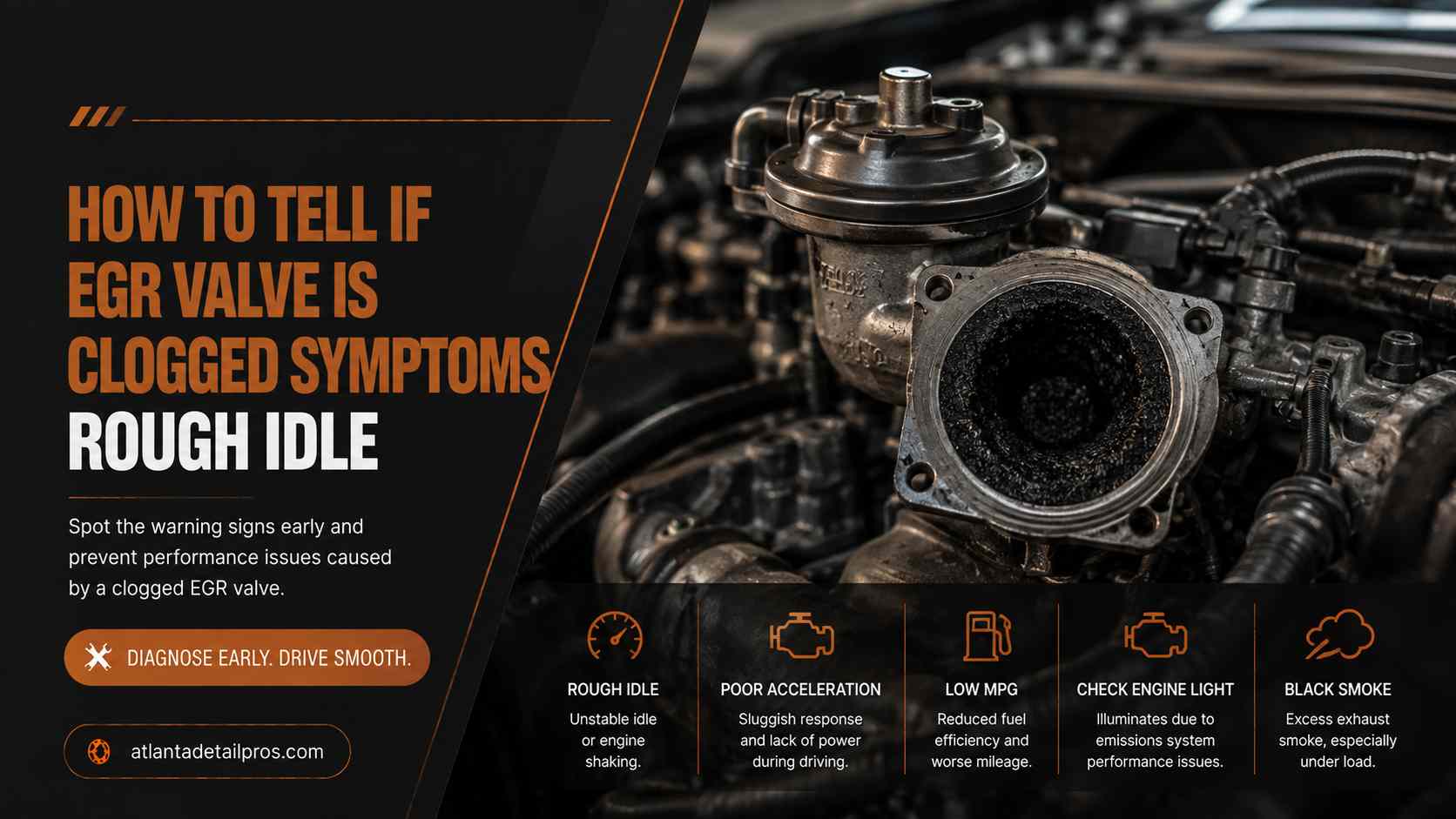
A clogged EGR valve causes a rough idle, particularly at low RPM and at fully warm operating temperature, because carbon buildup either holds the valve partially open (allowing unmetered exhaust gas to dilute the air-fuel mixture at idle) or holds it stuck closed (causing elevated combustion temperatures, increased knock, and ECU timing retard that destabilizes idle quality).
Both failure modes produce rough idle, but through different mechanisms, and distinguishing which one you have determines whether cleaning is the correct first step or whether replacement is necessary.
The EGR (exhaust gas recirculation) valve routes a controlled amount of exhaust gas back into the intake manifold to lower combustion chamber temperatures and reduce NOx emissions. Carbon deposits from exhaust gas accumulate on the valve pintle, the valve seat, and the EGR passages over time, progressively restricting flow or preventing the valve from closing fully. Most EGR valves begin exhibiting symptoms between 50,000 and 100,000 miles depending on driving conditions: highway drivers with sustained RPM accumulate deposits more slowly than city drivers with frequent low-speed, rich-mixture operation.
How a Clogged EGR Valve Affects Idle Quality
Stuck Open (Most Common Cause of Rough Idle)
An EGR valve stuck partially open at idle introduces exhaust gas into the intake manifold when the engine does not need it. At idle, the ECU commands the EGR fully closed because the idle mixture is already stoichiometric and dilution from exhaust gas causes a lean misfire condition. A valve held partially open by carbon deposits passes exhaust gas continuously, making the idle mixture unpredictably lean. The result is a rough, fluctuating idle that may trigger a P0401 (EGR insufficient flow) or P0300-series misfire codes.
Stuck Closed (More Common Under Load, Also Affects Idle)
An EGR valve stuck fully closed cannot route exhaust gas into the intake when commanded. Under light load and at idle, this means combustion temperatures are higher than designed. The ECU detects knock through the knock sensor and retards ignition timing. Retarded timing at idle produces a rough, low-power idle similar to a stuck-open symptom but without the lean misfire pattern.
Primary Symptoms of a Clogged or Failed EGR Valve
Rough Idle at Operating Temperature
Rough idle that is present specifically at warm operating temperature but not at cold start is the signature EGR symptom. At cold start, the ECU typically keeps the EGR closed during the warm-up phase regardless of the valve’s condition, so a failed EGR does not affect cold-start idle quality. Once the engine reaches operating temperature and the ECU begins commanding EGR operation, the fault becomes active and the rough idle appears.
Hesitation During Light-Throttle Acceleration
A stuck-open EGR valve that passes exhaust gas at idle also passes it during the transition from idle to light throttle. This produces a stumble or hesitation in the first moment of throttle application as the lean-diluted mixture struggles to sustain the acceleration event.
Engine Knocking or Pinging Under Load
A stuck-closed EGR valve causes elevated combustion temperatures under load. These temperatures can produce detonation (knock). The knock sensor signals the ECU, which retards timing to prevent engine damage. The driver hears light pinging under load and feels reduced power and fuel economy.
Check Engine Light with P0400-Series Codes
EGR-related codes include P0400 (EGR flow malfunction), P0401 (EGR insufficient flow detected), P0402 (EGR excessive flow detected), and P0404 (EGR open position performance). These codes do not always appear in the early stages of carbon buildup: the EGR circuit must deviate significantly from specification before the ECU flags it. Rough idle with no codes is possible with a partially clogged EGR.
Symptom Identification Table
Symptom | EGR Condition | Likely Code |
|---|---|---|
Rough idle only when fully warm | Stuck open: exhaust gas present at idle | P0401 or P0300 series |
Hesitation at light throttle on warm engine | Stuck open: partial opening during acceleration | P0401 |
Knocking or pinging under load | Stuck closed: elevated combustion temperature | P0402 or none |
Rough idle with no codes stored | Partial carbon restriction, not yet flagging ECU | None initially |
Stalling at idle when warm | Severely stuck open: excessive dilution | P0300 or P0401 |
At-Home Diagnostic Tests | If an EGR Valve Is Clogged
Test 1: Disconnect the EGR and Observe Idle
On older vacuum-operated EGR valves (typically pre-2000 vehicles), disconnect the vacuum hose from the EGR valve at idle. A valve stuck open shows an immediate improvement in idle quality when the vacuum supply is removed, because the passage through the valve is physically isolated from the intake. If idle quality does not improve with the hose disconnected, the EGR is not the primary idle concern.
On electronic EGR valves (most post-2000 vehicles), unplug the EGR valve’s electrical connector to disable ECU control of the valve. Note that unplugging may set a code, which can be cleared after the test.
Test 2: Visual Inspection for Carbon Buildup
Remove the EGR valve (typically held by two or three bolts and a single electrical connector or vacuum line). Inspect the valve pintle and seat for carbon deposits. A pintle covered in hard black carbon that prevents it from seating flush is a stuck-open valve. A pintle coated but moving freely suggests restriction in the EGR passages rather than the valve itself.
Test 3: EGR Passage Inspection
On vehicles where the EGR passages are accessible (typically in the intake manifold or a separate EGR cooler), inspect for carbon blockage. Restricted EGR passages cause stuck-closed symptoms even when the valve itself is clean and functional. A restricted passage is cleaned with a scraper and carburetor cleaner.
“My 5.4L F-150 had a rough idle that came and went after warming up. No codes for weeks. Finally pulled the EGR valve and found the pintle completely caked in carbon: could not move it by hand. Soaked it in cleaner for a day and reinstalled. Idle was smooth immediately.” : Sandra Witkowska, 2004 Ford F-150 5.4L owner
Cleaning vs. Replacement Decision Table
EGR Valve Condition | Recommended Action | Cost |
|---|---|---|
Carbon on pintle, pintle moves freely | Clean with EGR or carburetor cleaner | $5 to $15 DIY |
Heavy carbon, pintle stuck but frees with soaking | Clean and reinstall: monitor for recurrence | $5 to $15 DIY |
Pintle stuck, cannot be freed by cleaning | Replace valve | $60 to $250 parts |
Valve electronically failed (resistance out of spec) | Replace valve | $60 to $250 parts |
EGR passages in manifold blocked | Clean passages or replace manifold if integrated | $100 to $400 shop |
Vehicle-Specific Notes
Ford 5.4L Triton V8 (F-150, Expedition, Navigator): EGR valve carbon buildup is a well-documented high-mileage issue, typically presenting between 80,000 and 130,000 miles. The EGR cooler on some versions also develops internal leaks that introduce coolant into the exhaust circuit.
GM 5.3L and 6.0L V8 trucks: EGR valve and passage carbon accumulation is common on city-driven examples with frequent short trips. Cleaning the valve and the EGR passages in the intake manifold resolves the symptom in most cases without valve replacement.
VW and Audi 2.0L TDI diesel: EGR valves on these engines accumulate carbon rapidly and are a primary cause of rough idle and power loss. Replacement is often more practical than cleaning given the extent of buildup on high-mileage examples.
BMW N52 and N54: EGR-adjacent carbon buildup on the intake valves (a consequence of direct injection, which does not wash carbon from the valves with fuel) produces similar symptoms. The EGR valve itself is not always the primary carbon source on these engines.
FAQs
Can a clogged EGR valve cause the engine to overheat?
Not typically, though elevated combustion temperatures from a stuck-closed EGR contribute to higher operating temperatures under sustained load. The cooling system is generally sufficient to manage this unless there is a separate cooling system issue. The more significant consequence is accelerated knock and the ECU timing retard that follows.
Can I clean an EGR valve without removing it?
EGR valve cleaner sprays can be applied through the vacuum port or electrical port with the valve in place and are marginally effective for very light deposits. For moderate to heavy carbon buildup, the valve must be removed and soaked to achieve meaningful cleaning.
Will clearing the code fix the EGR problem?
No. Clearing the code removes the stored fault but does not address the mechanical cause. The code will return within one or two drive cycles if the EGR valve or passage restriction is still present.
Is it worth cleaning an EGR valve or should I just replace it?
On vehicles where the valve is externally accessible and the symptom has developed recently, cleaning is always the correct first step. EGR cleaner or carburetor cleaner and a wire brush can remove the majority of carbon deposits. If cleaning restores smooth idle and the code does not return, the cleaning was sufficient. If symptoms persist or the code returns within a few thousand miles, replacement is the appropriate next step.
Can a clogged EGR affect fuel economy?
Yes, in both failure modes. A stuck-open EGR at idle causes lean misfires that reduce combustion efficiency. A stuck-closed EGR under load causes timing retard from knock that reduces power output and increases fuel consumption. Either failure mode degrades fuel economy, often noticeably on city driving cycles.
Bottom Line
A clogged EGR valve produces a rough idle at operating temperature through two distinct mechanisms: a stuck-open valve dilutes the idle mixture with exhaust gas causing a lean misfire, while a stuck-closed valve elevates combustion temperatures causing ECU timing retard.
Both paths produce the same rough warm-idle symptom, and distinguishing which failure mode is present determines the correct repair sequence.
Remove and inspect the valve before buying a replacement. Carbon-packed pintles that cannot seat properly are the most common finding and are often fully correctable with cleaning at a cost of under $15 in supplies. A valve that is electrically failed or whose pintle cannot be freed after soaking requires replacement at $60 to $250. Acting on the symptom before the codes accumulate keeps the repair at the cleaning level in the majority of cases.