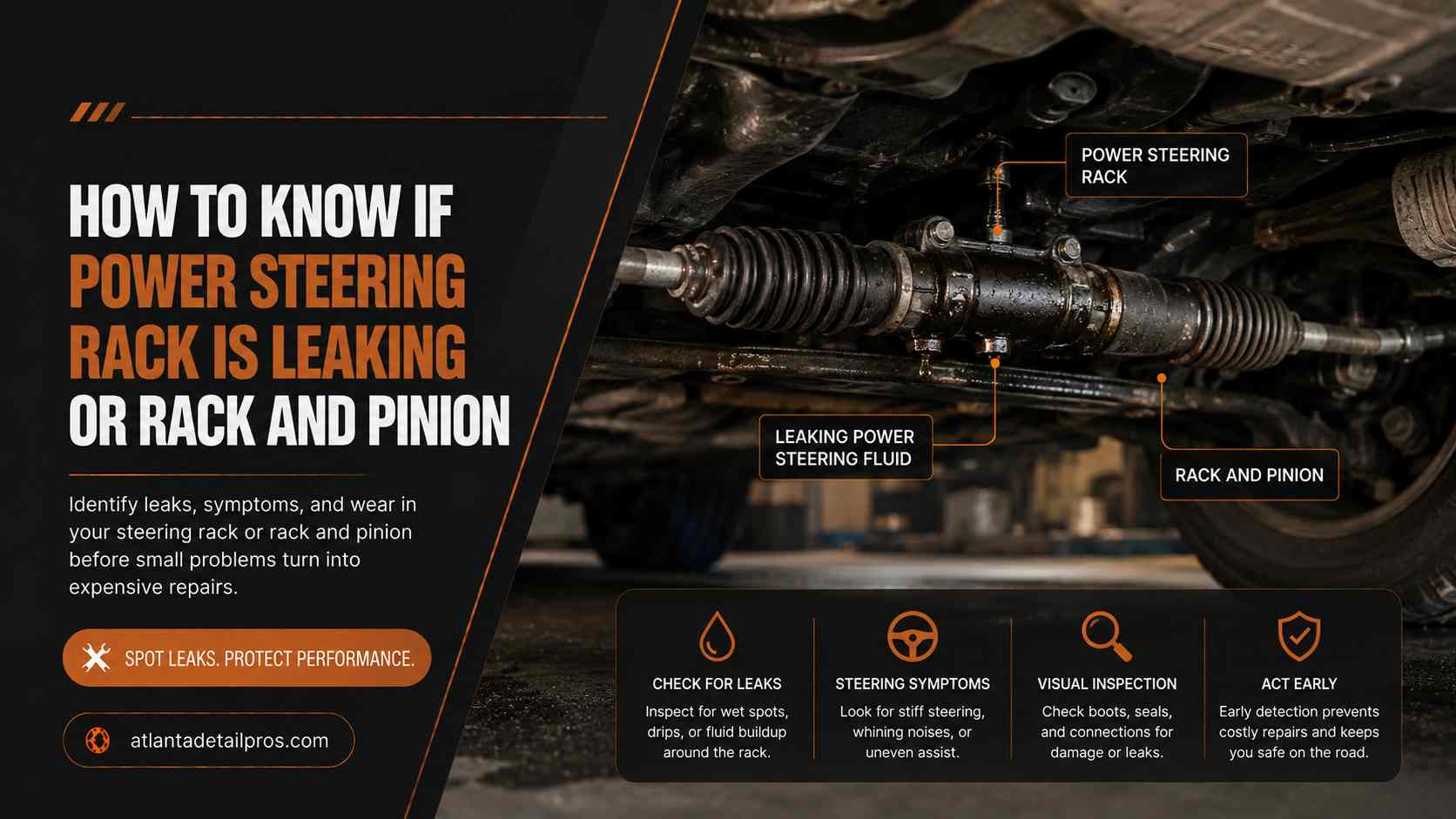
A leaking power steering rack announces itself through a combination of power steering fluid pooling near the front axle centerline, a groaning or whining noise when the steering wheel is turned at low speed or at full lock, and a steering wheel that feels increasingly heavy or slow to respond.
The power steering rack and the rack and pinion assembly are the same component: the rack and pinion is the mechanical gear set housed inside the power steering rack, and the hydraulic seals inside that housing are the most common source of the leak. Understanding exactly where the fluid is coming from, and whether the leak originates at the inner rack seals, the outer tie rod boots, or elsewhere in the hydraulic circuit, determines the repair cost and urgency.
This article covers how to locate a rack and pinion leak precisely, how to distinguish a rack seal leak from a pump or hose leak, what the symptoms mean at each stage of progression, and what independent shop repair costs look like.
What the Power Steering Rack and Pinion System Contains
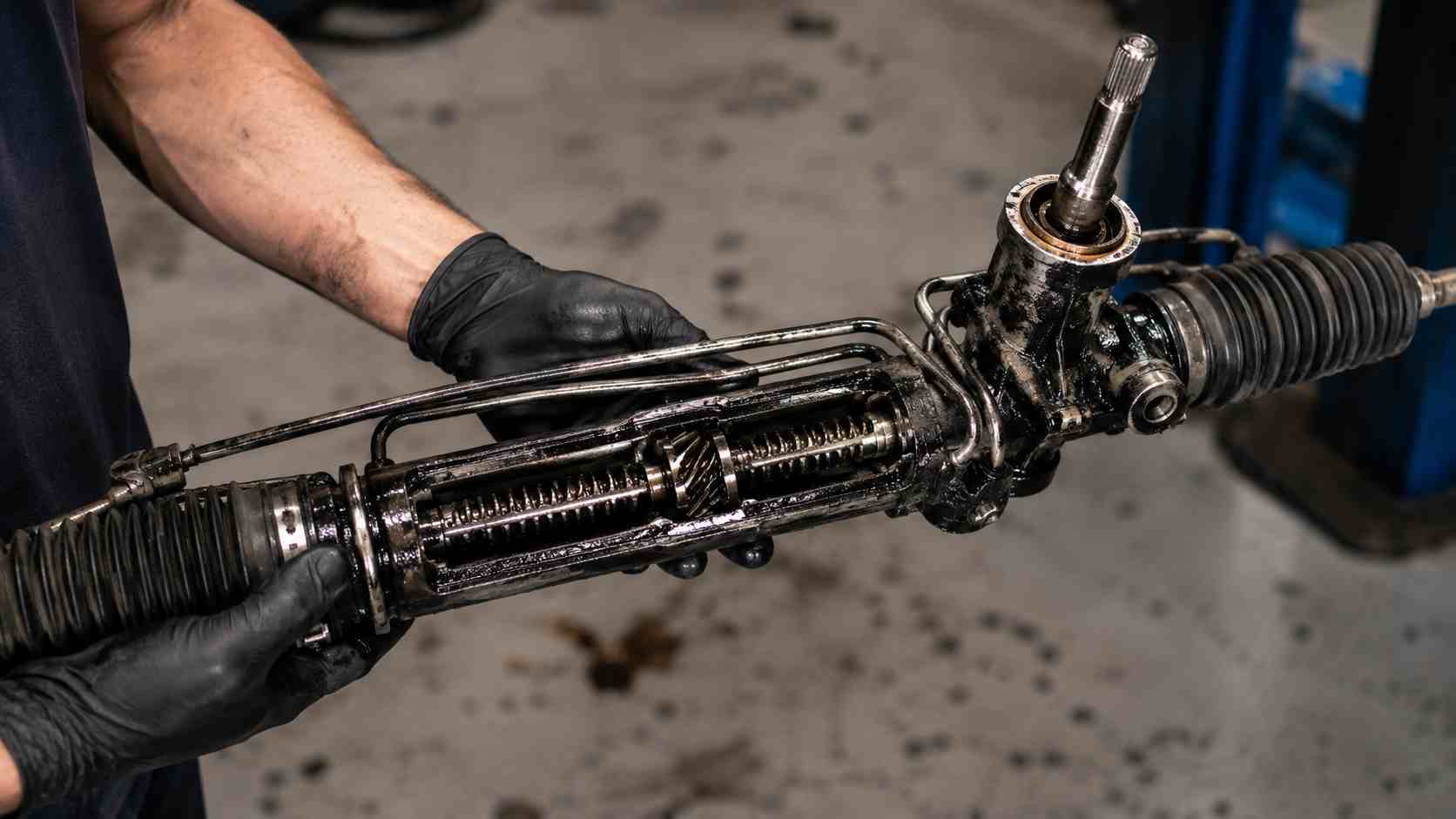
The rack and pinion assembly is the central component of hydraulic power steering. It houses the rack gear, the pinion gear, the steering input shaft, and a series of high-pressure hydraulic seals that allow pressurized power steering fluid to assist the steering motion. The power steering pump (driven by the serpentine belt) generates the hydraulic pressure. High-pressure lines deliver that pressure to the rack, and low-pressure return lines carry fluid back to the reservoir. Any of these components can leak, but the symptoms they produce and their locations are distinct.
Rack Inner Seals
The inner seals sit inside the rack housing and prevent high-pressure fluid from escaping along the length of the rack shaft. When these seals fail, fluid leaks from the rubber boots at each end of the rack, where the inner tie rods exit the housing. The leak is typically visible as a wet, oily residue inside the boot, and the boot may inflate visibly from internal pressure if the seal is leaking severely.
Rack and Pinion Boot Failure
The boots (also called bellows or gaiters) at each end of the rack and pinion protect the inner tie rod joints from contamination, not from hydraulic pressure. On hydraulic racks, the boots serve a dual purpose: they also contain the fluid that leaks past the inner seals. A torn boot does not cause a leak by itself, but a torn boot on a rack with a failing inner seal allows fluid to escape to the outside rather than collecting inside the boot.
High-Pressure Hose and Line Leaks
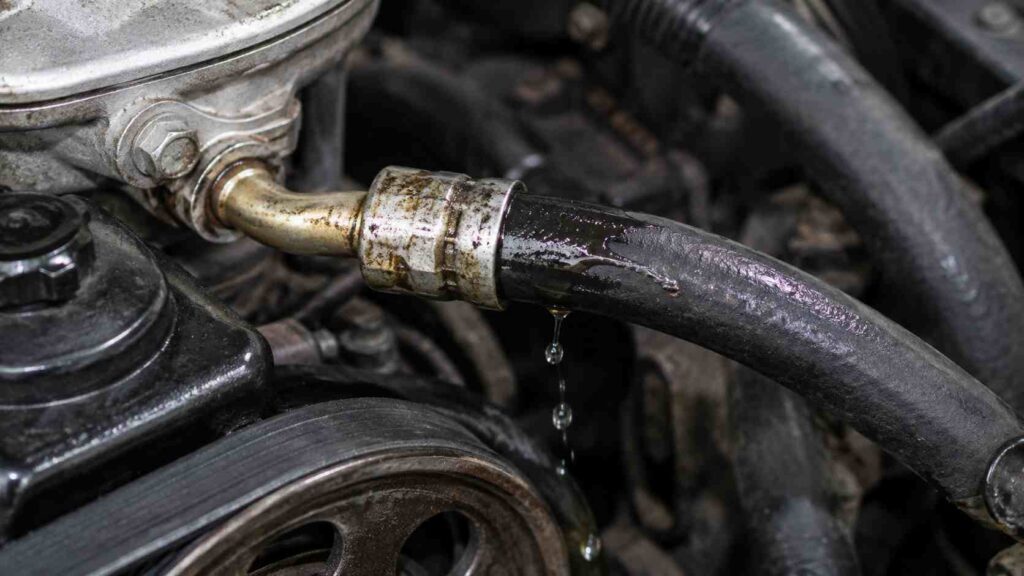
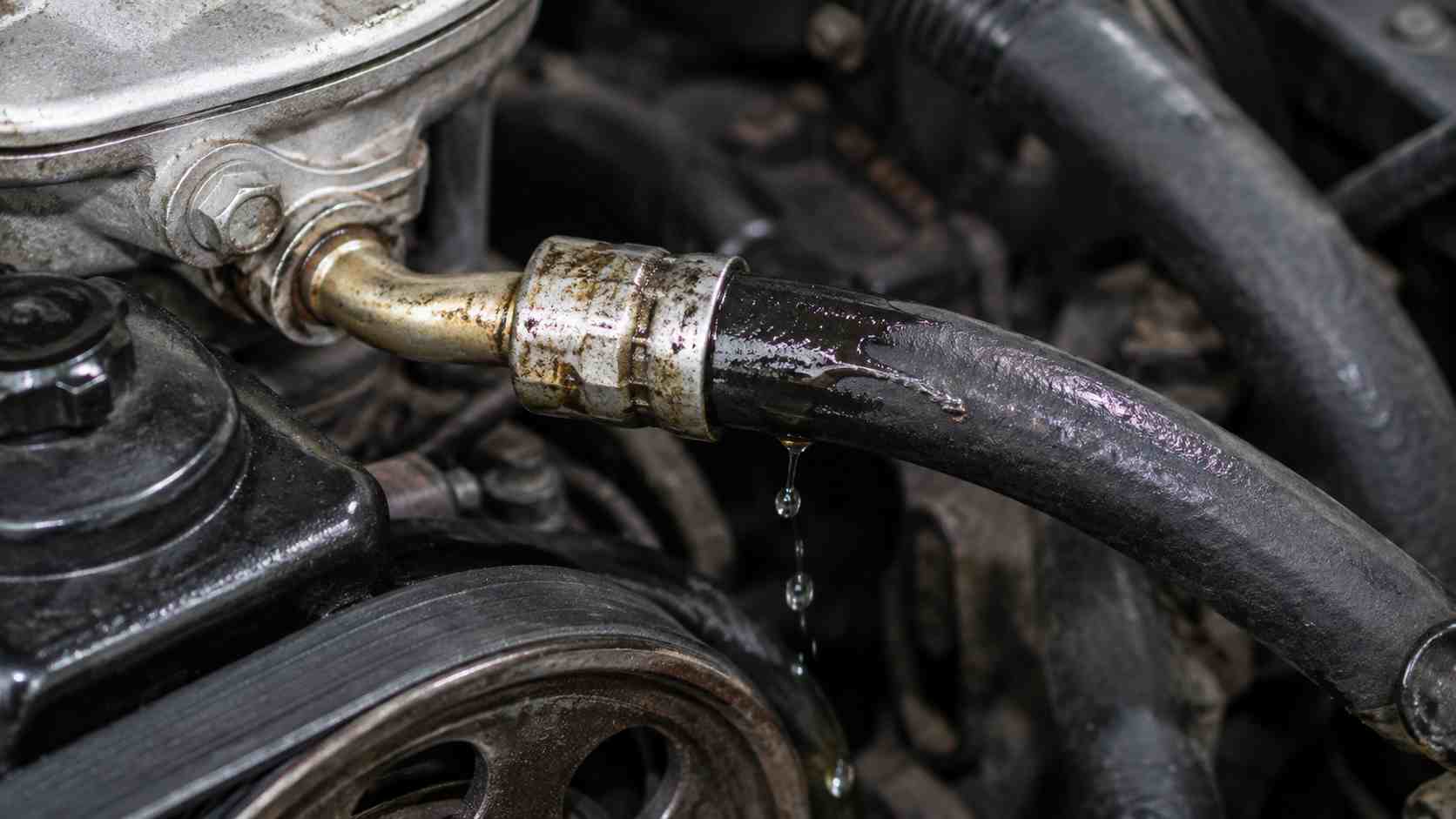
The high-pressure steel and rubber lines between the pump and the rack are a common leak source, particularly at the fittings where rubber meets metal. Line leaks deposit fluid anywhere along the hose run, which can be anywhere from the pump at the front of the engine to the rack at the lower front axle. Distinguishing a line leak from a rack seal leak requires tracing the fluid trail to its origin.
Pump Seal Leaks
The power steering pump has a shaft seal where the pulley shaft enters the pump housing. A failing pump seal deposits fluid on the engine-side surface of the pump and on the adjacent belts and pulleys. Pump seal leaks are higher up in the engine bay and do not leave fluid near the rack centerline.
Leak Location Identification Table
Leak Location | Most Likely Source | Typical Repair Cost |
|---|---|---|
Fluid inside or weeping from rack boots at each end | Inner rack seals failing | $400 to $900 rack replacement |
Fluid pooling at rack center near pinion input shaft | Pinion seal failure | $300 to $700 rack replacement or seal |
Fluid at a specific fitting along the hose run | High-pressure line fitting leak | $80 to $250 line replacement |
Fluid on the pump body or behind the pump pulley | Pump shaft seal failure | $200 to $450 pump replacement |
Fluid at the reservoir cap or reservoir neck | Reservoir o-ring or cap seal | $30 to $80 |
How to Find the Exact Leak Source at Home
Finding the exact source on the power steering system requires a clean inspection and a little patience. The most common mistake is assuming the rack is the source because the fluid pools near the front of the vehicle, when the actual source may be a high-pressure hose fitting above the rack that drips down to the same location.
Step 1: Clean and Observe
Degrease the entire power steering system with brake cleaner: the pump, all hoses and fittings, the rack housing, and the boots. Drive the vehicle for 20 minutes, including slow-speed full-lock turns in a parking lot. Full-lock turns load the rack seals maximally and accelerate leaking at any weak point. Park on clean cardboard and inspect immediately. The first wet area to reappear identifies the source.
Step 2: Inspect the Boots
Remove the inner boot clamps if accessible and fold back each boot. A healthy rack inner seal leaves the inside of the boot dry or with only a trace of assembly grease. A failing inner seal leaves the inside of the boot wet or fully saturated with power steering fluid. A boot that has inflated visibly from internal pressure has a fully failed inner seal.
Step 3: Check Full-Lock Leak Rate
Turn the steering wheel to full left lock and hold for 5 seconds while an assistant observes beneath the vehicle. Then full right lock. Fluid that streams or drips during full-lock application and slows at center confirms a rack inner seal: the seal is loaded maximally at full lock and less stressed at center.
Symptoms at Each Stage of Progression
How you experience a power steering rack leak changes as the fluid loss increases. The early stages are subtle and easy to dismiss.
Early Stage: Minor Seep
The rack or a hose fitting is weeping slowly. The reservoir level drops by a noticeable amount every few weeks. The steering feels normal. There is a slight power steering fluid smell after driving (the fluid that contacts hot exhaust components produces a characteristic smell). No noise yet.
Mid Stage: Moderate Leak
The reservoir needs topping off weekly. The steering begins to feel heavier at low speed and at parking lot maneuvers. A groan or whine is audible when turning, particularly on cold mornings before the fluid warms. The noise is from the pump working against reduced fluid volume and increased internal friction.
Late Stage: Severe Leak
The reservoir empties within a short drive. The steering is significantly heavier and may require noticeably more effort at low speed. The pump whines loudly at any steering input. At this stage, the pump itself is at risk: power steering pumps rely on fluid for both lubrication and cooling, and a pump that runs low on fluid will fail prematurely.
Symptom Progression Table
Symptom | Fluid Level | Urgency |
|---|---|---|
Fluid smell after driving, level slightly low | Slightly low | Low: inspect source within 1 week |
Groan at low speed, level dropping weekly | Noticeably low | Moderate: repair within 1 week |
Heavy steering, loud whine at all steering inputs | Significantly low | High: repair within 2 to 3 days |
Steering very heavy, pump screaming | Nearly empty | Do not drive: pump damage risk |
“I thought my power steering pump was dying because of the whine when I turned. Turned out the inner rack seal was leaking and the fluid level had dropped enough that the pump was cavitating. Shop replaced the rack and the noise disappeared completely. Wish I had caught the fluid level drop weeks earlier.” : Carla Novak, 2011 Chevrolet Malibu owner
Can You Drive With a Leaking Power Steering Rack?
If the leak rate is slow and the reservoir stays above the MIN mark, short-distance driving to a shop is generally safe. The critical threshold is the reservoir level: a pump that runs dry will be damaged within minutes of operation. Check the power steering reservoir before every drive if you suspect a leak. Never operate the steering system with a dry or near-empty reservoir.
If steering effort is noticeably higher than normal, particularly at parking speed, do not drive the vehicle long distances. The increase in effort means the hydraulic assist is compromised from low fluid volume, which makes emergency maneuvering less predictable.
Repair Cost Overview
Repair | Typical Cost Range (Shop) |
|---|---|
High-pressure power steering hose replacement | $150 to $350 |
Return line replacement | $80 to $200 |
Power steering rack replacement (hydraulic) | $400 to $900 |
Power steering pump replacement | $200 to $450 |
Electric power steering rack replacement (EPAS) | $700 to $1,500 |
Full fluid flush after repair | $60 to $100 |
FAQ
How do I know if it is the rack or the pump causing the whining noise?
Pump whine is typically present at idle and worsens when the steering wheel is turned. Rack-related noise is almost exclusively tied to steering input and is not present with the wheels straight. If the noise occurs at idle with the wheels straight ahead, the pump is the more likely source. If the noise occurs only when steering, both the pump (reacting to increased load from a leaking rack) and the rack itself may contribute.
Can a power steering leak fix itself?
No. Seals that have begun to leak will continue to deteriorate. Stop-leak additives for power steering systems can temporarily swell rubber seals and slow minor seepage, but they do not repair a torn seal or a cracked hose fitting. Use them only as a temporary measure while scheduling the repair.
Is it safe to add power steering fluid to keep driving while waiting for the repair?
Yes, provided the leak rate is slow enough that the reservoir stays above MIN between checks. Top off with the correct fluid type (specified in the owner’s manual) and monitor the level before each drive. Do not allow the system to run dry.
Does a rack and pinion leak always mean the entire rack must be replaced?
Not always. High-pressure hose and fitting leaks are repaired without touching the rack. On some vehicles, individual rack seals can be replaced without full rack replacement, though this repair is labor-intensive and not always practical relative to the cost of a remanufactured rack. A shop evaluation determines whether a seal-only repair is feasible for your specific rack design.
What happens if the power steering rack is not repaired and keeps leaking?
Continued fluid loss leads to pump damage from low fluid operation. A failed power steering pump adds $200 to $450 to the repair bill. In extreme cases, a rack that has been running without adequate fluid pressure can develop internal wear on the rack shaft and housing, making the mechanical steering feel vague or loose even after the fluid is restored.
Bottom Line
A leaking power steering rack is identified by power steering fluid inside or weeping from the rack boots, a groan or whine during low-speed steering, and a reservoir that requires regular topping off. The first diagnostic step is always a clean-and-observe: degrease the system, perform full-lock turns, and identify the first wet point that reappears. This takes the guesswork out of whether the source is the rack, a hose, or the pump.
Act before the reservoir runs low. A rack or hose repair at the early-to-moderate leak stage costs $150 to $900. A rack repair plus a pump replacement from running the system dry adds $200 to $450 to that bill. The fluid level is the urgency indicator: as long as it stays above MIN and steering effort is normal, you have time to book a shop appointment. Once the reservoir is near empty or effort is elevated, the clock is running on secondary pump damage.