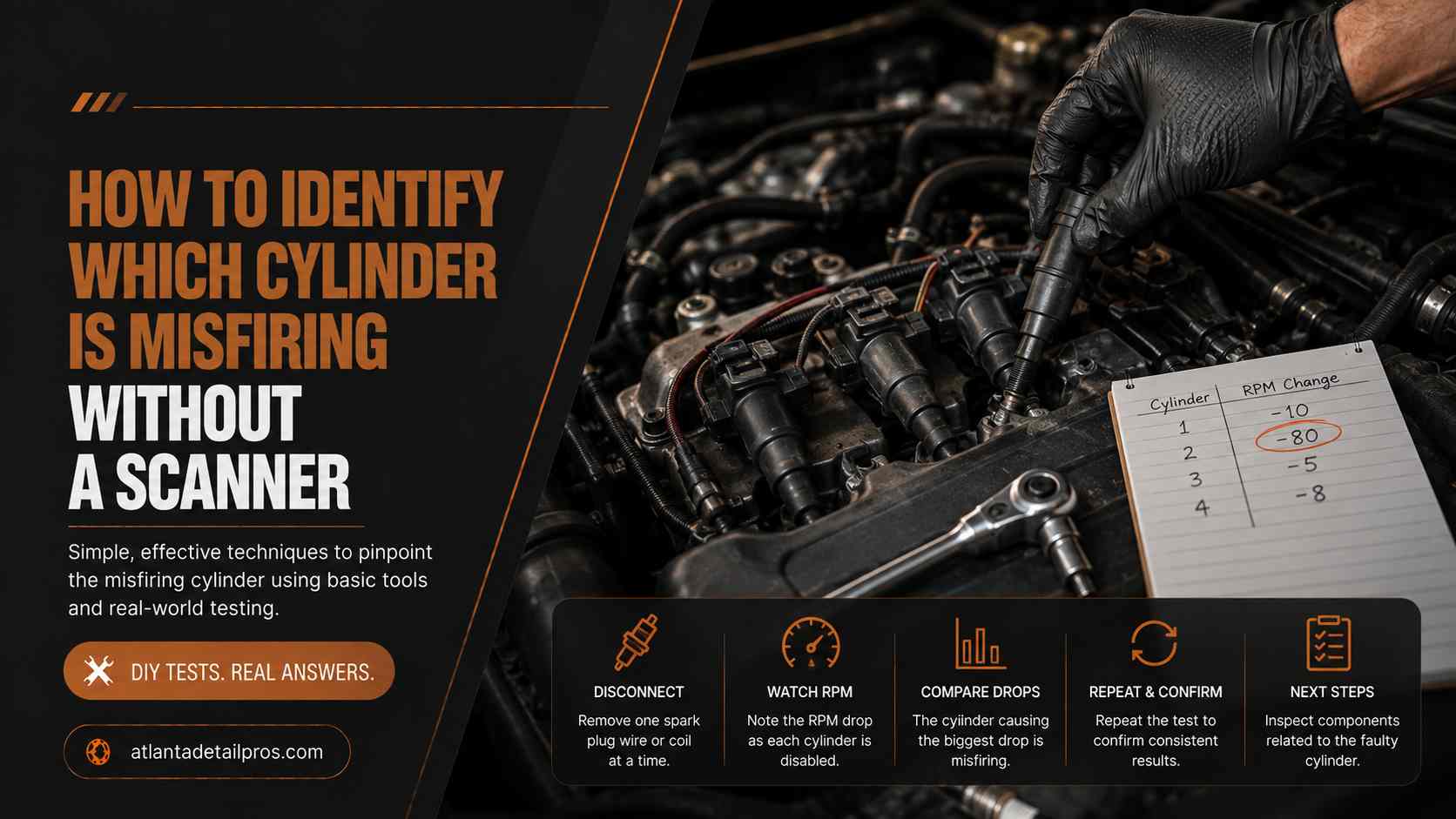
You can identify which cylinder is misfiring without a scanner using the cylinder cut test: with the engine idling, unplug each ignition coil or pull each spark plug wire one at a time and observe the change in idle quality: the cylinder whose disconnection produces no change (or the least change) in idle quality is the misfiring cylinder, because it was already not contributing to engine output.
This test requires no tools, takes under 10 minutes, and produces a clear, repeatable result on any vehicle with individual coil-on-plug ignition or a distributor-based system.
A misfire produces a rough idle, sometimes a check engine light, and on modern vehicles may cause the check engine light to flash during active misfiring to warn of potential catalytic converter damage. Identifying which cylinder is misfiring allows you to focus on that cylinder’s spark plug, ignition coil, fuel injector, or compression rather than performing a vehicle-wide diagnosis. This narrows a complex situation down to a single cylinder and dramatically reduces diagnostic time and cost.
What Causes a Misfire
Ignition System (Most Common)
A worn or fouled spark plug, a failed ignition coil, a cracked distributor cap, or a damaged spark plug wire prevents the ignition event from occurring or causes it to occur at insufficient voltage. The fuel-air mixture is not ignited, the piston travel produces no power, and the unburned mixture exits through the exhaust. This is the most common cause of a misfire, particularly on vehicles with more than 80,000 miles.
Fuel Delivery (Second Most Common)
A clogged or failed fuel injector for that cylinder delivers insufficient fuel (lean misfire) or excessive fuel (rich misfire from a stuck-open injector). The air-fuel mixture is outside the ignitable range and combustion fails or is incomplete.
Compression Loss
A worn piston ring, leaking head gasket, or bent valve on a specific cylinder allows compression pressure to fall below the threshold for reliable ignition. Even with a correct spark and correct fuel delivery, an engine cannot fire a mixture that has not been adequately compressed.
How to Identify Which Cylinder Is Misfiring Without a Scanner: A Test-by-Test Guide
Test 1: Ignition Coil or Spark Plug Wire Pull (Cylinder Cut Test)
Coil-on-Plug Systems (Most Modern Vehicles)
Each cylinder on a coil-on-plug (COP) system has an individual ignition coil mounted directly on the spark plug, connected to the wiring harness by a clip-on electrical connector.
With the engine idling at operating temperature, unplug the connector from one ignition coil. Listen to and feel the idle quality.
If the idle becomes noticeably rougher and the RPM drops, that cylinder was contributing normally before you disabled it. Reconnect and move to the next cylinder.
If the idle does not change (or the engine seems to smooth out slightly), that cylinder was already misfiring. This is the cylinder to investigate.
Work through each cylinder systematically. On a 4-cylinder this takes under 2 minutes. On a 6-cylinder or 8-cylinder, under 5 minutes.
Distributor and Spark Plug Wire Systems (Older Vehicles)
On vehicles with a single coil and distributor, each cylinder has an individual spark plug wire. Pull the wire from the distributor cap end (safer than the plug end, which involves the high-voltage secondary circuit near the engine block ground). Use insulated pliers or a rubber glove. Note the change in idle.
Same interpretation: no change in idle when the wire is pulled means that cylinder was not firing.
Cylinder Cut Test Result Table
Observation When Connector Unplugged | Interpretation |
|---|---|
Idle becomes rougher, RPM drops noticeably | Cylinder was contributing: not the misfire source |
Idle unchanged or slightly improved | Cylinder was already misfiring: investigate this one |
Idle briefly roughens then smooths again | Intermittent misfire: note as secondary suspect |
Idle dramatically worsens on multiple cylinders | Multi-cylinder misfire: check vacuum leak or fuel pressure |
Test 2: Spark Plug Visual Inspection
Once the misfiring cylinder is identified, remove and inspect the spark plug for that cylinder. The plug’s condition reveals the cause of the misfire.
Spark Plug Appearance | Likely Misfire Cause |
|---|---|
Dry black soot (carbon fouling) | Rich mixture: stuck-open injector or excessive fuel |
Wet black or oily deposits | Oil fouling: worn piston rings or valve seals |
White or gray powdery deposits | Lean mixture or overheating: check fuel delivery and cooling |
Worn or eroded electrode, large gap | Plug worn out: replace plug and retest |
Cracked insulator or melted electrode | Pre-ignition or detonation: check timing and fuel quality |
Normal tan to gray color but misfiring | Likely ignition coil or coil wire failure |
Test 3: Coil Swap Test (Confirming a Bad Coil)
On coil-on-plug systems, once you have identified the suspect cylinder, swap that cylinder’s coil with the coil from an adjacent, confirmed-good cylinder. Swap only the coil, not the spark plug yet.
Start the engine and perform the cylinder cut test again. Note whether the misfire has moved to the cylinder where you placed the suspect coil, or whether it remains on the original cylinder.
If the misfire follows the coil to its new position: the coil is faulty. Replace it.
If the misfire stays on the original cylinder after the coil swap: the coil is not the cause. The spark plug, injector, or compression is the next investigation target.
“I had a rough idle on my 4Runner and no scanner at home. Pulled each coil connector one at a time at idle and cylinder 3 made zero difference when unplugged. Swapped the coil to cylinder 5, started it up, and the roughness moved to cylinder 5. Ordered a new coil for $35 and the idle was perfect.” : Joe Ferraro, 2007 Toyota 4Runner owner
Test 4: Compression Test on the Misfiring Cylinder
If swapping the coil and replacing the spark plug do not resolve the misfire on the identified cylinder, a compression test confirms whether a mechanical issue is the cause.
Remove the spark plug from the misfiring cylinder and thread the compression tester into the plug hole. Disable the ignition by pulling the fuel pump fuse. Crank the engine for 4 to 5 seconds and record the compression reading.
Compression Comparison | Interpretation |
|---|---|
Within 10 to 15 percent of other cylinders | Compression not the cause: check injector |
20 to 40 percent below adjacent cylinders | Moderate compression loss: worn rings or valve |
50 percent or more below adjacent cylinders | Severe compression loss: head gasket or bent valve |
Zero compression | Catastrophic mechanical failure: valve or gasket |
What to Do With the Results
If the cylinder cut test identifies one cylinder and the coil swap moves the misfire to the swapped location: replace that coil. Cost is typically $25 to $80 for an aftermarket COP coil.
If the coil is confirmed good but the plug is fouled or worn: replace the plug (and consider replacing all plugs if they are past their service interval). Cost is $4 to $20 per plug.
If the plug is normal in appearance and the coil is confirmed good: test the injector using the resistance test and listening test. If injector tests are normal: perform a compression test. Low compression points to a mechanical issue requiring deeper engine diagnosis.
Urgency: The Flashing Check Engine Light
A steady check engine light indicates a stored misfire code. A flashing check engine light indicates an active, severe misfire that is currently sending unburned fuel into the catalytic converter. The flashing light is the urgency signal: do not drive hard or at highway speed with a flashing check engine light because the catalytic converter can be damaged within minutes of sustained severe misfiring. Catalyst replacement costs $400 to $1,200 depending on the vehicle. Identifying and correcting the misfiring cylinder is far less expensive.
Repair Cost by Cause
Misfire Cause | Typical Repair Cost |
|---|---|
Failed ignition coil (single coil-on-plug) | $30 to $100 parts, $40 to $80 labor |
Worn or fouled spark plug | $4 to $20 per plug DIY, $80 to $200 full set shop |
Clogged fuel injector (cleaning) | $20 to $40 DIY kit, $80 to $150 shop |
Leaking injector o-ring | $10 to $30 DIY parts |
Compression loss from head gasket or valve | $800 to $2,500 shop |
FAQ
Is it safe to pull ignition coil connectors while the engine is running?
Yes. The coil-on-plug connector carries the low-voltage trigger signal from the ECU, not the high-voltage secondary spark current. The spark current is contained within the coil body and spark plug well. On distributor and plug wire systems, handle the plug wire at the boot end or distributor cap end with rubber gloves: the secondary spark voltage (20,000 to 40,000 volts) can produce a painful shock if you contact a damaged wire.
Will this test set any codes?
Temporarily unplugging a coil connector may log a misfire code for that cylinder in ECU memory (P0301 to P0308 depending on the cylinder) if the engine is run for more than 30 to 60 seconds with the connector unplugged. This code can be cleared with any OBD-II code reader after the diagnosis is complete and does not indicate damage from the test.
What if multiple cylinders show no change when unplugged?
Multiple cylinders that show no idle change when individually disabled indicate a multi-cylinder misfire condition. This shifts the likely cause from a single component (coil, plug, injector) to a system-wide problem: a significant vacuum leak affecting multiple cylinders, a failing fuel pump causing low fuel pressure across all injectors, or severely retarded ignition timing.
Can I use this test on a diesel engine?
Diesel engines do not have spark plugs or ignition coils: combustion occurs from compression alone. The cylinder cut test on a diesel involves disabling individual injectors rather than coils. On modern diesel common-rail systems this requires a scan tool to command injector disable. The concept is identical: identify the non-contributing cylinder.
Does a misfire always produce a rough idle?
Most misfires at idle produce a rough, uneven idle that is clearly audible. Some intermittent misfires only occur under specific conditions: at highway speed, during hard acceleration, or at a specific RPM. If the misfire is not active at idle, the cylinder cut test will not produce a clear result. Perform the test when the misfire symptom is actively present for the most accurate results.
Bottom Line
The cylinder cut test identifies a misfiring cylinder without any tools in under 10 minutes: unplug each coil connector or pull each plug wire one at a time at idle, and the cylinder that produces no change in idle quality when disabled is your misfire source.
Follow up with the coil swap test, plug inspection, and if necessary the compression test to identify whether the cause is the ignition coil, the spark plug, the fuel injector, or a compression issue.
A misfire caught at the single ignition coil or spark plug stage costs $30 to $100 to resolve. A misfire that has been running long enough to damage the catalytic converter adds $400 to $1,200 in catalyst replacement. Use the flashing check engine light as the urgency signal: a flashing light means the misfire is severe enough to damage the converter and the vehicle should not be driven hard until the cylinder is identified and the cause corrected.