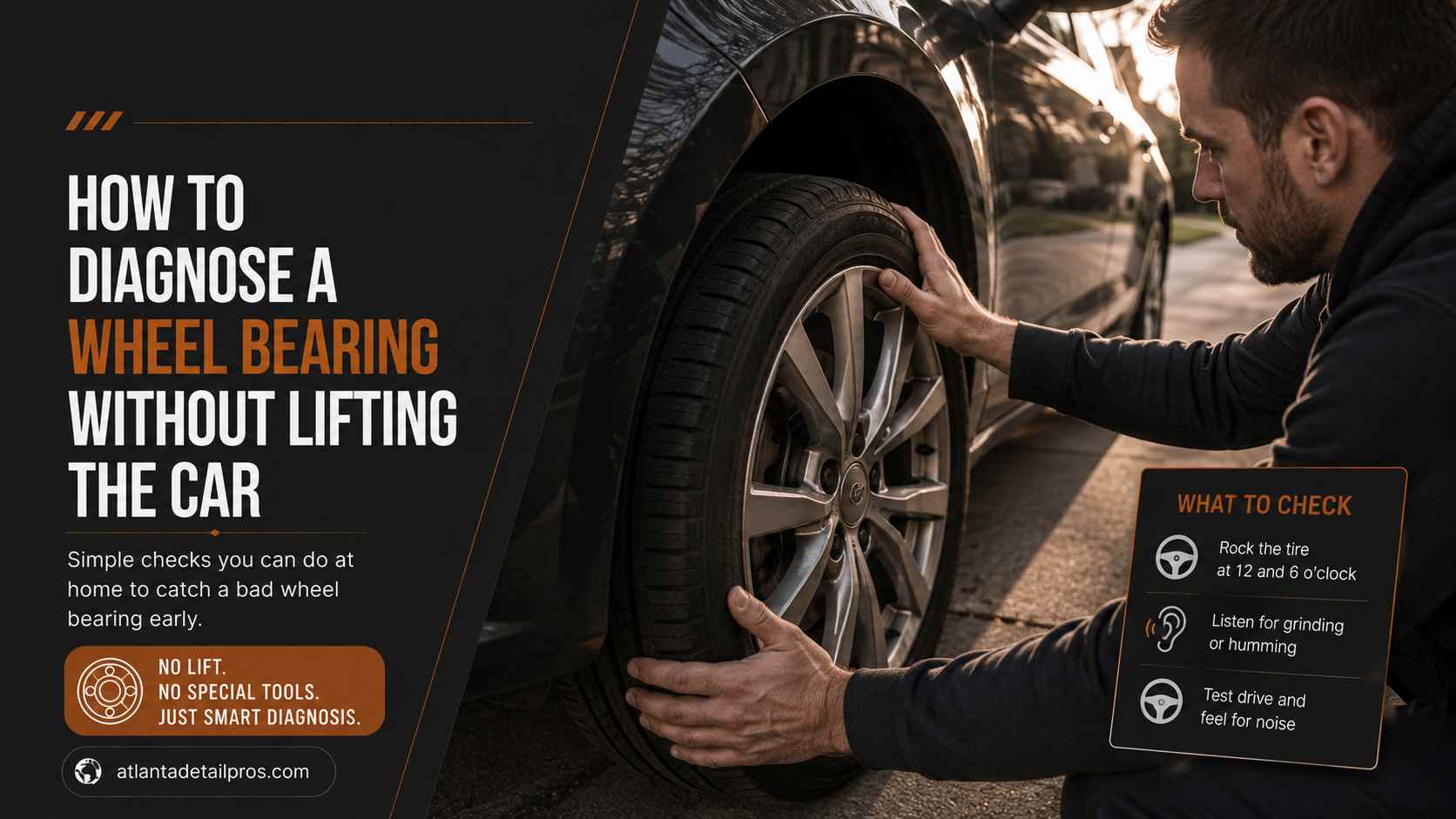
You can diagnose a failing wheel bearing without lifting the car using the swerve test: while driving at 50 to 60 mph on a safe, empty road, gently weave the vehicle left and right: the noise from a failing wheel bearing increases when weight loads the bad bearing and decreases when weight shifts away from it, which identifies which corner is affected.
A bearing generating noise on the right side will be louder when the vehicle swerves left (loading the right-side bearings) and quieter when it swerves right (unloading the right side). This test exploits the lateral load sensitivity of a worn wheel bearing and is the most reliable in-car diagnostic technique available without a lift.
A failing wheel bearing rarely announces itself with immediate catastrophic noise. The progression is gradual: a faint hum at highway speed that is easy to dismiss as tire noise, followed by a growl that changes with vehicle speed, and eventually a droning roar that is present at all speeds. Identifying which bearing is failing and confirming it is a bearing and not a tire before visiting a shop saves diagnostic time and prevents unnecessary tire rotation services that address the wrong cause.
What a Wheel Bearing Noise Sounds Like
Compared to Tire Noise
Tire noise from worn tread patterns, feathered wear, or flat spots is generally consistent at a given speed and changes minimally with gentle swerving. Wheel bearing noise changes in intensity and pitch as lateral load shifts: the swerve test exploits this difference and is the primary way to distinguish the two causes.
Speed Relationship
Wheel bearing noise is almost always speed-related: it increases with vehicle speed and decreases as speed drops. It is not affected by engine load, meaning the noise does not change when you lift off the throttle or apply light engine braking on the same road at the same speed. A noise that changes with engine load rather than vehicle speed is more likely a drivetrain component than a wheel bearing.
Compared to Road Surface
A bearing that is droning loudly on smooth pavement but becomes much quieter on rough concrete is more likely a tire issue: tires are often louder on smooth concrete. A bearing noise is relatively consistent across surface types at the same speed.
The Swerve Test Procedure
Find a safe, empty section of road. Bring the vehicle to 50 to 60 mph. Make a gentle, controlled swerve to the left (as if changing lanes slowly) while maintaining speed and note whether the droning noise increases or decreases. Then make a gentle, controlled swerve to the right at the same speed and note the change again.
Interpreting the Results
Noise Behavior During Swerve | Weight Transfer | Suspect Bearing Location |
|---|---|---|
Louder when swerving left | Weight loads right side | Right front or right rear bearing |
Louder when swerving right | Weight loads left side | Left front or left rear bearing |
No change in either direction | No lateral load sensitivity | Tire noise or driveline: not a bearing |
Present only at one specific speed | Harmonic resonance at one frequency | Tire flat spot or balance weight loss |
Distinguishing Front vs. Rear Bearing Without Lifting
Once the side is identified, distinguishing front from rear takes one additional observation. Apply the brakes moderately from highway speed while noting the noise. Braking shifts weight forward. If the noise increases under braking, the failing bearing is more likely on the front axle. If the noise is unchanged or slightly decreases under braking, it is more likely rear.
On front-wheel-drive vehicles with a failing front bearing, the noise may also change slightly during acceleration under load versus steady cruise versus coasting, because the front bearings see different axle shaft thrust loads under each condition.
Additional No-Lift Observation Tests
Speed-Noise Correlation
Drive at 40, 50, 60, and 70 mph and note at what speed the noise is loudest. A true wheel bearing noise typically increases progressively with speed. Some bearings develop a harmonic that is loudest at a specific speed and quieter above and below it: this is still a bearing pattern. A noise that is the same volume at 40 mph and 70 mph is less consistent with a bearing and more consistent with road surface interaction.
Steering Wheel Feel at Highway Speed
A front wheel bearing that has developed significant play can transmit vibration into the steering wheel at highway speed. A drone combined with a vibration in the steering wheel that is isolated to one side and present at a consistent speed narrows the suspect to a front bearing on the louder side.
“I had a drone from the rear of my Accord that I thought was a tire. Did the swerve test on an empty road and the noise clearly got louder when I moved left and quieter going right. Took it to the shop and told them right rear wheel bearing. They put it on the lift, spun the hub by hand, and confirmed it immediately. Having that diagnosis ready saved me paying for a full inspection.” : Mitch Dominguez, 2015 Honda Accord owner
Urgency Assessment
Noise Level | Swerve Test Response | Urgency |
|---|---|---|
Faint hum at highway speed only | Moderate response to swerve | Schedule repair within 2 to 3 weeks |
Moderate drone above 40 mph | Clear response to swerve | Repair within 1 week |
Loud growl, present above 30 mph | Strong response to swerve | Repair within 2 to 3 days |
Loud roar at all speeds, vibration in steering wheel | Strong response to swerve | Do not drive long distances: repair immediately |
Clunking or grinding sensation | Any result | Do not drive: tow to shop |
A wheel bearing that has progressed to clunking or grinding has lost significant internal clearance. A fractured wheel bearing can cause sudden loss of vehicle control at any speed and must not be driven on.
ABS and Traction Control Warning Connection
On vehicles with ABS, the wheel speed sensor is typically integrated into or mounted adjacent to the wheel bearing hub assembly. A failing bearing that has developed play or roughness can produce a false ABS activation or disable ABS on the affected corner because the sensor no longer reads wheel speed correctly. If the ABS warning light or traction control light comes on alongside a bearing drone, the sensor has been affected and the bearing hub assembly must be replaced as a complete unit.
Repair Cost Table
Repair | Typical Cost Range (Shop) |
|---|---|
Front wheel bearing hub assembly (most cars) | $200 to $450 per side |
Rear wheel bearing hub assembly (most cars) | $200 to $400 per side |
Press-in wheel bearing (solid rear axle) | $150 to $300 per side |
Four-wheel-drive front axle bearing | $300 to $600 per side |
FAQ
How long can I drive on a failing wheel bearing?
A faint-drone bearing that has just been identified may be drivable for weeks to a few months under normal conditions. A bearing producing a loud drone or growl should be replaced within days. A bearing producing clunking, grinding, or vibration in the steering wheel should not be driven: the risk of the bearing seizing or the hub separating is real at this stage.
Can a bad wheel bearing affect braking?
Yes. A failing bearing can disable ABS on the affected corner because the integrated wheel speed sensor no longer reads correctly. If the ABS or traction control warning light comes on alongside a bearing drone, the sensor has been affected by the bearing wear.
Is it possible to have two failing wheel bearings at the same time?
Yes, particularly on high-mileage vehicles where both front or both rear bearings were installed at the same time and have accumulated similar wear. When both bearings on the same axle are near the same wear point, the swerve test may produce an ambiguous result. Lifting the vehicle and checking each hub for play and roughness by hand is the definitive test in that case.
Can a wheel bearing failure be confused with a CV axle noise?
Yes. A failing CV axle on a front-wheel-drive vehicle produces a clicking or popping noise during turns that is loudest at low speeds with the wheel at full lock. A wheel bearing produces a drone or growl that is present at highway speed and changes with the swerve test. The sounds are distinct, but both worsen during direction changes, which can cause confusion. The CV axle noise is very low-speed and steering-angle dependent: the bearing noise is speed dependent.
Does temperature affect wheel bearing noise?
Yes. Cold bearings may be quieter on the first few miles of driving and louder as they warm up. Conversely, some bearings are noisiest when cold and quiet slightly as the grease warms and redistributes. If the noise is highly variable with temperature rather than consistent at a given speed, this is still consistent with a bearing issue: report this observation to the shop as it aids diagnosis.
Bottom Line
The swerve test is the most reliable way to diagnose a failing wheel bearing without lifting the car: a drone that increases when weight loads a corner and decreases when weight leaves it is a wheel bearing. Perform the test at 50 to 60 mph on an empty road with controlled, gentle swerves and note which direction loads the noise. Combine this with the speed-correlation test and the braking-response test to narrow the failing corner before arriving at the shop.
A wheel bearing identified at the drone stage costs $200 to $450 to replace and is a routine shop repair. A bearing that has progressed to grinding costs the same to replace but carries the additional risk of hub damage, ABS sensor failure, and in severe cases the risk of sudden hub separation. Act on the drone before it becomes a growl.