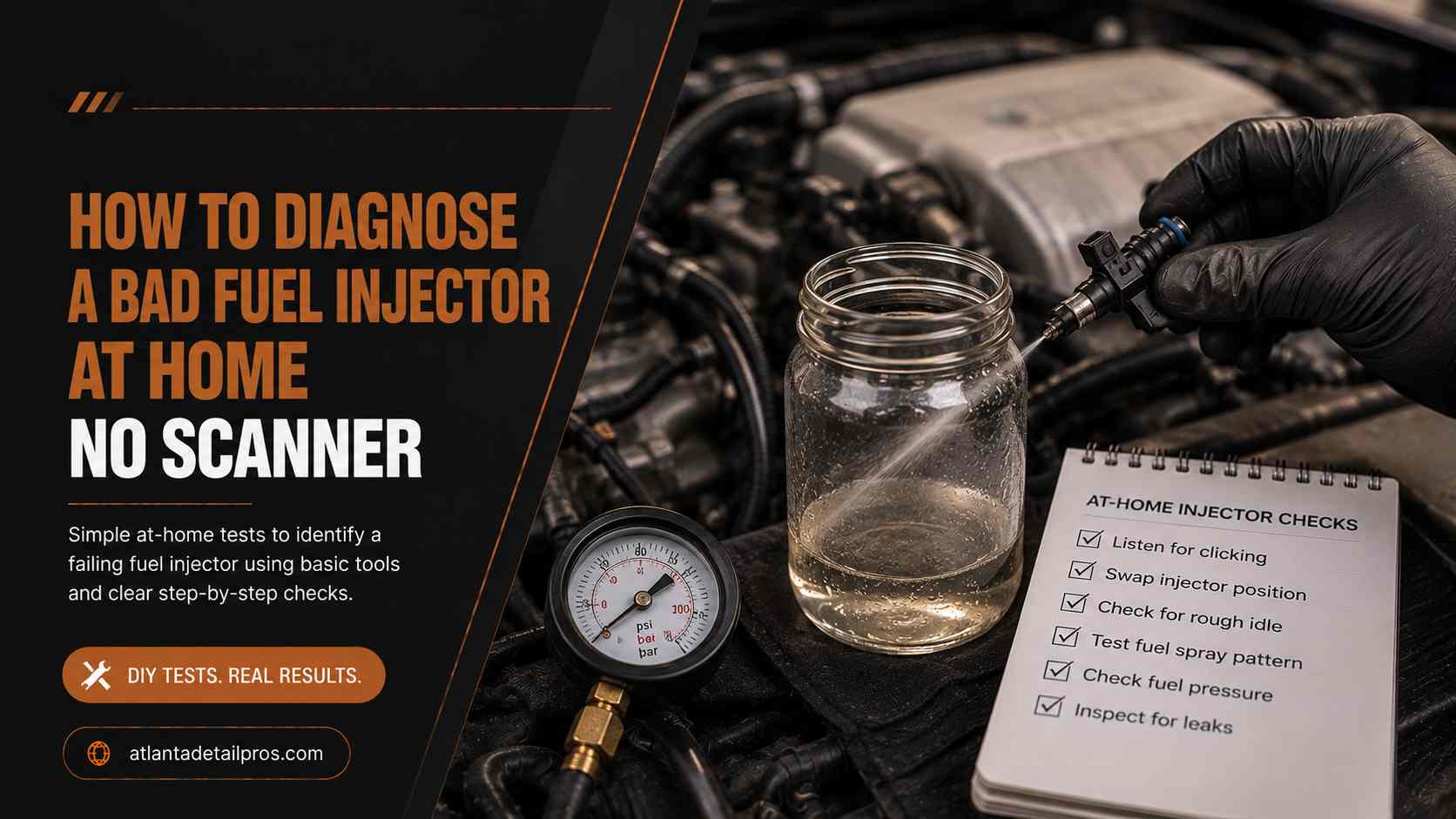
You can diagnose a bad fuel injector at home without a scanner using four tests: the listening test with a long screwdriver or mechanic’s stethoscope, the cylinder balance test by pulling injector connectors one at a time, the resistance test with a multimeter, and a visual inspection of the injector harness and o-rings for obvious failures.
These tests identify whether an injector is mechanically stuck, electrically failed, or not firing consistently, covering the three most common injector failure modes without any specialized scan tool equipment. A basic multimeter ($15 to $30) is the only tool you need beyond hand tools to access the injectors.
Fuel injector problems produce a predictable set of symptoms: a rough idle, a misfire on a specific cylinder, poor fuel economy, a hesitation during acceleration, or a hard start condition. The difficulty without a scanner is that many of these symptoms also describe a bad spark plug, failing ignition coil, or vacuum leak. The tests in this article are designed to isolate the injector specifically and distinguish an injector problem from those other causes.
Common Fuel Injector Failure Modes
Clogged Injector
The most common failure mode. Carbon deposits and fuel varnish build up on the injector tip over time, particularly from low-quality fuel, short-trip driving where the engine never fully warms up, or extended periods without driving. A clogged injector delivers less fuel than commanded, causing a lean misfire on that cylinder. The injector clicks normally (electrically functional) but the spray pattern is reduced or disrupted.
Stuck-Open Injector
A stuck-open injector delivers fuel continuously regardless of the ECU command signal. This produces a rich condition on that cylinder, black smoke at the exhaust, a strong fuel smell, and dramatically poor fuel economy. A stuck-open injector causes a rough idle that worsens as the engine reaches operating temperature.
Failed Injector Solenoid
The injector is an electronically controlled solenoid. When the solenoid winding fails open-circuit or short-circuit, the injector either does not fire at all or fires continuously. A multimeter test confirms this failure mode definitively and distinguishes it from a clogged injector.
Leaking O-Ring
The injector o-rings seal the injector body to the fuel rail and to the intake manifold. A cracked or dried o-ring allows fuel to leak around the outside of the injector body, producing a fuel smell and a potential fire hazard. This is a visual inspection finding, not an electrical one.
How to Diagnose a Bad Fuel Injector at Home Without a Scanner: A Test-by-Test Guide
Test 1: Listening Test (Stethoscope or Screwdriver)
With the engine running at idle, place the tip of a long screwdriver against each injector body in turn and press your ear to the handle. Alternatively, use a mechanic’s stethoscope ($10 to $20) or a length of vacuum hose with one end near the injector and one end near your ear.
A functioning injector produces a rapid, consistent clicking sound: the solenoid opening and closing at the fuel pulse rate commanded by the ECU. At idle on a warm engine this is typically 2 to 5 clicks per second depending on the vehicle.
A silent injector is not firing. This immediately identifies it as the suspect. An injector with an irregular or intermittent click pattern may be firing inconsistently, which correlates with an intermittent misfire. Note which cylinder corresponds to each injector and correlate any silent or irregular injector with the rough idle or misfire symptom you are experiencing.
Test 2: Cylinder Balance Test (Injector Connector Pull)
This test identifies which cylinder’s injector is not contributing to engine output by disabling one injector at a time and observing the effect on idle quality.
Procedure
Start the engine and let it reach operating temperature. One at a time, unplug the electrical connector from each fuel injector. Observe and listen to the idle after each disconnection.
When you disconnect a functioning injector, the idle deteriorates noticeably: RPM drops and roughness increases because that cylinder is now contributing nothing. When you disconnect a failed or non-contributing injector, the idle does not change or may even improve slightly, because that cylinder was already not contributing to engine output.
The injector whose disconnection produces no change in idle quality is the faulty one. This is the most effective no-scanner balance test available and requires zero tools.
Test 3: Resistance Test with a Multimeter
Every fuel injector solenoid has a resistance specification. With the injector disconnected and the engine off, set your multimeter to the resistance (ohms) setting and probe both terminals of the injector connector or the injector pins directly.
Resistance Specifications
Injector Type | Typical Resistance Range |
|---|---|
High-impedance (most port-injected gasoline engines) | 12 to 17 ohms |
Low-impedance (some performance and diesel applications) | 2 to 5 ohms |
An open circuit reading (OL or infinite on the multimeter) means the solenoid winding has broken: the injector cannot fire and must be replaced.
A reading significantly below specification (for example, 3 ohms on a high-impedance injector) indicates a shorted winding that draws excessive current and may damage the ECU driver circuit.
A reading within specification confirms the solenoid is electrically intact. This does not rule out a clogged injector, which is a mechanical issue rather than electrical, but it eliminates solenoid failure as the cause and points toward cleaning as the next step.
Test 4: Visual Inspection for Leaks and O-Ring Condition
With the engine off and the fuel rail accessible, inspect each injector at both ends: where it connects to the fuel rail and where it enters the intake manifold.
Signs of o-ring failure include a wet fuel stain or fuel smell localized to a specific injector, discoloration of the injector body at the o-ring seat, and visible cracking on the o-ring if it can be inspected. Fuel from a leaking o-ring creates a fire risk and must be addressed immediately.
Also inspect the wiring harness connectors for corrosion, broken lock tabs, or wires that have pulled back from the connector body. A connector that is not fully seated does not complete the electrical circuit and produces the same symptoms as a failed injector solenoid.
Test Results Interpretation Table
Test Result | Most Likely Injector Condition | Next Step |
|---|---|---|
Silent on stethoscope test | Not firing: electrical or solenoid failure | Proceed to resistance test |
Connector pull: no idle change | Not contributing to engine output | Confirm with stethoscope and resistance test |
Resistance open circuit (OL) | Solenoid winding broken | Replace injector |
Resistance within spec but injector silent | Wiring or connector fault | Inspect connector and harness |
Resistance within spec, clicks normally, rough idle | Clogged injector tip | Injector cleaning or replacement |
Fuel smell at injector body | O-ring failure | Replace o-rings or full injector |
“I had a rough idle on cylinder 4 of my Mustang. Pulled the connectors one at a time at idle and found that disconnecting injector 4 made absolutely no difference to the idle. All other injectors caused an immediate stumble when disconnected. Pulled the injector, cleaned it with a DIY kit, reinstalled it, and the rough idle was gone.” : Jordan Whitmore, 2011 Ford Mustang GT owner
Clogged Injector Confirmation and Cleaning Options
If the stethoscope test and cylinder balance test both point to a specific injector but the resistance test shows the solenoid is electrically intact, the most likely cause is a clogged injector tip. Options for resolving this:
A fuel injector cleaning service at a shop runs pressurized cleaning solvent through the injectors via the fuel rail while the engine is off. Cost at an independent shop is typically $80 to $150 for a full set.
A DIY injector cleaning kit connects to the Schrader valve on the fuel rail and requires disabling the in-tank fuel pump. These kits are available for $20 to $40 and are effective for mild to moderate clogging.
Removal and ultrasonic cleaning at a dedicated fuel injector cleaning service restores injectors with heavy deposits and tests the spray pattern before reinstallation. This service costs $15 to $30 per injector.
Repair Cost Comparison
Repair | Typical Cost |
|---|---|
In-car injector cleaning at shop (full set) | $80 to $150 |
DIY injector cleaning kit | $20 to $40 |
Injector o-ring kit (DIY) | $10 to $30 |
Single replacement injector (aftermarket) | $25 to $90 |
Full set replacement injectors (aftermarket) | $100 to $350 |
Shop labor for single injector replacement | $60 to $120 |
FAQ
Can a bad fuel injector damage the engine?
A stuck-open injector can hydrolock the engine if enough raw fuel accumulates in the cylinder during engine-off periods. It also washes cylinder wall oil film away, accelerating piston ring and bore wear. A clogged injector causes a lean condition that can damage the catalyst and in severe cases cause detonation. Both failure modes should be addressed promptly.
Will a bad fuel injector always cause a check engine light?
Not always. A misfiring injector often triggers a P030X cylinder misfire code, but a mildly clogged injector that reduces fuel delivery without fully misfiring may not set a code. This is exactly why the home tests in this article are valuable: they identify injector problems that have not yet triggered an OBD-II code.
Is it better to replace one injector or all of them?
On high-mileage vehicles (100,000 miles or more), if one injector has failed from wear-related clogging or o-ring degradation, the others are at a similar mileage point. Replacing the full set while the fuel rail is already removed is often economically sensible: the additional parts cost is typically $75 to $250 and the additional labor is minimal since the rail is already off.
Can I clean a fuel injector without removing it?
Fuel injector cleaner additives poured into the fuel tank provide mild cleaning for very light deposits in some cases. They are not effective for moderately or heavily clogged injectors. For any injector identified as underperforming through the balance test, chemical cleaning through the fuel rail or physical removal and ultrasonic cleaning is required.
How do I know which cylinder number corresponds to which injector?
On inline engines, the cylinders are numbered front to back (cylinder 1 at the front of the engine). On V-engines, the numbering convention varies by manufacturer: check the owner’s manual or a vehicle-specific diagram. Many engines have the cylinder number stamped or molded near the spark plug or coil. Identifying the correct cylinder-to-injector mapping before the balance test prevents misidentifying which injector is faulty.
Bottom Line
Four home tests identify a bad fuel injector without a scan tool: the listening test confirms whether the solenoid is clicking, the connector pull test confirms whether the cylinder is contributing to engine output, the multimeter resistance test confirms solenoid integrity, and a visual inspection identifies o-ring and connector issues.
The listening test and connector pull test require no tools at all. The resistance test requires a $15 multimeter.
A bad injector identified through these tests costs $25 to $90 for an aftermarket replacement, or $15 to $30 for ultrasonic cleaning if the solenoid is electrically intact. Acting on the diagnosis before the condition worsens keeps the repair at the injector level and out of the catalyst and piston ring territory where the costs multiply rapidly.