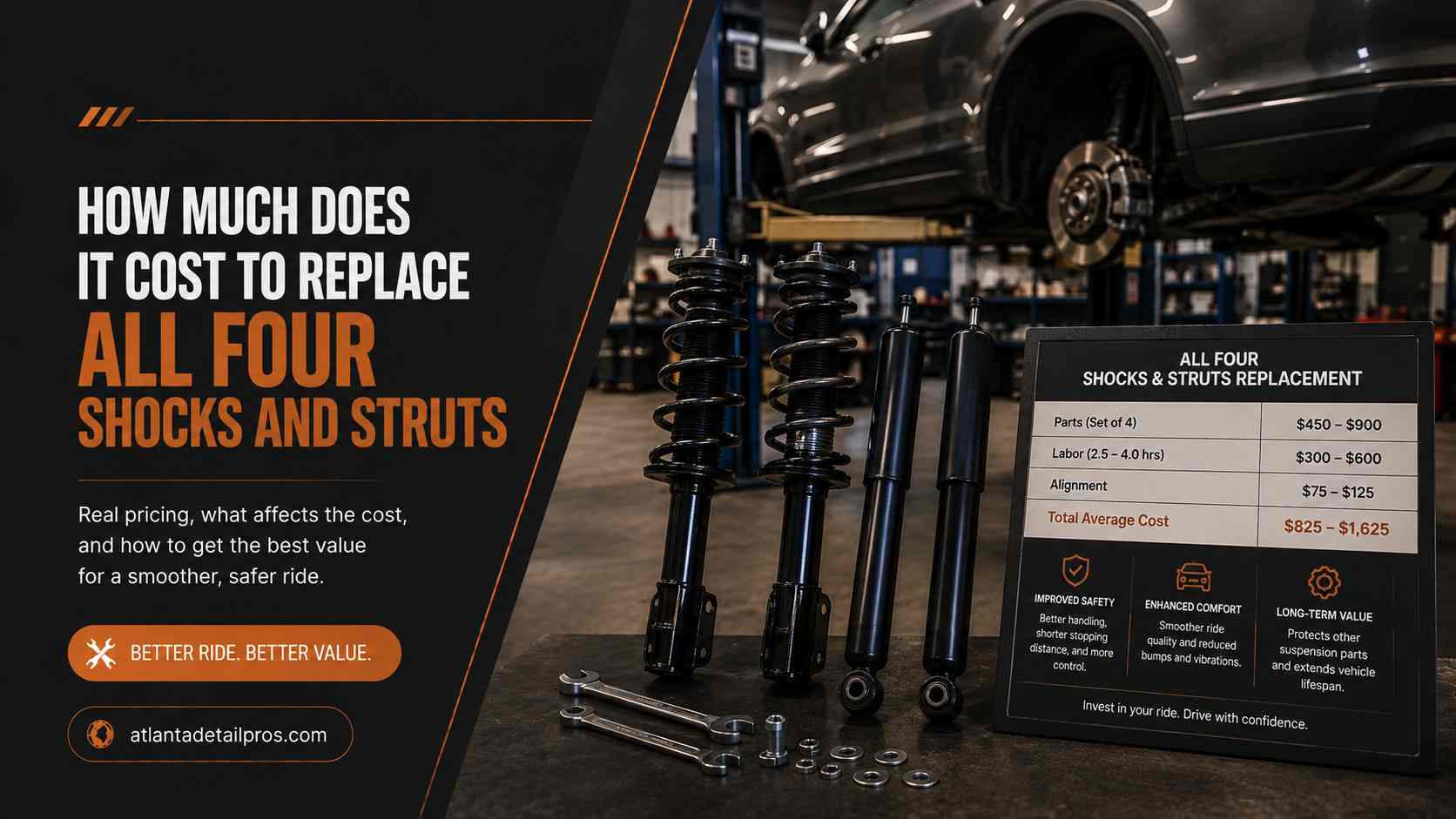
Replacing all four shocks and struts costs $600 to $1,800 at an independent shop and $900 to $2,800 at a dealership for most passenger vehicles, with the wide range driven by whether the vehicle uses simple bolt-on shocks (lower cost) or MacPherson struts that require spring compression equipment and strut mount replacement (higher cost), and by whether OEM or quality aftermarket components are used.
A four-corner replacement in a single visit is more economical per unit than replacing axles separately, because the front-to-rear labor overlap on many platforms allows the shop to complete all four in fewer total hours than two separate visits.
This repair is one of the most commonly deferred on high-mileage vehicles because shock and strut wear is gradual and the driver adapts to the degraded ride and handling without noticing a single dramatic failure event. The consequence of this deferral is compounded wear on tires, bushings, and ball joints that the compromised dampers fail to protect from impact loading. Replacing worn shocks and struts at the appropriate interval restores handling and extends the life of the surrounding suspension components.
What the Job Involves: Shocks vs Struts
The cost difference between a shock replacement and a strut replacement comes from the fundamental design difference between the two components.
A shock absorber is a separate component that bolts to the vehicle frame or body and to the suspension arm without supporting any of the vehicle’s weight. Shock replacement typically involves removing two to four bolts per unit and installing the new shock. The spring remains in place on the vehicle. Most rear suspensions on trucks, SUVs, and some rear-wheel-drive cars use bolt-on shocks, making the rear replacement faster and less expensive.
A strut is a structural suspension component that combines the shock absorber function with the spring perch and the upper strut mount, which connects to the vehicle body. The spring sits around the strut body. Replacing a strut requires either removing the spring from the old strut using a spring compressor and transferring it to the new strut body, or purchasing a pre-assembled quick-strut unit that includes the spring and mount. The spring compression step requires specialized equipment and adds labor time compared to a simple bolt-on shock. Front suspensions on the vast majority of front-wheel-drive and all-wheel-drive passenger vehicles use MacPherson struts.
Parts Cost: OEM vs Aftermarket vs Quick-Strut
Parts cost varies significantly based on the component type and quality level selected.
Component Type | Per Unit Cost | Four-Corner Cost | Notes |
|---|---|---|---|
Budget aftermarket shock or strut | $25 to $60 | $100 to $240 | Short service life, 12 to 24 months typical |
Mid-tier aftermarket (KYB, Monroe) | $50 to $120 | $200 to $480 | Appropriate for most daily drivers |
Performance aftermarket (Bilstein, Koni) | $80 to $200 | $320 to $800 | Longer service life, better handling |
OEM equivalent or OEM (dealer parts) | $80 to $250 | $320 to $1,000 | Factory specification match |
Quick-strut assembly (strut plus spring plus mount) | $120 to $280 each | $480 to $1,120 | Front axle only, reduces labor time |
Quick-strut assemblies are a complete pre-assembled unit that includes the strut body, coil spring, and upper strut mount. They cost more in parts than a strut-only replacement but reduce front labor time by 30 to 60 minutes per side because the spring compression step is eliminated. On platforms where spring compression is particularly time-consuming or difficult, the quick-strut option may reduce the total cost despite higher parts pricing.
Labor Cost by Vehicle Type
Labor time for shock and strut replacement varies by design complexity. Front struts are consistently more labor-intensive than rear shocks or rear struts due to the spring compression and upper mount hardware.
Vehicle Configuration | Front Labor (Per Side) | Rear Labor (Per Side) | Four-Corner Total Labor |
|---|---|---|---|
FWD car, front MacPherson struts, rear shocks | 1.5 to 2 hours front | 0.5 to 1 hour rear | 5 to 7 hours total |
FWD car, four-corner struts | 1.5 to 2 hours front | 1 to 1.5 hours rear | 6 to 8 hours total |
RWD car or truck, front struts, rear shocks | 1.5 to 2 hours front | 0.5 to 1 hour rear | 5 to 7 hours total |
4WD truck, four bolt-on shocks | 0.75 to 1.25 hours front | 0.5 to 1 hour rear | 3.5 to 5.5 hours total |
SUV with front struts and rear shock-over-coil | 1.5 to 2 hours front | 1 to 1.5 hours rear | 6 to 8 hours total |
Luxury or European, complex air suspension | 2 to 4 hours per corner | 2 to 4 hours per corner | 12 to 20 hours total |
Total Cost by Vehicle Platform
The following totals represent all four corners replaced at an independent shop using mid-tier quality aftermarket components (KYB, Monroe, or equivalent), including the mandatory wheel alignment.
Vehicle Platform | Four-Corner Total (Independent Shop) |
|---|---|
Honda Civic or Accord | $600 to $1,100 |
Toyota Camry or RAV4 | $650 to $1,150 |
Ford F-150 (front struts, rear leaf spring shocks) | $500 to $950 |
Chevrolet Silverado (front struts, rear shocks) | $500 to $900 |
Toyota Tacoma (front struts, rear leaf shocks) | $450 to $850 |
Jeep Wrangler (all bolt-on shocks) | $400 to $750 |
Ford Explorer or Toyota Highlander | $700 to $1,300 |
BMW 3 Series or 5 Series | $900 to $1,800 |
The Mandatory Alignment After Strut Replacement
Replacing front struts changes the suspension geometry because the upper strut mount position affects camber and caster. A wheel alignment is required after any front strut replacement to restore the steering geometry to specification. Skipping the alignment after strut replacement results in accelerated tire wear and degraded handling from the moment the vehicle leaves the shop.
A four-wheel alignment at an independent shop costs $80 to $150. At a dealership it costs $100 to $200. This cost is not optional and should be included in the quote as part of the complete job. A shop that quotes strut replacement without mentioning the alignment is providing an incomplete price.
On vehicles where only the rear shocks are replaced (bolt-on design with no effect on rear alignment), a rear alignment may not be necessary. On vehicles with adjustable rear camber or toe settings, a rear alignment check after rear strut replacement is appropriate.
“Got quotes for four-corner strut replacement on my Camry. Dealer quoted $1,680 using OEM parts. Independent shop quoted $920 with KYB Excel-G units and a four-wheel alignment included. I asked the independent shop specifically about the alignment and they said it was in the price. Went with the independent shop. Ride and handling are noticeably better and the tires are wearing evenly 15,000 miles later.” : Craig Walters, 2016 Toyota Camry owner
Should You Replace All Four at Once or in Pairs?
The conventional recommendation is to replace shocks and struts in axle pairs (both fronts together, both rears together) to maintain consistent handling side to side. Replacing only one front strut while the other is worn creates an imbalance in cornering behavior that can be difficult to predict in emergency handling situations.
Replacing all four at the same visit is the most cost-effective approach for two reasons. First, the alignment is done once rather than twice (saving $80 to $150). Second, if the rears are clearly worn alongside the fronts, the incremental labor cost of doing the rears while the alignment machine is already booked and the vehicle is already on the lift is lower than a separate return visit.
The exception is a vehicle where the front struts have clearly failed (leaking fluid, bottoming out) but the rear shocks are mid-life and not yet worn. In this case, doing the fronts and waiting to assess the rears at the next service is a reasonable approach.
FAQs
How do I know when shocks and struts need replacement?
The most reliable indicators are a bounce test (push down firmly on each corner of the bumper and release: the car should return to level and stop within one bounce) and visual inspection (fluid leaking from the shock or strut body confirms damper failure). Driving symptoms include a wallowing or floating sensation over undulations, excessive body roll in corners, and a nose-dive sensation under braking. Most OEMs recommend inspection at 50,000 miles and replacement based on condition rather than a fixed mileage interval.
Can worn shocks damage tires?
Yes. A shock that cannot damp wheel oscillation allows the tire to bounce on the road surface rather than maintaining consistent contact. This produces a tire wear pattern called cupping or scalloping: uneven wear around the circumference of the tread that is most visible on the inside tread block edge. Cupped tires also create a thudding road noise that is often mistaken for a wheel bearing.
Are more expensive shocks worth the price?
For daily drivers, mid-tier quality brands (KYB, Monroe, Gabriel) deliver appropriate performance at a reasonable price and last 50,000 to 80,000 miles under normal use. Bilstein and Koni are worth the additional cost on vehicles used for frequent highway driving, towing, or spirited driving where the superior valving control is genuinely noticeable. On a vehicle driven primarily at low speeds in the city, the performance difference between a KYB and a Bilstein is marginal in daily use.
Does strut replacement include new strut mounts?
It depends on the shop and the components used. A quick-strut assembly includes new mounts as part of the assembly. A strut-body-only replacement reuses the existing spring and mount: the mount should be inspected and replaced if the bearing plate is worn or if the rubber isolator has deteriorated. Ask the shop specifically whether new mounts are included when they quote the job.
What is the difference in cost between replacing just the fronts vs all four?
Replacing the front struts only at an independent shop typically costs $350 to $700 including alignment. Replacing all four corners at the same visit costs $200 to $400 more in parts and $100 to $200 more in labor but saves a second alignment cost and a second diagnostic and setup visit.
Bottom Line
Replacing all four shocks and struts costs $600 to $1,800 at an independent shop and $900 to $2,800 at a dealership, always plus a mandatory wheel alignment of $80 to $150. Mid-tier quality brands (KYB, Monroe) deliver appropriate performance at the lower end of the parts cost range and are the correct choice for most daily drivers. Quick-strut assemblies reduce front labor time and may reduce the total cost despite higher unit pricing on platforms where spring compression is particularly time-consuming.
Get an itemized quote that separates parts cost (with brand specified), labor, and alignment. Confirm whether strut mounts are included in the parts pricing. A complete, transparent quote from a reputable shop is the fastest way to compare two providers accurately and avoid discovering a mandatory alignment charge after the work is already done.