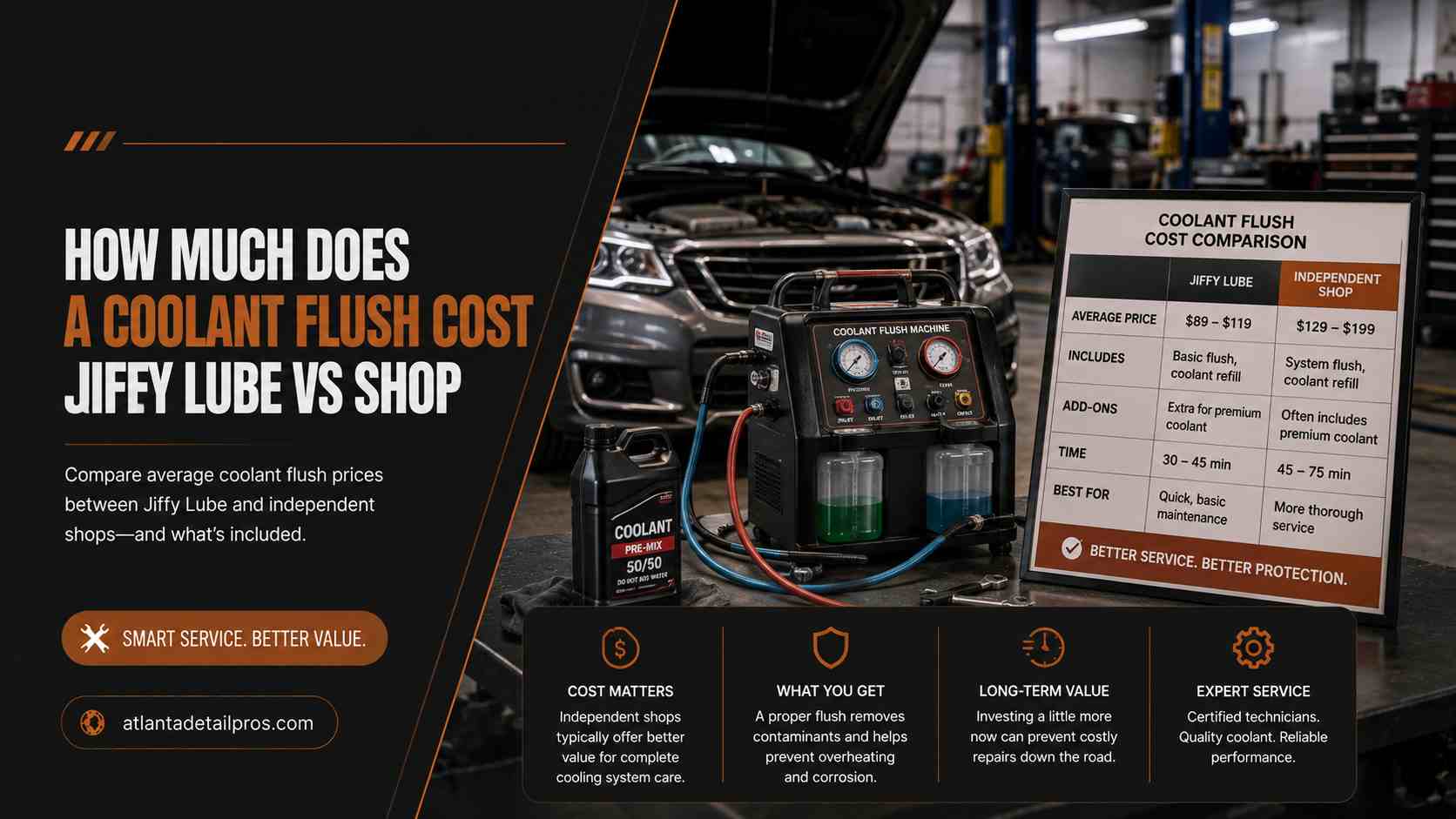
A coolant flush costs $70 to $120 at Jiffy Lube and similar quick-service chains and $80 to $150 at an independent shop, but the price is the least important factor in this service: what matters far more is whether the provider is performing an actual flush (machine-exchanged), a drain-and-refill, or just a top-off, and whether the coolant being installed matches your vehicle’s required specification.
Installing the wrong coolant type (the wrong OAT, HOAT, or NOAT formulation) during a flush creates a chemical incompatibility that degrades the corrosion inhibitor package and can accelerate corrosion of aluminum engine and cooling system components within months of the service.
Coolant flushes are a widely misunderstood service. Many drivers believe a coolant flush is performed far more often than necessary, partly because quick-service shops have a financial incentive to recommend it on every visit. Most modern vehicles require a coolant change every 5 years or 50,000 to 100,000 miles depending on the coolant type and the manufacturer’s specification. Understanding the correct interval for your vehicle prevents both premature service spending and the genuine damage caused by coolant that has degraded past its effective life.
What a Flush Is vs a Drain-and-Refill
The distinction between these two services matters because the industry uses the terms interchangeably at some shops when they refer to different procedures with different outcomes.
A drain-and-refill removes the coolant from the radiator and sometimes the reservoir, then refills. This exchanges approximately 40 to 60 percent of the total coolant volume in the system because coolant remaining in the engine block, heater core, and hose network is not removed. On most vehicles, a drain-and-refill replaces less than half of the actual coolant in the system.
A machine flush uses a coolant exchange machine that connects to the cooling system and simultaneously pumps new coolant in while drawing old coolant out. This process exchanges 90 to 95 percent of the total coolant volume including the block passages, heater core, and hose network. A machine flush is the correct procedure when the coolant is at the end of its service life or when the system has been contaminated.
A top-off adds fresh coolant to the reservoir to restore the level after evaporation or minor loss. This is not a flush or a drain-and-refill and is not a scheduled maintenance service: it is simply restoring lost volume.
Ask any shop quoting a “coolant flush” whether they are using a machine or performing a drain-and-refill. If the price is below $60, it is almost certainly a drain-and-refill, not a machine flush.
Price Comparison Across Provider Types
Service pricing for a coolant flush varies by provider type, coolant specification, and whether the service includes a system pressure test and inspection alongside the fluid exchange.
Provider Type | Typical Price Range | Method Used | Coolant Spec Match |
|---|---|---|---|
Jiffy Lube, Firestone, Valvoline Instant Oil Change | $70 to $120 | Machine flush or drain-and-refill (varies by location) | Universal or OEM-specific (ask before authorizing) |
Dealership | $120 to $200 | Machine flush with OEM coolant | OEM-specified coolant matched to vehicle |
Independent shop | $80 to $150 | Machine flush or drain-and-refill (varies by shop) | OEM-specific or correct aftermarket equivalent |
DIY (drain-and-refill) | $20 to $50 (coolant cost only) | Drain-and-refill | Correct if owner matches specification |
The Coolant Type Problem at Quick-Service Chains
The most significant risk of using a quick-service chain for a coolant flush is the use of a universal coolant that does not match the manufacturer’s specification for your vehicle. Universal coolants claim compatibility with all makes and models, but this claim is not accurate for all applications. Some OEM coolant specifications are genuinely unique in their chemistry: Honda Blue (a specific HOAT formulation), Toyota Super Long Life (OAT), Subaru Genuine Coolant (HOAT), and GM DEX-COOL (OAT) are formulations that interact differently with the metals and elastomers in their respective cooling systems.
Mixing an incompatible universal coolant with a residual OAT system can cause silicate crystallization that clogs the small passages in the heater core and water pump. This is not a hypothetical risk: it is a documented service failure that turns a $100 flush into a $400 to $800 heater core replacement.
Before authorizing any coolant service at a quick-service chain, ask specifically what coolant they plan to install and verify it matches the OEM specification in your owner’s manual. If the technician cannot tell you the coolant specification they will use, decline the service.
What a Complete Coolant Service Should Include
A coolant flush performed at the correct interval and by a competent provider should include more than simply exchanging the fluid. A complete coolant service includes a visual inspection of the hoses for cracking, softness, or swelling, an inspection of the radiator cap for correct pressure rating and seal condition, a check of the overflow reservoir for cracks and correct level, and ideally a cooling system pressure test to identify any small leaks that are not yet producing visible drips.
A quick-service chain that completes the fluid exchange in 20 minutes without inspecting the hoses, cap, or reservoir is providing a lesser service than an independent shop that takes 45 to 60 minutes and checks the system components. The price difference between these two services ($90 at a chain versus $130 at an independent shop) reflects a genuine difference in the service quality received.
“I let Jiffy Lube do a coolant flush on my Civic and did not ask what coolant they used. Two months later the heater was barely blowing warm air. The independent shop I took it to found the heater core partially blocked by white crystalline deposits. They said it was a common result of using silicated coolant in a Honda that specifies a phosphate-free HOAT. Ended up spending $550 on the heater core job. The flush was $89.” : Adrian Bellucci, 2015 Honda Civic owner
Coolant Service Intervals by Coolant Type
The correct service interval for a coolant flush depends on the coolant chemistry, not the mileage alone. Different coolant formulations have different corrosion inhibitor lifespans.
Coolant Type | Common Applications | Typical Service Interval |
|---|---|---|
Traditional green (IAT, silicate-based) | Older domestic vehicles pre-2000 | 2 years or 30,000 miles |
OAT (organic acid technology) | GM DEX-COOL, Toyota SLLC, VW G12+ | 5 years or 100,000 to 150,000 miles |
HOAT (hybrid organic acid) | Many European, Subaru, Honda | 5 years or 100,000 miles |
NOAT (nitrite OAT, diesel) | Heavy-duty diesel applications | Per manufacturer spec, typically 2 years |
A vehicle filled with OAT coolant from the factory does not need a coolant service every 2 years or 30,000 miles. Following the quick-service chain’s aggressive recommendation schedule on an OAT-equipped vehicle wastes money on a service the cooling system does not yet need.
When a Coolant Flush Is Genuinely Necessary
Beyond the standard interval service, a coolant flush is necessary in several specific situations regardless of mileage.
After a head gasket repair, a coolant flush removes combustion gas contamination and oil residue from the cooling circuit before the repaired engine is returned to service. After any internal cooling system component replacement (radiator, water pump, heater core), a flush purges assembly residue and ensures the system starts with fresh coolant chemistry. When the coolant appears brown, rusty, or has an oil film visible in the reservoir, a flush removes the contamination before it damages the water pump or heater core.
Any time the coolant type is being changed (for example, switching from traditional green to a long-life OAT), a complete machine flush with distilled water rinse ensures the old chemistry does not contaminate the new coolant’s inhibitor package.
DIY Coolant Drain and Refill
A DIY drain-and-refill is feasible for most drivers and requires no specialized equipment. The process involves opening the radiator or block drain, collecting the used coolant in a drain pan, refilling with the correct coolant mixed to the correct concentration (typically 50/50 with distilled water), and bleeding any air from the system.
The coolant cost for a typical passenger vehicle is $20 to $50 (1 to 2 gallons of coolant concentrate). Using distilled water rather than tap water is important: tap water contains minerals that accelerate internal corrosion and form deposits in small coolant passages over time.
The limitation of a DIY drain-and-refill is the same as at a quick-service chain: it exchanges only the coolant accessible through the drain point, leaving 40 to 60 percent of the old coolant in the system. For a routine maintenance service on a vehicle whose coolant is approaching but not yet at end-of-life, this partial exchange is acceptable. For a vehicle whose coolant has exceeded its service interval or is visibly degraded, a machine flush is the more thorough choice.
FAQs
How do I know what coolant my car needs?
The owner’s manual lists the coolant specification by type (OAT, HOAT, NOAT) and often by a specific part number or product name. The coolant cap on the reservoir is also often labeled with the required type. If neither source is clear, your vehicle’s dealer service department or a reputable independent shop can confirm the correct specification in under two minutes.
Can I mix different coolant types if I am just topping off?
Mixing different coolant types is not recommended and can degrade the inhibitor package of both fluids. For a top-off when the correct coolant is not immediately available, use distilled water as a temporary measure and replace with the correct coolant at the next service opportunity. Distilled water does not react with any coolant chemistry and is the correct emergency top-off fluid.
Is a $70 coolant flush at a quick-service chain as good as a $130 flush at an independent shop?
Not necessarily. The price difference often reflects a difference in whether a machine flush or a drain-and-refill is being performed, what coolant is being installed, and whether the hoses, cap, and pressure integrity are being checked as part of the service. Ask the same three questions at both locations: what is the method (machine or drain), what coolant brand and specification, and what inspection is included. The answers determine which service is actually more valuable.
What happens if I never change the coolant?
Coolant that has passed its inhibitor life loses its ability to prevent corrosion of aluminum cooling system components. The water pump impeller, heater core tubes, radiator core, and cylinder head coolant passages are all at risk from acidic, degraded coolant. The result is gradual corrosion that causes water pump failures, heater core leaks, and radiator core pinhole leaks: all significantly more expensive than a coolant service performed at the correct interval.
Does a coolant flush improve heater performance?
If the heater performance has degraded due to a partially blocked heater core from coolant deposit buildup, a flush combined with a chemical system cleaner can improve performance. If the heater core is blocked from silicate crystallization (from incompatible coolant mixing), a flush alone may not fully restore flow and a physical heater core replacement may be required.
Bottom Line
A coolant flush costs $70 to $120 at a quick-service chain and $80 to $150 at an independent shop, with the coolant specification used being more important than the price difference.
Before authorizing any coolant service, confirm the method (machine flush or drain-and-refill), verify the coolant specification matches your owner’s manual, and ensure the service includes a visual inspection of the hoses and radiator cap.
The most expensive coolant flush outcome is the one where the wrong coolant is installed: a $100 service that triggers a $500 heater core replacement three months later. Spending $20 to $30 more at an independent shop that uses the correct OEM-specified coolant is the better value in every case where the quick-service chain’s coolant specification cannot be confirmed in advance.