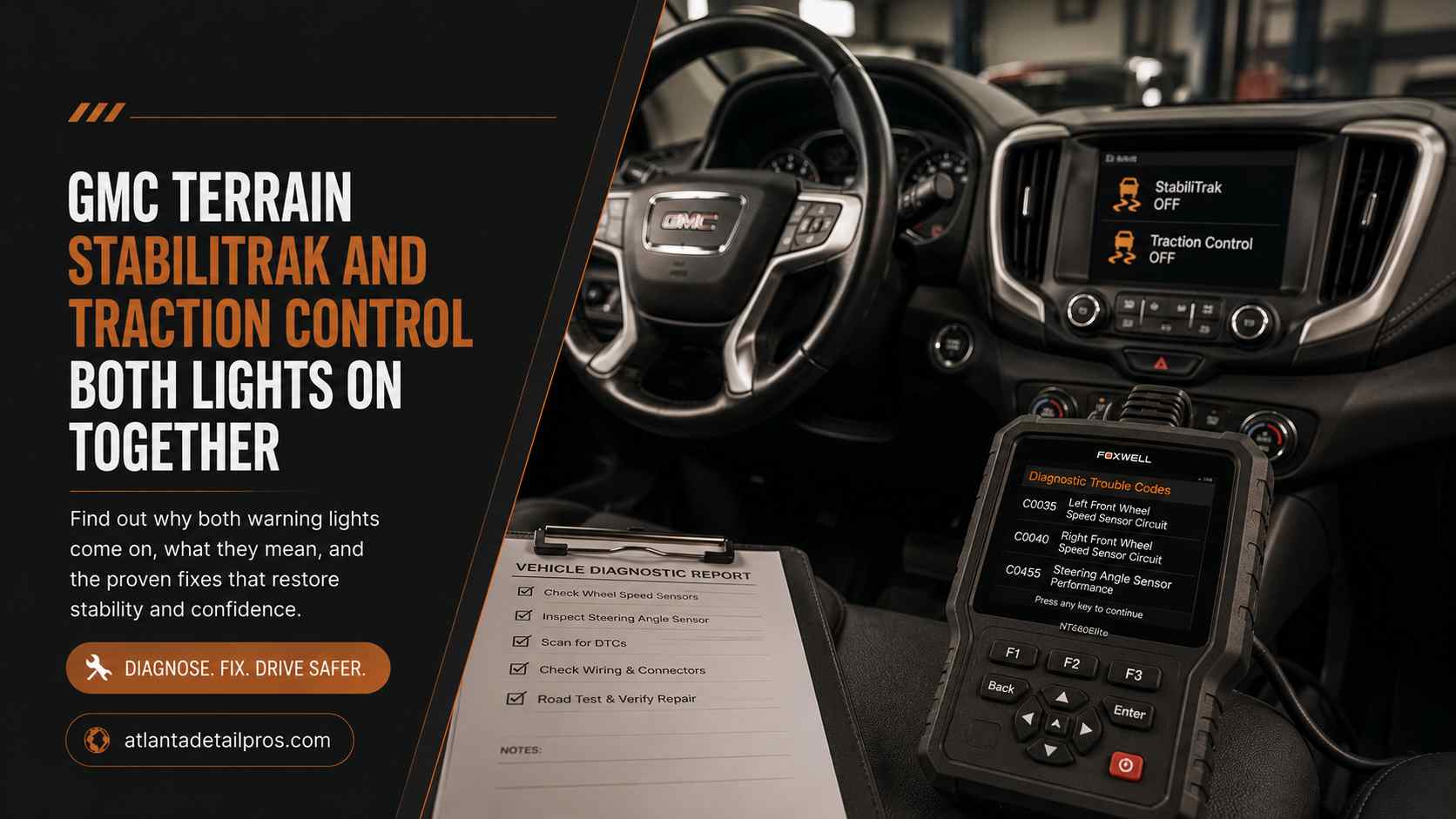
GMC Terrain StabiliTrak and traction control warning lights illuminating simultaneously almost always indicate a wheel speed sensor fault, a failed steering angle sensor, a throttle body that has accumulated enough carbon to disrupt the electronic throttle control signal, or a low battery voltage condition that corrupts the stability control module’s input data.
On the 2010 to 2017 Terrain with the 2.4L Ecotec engine, the throttle body carbon contamination is by far the most common single cause and is resolved with a cleaning procedure that costs $80 to $130 at a shop or under $15 in supplies for a DIY clean. It is the correct first step before any diagnostic fee is paid or any parts are replaced.
The StabiliTrak system on the GMC Terrain integrates wheel speed data, steering angle input, lateral acceleration, and throttle position to detect and correct vehicle instability. When both the StabiliTrak and traction control warning lights appear simultaneously, it means the system has detected an input signal it cannot trust and has disabled both stability and traction control as a safety precaution. The vehicle remains fully drivable in most cases, but the stability and traction control systems are inactive until the fault is cleared.
Why Both Lights Come On Together
The StabiliTrak and traction control systems share the same electronic control module (the Electronic Brake Control Module, or EBCM) and many of the same input sensors. A single faulty input that makes the module’s data unreliable causes both systems to disable simultaneously, which is why both lights appear together rather than one at a time.
The shared inputs most likely to cause dual illumination include the wheel speed sensors (which provide the speed differential data both systems rely on), the steering angle sensor (which tells the module which direction the driver intends to go versus which direction the vehicle is actually going), and the throttle position input (which the module uses to coordinate with electronic traction intervention). A battery voltage fault affects all of these inputs simultaneously by corrupting the CAN bus data the module depends on.
Most Common Causes by Frequency
Throttle Body Carbon Contamination (2.4L Ecotec: Most Frequent)
The 2.4L Ecotec in the 2010 to 2017 Terrain uses an electronic throttle body with no mechanical cable connection to the accelerator pedal. Carbon deposits from the PCV system accumulate on the throttle plate and bore over time, restricting air flow and creating resistance on the throttle plate that the electronic throttle control (ETC) motor must overcome. When this resistance exceeds the expected range for the commanded position, the ETC system detects a fault and the EBCM interprets it as a throttle input signal error. Both stability lights illuminate.
The characteristic presentation: both lights appear intermittently at first (especially on cold starts or after periods of idling), then more frequently as the carbon buildup increases. The engine may also hesitate briefly at light throttle inputs. Cleaning the throttle body resolves the fault in most cases without any parts replacement.
Wheel Speed Sensor Fault
Each wheel has a speed sensor (either a magnetic or Hall-effect sensor reading a toothed reluctor ring). A sensor that is failing, is contaminated with metallic debris, or has a damaged wiring harness connector produces an erratic or absent speed signal. The EBCM detects the inconsistency and disables both systems. Wheel speed sensor faults typically produce a specific code (C0035 through C0050 range depending on wheel position) that identifies the affected corner.
On the Terrain, the rear wheel speed sensors are integrated into the rear wheel bearing hub assemblies and cannot be replaced separately: a failed sensor requires hub assembly replacement. Front sensors are typically external and are replaced individually for $40 to $90 per side in parts.
Steering Angle Sensor (SAS) Fault
The steering angle sensor sits in the steering column and tells the EBCM which direction the front wheels are pointed. A failed or uncalibrated SAS produces a C0455 or C0460 code and causes both stability lights to illuminate. The SAS can be disrupted by battery disconnection (which erases its calibration), by an impact that changes the sensor’s reference position, or by internal sensor failure. Recalibration of the SAS is required after any steering system repair or battery replacement: this procedure can be performed with a capable scan tool and costs $40 to $80 at a shop.
Low Battery Voltage
A battery that is nearing end-of-life or an alternator that is not charging fully produces voltage that drops below the EBCM’s operating threshold during high-demand conditions (AC compressor cycling, heavy electrical load, prolonged idling). The EBCM sees corrupted input data from multiple sensors simultaneously and disables both systems as a precaution. The lights clear when the voltage stabilizes and may not return if the battery and charging system are functioning at the threshold. A battery and charging system test at any auto parts store (free) is the zero-cost first step.
Cause and Diagnostic Code Table
Cause | Typical Code | Diagnostic Step | Repair Cost |
|---|---|---|---|
Throttle body contamination | C0561 or U0121 may appear | Visual inspection, clean throttle body | $80 to $130 shop, $15 DIY |
Wheel speed sensor fault | C0035 to C0050 | Code scan identifies corner, inspect sensor and connector | $80 to $220 per corner |
Steering angle sensor | C0455 or C0460 | Scan tool calibration or sensor replacement | $80 to $250 |
Low battery voltage | Multiple codes simultaneously | Battery and charging system test | $120 to $250 battery replacement |
EBCM internal fault | Module-specific codes | Shop diagnosis, module replacement | $400 to $900 |
Throttle Body Cleaning Procedure (DIY or Shop)
This is the correct first step on any 2010 to 2017 Terrain with the 2.4L Ecotec engine before paying for any diagnostic fee.
With the engine cold and the ignition off, remove the air intake duct from the throttle body inlet. Do not start the engine during the cleaning: on electronic throttle bodies, the plate must be held open manually and with the ignition off. Manually open the throttle plate by pressing it gently open with a finger. Spray throttle body cleaner on a lint-free rag and wipe the interior bore, the face of the throttle plate, and the edges of the plate thoroughly. Carbon deposits appear as black or dark brown coating on the bright metal. Continue wiping until the deposits are removed from all accessible surfaces.
Reinstall the air duct, start the vehicle, and allow it to idle for 2 minutes. The EBCM may require one or two drive cycles after the throttle body is cleaned to relearn the correct throttle plate position and clear the fault. If the lights do not clear after two drive cycles with the engine at operating temperature, proceed to a code scan to identify whether a secondary cause is present.
“Both StabiliTrak and traction control lights came on in my 2013 Terrain in winter. Dealer wanted to charge me $120 diagnostic. I cleaned the throttle body myself with a $10 can of cleaner. Both lights cleared after the first cold start the next morning and have not come back in 18 months. Total time was 15 minutes.” : Leanne Vogel, 2013 GMC Terrain 2.4L owner
When the Throttle Body Clean Does Not Fix It
If the lights return within one to two days after a thorough throttle body cleaning, the throttle body is either too contaminated to be restored by surface cleaning (requiring replacement or a more aggressive cleaning with the throttle body removed) or a secondary cause is present that the cleaning did not address.
The next step is a free code scan at an auto parts store. Copy the exact code numbers (the C-code format, not just the description) and research each code before visiting a shop. The specific code identifies the system and in many cases the specific sensor causing the fault, which allows you to get an accurate parts and labor quote without paying a full diagnostic fee.
Repair Cost Reference
Repair | Typical Cost |
|---|---|
Throttle body cleaning (shop) | $80 to $130 |
Throttle body cleaner (DIY) | $8 to $15 |
Throttle body replacement (2.4L Ecotec) | $200 to $450 shop installed |
Front wheel speed sensor replacement | $80 to $180 per side |
Rear wheel bearing hub assembly (with integrated sensor) | $200 to $380 per side |
Steering angle sensor recalibration | $40 to $80 |
Battery replacement (if low voltage cause) | $120 to $220 shop installed |
FAQs
Is it safe to drive a GMC Terrain with both StabiliTrak and traction control lights on?
The vehicle is fully drivable with both lights on in the sense that steering, braking, and powertrain operation are not affected. What is disabled is the electronic stability and traction intervention: in a situation where the vehicle would normally benefit from StabiliTrak correction (a sudden swerve, a slippery surface, an emergency lane change), the system will not activate. Drive conservatively and avoid conditions where stability control assistance would normally be valuable until the fault is corrected.
Will the lights come back after clearing the codes?
If the underlying cause has not been repaired, yes: the lights will return within one or two drive cycles after the codes are cleared. Code clearing (by disconnecting the battery or using a scan tool) does not repair any of the causes listed above. The only way to permanently clear the lights is to resolve the cause.
Does the 3.0L and 3.6L V6 Terrain have the same throttle body issue?
The throttle body carbon contamination is most commonly associated with the 2.4L Ecotec engine, where the PCV system routes crankcase vapors through the intake and throttle body more aggressively than on the V6 platforms. The V6 Terrain can still experience wheel speed sensor faults, steering angle sensor issues, and battery-related stability light faults through the same mechanisms, but the throttle body cleaning is less commonly the single cause on V6 applications.
Why do the lights come on more often in cold weather?
Cold temperatures cause slightly thicker oil vapor from the PCV system to deposit on the throttle body plate more quickly, and cold temperatures lower battery voltage output. Both factors increase the likelihood of a stability light event in winter. Owners who see the lights only in cold weather and have them clear after a few minutes of driving typically have a throttle body that is approaching the contamination threshold or a battery that is approaching end-of-life.
Do I need a dealer scan tool to diagnose this problem?
No. The stability control system codes on the Terrain are accessible through standard OBD-II protocol and can be read by any professional or consumer-grade scan tool that supports enhanced GM codes, including the code readers available for free use at most major auto parts stores. A dealer’s scan tool accesses additional proprietary data channels but is not required to retrieve the fault codes that identify the specific cause.
Bottom Line
GMC Terrain StabiliTrak and traction control lights on together are most commonly caused by throttle body carbon contamination on the 2.4L Ecotec engine, and the correct first response is a throttle body cleaning that costs $8 to $130 and takes 15 minutes.
If the lights return after a thorough cleaning, a free code scan identifies whether a wheel speed sensor, steering angle sensor, or battery voltage issue is the actual cause.
Do not pay a $120 diagnostic fee before cleaning the throttle body and getting the free code scan. These two zero-to-low-cost steps resolve the problem completely in the majority of 2010 to 2017 Terrain cases and give you the specific information you need to have an accurate repair conversation with any shop.