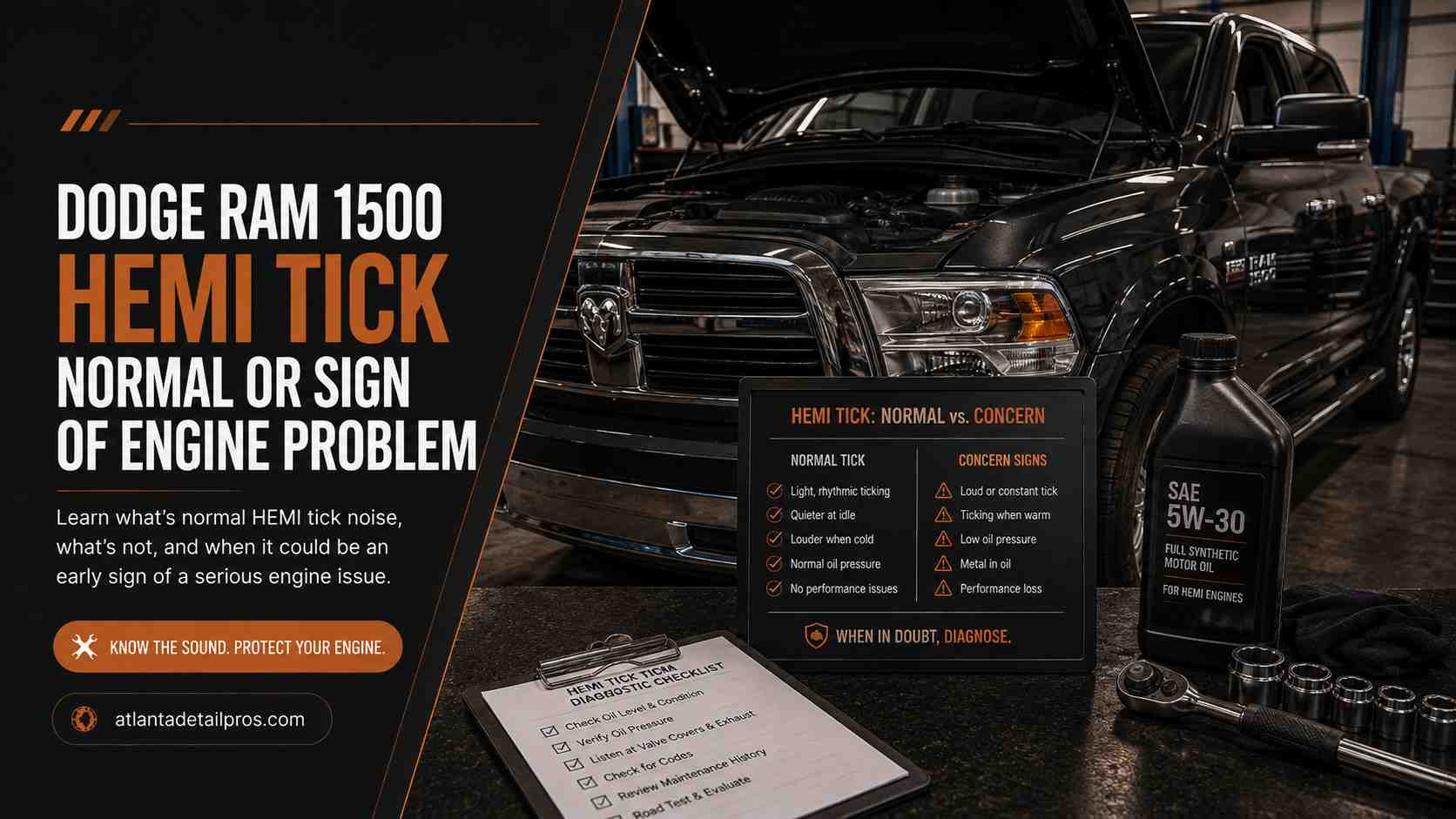
The Dodge Ram 1500 HEMI tick that appears at cold start and clears within 60 to 90 seconds as the engine warms to operating temperature is a known and documented characteristic of the 5.7L HEMI’s Multi-Displacement System (MDS) lifter design, but a tick that persists at operating temperature, appears only at certain RPM ranges when the engine is fully warm, worsens progressively over weeks, or is accompanied by a misfire code is not normal and is an early warning sign of MDS lifter or rocker arm failure.
The challenge for Ram 1500 5.7L owners is that the normal HEMI tick and the abnormal MDS lifter failure tick can sound nearly identical to each other, particularly in the early stages of failure. The key diagnostic information is not the presence of the tick but its behavior: when it occurs, how long it lasts, whether it clears completely at operating temperature, and whether any codes accompany it.
The 5.7L HEMI in the Ram 1500 uses a Multi-Displacement System (MDS) that deactivates four of the eight cylinders during light-throttle cruising, similar to General Motors’ Active Fuel Management. The MDS lifters are hydraulic collapsing lifters on cylinders 1, 4, 6, and 7, and they are the same failure-prone design that has produced widespread documented issues across both GM (AFM) and Chrysler (MDS) applications. Understanding which tick you are hearing is the first and most important diagnostic step.
The Normal HEMI Tick: What It Is and Why It Happens
The normal HEMI tick is present at cold start and is most audible in the first 30 to 90 seconds of operation before the engine reaches operating temperature and oil fully pressurizes the MDS lifter circuit. It is also audible briefly each time the MDS system transitions from 8-cylinder mode to 4-cylinder mode, as the MDS lifters collapse and the oil pressure redistributes in the valvetrain. This transition tick is typically very brief (under 1 second) and imperceptible to most drivers at highway cruise.
The normal tick has a consistent character: it does not worsen over time, it does not appear between MDS transitions, and the engine produces no misfire codes. Owners who have driven Ram 1500 HEMIs for 200,000 miles report the same cold-start tick they heard from new. This is because the MDS lifter design has an inherent oil bleed-down characteristic overnight that requires a brief prime period before the lifter plunger fully pressurizes.
Chrysler explicitly acknowledged this tick in Technical Service Bulletin (TSB) 09-001-09 REV.A and subsequent revisions, which describes the normal cold-start valve train noise characteristics of the MDS-equipped 5.7L HEMI and defines the conditions under which the tick is expected rather than indicative of a fault.
The Abnormal HEMI Tick: MDS Lifter Failure Pattern
The abnormal tick pattern follows a predictable failure sequence that is distinct from the normal cold-start characteristic in several specific ways.
Stage 1: Tick That Does Not Fully Clear at Warm Idle
The normal cold-start tick clears completely by the time the engine reaches full operating temperature (coolant temp at the full operating mark, typically 195 to 210 degrees Fahrenheit). A tick that reduces but does not completely disappear by warm idle, particularly one that is audible from the top of the engine at idle in a quiet environment, indicates a lifter that is not fully filling with oil pressure. At Stage 1, there are typically no stored codes and no performance issues. The MDS system may still be functioning.
Stage 2: Tick at Specific RPM Ranges When Warm
A tick that appears and disappears at a specific RPM range during warm operation (for example, noticeable at 1,200 to 1,500 RPM but absent above and below that range) indicates a valve train component that is resonating at the frequency of the affected cylinder’s firing event. This pattern is more consistent with an MDS lifter that is collapsing intermittently rather than a simple bleed-down issue.
Stage 3: Misfire Codes and MDS-Related Codes
Stored codes P0300 (random misfire), P0301 through P0308 (cylinder-specific misfire), or the Chrysler-specific MDS-related codes (U0404, U1404, or DTCs referencing cylinder deactivation system) alongside the tick confirm MDS system involvement. The affected cylinder is no longer contributing normally, and the abnormal lifter is the cause rather than an ignition or fuel system fault.
Stage 4: Loud Knock and Power Loss
Full lifter collapse or bent pushrod produces a loud rhythmic knock and a clear power deficit on the affected cylinder. At this stage, metal debris from the failed lifter is potentially circulating in the oil. Do not drive: tow immediately.
Tick Behavior Comparison Table
Tick Behavior | Normal HEMI Characteristic | Abnormal: MDS Failure Warning |
|---|---|---|
Duration at cold start | 30 to 90 seconds, then clears completely | Does not fully clear at operating temperature |
Behavior at warm idle | Absent or imperceptible | Audible, may be faint or moderate |
Response to MDS transitions | Brief click during mode change | Prolonged tick after mode change |
Codes stored | None | P030X or MDS DTCs |
Progression over time | Stable for years | Worsens over weeks to months |
Oil pressure gauge reading | Normal | Normal initially, may drop at Stage 4 |
At-Home Tests to Distinguish Normal from Abnormal
Several observations you can make without lifting the vehicle help distinguish the two tick types before visiting a shop.
Cold-Start Timing Test
Start the vehicle from a full cold soak (at least 6 hours since last operation). Using a stopwatch or phone timer, note exactly when the tick begins and when it fully disappears. A tick that is gone by 90 seconds at temperatures above 40 degrees Fahrenheit is within the normal characteristic range. A tick that is still audible at 3 minutes of idling indicates a lifter that is not building pressure correctly.
Free Code Scan
Take the Ram to any major auto parts store for a free OBD-II scan. A completely clean scan with no pending or stored misfire codes, no MDS system codes, and no cylinder deactivation codes alongside a cold-start tick strongly supports the normal characteristic conclusion. Any code in the P030X range on an MDS cylinder (1, 4, 6, or 7) combined with the tick confirms advancing lifter failure.
MDS Disable Test
Aftermarket MDS disabler devices (such as the Range AFM/MDS Disabler) plug into the OBD-II port and prevent the PCM from commanding MDS operation. If the tick at warm idle disappears when MDS is disabled and returns when the device is removed, the MDS lifters are confirmed as the source of the warm-idle tick. This test does not repair the issue but definitively identifies the MDS system as the noise source.
“My 2014 Ram 1500 5.7 always ticked for about 45 seconds at cold start. I ignored it for two years because the dealer said it was normal. Then I noticed the tick was still there at warm idle one day. Got a code read: P0306 and a Chrysler cylinder deactivation code on cylinder 6. MDS lifter on cylinder 6 was collapsing intermittently. Caught it before the pushrod bent. The full MDS delete with updated lifters and a tune cost me $1,400 at an independent shop.” : Brett Garrison, 2014 Ram 1500 5.7L HEMI owner
MDS Delete: The Permanent Solution
The most permanent resolution for recurring MDS lifter problems on the 5.7L HEMI is the MDS delete: replacing all four MDS lifters with standard non-collapsing lifters and disabling the MDS system through a PCM calibration change. This eliminates the collapsing lifter design entirely and removes the failure mode from the equation.
An MDS delete on the Ram 5.7L requires replacing the four MDS lifters (and ideally all 16 lifters simultaneously for consistent valvetrain operation), replacing the associated pushrods, and using a PCM tune that removes the MDS commands. It does not change the character of the engine in terms of power or reliability: it simply removes the cylinder deactivation function and the associated hardware.
Repair Cost Reference
Repair | Typical Cost (Independent Shop) |
|---|---|
MDS disabler device (OBD-II plug-in) | $60 to $80 (DIY purchase) |
Partial MDS lifter replacement (4 MDS lifters only) | $700 to $1,200 |
Full MDS delete (16 lifters, pushrods, PCM tune) | $1,200 to $2,000 |
Engine repair if pushrod bent (valve train) | $1,500 to $3,000 |
Engine replacement if catastrophic failure | $5,000 to $9,000 |
FAQs
Is the HEMI tick covered under warranty?
Chrysler’s powertrain warranty covers MDS lifter failures that cause misfires, power loss, or engine damage when the vehicle is within the warranty period. The normal cold-start tick is explicitly described in the TSB as a characteristic and is not covered as a defect. If the tick is accompanied by codes or performance symptoms within the warranty period, document the complaint formally in writing with the dealer before the warranty expires.
Does the HEMI tick get worse with age?
The normal cold-start tick is stable and does not worsen over time on a healthy engine with regular oil changes. An abnormal tick from a failing MDS lifter worsens progressively over weeks to months. The direction of change over time is one of the most reliable ways to distinguish normal from abnormal: a tick that sounds the same as it did 50,000 miles ago is almost certainly normal. A tick that is noticeably louder than it was six months ago requires investigation.
Can using thicker oil reduce the HEMI tick?
Chrysler specifies 5W-20 for the 5.7L HEMI. Some owners report that 5W-30 reduces the cold-start tick duration slightly by maintaining a thicker oil film in the MDS lifter bores overnight. This is not Chrysler’s specification and is not a repair for a failing lifter. Thicker oil in a failing MDS lifter may temporarily quiet it but does not address the underlying wear.
Does the 6.4L HEMI (392) have the same MDS tick issue?
The 6.4L HEMI in the Ram 1500 TRX and Hellcat applications also uses MDS but at a lower proportion of total engine operation time due to the engine’s performance-oriented use profile. The MDS lifter failure pattern exists on the 6.4L but is less common than on the 5.7L because the 6.4L spends less time in 4-cylinder mode during typical driving.
What oil change interval should I use if my HEMI has the tick?
Strict adherence to a 5,000-mile oil change interval (rather than the oil life monitor’s recommendation, which can extend to 10,000 miles under ideal conditions) reduces the period the MDS system operates with degraded oil. Degraded oil loses its film strength and accelerates MDS lifter internal wear. Shorter intervals are a meaningful preventive measure on high-mileage HEMI applications.
Bottom Line
The Ram 1500 HEMI tick is normal if it clears completely within 90 seconds of cold start and produces no codes: it is abnormal if it persists at warm idle, worsens progressively, or is accompanied by any misfire or MDS system code. Get a free code scan before drawing any conclusion. A clean scan with a cold-start-only tick is reassurance. A P030X code on an MDS cylinder alongside any tick is the diagnosis: MDS lifter failure at a stage where the MDS delete repair is still straightforward and affordable.
Act at Stage 2 (warm idle tick plus codes) rather than Stage 4 (loud knock plus power loss). The cost difference is $1,200 to $2,000 for an MDS delete versus $5,000 to $9,000 for an engine replacement.