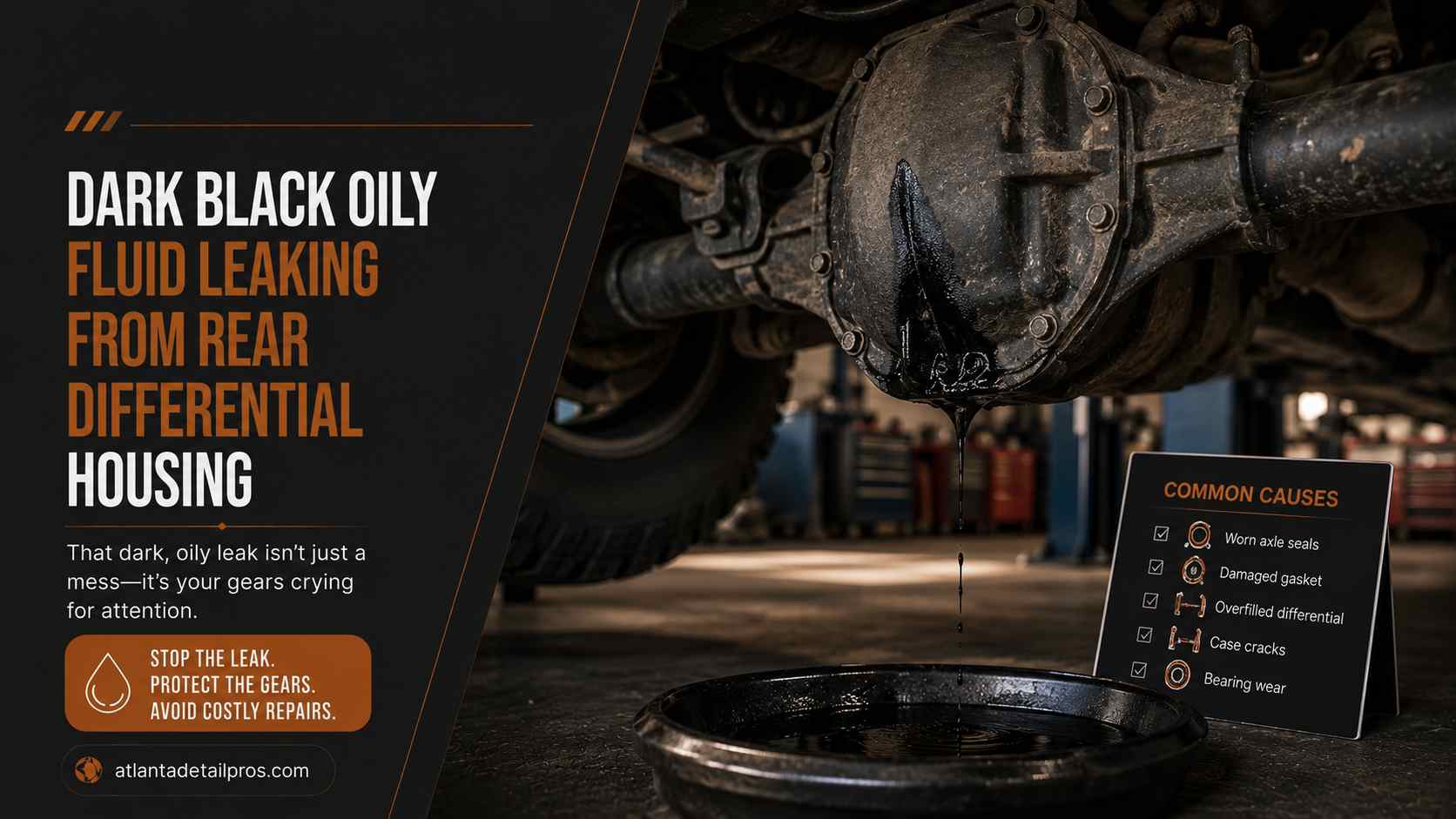
Dark black oily fluid leaking from the rear differential housing almost always means differential gear oil has broken down and is escaping past a worn or damaged seal, most commonly the pinion seal or axle shaft seal.
The color is the diagnostic clue: gear oil darkens to near-black with heat cycling and metal particle contamination over time, which distinguishes it from engine oil (which tends to be brown to black but smells different and leaks from locations further forward) and from brake fluid (which is clear to pale yellow). A rear differential leak is not an emergency if the level is only slightly low, but left unaddressed it will drain the housing and destroy the ring and pinion gear set in a matter of miles.
The rear differential is one of the most abuse-tolerant components on a truck or SUV, built with thick cast iron or aluminum housings and designed for decades of service. What kills differentials is not age: it is operating at low fluid level. The moment the oil film breaks down on the ring and pinion gear mesh, metal-to-metal contact begins and the gear set generates heat that accelerates the failure exponentially. Understanding where the leak is coming from, how fast it is losing fluid, and what the repair costs look like will help you make the right call quickly.
Most drivers who catch a rear differential leak early spend $80 to $250 at an independent shop to fix it. Most drivers who ignore it spend $1,200 to $3,500 rebuilding or replacing the differential entirely.
Common Sources of Rear Differential Fluid Leaks
Pinion Seal Failure
The pinion seal sits at the front of the differential housing where the driveshaft yoke connects to the ring-and-pinion assembly. This seal experiences high rotational speed and significant heat, making it one of the first components to degrade. A failing pinion seal leaks from the front of the differential, and the fluid pattern typically runs forward along the bottom of the driveshaft. Pinion seal replacement requires removal of the driveshaft yoke and careful preservation of the pinion bearing preload during reassembly. This is not a beginner DIY job.
Axle Shaft Seal Failure
The axle shaft seals sit where each axle shaft enters the differential housing on the left and right sides. These seals see less rotational speed than the pinion seal but are exposed to contamination from road debris and water intrusion. Failed axle seals leak from the inboard end of each rear axle, and the fluid often coats the inside of the brake drum or disc. If gear oil has reached your rear brakes, brake system cleaning or pad replacement may be required in addition to the seal repair.
Cover Gasket Failure
The differential cover sits on the rear of the housing and is sealed with either a reusable gasket or RTV sealant. Over time and through repeated thermal cycling, this seal can harden and crack. Fluid from a cover gasket leak typically drips from the lowest point of the cover, leaving a pool directly behind the axle centerline. This is the most DIY-accessible rear differential leak repair: drain the housing, remove the cover, clean the mating surface, install a new gasket or fresh RTV, refill to the correct level.
Housing Crack or Casting Defect
Less common but worth knowing: impact damage from road hazards, off-road use, or a tow strap attachment point failure can crack the housing itself. Cracks typically require welding repair or housing replacement and are beyond the scope of a seal replacement.
Cause Hierarchy Table
Cause | Symptom Pattern | Repair Cost (Independent Shop) |
|---|---|---|
Pinion seal failure | Leak from front of diff housing, fluid on driveshaft | $120 to $250 |
Axle shaft seal (left or right) | Leak at axle tube end, may reach brake components | $80 to $180 per side |
Rear cover gasket failure | Drip at rear/bottom of housing, pool under axle centerline | $60 to $120 |
Vent tube clogged (overpressure) | Fluid weeping from multiple points, no single seal failure | $20 to $60 (vent cleaning) |
Pinion bearing failure (advanced) | Leak with rumbling noise under load | $350 to $700 |
Housing crack | Visible fracture line, large fluid loss | $500 to $1,500+ |
How to Check the Differential Fluid Level
Most rear differentials have a fill plug on the housing, typically a square drive or hex plug located on the side of the cover or the housing body. To check:
- Warm up the vehicle with a short drive to bring the fluid to operating temperature.
- Locate the fill plug: it sits at the side of the housing, typically midpoint on the vertical face.
- Remove the fill plug using the correct drive size (3/8” square or 1/2” square on most trucks).
- Insert your finger or a small pick into the hole: the fluid level should be at or just below the bottom edge of the plug opening.
- If the level is more than half an inch below the plug, you have lost significant volume.
Do not confuse the fill plug with the drain plug. Many solid axle differentials have a drain plug at the bottom and a fill plug at the side. On some vehicles (older Dana 44 and Dana 60 axles, for example) there is only a fill plug and no separate drain: the cover must be removed to drain the housing.
What Differential Gear Oil Actually Looks Like
Fresh gear oil ranges from amber to light brown. It is thick and has a sulfur-based odor from the extreme pressure additives it contains. Gear oil that has been in service for 30,000 miles or more darkens progressively to dark brown and eventually near-black as the additive package breaks down and fine metal particles from normal gear wear accumulate in suspension. This is why the leak from a rear differential almost always looks black: it is not burned, it is simply old and fully degraded. The color tells you the fluid has not been serviced in a long time, which is useful diagnostic information but does not by itself indicate internal damage.
Urgency and Drive-Ability Assessment
Fluid Loss Rate | Drive-Ability |
|---|---|
Drip only when parked after driving (less than 5 drops) | Drive cautiously: check level every 100 miles |
Visible wet streak but no active drip | Monitor closely: repair within 1 week |
Active drip while parked | Do not drive long distances: repair immediately |
Puddle forming within 30 minutes of parking | Do not drive: tow to shop |
Vehicle-Specific Notes
Dana 35 and Dana 44 axles (Jeep Wrangler, older Ford Ranger, older Chevrolet trucks) are known for pinion seal failure before the 100,000-mile mark, particularly when the vehicle has seen any off-road use involving water crossings that degrade the seal lip faster than normal highway use.
Ford 8.8 axles (F-150, Mustang, Explorer) develop axle shaft seal failures frequently between 80,000 and 120,000 miles. Gear oil contamination of the rear brakes is a common finding when this seal fails.
GM 10-bolt and 12-bolt rear axles are generally robust but the cover gaskets frequently weep after 100,000 miles if the original fluid was never changed. The RTV used at the factory hardens and shrinks over time.
Ram 1500 and 2500 trucks with Chrysler 9.25 and AAM axles are known for pinion seal leaks. The pinion nut staking method used at the factory makes pinion preload preservation during seal replacement critical: improper reassembly destroys the pinion bearing.
“I noticed a small wet spot under my Tundra every morning but kept telling myself it could wait. About six weeks later the differential started whining under load. The shop found the fluid was completely out and the pinion bearing had started spalling. Went from what would’ve been a $150 pinion seal job to a $1,400 rebuild.” : Nate Perkins, 2014 Toyota Tundra owner
DIY Diagnosis Steps
Step 1: Identify the Leak Location Precisely
Clean the entire underside of the differential housing with brake cleaner and a rag. Drive the vehicle for 30 minutes, then park on a clean surface. Inspect where the fluid first appears on the housing. Front of the housing near the driveshaft connection: pinion seal. Sides of the housing near the axle tubes: axle shaft seals. Rear cover perimeter: cover gasket.
Step 2: Check for Vent Tube Clogging
The differential vent tube or vent plug allows the housing to breathe as it heats and cools. A clogged vent creates internal pressure that pushes fluid past otherwise intact seals. Locate the vent (usually a small rubber tube or threaded plug near the top of the housing) and verify it is clear and unobstructed. A clogged vent explains why a fresh seal continues to leak after replacement.
Step 3: Smell Test
Gear oil has a distinct sulfur odor that is sharper and more chemical than engine oil. Brake fluid smells slightly sweet and is typically clear to yellowish. Transmission fluid (which can also leak toward the rear on rear-wheel-drive vehicles) is red or pinkish and has a synthetic or mineral oil smell. Confirming the fluid type by smell rules out other sources before you commit to a differential repair.
FAQ
How long can you drive with a rear differential leak?
It depends entirely on the rate of fluid loss. A weeping cover gasket that loses a few drops per day gives you time to schedule a shop appointment. An active pinion seal leak that empties the housing within a week of normal driving needs to be addressed immediately. Check the fluid level through the fill plug before every trip if you suspect an active leak and stop driving if the level has dropped significantly.
What happens if the rear differential runs out of fluid?
Without gear oil, the ring and pinion gears run dry within minutes. The extreme pressure loads on the gear mesh generate heat that exceeds the metal’s thermal limits rapidly. The gear teeth begin to micro-weld and tear apart in a process called scuffing, then spalling as surface material breaks free. Within a few miles of dry operation the differential is making a loud howl or grinding noise. Within 10 to 20 miles of dry operation, catastrophic failure is likely: the ring and pinion gear set are destroyed and may lock the axle.
Can I use stop-leak additive in my rear differential?
Stop-leak additives for differentials work by swelling and softening the seal material, which can temporarily slow or stop a minor seal weep. They will not fix a fully torn seal, a failed cover gasket, or a cracked housing. More importantly, some stop-leak products are not compatible with limited-slip differentials: using the wrong product in a Positraction, Trac-Lok, or similar unit can cause the friction clutch packs to slip and destroy the limited-slip function. Always confirm compatibility before adding any additive.
What fluid does a rear differential use?
Most rear differentials require gear oil rated GL-4 or GL-5, typically in viscosity grades 75W-90 or 80W-90. Limited-slip differentials require a gear oil formulated for or supplemented with a friction modifier. Refer to the vehicle’s owner manual or the manufacturer’s differential service specification for the correct product. Using the wrong fluid will damage friction clutch packs in a limited-slip unit and can void any warranty on a new differential seal repair.
Is a rear differential leak a safety inspection failure?
In many states and jurisdictions, an active fluid leak from any drivetrain component is grounds for a failed safety inspection. Even if your specific inspection does not flag it, a rear differential leak is a maintenance item with clear consequences for failure to address it.
Bottom Line
Dark black oily fluid from the rear differential housing is gear oil that has aged past its service life and is escaping through a failed seal. The cause is almost always a pinion seal, axle shaft seal, or cover gasket: all three are inexpensive repairs when caught early. The risk of ignoring the leak is severe because the differential can drain completely within weeks or months of normal driving, and operating a differential without fluid destroys the ring and pinion gear set in a matter of miles.
Check the fluid level now using the fill plug. Identify the leak location precisely by cleaning the housing and driving a short distance. Then get it to a shop. A $150 seal replacement versus a $1,400 differential rebuild is a decision that becomes easier the moment you understand what is actually at stake.