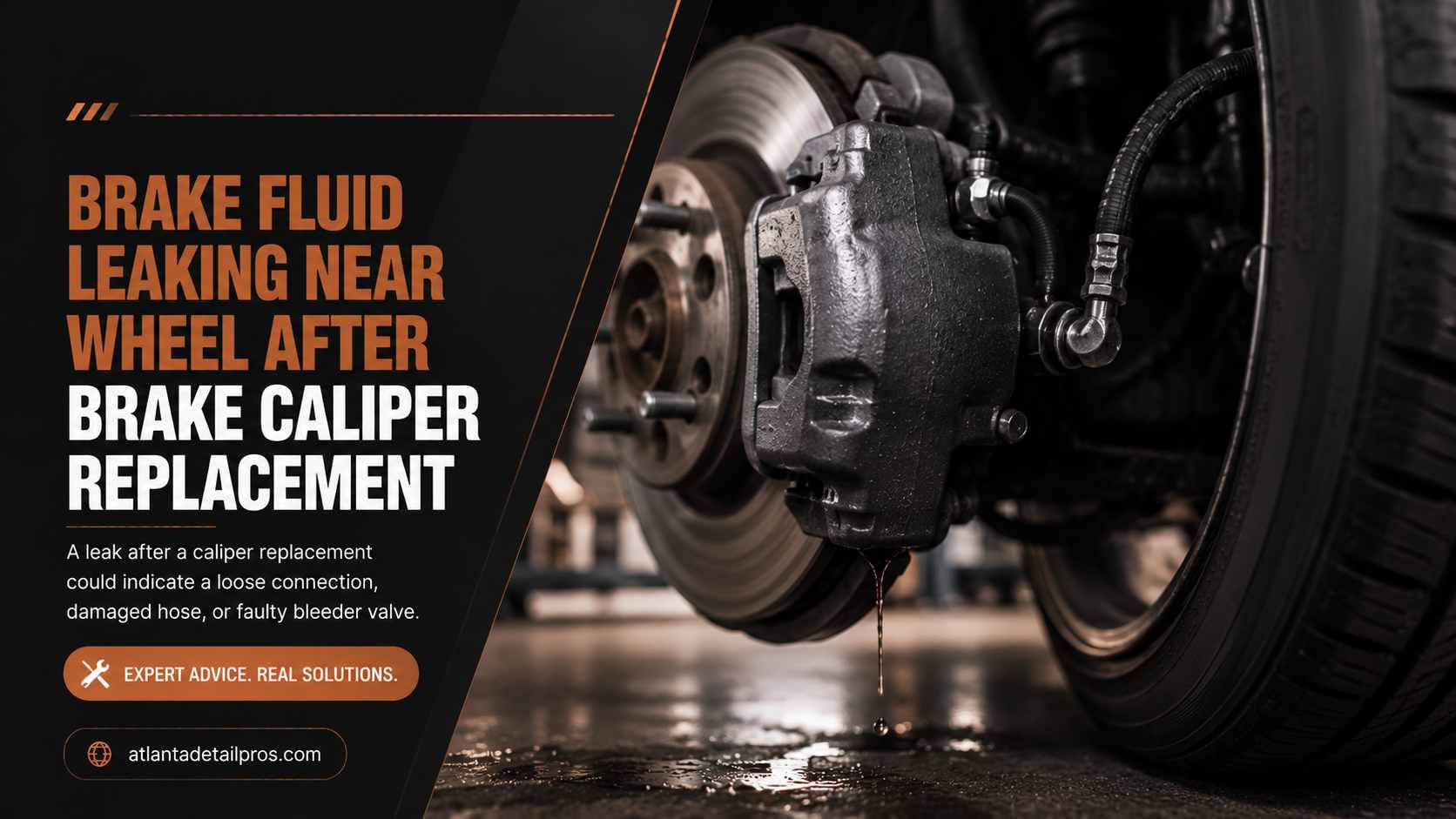
Brake fluid leaking near the wheel after a caliper replacement almost always means a fitting was not fully tightened, a copper banjo washer was reused or improperly seated, or the bleeder screw was left open or cracked during the bleeding process.
This is not a situation that gets better on its own, and it is not safe to drive. A brake system loses hydraulic integrity the moment fluid escapes past a fitting: the brake pedal will feel spongy at first, then increasingly long, and eventually the pedal will travel to the floor without building pressure. A brake pedal that goes to the floor on a moving vehicle is a life-threatening condition.
If you or a shop just completed a caliper replacement and you are now seeing fluid near the wheel, the repair has an incomplete element. This is a known risk in brake work: hydraulic fittings, banjo bolts, and bleeder screws must all be verified torqued and sealed before the vehicle leaves the shop or driveway. The good news is that post-caliper brake fluid leaks almost always have a mechanical cause that is straightforward to identify and fix if you act before significant fluid loss occurs.
This article covers every likely source of a post-caliper fluid leak, how to identify the exact one on your vehicle, and what it costs to have a shop resolve it correctly.
Why Brake Fluid Leaks After Caliper Replacement
Banjo Bolt and Copper Washer Failure
The banjo bolt connects the brake line to the caliper body. The bolt passes through a banjo fitting on the end of the brake hose, and copper washers (one on each side of the banjo fitting) create the hydraulic seal. These copper washers are single-use components: copper is soft enough to conform to the mating surface on first compression, sealing any microscopic irregularities. A reused copper washer has already deformed to its original mating surfaces and cannot seal a new connection reliably. If the banjo bolt threads were not fully engaged, or if the washer was misaligned during installation, the fitting will weep or drip from the joint where the hose meets the caliper body.
Bleeder Screw Not Fully Closed
The bleeder screw must be fully closed and torqued before the vehicle is returned to service. A bleeder screw opened during bleeding and then only finger-tightened will weep fluid from the screw threads or tip under the pressure of a brake application. This is the easiest post-replacement leak to identify: the fluid appears at the top of the caliper body at the bleeder port.
Brake Hose Connection at the Hard Line
The rubber brake hose connects to the steel hard line at a fitting above the wheel, typically at a bracket mounted to the chassis or knuckle. If the hose was disconnected from the hard line during caliper removal and not fully retightened, this junction will leak. The drip appears above the caliper, at the hose-to-hardline junction, rather than at the caliper body itself.
Cracked or Damaged Caliper Body
In rare cases, installing the caliper under force without fully retracting the piston can crack the caliper body at a thin casting section. This is more common with aftermarket calipers that have dimensional variations or with calipers installed on corroded brackets without proper cleaning and lubrication. A cracked caliper body leaks from the fracture line, not from a fitting.
Caliper Piston Boot Damage
The rubber piston boot seals the caliper piston bore against contamination. If the boot was torn during piston retraction using improper tools or excessive force on an old, brittle boot, brake fluid can escape past the piston seal and migrate outward along the boot tear. This type of leak typically appears at the inner edge of the caliper, behind the brake pad.
Leak Source Identification Table
Leak Location on Caliper | Most Likely Cause | Urgency |
|---|---|---|
At banjo fitting where hose meets caliper body | Loose banjo bolt or reused copper washer | Do not drive: repair immediately |
At bleeder screw port at top of caliper | Bleeder screw not fully closed | Do not drive: repair immediately |
At hose-to-hardline junction above caliper | Brake hose fitting not tightened | Do not drive: repair immediately |
Behind brake pad at inner caliper face | Piston boot torn, piston seal failure | Do not drive: caliper replacement needed |
At caliper body casting, not at any fitting | Cracked caliper body | Do not drive: replace caliper |
Fluid at wheel but no caliper source identified | Wheel cylinder on rear drum brake affected | Do not drive: check full brake system |
All brake fluid leaks after caliper replacement carry the same urgency: do not drive the vehicle regardless of which source is identified.
Immediate Steps After Discovering the Leak
Step 1: Do Not Drive the Vehicle
A brake system that is losing fluid will progressively lose pedal pressure. The first symptom is a spongy pedal. The second is a long pedal. The third is the pedal reaching the floor without building stopping pressure. Do not attempt to drive the vehicle to the shop.
Step 2: Identify the Exact Leak Point Under Pedal Pressure
With the vehicle stationary, have a helper slowly press the brake pedal while you observe the caliper, banjo fitting, bleeder screw, and brake hose connection from a safe position. Pressure-checking the system this way reveals the exact leak point within one or two pedal applications. Mark the source.
Step 3: Correct the Fitting
If the bleeder screw is open: close and torque it. Typical bleeder screw torque is 60 to 80 inch-pounds (note: inch-pounds, not foot-pounds: over-torquing cracks the bleeder screw). If the banjo bolt is loose: remove the bolt, replace both copper washers, reinstall with washers correctly positioned on each side of the banjo fitting, and torque to specification (typically 22 to 30 foot-pounds depending on vehicle). If the hard line fitting is loose: tighten to specification (typically 10 to 15 foot-pounds for inverted flare fittings).
Step 4: Bleed the System and Verify a Firm Pedal
After correcting the fitting, bleed the brake system at the affected caliper to remove any air introduced during the leak event. Verify the pedal is firm at full travel before test-driving. A spongy pedal after correction means air is still present in the system and bleeding is incomplete.
Copper Washer Note
The most preventable cause of post-caliper brake fluid leaks is the reuse of banjo bolt copper washers. New calipers sometimes include replacement washers in the hardware kit. Aftermarket calipers often do not, and technicians or DIYers reuse the originals rather than purchasing new ones ($1 to $3 for a pair). This is the single most common source of banjo fitting leaks after caliper replacement and the easiest to prevent. Always install new copper washers. Do not reuse originals. Verify the banjo bolt threads are fully engaged before torquing.
“Changed the front calipers on my Subaru myself. Used new pads, new calipers, torqued everything down. Found a small drip on the garage floor the next morning. Turned out I had reused the banjo washers because the kit did not include new ones. Replaced both washers, re-torqued, no more leak. A $2 fix for a mistake I won’t make again.” : Colin Mathers, 2017 Subaru Outback owner
Repair Cost Table (Independent Shop)
Repair Required | Typical Cost Range |
|---|---|
Banjo bolt re-torque with new copper washers | $40 to $80 labor and parts |
Bleeder screw tightening and caliper re-bleed | $40 to $80 labor |
Brake hose fitting re-torque | $40 to $80 labor |
Piston boot replacement, one caliper | $60 to $140 |
New caliper if cracked or defective | $80 to $280 caliper plus $60 to $100 labor |
Full four-corner brake bleed | $60 to $100 |
FAQs
Is it normal for there to be a small amount of brake fluid on the caliper after replacement?
Residual fluid from the disconnected brake line during installation is normal on the caliper body immediately after the job. This should wipe off and not recur. If you see fresh fluid appearing after the vehicle has sat or after a brake application, the leak is active and must be addressed before driving.
Can I drive the car if the leak is very small?
No. Brake hydraulic systems are sealed and pressurized: any active leak will progress. A small leak under static conditions becomes a larger leak under the pressure of a brake application. Driving with any active brake fluid leak is unsafe regardless of the volume.
How long should new copper banjo washers last?
Copper banjo washers are designed for a single installation and should be replaced every time the banjo bolt is removed. On a correctly assembled connection with new washers, the joint should not require attention for the life of the hose or caliper.
What if the shop did the caliper replacement and there is now a leak?
A brake fluid leak discovered after a shop performed the caliper replacement is the shop’s responsibility to correct at no additional charge. Contact the shop immediately and do not drive the vehicle to them: have it towed. A reputable shop will acknowledge the oversight and correct it promptly.
How do I know if air has entered the brake system from the leak?
Air in the brake system produces a spongy or soft pedal that may firm up slightly after pumping but does not hold. A normal brake pedal is firm and consistent from the first application. If the pedal feels different from before the caliper replacement, softer, longer, or inconsistent, bleed the affected caliper before driving.
Bottom Line
Brake fluid near the wheel after a caliper replacement is an incomplete repair, not a new problem, and it must be corrected before the vehicle moves under any circumstances. The causes are mechanical and straightforward: a banjo washer, a bleeder screw, a fitting torque. The fix is inexpensive. The consequence of driving with the leak is not: a brake system that cannot build pressure has no ability to stop the vehicle in an emergency.
Identify the exact leak point under light pedal pressure with a helper. Correct the fitting, replace the copper washers if the banjo bolt was the source, re-bleed the caliper, and verify a firm pedal before any test drive. If a shop did the original work, this is their correction to make at no cost to you. Do not move the vehicle until the system holds pressure and the pedal is firm.