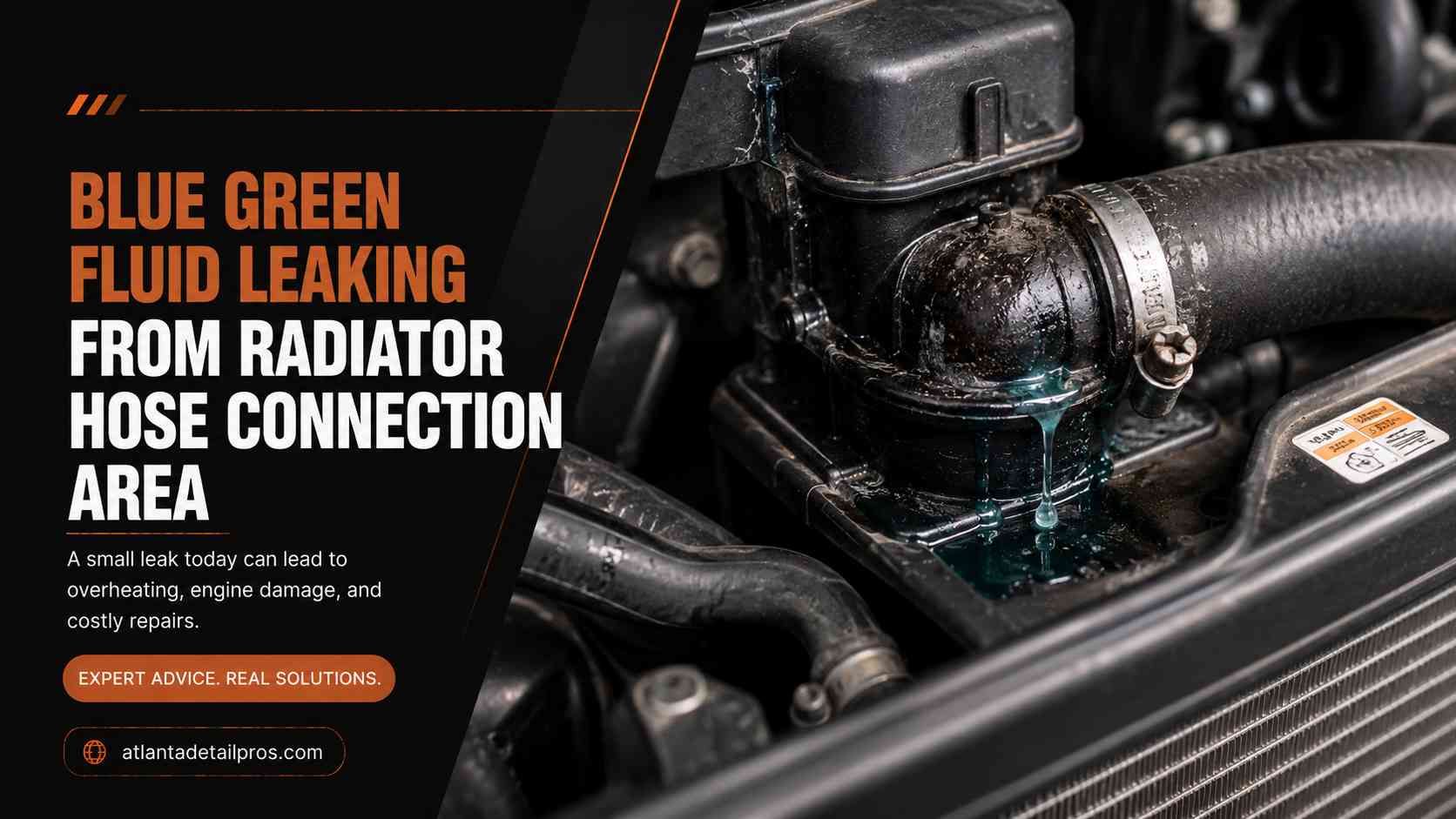
Blue-green fluid leaking from the radiator hose connection area is engine coolant (antifreeze), and the most common cause is a deteriorated hose, a corroded or loose hose clamp, or a cracked plastic radiator neck where the hose attaches.
Coolant comes in multiple colors depending on the formulation: the blue-green you are seeing is typically OAT (organic acid technology) or HOAT (hybrid organic acid technology) coolant, common as original fill in many Asian and European vehicles and widely available as aftermarket product. The color itself is not the concern: the leak is. Engine coolant leaks are among the most urgent fluid loss situations a driver faces because modern engines operate within a narrow temperature window, and coolant loss can produce catastrophic overheating within a single drive.
Do not confuse blue-green coolant with windshield washer fluid, which is also blue and can drip from the reservoir or lines. Coolant has a distinctly sweet smell, feels slightly slick between your fingers, and leaks from the engine cooling system components. Washer fluid smells sharply of methanol or isopropyl alcohol and leaks from a reservoir typically located at the front corner of the engine bay.
This article covers exactly what causes hose connection area leaks, how to assess the urgency, what the repair costs look like at an independent shop, and what you absolutely should not do if the engine begins to overheat while the cooling system is compromised.
Why Radiator Hose Connections Fail
Hose Deterioration
Radiator hoses are made of reinforced rubber that undergoes thousands of heat cycles over its service life. The inner liner softens and degrades, the reinforcing layer fatigues, and the outer surface cracks. At the connection point, the hose is under constant pressure cycling from the cooling system, typically 13 to 16 PSI on a cold system and higher at operating temperature. A hose that is past its service life will swell, crack, or develop pinhole leaks, most commonly at or near the clamp where the material is compressed and stressed.
Clamp Failure
The worm-gear hose clamps used on most production vehicles exert clamping force over a narrow band of the hose surface. Over time, the clamp screw corrodes, the clamp band fatigues, or the hose material under the clamp deforms permanently, reducing the interface pressure. A clamp that has lost tension allows the hose to weep coolant from the junction. This type of leak is often intermittent: it seals when the system is cold and the hose is at rest, but seeps under pressure when the engine reaches operating temperature. This makes it easy to miss on a cold morning inspection.
Radiator Neck Cracks
The upper and lower radiator hose necks on most modern radiators are made of plastic, integrated into the radiator end tanks. These plastic necks become brittle with age and heat exposure. Cracks develop either at the hose seat (where the hose makes contact) or at the base where the neck meets the end tank. A cracked plastic radiator neck requires radiator replacement: the neck cannot be welded or bonded reliably under cooling system pressure.
Coolant Reservoir Hose Connection
The overflow or expansion tank connects to the cooling system via a small-diameter hose. These smaller hoses and their connection points can leak coolant, and because they are often difficult to see, the leak can go unnoticed until the reservoir level drops significantly and the low coolant warning light activates.
Cause Hierarchy Table
Cause | Symptom Pattern | Repair Cost (Independent Shop) |
|---|---|---|
Loose or corroded hose clamp | Minor seep at hose collar, often intermittent | $20 to $60 (clamp replacement, labor) |
Deteriorated hose at clamp point | Crack or split near clamp, continuous drip | $60 to $150 per hose (upper or lower) |
Cracked plastic radiator neck | Coolant seeping from hose seat area, hairline crack visible | $250 to $600 (radiator replacement) |
Hose mid-section pinhole or crack | Spray or drip away from connection point | $60 to $150 hose replacement |
Coolant reservoir hose connection | Small drip near reservoir, often near filler neck | $30 to $80 |
Thermostat housing leak | Drip at housing gasket, near upper hose connection | $80 to $220 |
How to Assess the Urgency
Coolant leaks carry a higher urgency rating than oil leaks because the consequences of running low happen faster and the damage is more severe. Engine oil can drop a quart and the engine will continue to function for hundreds of miles with only marginally increased wear. Coolant can drop below the critical threshold in a single drive if the leak rate is moderate to high, and the resulting overheating can warp a cylinder head in minutes.
Leak Rate | Temperature Gauge Behavior | Action |
|---|---|---|
Minor seep at clamp, no coolant loss in reservoir | Normal | Repair within 3 to 5 days |
Visible wet area, slight coolant loss in reservoir | Normal, but monitor | Repair within 1 to 2 days |
Active drip, reservoir noticeably low | May fluctuate slightly | Do not take highway trips: repair today |
Steady stream or spray | Rising toward hot | Stop immediately: do not continue driving |
What to Do Right Now
Step 1: Check the Coolant Level
With the engine cold, remove the coolant reservoir cap or the radiator cap (on systems without a pressurized reservoir) and check the level. If the level is at or above the MIN mark, the system has not lost a dangerous volume yet. If the level is below MIN or the reservoir is empty, do not drive the vehicle until the system has been pressure tested and the leak source confirmed and repaired.
Never open a radiator cap on a hot engine. The cooling system operates at 13 to 16 PSI above atmospheric pressure. Removing the cap while the system is hot releases that pressure instantly, causing boiling coolant to spray outward. This causes severe burns.
Step 2: Squeeze Test the Hoses
With the engine cold, squeeze each radiator hose by hand. A healthy hose feels firm but has some compliance: it should not collapse flat or feel rock-hard. A hose that feels mushy, spongy, or that has visible surface cracking near the clamp is overdue for replacement regardless of whether it is currently leaking. Hose failure while driving is a faster-onset emergency than a slow leak: a burst hose can empty the cooling system in under a minute.
Step 3: Inspect the Clamps
Look at each hose clamp where the hose meets the radiator neck or engine fitting. Corrosion on the clamp band, visible coolant residue or mineral deposits around the hose collar, and any visible gap between the hose and the fitting all indicate the clamp connection as the source. A simple clamp replacement or tightening may resolve a minor seep, but if the hose material under the clamp has deformed significantly, hose replacement is required.
“I saw a drip coming from the lower hose connection on my Civic and thought it was just a loose clamp. Tightened it and the drip stopped for a week. Then the lower hose split completely on the freeway. The temperature gauge shot up in about 90 seconds. I pulled over fast enough that the head was okay, but it was a close call.” : Tyler Ashford, 2013 Honda Civic owner
Do Not Do This If the Temperature Gauge Rises
If the temperature gauge begins to climb toward the red zone while you are driving with a coolant leak:
- Pull off the road immediately. Do not try to reach the shop.
- Turn off the engine and do not restart it.
- Do not open the hood for at least 20 minutes.
- Do not add cold water to a hot engine: thermal shock can crack the block or head.
- Do not continue driving even a short distance: a warped cylinder head from a single overheating event costs $800 to $2,500 to repair and may require engine replacement on interference engines where the head gasket failure cascades into further damage.
Vehicle-Specific Notes
Toyota and Lexus vehicles equipped with the 2GR-FE, 1MZ-FE, and 3MZ-FE V6 engines are known for coolant leaks from the plastic water inlet housing on the back of the engine, which is not directly at the radiator hose but contributes to overall coolant loss. The blue-green coolant these engines use from the factory (Toyota Super Long Life Coolant) falls into the OAT coolant category.
Honda vehicles (particularly 2001 to 2005 Civic and Accord) with the SOHC four-cylinder developed a known failure mode: the upper radiator hose degrades at the engine fitting earlier than expected. The blue-green coolant Honda uses is specific to Honda formulation and should not be substituted with universal green coolant without confirming compatibility.
GM vehicles with the 3.8L V6 (Series II and III) develop leaks at the lower intake manifold coolant passages that can appear to originate at the hose connections. Confirm the actual source before replacing hoses.
Subaru vehicles with the EJ-series flat-four are known for head gasket failures that can present as external coolant seeps near the cylinder head-to-block junction, which can look similar to a hose connection leak from underneath.
Repair Cost Overview
Repair | Typical Cost Range (Independent Shop) |
|---|---|
Hose clamp replacement (one hose) | $20 to $60 |
Upper or lower radiator hose replacement | $60 to $150 |
Both hoses (upper and lower, same service visit) | $120 to $280 |
Radiator replacement (plastic neck cracked) | $250 to $600 |
Thermostat housing and gasket | $80 to $220 |
Coolant flush and refill (combined with any of above) | $60 to $100 added |
Cylinder head resurfacing if overheating occurred | $400 to $900 additional |
FAQs
Can I drive with a minor coolant leak?
Short distances to a shop appointment with a cold engine and a confirmed adequate coolant level: yes, cautiously. Highway distances or driving until the repair appointment next week: no. The risk profile of a coolant leak is asymmetric. Best case you lose a small amount of fluid and reach the shop fine. Worst case you overheat and warp the head.
Can I top off the coolant and keep driving temporarily?
Topping off with the correct coolant or distilled water as a temporary measure is acceptable if the level has dropped and the leak rate is slow. Use distilled water, not tap water, if coolant is not available: tap water contains minerals that accelerate corrosion inside the cooling system. This is a bridge measure only, not a repair.
Why does coolant leak specifically when the engine is hot and not when it is cold?
The cooling system is a pressurized system. When the engine is cold, the system is at or near atmospheric pressure and small leak points can stay sealed. As the engine warms up, the thermostat opens, coolant circulates, and system pressure rises to the rated cap pressure (typically 13 to 16 PSI). This added pressure pushes coolant past imperfect seals, fatigued hoses, and loose clamps. This is why many coolant leaks are only visible after a drive and not when inspecting a cold car in the morning.
How do I know if the coolant color matters when topping off?
It matters significantly. OAT, HOAT, NOAT, and traditional green coolants use different corrosion inhibitor packages that are not fully compatible with each other. Mixing different types degrades the inhibitor chemistry and can accelerate corrosion of aluminum components. Use the same type as the original fill if you are topping off, or flush the system completely before switching to a different formulation.
What does it mean if there is white steam or sweet smell from the vents inside the car?
Coolant entering the passenger compartment through the HVAC system indicates a leaking heater core, not a radiator hose leak. The heater core is a small radiator mounted behind the dashboard that provides cabin heat. A leaking heater core is a separate, more involved repair than a hose connection issue and typically costs $400 to $900 to replace. If you smell sweetness inside the cabin with the heater on and see fogging on the windshield from the inside, the heater core is the source.
Bottom Line
Blue-green fluid at the radiator hose connection area is engine coolant, and it needs to be addressed today, not next week. The repair at the hose and clamp level is one of the least expensive cooling system fixes available: $20 to $280 depending on what needs to be replaced. The consequence of ignoring it is a warped cylinder head or blown head gasket that costs $800 to $2,500 and may leave the vehicle uneconomical to repair.
Check the coolant level now. Squeeze the hoses and inspect the clamps. If the hose feels mushy or the clamp is corroded, do not wait for the leak to escalate. The cooling system has zero tolerance for a wait-and-see approach, because by the time the temperature gauge tells you there is a problem, significant damage may already have occurred.