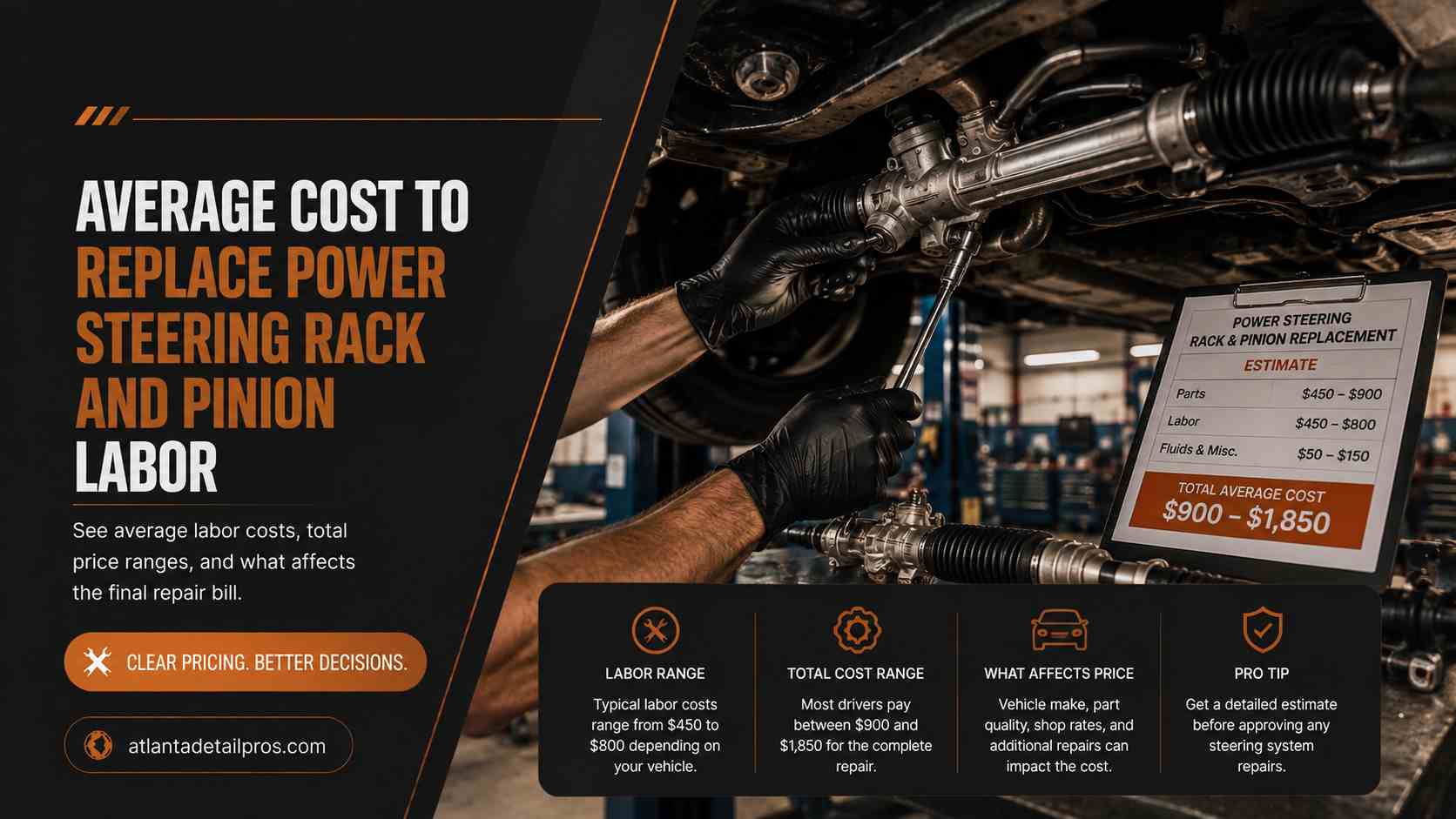
Power steering rack and pinion replacement costs $400 to $1,200 total at an independent shop for most front-wheel-drive and rear-wheel-drive passenger vehicles, with parts accounting for $180 to $600 of that total and labor accounting for $200 to $500, plus a mandatory wheel alignment that adds $80 to $150.
Electric power steering (EPS) racks on newer vehicles are significantly more expensive: parts alone for an EPS rack run $500 to $1,400, pushing the total job to $800 to $2,200 depending on the platform. The alignment cost is not optional: replacing the steering rack changes the tie rod positions and any vehicle that has had its rack replaced without a subsequent alignment is dangerous to drive at highway speed.
Understanding the parts-to-labor ratio on this job helps you evaluate quotes accurately. A shop charging $400 for labor on a rack that costs $150 in parts may be padding the labor. A shop quoting $800 for an EPS rack job that actually requires $600 in parts and 3 hours of labor is not unreasonable. The vehicle platform determines the fair labor time, and knowing your vehicle’s labor hours keeps you from paying for time that was not worked.
What the Job Actually Involves
Replacing a rack and pinion is a moderately involved job that requires removing the steering column connection from the rack input shaft, disconnecting both inner tie rod assemblies from the rack ends, removing the rack mounting hardware, and in many cases removing subframe bolts or cross-member components to lower the rack enough to extract it from the vehicle.
On front-wheel-drive vehicles where the engine and transaxle sit above the rack, access can be limited and the rack sometimes requires partial subframe lowering to extract. On rear-wheel-drive vehicles with a conventional front suspension, the rack is more accessible and labor time is shorter. Electric power steering racks on modern vehicles also require a programming step with a factory or aftermarket scan tool to match the new rack’s torque sensor to the vehicle’s ECU.
The outer tie rod ends are reused if they are within specification or replaced as part of the job. Replacing the outer tie rods at the same time as the rack (they share the same labor access) adds only parts cost: typically $30 to $80 per side for quality aftermarket tie rod ends.
Parts Cost: New vs Remanufactured
The parts cost for a rack and pinion replacement varies significantly depending on whether a new OEM rack, a remanufactured rack, or a new aftermarket rack is used.
Remanufactured Racks
A remanufactured rack is a core-exchange unit where the original rack is rebuilt with new seals, bearings, and valve components. Remanufactured racks from reputable suppliers such as Maval, A1 Cardone, and Moog are appropriate for most passenger vehicles and are the most common choice at independent shops. Cost: $150 to $450 for hydraulic racks, $350 to $800 for EPS racks.
New OEM Racks
An OEM rack from the dealer is built to the original factory specification and is backed by the manufacturer’s parts warranty. The premium over a remanufactured rack is significant: OEM hydraulic racks cost $350 to $900 on most platforms, and OEM EPS racks cost $700 to $1,800. Most independent shops do not use OEM parts unless the customer specifically requests them or the vehicle is under manufacturer warranty.
New Aftermarket Racks
Quality new aftermarket racks (not remanufactured) from brands such as Cardone Select, TRW, and ZF are available for some platforms and cost $200 to $600. These are built to original specifications using new components rather than reconditioned cores and represent a middle ground between remanufactured and OEM.
Parts Cost Comparison Table
Part Type | Hydraulic Rack Cost | EPS Rack Cost |
|---|---|---|
Remanufactured (independent shop standard) | $150 to $450 | $350 to $800 |
New aftermarket | $200 to $600 | $400 to $900 |
New OEM (dealer) | $350 to $900 | $700 to $1,800 |
Labor Cost by Vehicle Type
Labor time for a rack and pinion replacement is published in each manufacturer’s flat-rate manual and is what shops use to calculate the labor charge. Actual time can exceed flat rate on corroded or difficult vehicles, but the flat rate provides a useful baseline for evaluating quotes.
Vehicle Category | Typical Labor Hours | At $100/hr Independent | At $150/hr Dealer |
|---|---|---|---|
Front-wheel-drive compact (Civic, Corolla, Focus) | 2 to 3.5 hours | $200 to $350 | $300 to $525 |
Front-wheel-drive midsize (Accord, Camry, Fusion) | 2.5 to 4 hours | $250 to $400 | $375 to $600 |
Rear-wheel-drive car (Mustang, Charger) | 2 to 3 hours | $200 to $300 | $300 to $450 |
Rear-wheel-drive truck or SUV (Tacoma, 4Runner) | 2.5 to 4 hours | $250 to $400 | $375 to $600 |
Front-wheel-drive SUV with subframe removal | 3.5 to 5.5 hours | $350 to $550 | $525 to $825 |
EPS rack with programming (most modern platforms) | 3 to 5 hours plus programming | $300 to $500 plus $50 to $150 | $450 to $750 plus $100 to $200 |
The Mandatory Alignment Cost
Replacing the steering rack changes the effective length of the steering linkage. The tie rod adjustment position that was set during the previous alignment is no longer valid after the new rack is installed. Driving without a post-rack-replacement alignment is not safe at highway speed because the steering geometry is no longer within specification.
A four-wheel alignment costs $80 to $150 at most independent shops and $100 to $200 at a dealer. This cost is not avoidable and should be quoted as part of the total job from the beginning. A shop that quotes a rack replacement without mentioning the alignment is giving you an incomplete price.
Some shops attempt to set the tie rod length approximately to the previous position before removing the old rack, which reduces but does not eliminate the alignment variation. This is an approximation, not a substitute for a proper alignment.
“Got two quotes for my Accord rack: one for $620 and one for $580. The $620 quote included the alignment. The $580 quote did not. When I asked about the alignment, the cheaper shop said it would be another $90. Real comparison was $620 vs $670. Went with the $620 shop because the alignment was already in the price and they did not try to hide the total cost.” : Nathan Kimura, 2016 Honda Accord owner
Independent Shop vs Dealer: Which to Choose
For a rack and pinion replacement, the choice between a dealer and an independent shop follows the same logic as most major suspension and steering jobs.
At a dealership, the advantages are OEM parts availability, factory-trained technicians, and for EPS systems, factory programming tools that guarantee the correct torque sensor calibration. Some EPS racks require a specific factory relearn procedure that aftermarket scan tools cannot perform on every platform. If your vehicle’s EPS system requires a factory relearn that an independent shop cannot perform, the dealer is the appropriate choice even at the higher cost.
At an independent shop, the advantages are the lower labor rate (typically $30 to $60 per hour less than a dealer) and remanufactured parts pricing that reduces the total bill by 25 to 40 percent. For hydraulic power steering racks on vehicles without complex EPS programming requirements, there is no functional reason to pay the dealer premium.
Vehicles with Higher-Than-Average Rack Replacement Costs
Some platforms carry a disproportionately high rack replacement cost due to design complexity, EPS programming requirements, or parts availability.
BMW 3-series and 5-series (2010 to present) with EPS: EPS rack parts run $700 to $1,400 and programming is required. Total dealer cost is typically $1,500 to $2,800.
Ford F-150 (2011 to present) with EPS: The EPS rack on these trucks is a large, heavy unit that requires subframe access and dealer programming. Total cost at an independent shop runs $900 to $1,800.
Chevrolet Malibu (2013 to 2016) with EPS: These racks have a known failure pattern and are commonly replaced at 80,000 to 120,000 miles. Total cost at an independent shop runs $700 to $1,200.
Subaru Forester and Outback (2014 to 2018) with EPS: Subaru EPS racks require dealer programming for full function restoration. Total dealer cost is typically $1,100 to $1,800.
Total Job Cost Summary
Vehicle Category | Independent Shop Total (Parts, Labor, Alignment) | Dealer Total |
|---|---|---|
Compact FWD, hydraulic rack | $400 to $750 | $600 to $1,100 |
Midsize FWD, hydraulic rack | $500 to $900 | $750 to $1,300 |
Midsize FWD or RWD, EPS rack | $700 to $1,400 | $1,100 to $2,000 |
Truck or SUV, hydraulic rack | $550 to $1,000 | $800 to $1,400 |
Truck or SUV, EPS rack | $900 to $1,800 | $1,400 to $2,600 |
FAQ
How do I know if I need a full rack replacement or just a seal repair?
A rack with leaking inner seals can sometimes be repaired with a seal kit rather than full replacement, but this is only practical if the rack shaft itself is in good condition (no scoring or wear grooves at the seal contact surface) and the shop has the tooling to perform the repair. Most independent shops recommend full rack replacement as the more reliable and cost-effective solution because a repaired seal on a worn rack shaft is likely to fail again within a year.
Can I replace only the outer tie rod ends without replacing the rack?
Yes. If the rack itself is functioning correctly (no leak, no internal looseness) but the outer tie rod ends are worn, they can be replaced independently for $30 to $80 per side in parts plus $60 to $100 in labor. A full rack replacement is not required unless the rack itself is the source of the problem.
Does a rack and pinion replacement fix a vague or loose steering feel?
It depends on the cause. A worn rack with internal play or a leaking rack with low fluid causing poor hydraulic response will feel significantly improved after replacement. Vague steering from worn outer tie rod ends, a worn steering column intermediate shaft, or worn front control arm bushings is not improved by rack replacement. A steering inspection that identifies the specific worn component is more valuable than replacing the most expensive component first.
How long does a power steering rack last?
Most hydraulic racks last 100,000 to 150,000 miles under normal driving conditions. EPS racks have a less established lifespan track record but many platforms are seeing failures at 80,000 to 120,000 miles, particularly those with known design issues. Vehicles in regions with heavy road salt exposure develop seal and boot failures earlier than vehicles in dry climates.
What happens if I delay a leaking rack replacement?
A slowly leaking rack causes the power steering reservoir to drop, which eventually causes the pump to cavitate and fail. A pump failure adds $200 to $450 to the repair bill and is entirely avoidable by keeping the reservoir topped off and scheduling the rack repair before the level drops critically. Check the power steering reservoir before every drive if you know the rack is leaking.
Bottom Line
Power steering rack and pinion replacement costs $400 to $900 at an independent shop for most hydraulic systems and $700 to $1,800 for EPS systems, always plus a mandatory alignment that adds $80 to $150. The parts-to-labor ratio varies by platform: labor is typically 2 to 5 hours on most vehicles, and the alignment is the non-negotiable final step.
Get an itemized quote that separates parts, labor, and alignment. Confirm whether the outer tie rod ends are included or available at additional cost, and for EPS racks, confirm whether the shop can perform the required programming procedure. A complete quote for the full job, not just the rack, is the only way to compare two shops accurately.