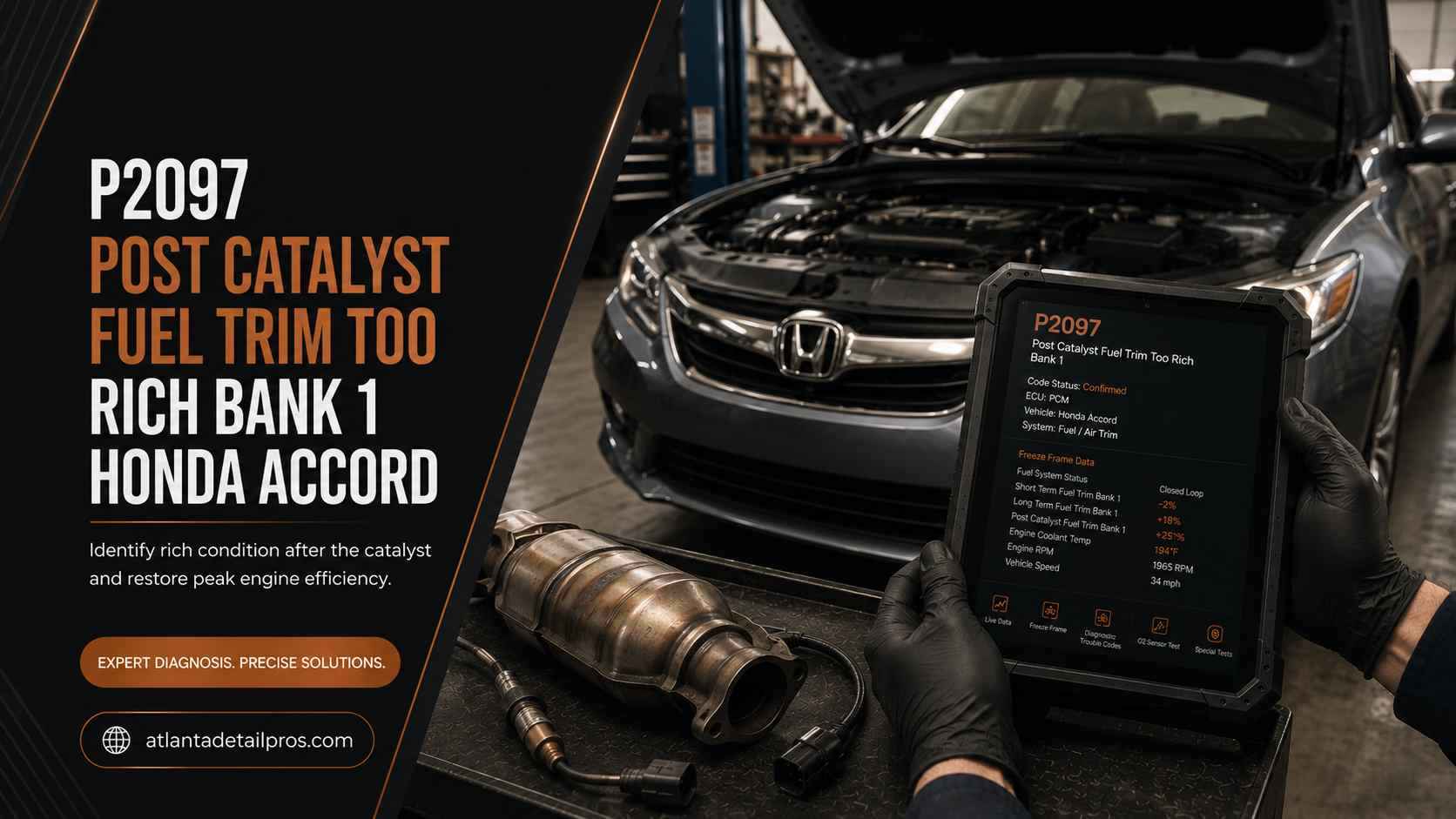
P2097 on a Honda Accord means the ECM has detected that the post-catalyst oxygen sensor on Bank 1 is consistently reading a rich exhaust mixture downstream of the catalytic converter: a condition that either means the catalytic converter is no longer efficiently processing the exhaust (allowing rich gases to pass through), or that the engine itself is running rich and the converter cannot clean up the excess fuel before it reaches the rear oxygen sensor.
This code is specifically about what is happening after the cat, not before it, which makes it one of the more informative codes for diagnosing converter health and engine fuel management simultaneously.
“My 2010 Accord V6 threw P2097 at about 98,000 miles. I was told I needed a new catalytic converter immediately. Before spending $800, I did some research and found that a tune-up with new plugs sometimes resolves it if the cat is being overwhelmed by misfires. Did the tune-up: code cleared for about 1,500 miles then came back. Cat was genuinely failing. Replaced it and the car runs great. Lesson: don’t skip the tune-up check before condemning the converter.”: James Nakamura, 2010 Accord V6 EX-L owner
Understanding P2097 on the Honda Accord
How the Honda ECM Uses Two Oxygen Sensors Per Bank
Modern Honda Accords use two oxygen sensors per exhaust bank:
- Front oxygen sensor (upstream/pre-cat): positioned before the catalytic converter; measures exhaust richness to help the ECM adjust fuel injection in real time
- Rear oxygen sensor (downstream/post-cat): positioned after the catalytic converter; monitors the converter’s efficiency by measuring what the converter outputs A healthy catalytic converter processes the variable rich-lean exhaust from the engine and outputs a relatively steady, clean exhaust. The rear O2 sensor on a healthy system shows a fairly stable voltage (around 0.6 to 0.7V on most Honda applications) because the converter buffers the combustion variations.
What P2097 Specifically Means
P2097 stores when the rear oxygen sensor voltage on Bank 1 is consistently elevated (indicating rich output) and the long-term fuel trim adjustment for the post-catalyst circuit has been pushed beyond the calibrated lean correction limit. In plain terms: the ECM tried to correct for the rich downstream condition and ran out of correction authority. Bank 1 on the Honda Accord: on the 4-cylinder Accord, there is only one bank. On the V6 (3.5L J35), Bank 1 is the front bank (the side with cylinder 1, facing the front of the vehicle).
What Causes P2097 on a Honda Accord
Cause 1: Failing or Saturated Catalytic Converter
How a Failing Cat Causes P2097
A catalytic converter that has lost its ability to oxidize hydrocarbons and carbon monoxide allows unburned rich exhaust gases to pass through without conversion. The rear O2 sensor detects this rich exhaust and generates a voltage signal that triggers P2097. How a cat becomes saturated or fails:
- Long-term engine misfires flooding the converter with unburned fuel
- Coolant contamination from a head gasket leak coating the catalyst substrate
- Oil consumption coating the catalyst with carbon deposits
- Physical damage from road debris or overheating
- Normal end-of-life degradation after 100,000 to 150,000 miles
Confirming Converter Failure With Rear O2 Sensor Data
Connect a scan tool and observe both front and rear O2 sensor data simultaneously at steady-state highway speed (not idle):
- Healthy converter: front sensor fluctuates rapidly between 0.1V and 0.9V; rear sensor holds relatively stable at 0.6 to 0.7V
- Failing converter: rear sensor mimics or closely follows the front sensor, fluctuating similarly instead of staying stable If the rear sensor is clearly following the front sensor’s pattern rather than holding steady, the converter is not buffering effectively and is likely the cause. Catalytic converter replacement cost on Honda Accord:
- OEM Honda converter: $600 to $1,200 depending on model year and configuration
- Quality aftermarket (direct-fit): $200 to $500
- Labor: 1 to 2 hours
- Total at an independent shop: $350 to $900
Cause 2: Engine Running Rich (Overwhelming the Converter)
How Engine Rich Running Generates P2097
If the engine is producing excess fuel that overwhelms the converter’s processing capacity, the downstream sensor sees rich exhaust even from a functional converter. P2097 in this context is a symptom of an upstream fuel management problem:
- Failing fuel pressure regulator holding pressure too high
- Leaking fuel injector(s) dripping fuel between injection events
- Failed front oxygen sensor giving incorrect feedback to the fuel management system
- Coolant temperature sensor failure causing the ECM to remain in cold enrichment mode How to distinguish engine-rich from converter failure:
- Check long-term fuel trim (LTFT) on Bank 1: a LTFT below -10 percent (negative) indicates the ECM has been reducing fuel because the engine is running rich: consistent with an engine-side fueling problem
- Check for accompanying codes: a failing fuel pressure regulator or leaking injector often produces additional codes or symptoms (rough idle, fuel smell, black smoke)
Cause 3: Failed Rear Oxygen Sensor (False Rich Reading)
When the Sensor Itself Is the Problem
A rear oxygen sensor that has developed an internal fault can stick at a high-voltage reading indicating rich conditions even when the exhaust is actually clean. This generates P2097 without any actual converter or fueling problem. How to identify a failed rear sensor:
- Live data shows the rear O2 sensor locked at a fixed high voltage (0.8V or above) regardless of throttle input and engine load changes
- A healthy sensor, even downstream of a good converter, should show some slight variation; a sensor reading exactly the same voltage for minutes at a time is likely stuck Rear oxygen sensor replacement cost on Honda Accord: $80 to $200 for the sensor. Labor: 30 to 60 minutes. Total: $120 to $300.
P2097 Diagnosis Decision Flow
| Test | Result | Conclusion |
|---|---|---|
| Rear O2 sensor data: follows front sensor pattern | Yes | Catalytic converter is failing |
| Rear O2 sensor locked at fixed high voltage | Yes | Rear O2 sensor has failed |
| Long-term fuel trim Bank 1 below -10% | Yes | Engine is running rich; find fueling cause first |
| Misfire codes present (P030X) | Yes | Converter may be saturated by misfires; repair misfires first |
| All above normal; P2097 only | Code intermittent | Check for sensor connector corrosion; monitor |
Frequently Asked Questions
What Does P2097 Mean on a Honda Accord?
P2097 means the ECM has detected a persistently rich exhaust condition downstream of the catalytic converter on Bank 1. The post-catalyst oxygen sensor is reading high voltage (rich) and the ECM’s fuel trim correction has reached its limit. The most common causes are a failing catalytic converter, an engine running excessively rich, or a faulty rear oxygen sensor.
Can P2097 Go Away on Its Own?
P2097 will not resolve on its own because the underlying cause (converter degradation, rich running, or failed sensor) does not self-correct. If the code was caused by temporary misfires that have since been resolved (new spark plugs, etc.), the converter may recover partially if it was not permanently damaged. Clear the code after addressing the misfire and monitor for recurrence.
How Much Does It Cost to Fix P2097 on a Honda Accord?
Rear oxygen sensor replacement: $120 to $300. Catalytic converter replacement: $350 to $900 at an independent shop. Addressing an engine rich condition varies by the root cause (fuel pressure regulator, injector, sensor). Never replace the catalytic converter without first confirming the engine is not running rich: a new converter installed in a rich-running engine will fail prematurely.
Is P2097 an Emissions Failure?
Yes. P2097 will cause a failed emissions inspection in most states because it indicates the catalytic converter is not performing correctly. The vehicle’s readiness monitors will also not complete properly while this code is active, which independently causes an emissions test failure in states that check monitor completion.
The Bottom Line
P2097 on the Honda Accord has a specific diagnostic sequence: check engine fuel trims first to rule out a rich-running engine, evaluate the rear O2 sensor data for the converter health signature, and confirm the sensor itself is functioning correctly before authorizing a converter replacement. James Nakamura’s experience is worth repeating: resolve any misfire-related tune-up needs before condemning the converter, because a converter saturated by misfires may show partial recovery once the misfires stop.